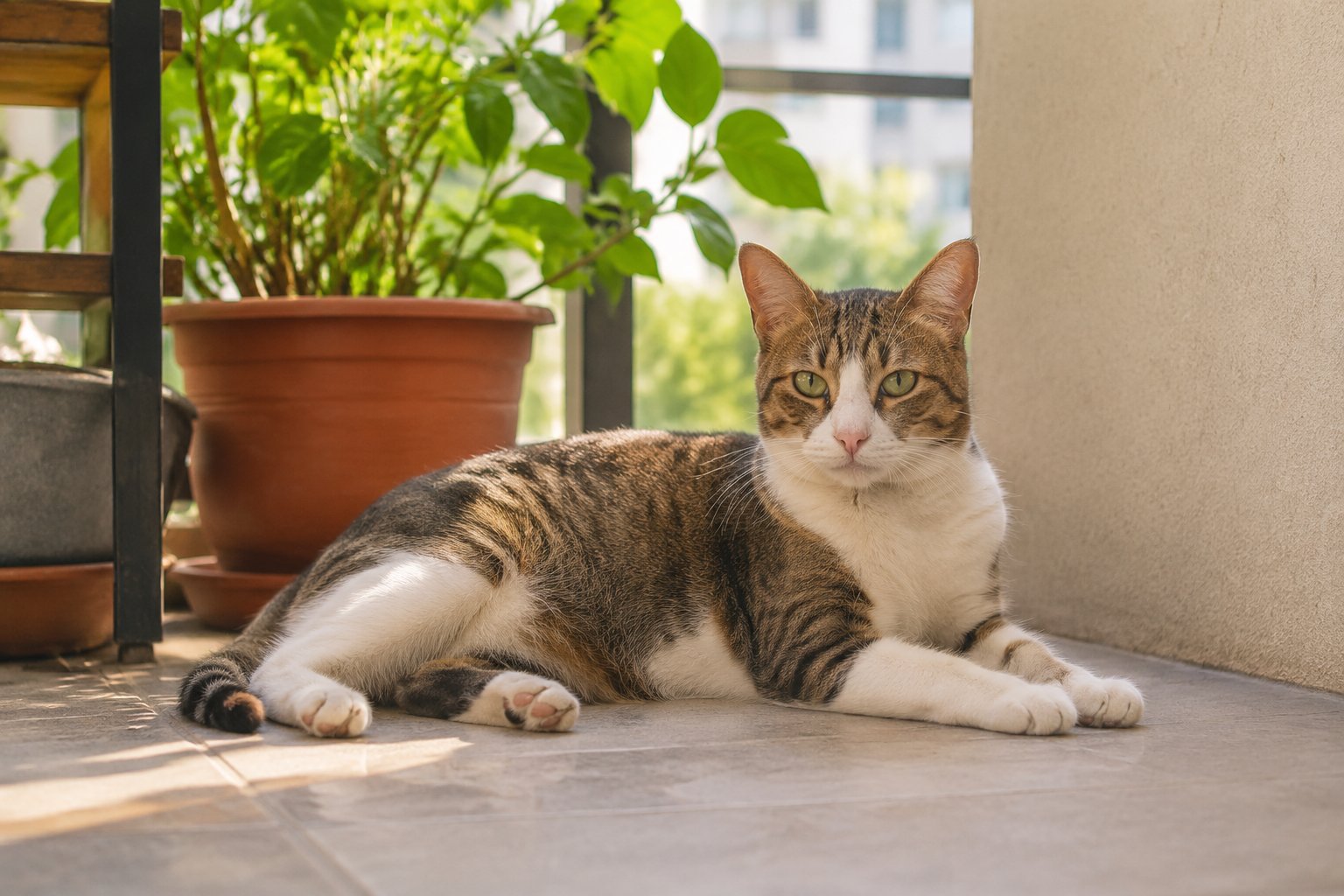
The short answer
An indoor cat can go outside in Malaysia, but the safe version is supervised: harness and leash, carrier, or a secured balcony or catio. Free roaming is a different activity with a different risk profile, and for most Malaysian homes it is not worth it. Traffic, free-roaming dogs, parasites, cat fights and heat are all real hazards, and a cat that has never learned street sense is poorly equipped to handle them.
This guide walks through harness training, the health risks, dog encounters, heat management, and how to decide between supervised and free roaming. It also covers the practical side many owners forget: building management rules, neighbours, and what to ask your vet before the first outing.
Supervised versus free roaming: what is the difference?
Supervised outdoor time means you are present and the cat is contained, by harness, carrier, enclosure or a secured balcony. Free roaming means the cat goes out alone and comes back when it wants.
| Factor | Supervised (harness, carrier, catio) | Free roaming |
|---|---|---|
| Traffic risk | Very low if you choose quiet spots | High, especially near roads and car parks |
| Dog encounters | You can intervene | Cat must escape alone |
| Parasites | Reduced with prevention and short sessions | Constant exposure |
| Fighting and disease | Avoidable | Common |
| Heat and dehydration | You can cut sessions short | Cat may be stuck outside |
| Neighbour complaints | Rare | More likely |
| Owner peace of mind | High | Low |
| Enrichment value | Good with variety | High but risky |
Supervised time gives most of the enrichment benefit, smells, textures, birdsong, sun on fur, without most of the danger. For a cat that has lived its whole life indoors, that is usually enough.
Step-by-step harness training
Harness training is a gradual process. Most cats need days to weeks, and some never accept a leash. That is fine; a carrier or catio is a valid alternative.
Step 1: Choose the right harness. Look for an H-style or vest-style harness with adjustable straps and a secure buckle. A cat can slip a loose strap, so fit matters more than style. Measure the chest girth and check the fit with two fingers of slack, no more. Avoid harnesses that rely only on neck straps.
Step 2: Make the harness boring. Leave it near the cat's bed or feeding area for a few days so it stops being a strange object. Reward sniffing with treats or play.
Step 3: Wear it indoors, briefly. Fasten the harness loosely for a few minutes, then remove it and reward. Repeat daily, extending the time slowly. Do not chase the cat to put it on; let the cat come to you.
Step 4: Tighten the fit and add a light leash. Once the cat moves normally in the harness, adjust the fit and attach a light leash indoors. Let the cat drag it under supervision, then practise holding it while the cat walks around the room.
Step 5: First outdoor session. Choose a quiet time, early morning or after sunset, in a closed compound, quiet corridor or balcony. Carry the cat out in a carrier, then attach the leash before opening the carrier. Keep the first session to a few minutes.
Step 6: Build slowly. Add a few minutes each session and vary the route. Watch for stress signals: flattened ears, crouching, tail tucked, dilated pupils, sudden freezing. If you see them, go back inside and try again another day.
Step 7: Never tether and leave. A tied cat cannot escape a dog or a sudden scare. Supervised means you are holding the leash.
Health risks: parasites, disease and vaccination
Outdoor time, even supervised, increases exposure to parasites and infectious disease. The main concerns in Malaysia are:
- Fleas and ticks. Common in warm, humid climates and easy to pick up from grass and soil. Use vet-recommended parasite prevention year-round, not just when you see fleas.
- Intestinal worms. Can be picked up from contaminated soil. Regular deworming according to your vet's schedule is the standard approach.
- Feline leukemia virus (FeLV) and feline immunodeficiency virus (FIV). Spread mainly through close contact and bites from infected cats. Keep vaccinations current and prevent contact with unknown cats.
- Feline herpesvirus and calicivirus. Part of routine vaccination, but outdoor contact raises exposure.
- Fungal skin infections. Warm, damp environments can favour ringworm, especially in cats that lie on damp ground.
Before the first outing, ask your vet to confirm vaccinations are current and to recommend a parasite prevention plan suited to your cat's lifestyle. If your cat is older, has a chronic condition, or is a flat-faced breed, ask whether outdoor time is appropriate at all.
Heat and humidity: timing matters
Malaysia's heat is the most underrated risk. Cats do not sweat efficiently, and flat-faced breeds such as Persians and British Shorthairs struggle to cool down. Ground temperature matters too: paved surfaces and artificial turf can become painfully hot.
Practical rules:
- Avoid late morning to late afternoon. Early morning and after sunset are safer.
- Test the pavement with the back of your hand for a few seconds. If it is uncomfortable for you, it is too hot for paws.
- Take water for the cat and offer it during longer sessions.
- Keep to shade and grass rather than hot paving.
- Watch for heavy panting, drooling, wobbliness or lethargy. These are heat stress signs; go inside and cool the cat gradually.
- Keep sessions short in the rainy season too; wet fur and damp ground increase skin and parasite exposure.
Dog encounters and other animals
Free-roaming dogs are common in many Malaysian neighbourhoods, and even a friendly dog can frighten a cat badly. A frightened cat on a leash can injure itself trying to bolt.
- Choose routes away from known dog-walking areas and times.
- Keep the leash short in open areas so you can control the cat quickly.
- If a dog approaches, stay calm, put your body between them if safe, and ask the owner to recall the dog. Pick the cat up only if it will not panic and scratch you.
- Carry the cat in a carrier to and from the outdoor spot rather than walking through corridors on a leash.
- Avoid areas with free-roaming cats, which raise the risk of fights and disease transmission.
Building rules, neighbours and local authorities
Before you take a cat into shared spaces, check the rules. In apartments and condominiums, ask the Joint Management Body (JMB) or management office about by-laws covering pets in common areas, lifts and corridors. Rules vary by building, and some restrict pets in lifts or shared gardens.
For landed homes, keep the cat within your own compound and check whether your local council has any requirements. Requirements vary by state and council, so confirm directly with the relevant authority rather than relying on what a neighbour says.
Neighbours matter too. A cat on a leash in a shared corridor can upset people who fear animals. Keep sessions brief, avoid peak hours, and clean up after your cat.
When to see a vet
Contact a veterinarian if your cat shows any of the following after outdoor time:
- Ticks, fleas or visible worms
- Scratching, hair loss or skin lesions
- Sneezing, eye discharge or lethargy
- A bite wound or fight injury, even a small one
- Heavy panting, drooling or collapse after heat exposure
- Vomiting, diarrhoea or loss of appetite
- Any change in behaviour after an outing
Also see your vet before starting outdoor time if your cat is unvaccinated, elderly, pregnant, or has a chronic condition.
Practical checklist before the first outing
- Harness fitted and tested indoors
- Leash attached and held at all times
- Vaccinations current, confirmed by your vet
- Parasite prevention up to date
- Carrier for transport to and from the spot
- Quiet route chosen, away from dogs and traffic
- Time of day checked for heat
- Water packed for longer sessions
- JMB or management rules checked
- Phone charged in case of emergency
A note on Malaysian homes
A Kuala Lumpur apartment cat may do best with a secured balcony or a window-mounted enclosure, with harness sessions in a quiet corridor or nearby park at dusk. A Johor terrace house cat might use a fenced compound or a catio, with leash walks in the garden after sunset. In Penang's rainy season, plan around dry windows and keep sessions short to avoid damp fur and slippery surfaces.
The bottom line
Taking an indoor cat outside in Malaysia is possible and can be enriching, but it should be supervised, gradual and parasite-protected. Harness training takes patience, heat management is non-negotiable, and free roaming is a risk most owners can avoid. When in doubt, ask your vet and check your building's rules first.
This article is general information only and is not a substitute for veterinary advice. Always consult a licensed veterinarian about your cat's health and outdoor suitability.
Related reading
- Pet Life in Malaysia: The Seven Practical Decisions Before You Get a Pet
- Lost Cat in Malaysia: The First 72 Hours (Search Grid, Scent Stations & Posters)
- 24 Hour Vet KL: How to Find Genuine Emergency Care Before You Need It
- Bringing a Cat on a Flight from Malaysia: Cabin vs Checked Baggage, Approvals & Paperwork
- Cat-Proofing a Malaysian Apartment: Windows, Grilles and Balcony Nets That Actually Hold
- Cat Proof Balcony Malaysia: Weather-Proof Netting, No-Drill Fixings, JMB Approval & Inspection Routine
- Monsoon Pet Safety in Malaysia: Damp Coats, Thunderstorms and Indoor Cats
- Multi-Cat Household in Malaysia: A Practical Guide to Resources, Space and Peace
- Pet Travel to Malaysia: Import Permit, Rabies Timing, Health Certificate & Quarantine Risk
- Pet Insurance in Malaysia: How It Works, What's Covered and How to Compare Policies
- Pet Taxi Malaysia: How to Choose a Safe Pet Transport Service