
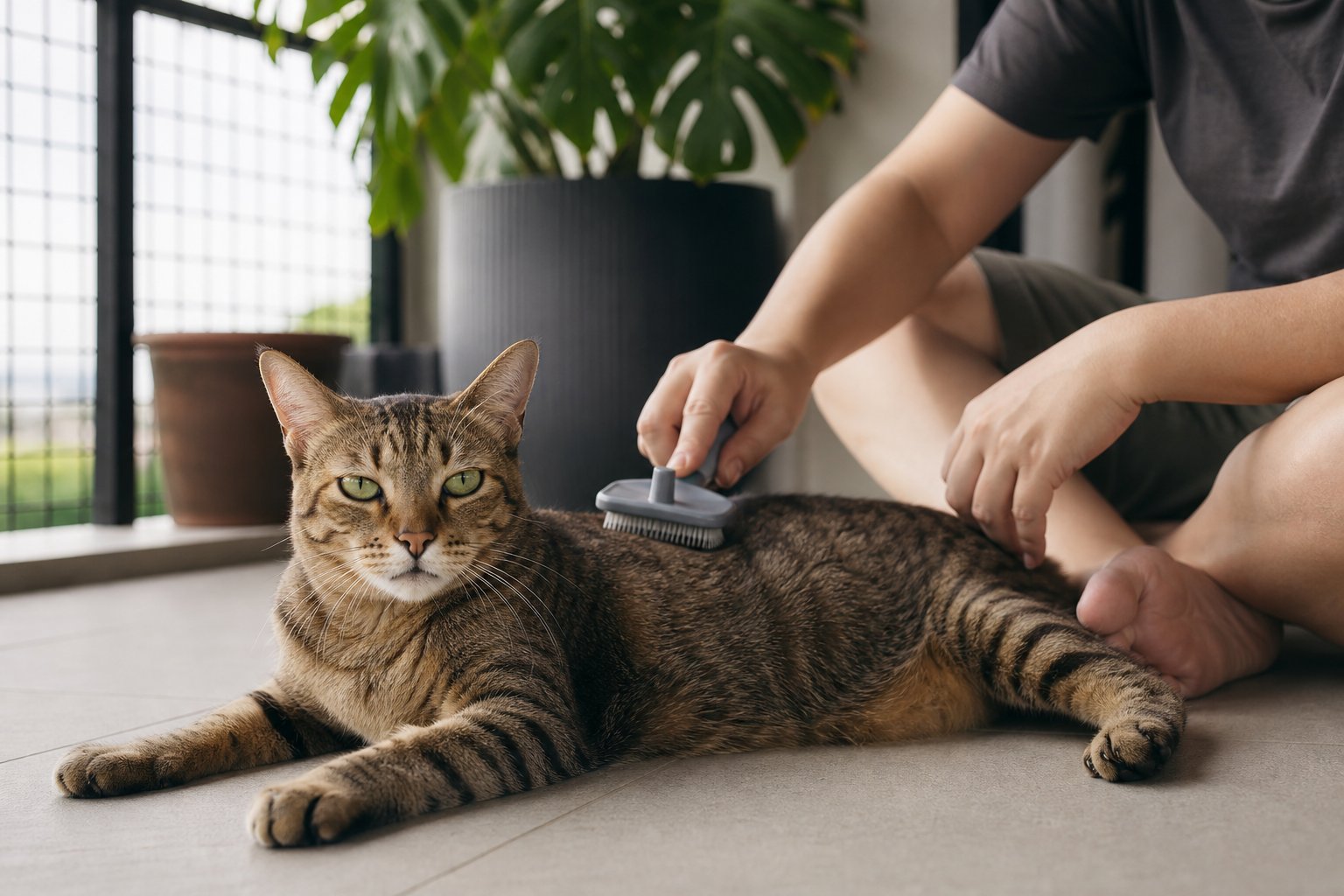
Do these two things today: fit an anti-lick collar so the tongue cannot reach the wound, and start a daily photo-and-notes log of the area. Cleaning, medication and any dressing follow your vet's instructions exactly — no home bandaging, no human ointment. Most cats wear the collar until at least 2–3 days after stitch removal, or until the vet confirms the wound has closed.
Normal licking or damage? Where to draw the line
Licking is a cat's main way of cleaning itself, so a weepy, scabby or blood-stained patch naturally triggers the same motion. "Some licking" is therefore not automatically a problem — frequency, duration and target area are what matter. Normal tidying-up usually happens in the first 1–2 days of healing, lasts under a minute per session, and mostly targets the fur around the wound rather than the wound itself. The frequency then tapers off as the crust dries.
Over-licking looks different: the cat returns to the same spot again and again, stays at it for more than five minutes straight, leaves the surrounding fur chronically damp, and gradually rubs the skin red, thin and bald. That repeated mechanical damage tears the wound edges apart and strips away freshly formed tissue, turning what should have been a few days of healing into two or three weeks of re-opening. In some cases the skin thickens or develops symmetrical bald patches.
Night-time licking catches most owners out. You see a well-behaved cat on the sofa all evening, then wake to find the wound wet, red and the collar sitting crooked. Set up a phone or pet camera overnight, and check whether the bedding or the fur near the wound feels unusually damp each morning.
| What you observe | Normal cleaning (acceptable) | Over-licking (must be stopped) | What to do at home |
|---|---|---|---|
| Length per session | Usually under 1 minute | Over 5 minutes non-stop | Distract with a toy or treat as soon as it passes a minute |
| Frequency | More in days 1–2, then declining | Getting heavier from day 3 onwards | Count daily sessions and bring the log to the vet visit |
| Target area | Fur around the wound and crust edge | Licks the wound directly, may bite until bleeding | Fit a collar — shouting the cat off does not work |
| Wound appearance | Crust intact, edges joined, area shrinking | Crust licked away, edges split, area widening | Photograph daily for comparison; spread over 1 cm in 24 hours means a vet visit |
| Skin and fur | Coat normal, no skin change | Bald, red, thin, thickened or darkened skin | Have the vet rule out a secondary infection |
| Overall condition | Bright, eating, temperature 38.0–39.2°C | Off food, hiding, temperature above 39.4°C | Treat as a same-day case |
One point worth spelling out: deciding when the collar comes off and when medication stops is your vet's call, not yours. Even if the wound looks better, any cat on medication, stitches or a drain needs vet confirmation before you change anything. Removing the collar early or stopping antibiotics partway is one of the most common reasons wounds worsen and bacteria become resistant to treatment.
Six reasons your cat won't stop licking
The wound is only one trigger. If your cat keeps attacking the same spot after the surface has closed, one of these six is usually responsible — and each needs a different fix. Get the direction wrong and you end up with a collar worn for two full weeks that comes off to immediate re-licking.
| Possible cause | Clues you are most likely to see | What you can do at home | When to see a vet |
|---|---|---|---|
| Itch from healing or a tight crust | Heavy licking in days 3–7, wound itself not worsening | Collar on, daily log, keep the area dry | No reduction after 3–5 days |
| Infection or abscess | Yellow-green pus, bad smell, spreading area, fever | Do not squeeze the pus — book immediately | Same day |
| Fleas, mites or fungus | Symmetrical bald patches at the base of the tail or along the back, dandruff, dark specks | Check the coat and the environment; no home medication | Within 24 hours |
| Allergy or dermatitis | Itching in several places at once, skin flaring red repeatedly | Note down diet and where the itching shows | Within 3 days |
| Pain (post-op, joints) | Reluctant to jump or walk, flinches when a spot is touched | Lower jump heights, add low step platforms | Within 24 hours |
| Stress or environment change | Symmetrical balding, changed behaviour, frantic night licking | More resources, fixed routine, a quiet retreat | No improvement within a week |
Briefly on each: healing itch from histamine release and tightening crusts is the most benign and usually eases over 3–7 days. Infection is easy to underestimate — a cat bite often looks like just two small punctures while bacteria are already sealed under the skin. Parasites cause intense itch, with fleas preferring the tail base, lower back and inner thighs. Allergies (food, dust mites, cigarette smoke, cleaning products, litter ingredients) tend to itch across multiple body areas. Cats hide pain extremely well, so a sudden reluctance to jump alongside licking is a red flag. And stress licking from a move, household changes, tension between cats or too little space is often symmetrical — a collar alone will not touch it.
Four anti-lick options, compared
There is no single "best" anti-lick product — only the one that suits your cat and the wound's position. The comparison below is general guidance; your vet should confirm the style and size for the specific injury, and takes priority if they have already specified one.
| Anti-lick option | Best suited to | Strengths | Limits to watch |
|---|---|---|---|
| Hard (rigid) cone | Head, neck, front legs, body wounds | Most complete physical barrier, unaffected by moisture | Obstructs vision, bumps into furniture, some cats stop eating |
| Soft (fabric/foam) cone | Body wounds when long enough | Comfortable, doubles as a pillow, better tolerance over long wear | Too short = useless; must reach the nose tip or beyond; check for damp daily |
| Recovery suit | Abdomen, flanks, back, larger wounds | Does not block movement, no bumping into furniture | Cannot cover head, neck, paws or tail base; check for twisting, tightness, wetness |
| Padded neck ring | Mild licking, as an accessory | Natural neck movement | Not enough for deep wounds, bites, paw or tail injuries; never the sole barrier |
Four things not to attempt on your own. First, no self-bandaging or taping unless your vet has instructed it — too tight cuts circulation, too loose slips off, and loose gauze can be swallowed. Second, do not smear bitterants, chilli water or human ointment on the wound or the surrounding fur; some ingredients irritate exposed tissue and anything licked off is swallowed. Third, no casual "on-off" releases — the timing is the vet's decision, and any moment the collar is off must be actively supervised. Fourth, do not improvise with household items such as socks or card, which do not reliably block the tongue.
Five steps to fit a cone so it actually works
A badly fitted collar is as good as no collar. Run through these five steps every time you fit or replace one.
- Measure the neck. Run a soft tape around the narrowest point behind the ears. Leave roughly 1.5–2 cm of slack, about one to two fingers' width. Too tight restricts the windpipe and swallowing; too loose lets the cat wriggle free.
- Check the length. From the neck band, the rim should extend to the nose tip or slightly beyond. Insufficient length is the commonest reason soft cones fail — one bend of the body and the cat reaches its hind legs and belly.
- Trial run for 5–10 minutes. Watch whether the cat can walk, sit, turn, eat, drink and use the litter tray. Check for rubbing marks on the ear roots, sides of the neck and chest, and confirm the fasteners are snug.
- Adjust the home. Clear sharp corners and topple-prone items within a one-metre radius, block or gate off stairways, and swap to shallow, wide food and water bowls. Raising the bowl 5–10 cm means the cat need not dip its head deeply to eat.
- Inspect once a day. Look for redness, hair loss, odour or broken skin under the band, and wipe or replace the collar if it is damp with saliva or soiled. Replace it at once if a crack appears or a fastener loosens.
The adjustment period generally runs 2–3 days, during which backing into furniture, moving slowly and eating at a slower pace are all normal. Seniors or cats with joint problems or chronic conditions may take longer, which is why trial-fitting a few days before surgery is far kinder than fitting it for the first time in recovery. If the cat eats nothing or drinks nothing for over 24 hours, or vomits, notify your vet the same day — do not remove the collar or cut medication on your own initiative.
Daily care that keeps the wound on track
The collar is only one piece. These four habits do more to decide whether a wound closes in days or drags on for weeks.
Cleaning and medication follow the vet exactly. Which solution, how many times a day, whether a dressing is needed and when stitches come out are all veterinary decisions. Do not use alcohol, hydrogen peroxide or human antibiotic creams, and never squeeze pus, pick at scabs or tear off stuck gauze — those actions drive bacteria deeper or reopen the wound. When in doubt, call the clinic rather than search online.
Photograph and log daily. Shoot from the same angle in the same light, place a coin or soft tape in frame for scale, and write down the measured size, the type of discharge (dry crust versus yellow-green pus), the temperature and the appetite. Bring the record to the follow-up appointment and the vet can tell at a glance whether things are improving. A cat's normal body temperature sits at 38.0–39.2°C; above 39.4°C warrants a visit.
Manage humidity and the environment. Prolonged dampness slows closure and encourages bacterial and fungal growth, so keep the resting spot dry and well ventilated and aim to hold indoor humidity under 60%. In a Penang rainy season stretch, that may mean running a dehumidifier or air-conditioner in the room where the cat recovers, wiping condensation off windowsills, and washing the bedding more often. Clean the litter tray daily and wash bedding every 1–2 weeks. In a multi-cat Kuala Lumpur apartment, separate the food and water stations, add an elevated resting spot, and keep one more litter tray than there are cats to reduce conflict-driven stress licking.
Support nutrition without confusing the picture. Healing needs protein, and cats are obligate carnivores whose diet should centre on animal protein, while omega-3 fatty acids help maintain the skin barrier. Nutrition supports treatment rather than replacing it. Do not add supplements without your vet's go-ahead, and avoid switching foods or introducing new treats mid-treatment, so any gut reaction cannot be mistaken for a wound problem. For flea-driven itch, your vet may suggest a product such as FRONTLINE Plus for Cats — follow the label and veterinary advice on age and weight limits, and never increase the frequency yourself. Prices and stock for supplies vary by retailer; ask your local vet or pet store for current pricing.
When to see a vet
Stop waiting and get help the same day if any of these appear:
- Yellow-green or grey-white pus, a rotten smell, or discharge that returns soon after being wiped away.
- Redness spreading more than 1 cm within 24 hours, or a red streak tracking up the skin.
- Temperature above 39.4°C, dullness, rapid breathing or repeated vomiting.
- No food at all for over 24 hours, or no water for over 24 hours.
- The wound has split open with tissue visible, or stitches have loosened or a drain has slipped.
- Tissue turning black or grey, or a foreign body such as glass, a nail or a bone fragment still embedded.
- Symmetrical bald patches, thickened darkened skin, a lump, or an ulcer that keeps enlarging.
- No improvement after 3–5 days of home prevention and prescribed treatment, or the wound still open and weeping on day 7.
A quick timeline to keep in mind: collar fitted and treatment followed properly → by days 3–5 licking should reduce and redness should narrow → days 7–14 the wound closes or stitches are removed → the collar stays on for at least 2–3 days after stitch removal → any item above appearing at any point means returning to the clinic immediately. Deep bite wounds, drained abscesses and cats with chronic conditions follow whatever schedule your vet sets.
Recovery timeline: what good progress looks like
Superficial wounds typically close within 7–14 days. Surgical incisions are commonly stitched out around 10–14 days, and the collar should remain for at least 2–3 days beyond that. Deep bites and abscesses that needed drainage can take 2–4 weeks. Across all of these, the deciding factor is the vet's confirmation, not how the wound looks to you — "it seems better" is precisely the reasoning that leads to a reopened wound.
Keep the daily log running until the collar finally comes off. Once it does, watch closely for the first 48 hours: a return to intense licking at the same spot suggests either an unaddressed cause such as itch or pain, or premature collar removal. That is the moment to ring the clinic rather than restart the collar yourself.
Frequently asked questions
Q: What should I do if my cat keeps licking the wound? A: Do two things today: fit an anti-lick collar to separate tongue from wound, and log redness, discharge and appetite daily. Keep it on until at least 2–3 days after stitch removal, or until your vet confirms closure. Follow vet instructions for cleaning and medication; never self-bandage or apply human ointment.
Q: Does constant licking mean the wound is infected? A: Not necessarily. Light cleaning during the first 1–2 days, under a minute each time, is normal. Warning signs: licking the same spot for over five minutes, redness spreading more than 1 cm in 24 hours, opening edges, thinning fur or hair loss — these need a vet check.
Q: How long must the collar stay on? A: Superficial wounds usually close in 7–14 days; surgical incisions are often stitched out at 10–14 days. Keep the collar until at least 2–3 days after stitch removal. Deep bites or abscesses may need 2–4 weeks. Your vet decides — removing it early is the commonest reason wounds reopen.
Q: My cat won't eat or move properly with the collar on. What now? A: A 2–3 day adjustment period is normal. Clear obstacles within a metre, switch to shallow wide bowls, raise food 5–10 cm, and stay with your cat. If it eats or drinks nothing for over 24 hours, or vomits, contact your vet the same day — don't remove the collar yourself.
Q: Are there alternatives to a cone? A: A recovery suit or soft cone can work, but not for every wound: injuries on the head, neck, paws or tail base aren't covered by a suit, so a cone is still needed. A soft cone must reach from the neck past the nose tip. Let your vet judge fit and temperament.
Q: What is the biggest mistake owners make? A: Treating the collar as the whole solution. If licking is driven by fleas, mites, allergy, pain or stress, the collar only hides the sign and licking returns the day it comes off. Avoid removing the collar early or stopping medication midway without your vet's approval.
This article is for general information only and does not replace veterinary diagnosis or treatment. If your cat has an open wound, see a licensed veterinarian.
Related reading
- Pet Skin Health Guide Malaysia: Itchy, Balding, Rash or Fungus?
- Apple Cider Vinegar for Your Pet's Skin: What Works, How to Dilute, and When to Stop
- Cat Wound Bandaging in Malaysia: When to Wrap, How to Do It, and When to Stop
- Black Dog Coat Turning Brown in Malaysia: Causes and a Five-Step Fix
- Cat Wound Bandaging in Malaysia: When to Wrap, When to Rush to the Vet
- Cat Wound Healing vs Infection in Malaysia: How to Tell the Difference
- Cat Wound Healing vs Infection in Malaysia: A Day-by-Day Sign Checklist
- Iodine Tincture vs Povidone-Iodine for Pet Skin: What Malaysian Owners Need to Know
- Iodine Tincture vs Povidone-Iodine for Pet Skin Cleaning in Malaysia