
The short answer
A microchip is a permanent identification tag about the size of a grain of rice, implanted under your cat's skin. It stores a unique number and nothing else. It is not a GPS tracker, it does not hold medical records, and it does not work on its own — it only becomes useful when a scanner reads it and someone can match that number to your current contact details.
For Malaysian cat owners, the chip is one part of a wider identification habit: a collar tag, a clear photo, a record of the chip number, and registry details that stay up to date after every move or phone change.
What a microchip actually does
A microchip is a passive radio-frequency identification (RFID) device. It has no battery and no moving parts. When a scanner is held close to it, the scanner's electromagnetic field briefly powers the chip, which then transmits its stored number. That is the whole function.
What that means in practice:
- It provides a permanent number. Unlike a collar, a chip cannot fall off or be removed by the cat.
- It links to a record. The number is only meaningful if a registry or clinic record connects it to an owner.
- It works with a scanner. A vet, shelter or rescue with a compatible scanner can read it.
- It supports reunification. If a found cat is scanned and the record is current, the finder can contact the owner.
What a microchip does not do
This is where many owners are misled by marketing language or by films. A microchip:
- Does not track location. There is no GPS, no signal, no app showing where your cat is.
- Does not store medical history. Vaccination status, allergies and medications live in your clinic's records, not on the chip.
- Does not prove ownership by itself. It is evidence that helps, but a registry record with your details is what makes it useful.
- Does not replace a collar tag. A visible tag with your phone number lets a neighbour who finds your cat in the corridor call you immediately, without a scanner.
- Does not work at a distance. A scanner must be close to the cat.
A useful way to think about it: a collar tag is a loud hello, and a microchip is a quiet permanent backup.
The implantation visit: what to expect
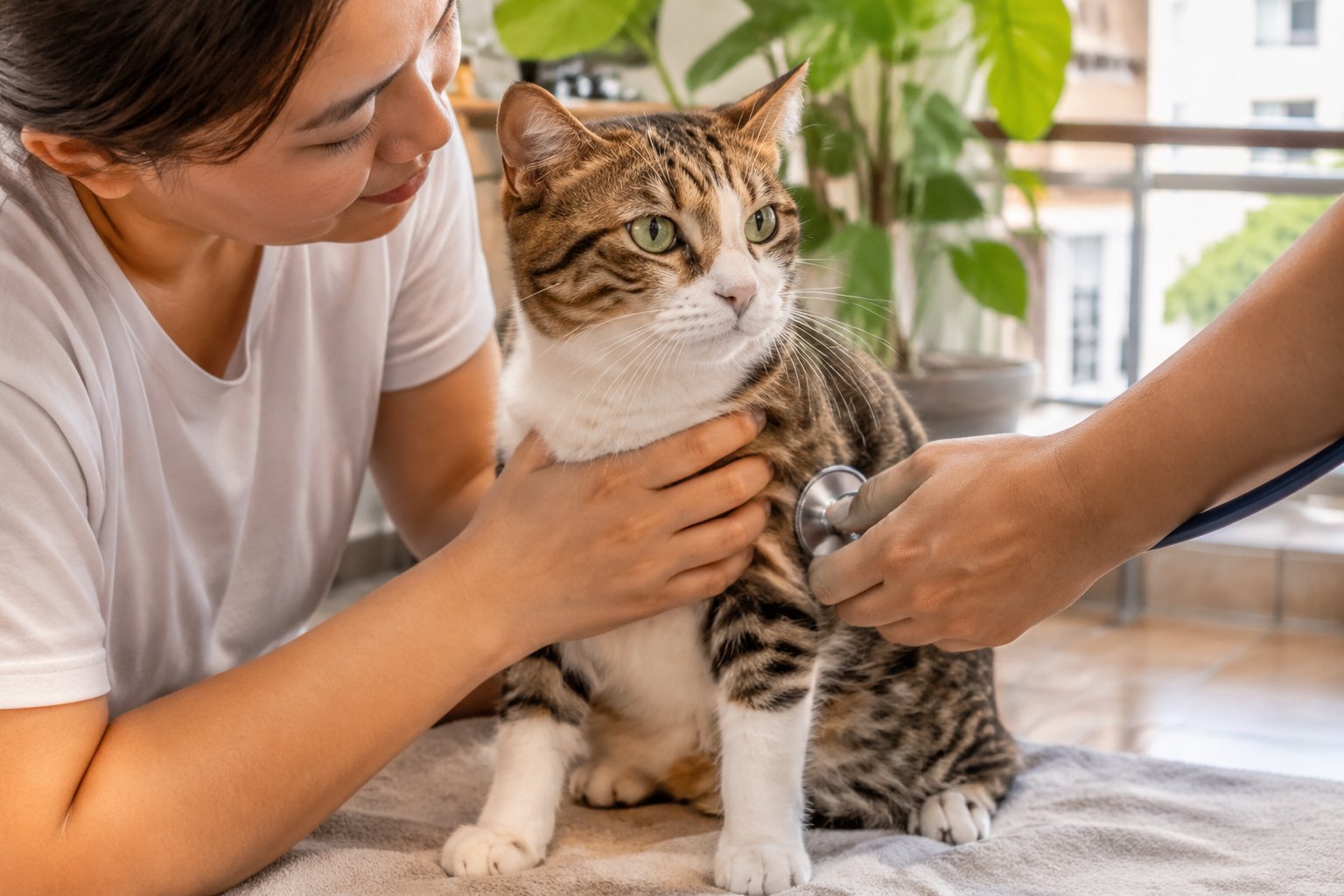
The chip is implanted with a needle, usually between the shoulder blades or slightly behind them. The visit is short, but it is still a vet visit, so prepare for it.
Before the appointment
- Ask what chip is being used. International brand names are common, but the important question is whether the chip meets a recognised standard and whether the number will be registered.
- Ask about registration. Some clinics register the chip for you; others hand you the paperwork and expect you to do it. Confirm who does what before you leave.
- Bring your cat's record. If your cat is already vaccinated, bring the vaccination card so the clinic can keep everything in one file.
- Ask about pain relief. For very small kittens or a nervous cat, ask whether a local anaesthetic is appropriate.
- Check the cat is well. A vet will usually not implant a chip into a sick or feverish cat without assessing it first.
During the visit
- The vet or nurse checks the implantation site and cleans the skin.
- The needle is inserted and the chip deposited under the skin.
- The vet scans the cat immediately to confirm the number reads correctly.
- You should be given the chip number in writing, or at least shown it and asked to record it.
After the visit
- Watch the site. Mild swelling or a small scab can occur. Ask the vet what normal looks like and what should prompt a call.
- Keep the cat calm. Avoid rough handling of the shoulder area for a short period, as advised by your vet.
- Record the number. Write it in your phone, your pet file and, if you have one, your cat's passport or health booklet.
- Confirm registration. If the clinic said it would register the chip, follow up to confirm it was done and that your details are correct.
Clinic records versus registry records
This is the part most owners get wrong. There are usually two separate records, and they do not always talk to each other.
| Record type | Who holds it | What it usually contains | What you must do |
|---|---|---|---|
| Clinic record | Your vet clinic | Chip number, vaccination history, weight, treatments, owner contact on file | Tell the clinic when you change phone number or address |
| Registry record | The chip registry or database the chip is registered with | Chip number, owner name, contact details, sometimes alternate contact | Update it yourself after a move or phone change, and keep proof |
| Council licence record | Local council, where a licensing scheme applies | Licence details and sometimes identification information | Check with your council what they require and how to update it |
A common failure: an owner moves from a Kuala Lumpur apartment to a different unit in the same building, updates the clinic file, but never updates the registry. The chip still reads correctly, but the phone number on the registry is an old one, so a finder cannot reach anyone.
A simple record-keeping checklist
- Chip number written in at least two places.
- Registry name and contact details saved in your phone.
- Clinic file updated with your current phone and address.
- A recent clear photo of your cat, including any distinctive markings.
- A note of any council licence or local registration, if applicable.
Updating owner details after a move
Moving is the single most common reason microchip records go stale. Treat it as a task on your moving checklist, alongside changing your address for utilities and banking.
- Find out which registry holds your chip. Check the paperwork from the implantation visit, or ask your vet to scan the cat and read the number, then contact the registry that matches that number.
- Update your phone number first. A working phone number is more useful to a finder than a perfect address.
- Update your address. Include the unit number and postcode, and note that Malaysian addresses can be long, so write it carefully.
- Add a second contact if the registry allows it. A family member or trusted neighbour can be a useful backup.
- Ask for confirmation. Keep a screenshot or email confirming the change.
- Tell your vet clinic too. Clinic records and registry records are separate.
- Check your council position. If your area has a licensing or registration scheme, ask the council whether your details need updating there as well.
If you rehome a cat, the same logic applies in reverse. The new owner should update the registry, and you should confirm the change has gone through rather than assuming it has. If you are unsure how to handle a rehoming, call your council before rehoming to ask what they require.
Scanning a found cat
If a cat turns up in your area and looks lost, a scan is one of the fastest ways to find an owner. Here is a practical sequence.
Step by step
- Keep the cat safe and contained. Use a carrier or a quiet room. Do not let it roam while you make calls.
- Check for a collar and tag first. A visible phone number may solve the problem in minutes.
- Take the cat to a scanner. Vet clinics, shelters and rescue groups commonly have universal scanners. Call ahead to confirm someone is available.
- Ask for a full-body scan. Chips can migrate slightly, so the operator should scan the shoulders, along the back and the sides, not just one spot.
- Write the number down exactly. Ask the operator to read it back to you and to write it on paper.
- Contact the registry. The scanner operator or the clinic can often help identify which registry the number belongs to.
- Ask the clinic to hold the cat or contact you. If the owner cannot be reached immediately, ask what the clinic's policy is.
- Use local networks carefully. Community groups can help, but avoid posting full chip numbers or your own address publicly. Share a photo and general area instead.
If the chip cannot be read
Sometimes a scanner finds nothing. That does not always mean the cat is unchipped. The chip may have migrated, the scanner may not be compatible, or the cat may genuinely not have one. Ask for a second scan with a different scanner before concluding anything.
Microchip, collar tag and licence: how they fit together
These three tools do different jobs, and the strongest identification plan uses more than one.
| Tool | Main strength | Main weakness | Best use |
|---|---|---|---|
| Collar tag | Immediate, visible, anyone can read it | Can fall off or be removed | Everyday visible ID with your phone number |
| Microchip | Permanent, cannot be removed | Needs a scanner and a current registry record | Backup ID and proof of identification |
| Council licence or local registration | May be required locally | Rules vary by state and council | Compliance and local record-keeping |
In a Malaysian context, a cat living in a Kuala Lumpur apartment may wear a soft breakaway collar with a tag, while a cat in a Johor terrace house that goes into the garden may rely more heavily on the chip as a backup. Neither replaces the other.
Common myths and mistakes
- "The chip has my vet records on it." It does not. Keep your vaccination card and clinic file.
- "The chip shows where my cat is." It does not. Consider a separate GPS device if you need tracking, and weigh battery and comfort.
- "I registered it once, so I am done." Records go stale. Update after every move and phone change.
- "The chip proves the cat is mine." It helps, but ownership conversations are usually resolved with records, photos and documentation.
- "Any scanner will find it instantly." Scanning takes a moment and should be done thoroughly.
- "A found cat with no chip has no owner." Not necessarily. The chip may have migrated or the scan may have been incomplete.
When to see a vet
Contact a vet if, after implantation:
- the site becomes increasingly swollen, hot or painful;
- there is discharge, bleeding or a bad smell;
- your cat seems unwell, lethargic or off food;
- your cat keeps scratching or biting at the area;
- you cannot confirm the chip reads correctly when scanned.
Also see a vet if you find a cat and are unsure whether it is injured, malnourished or unwell. A scan visit is a good moment to ask for a basic health check.
A practical checklist for Malaysian cat owners
- Ask your vet which chip is being implanted and who registers it.
- Get the chip number in writing.
- Confirm the registry record shows your current phone number.
- Save the registry contact in your phone.
- Update the registry after any move or phone change.
- Tell your clinic when your details change.
- Ask your council whether any local registration or licensing applies.
- Keep a collar tag with a reachable phone number.
- Keep a recent photo and a note of distinguishing marks.
- Ask your vet to scan the chip at routine check-ups to confirm it still reads.
Bottom line
A microchip is a simple, durable identification tool that works only when the number on the chip connects to a record that reaches you. The implantation visit is quick, the aftercare is minor, and the real work is administrative: registering the chip, keeping your details current, and knowing how to get a found cat scanned. Do those things, and the chip does its job.
This article is general information for Malaysian cat owners and is not veterinary advice. Microchipping requirements and local registration rules vary by state and council. Ask your veterinarian and your local authority for guidance specific to your cat and your area.
Related reading
- Pet Life in Malaysia: The Seven Practical Decisions Before You Get a Pet
- Cat Registration in Malaysia: What Actually Exists (and What Doesn't)
- Lost Cat in Malaysia: The First 72 Hours (Search Grid, Scent Stations & Posters)
- 24 Hour Vet KL: How to Find Genuine Emergency Care Before You Need It
- Cat and Newborn Baby in Malaysia: A Practical Prep Guide
- Dog Licence Malaysia: Step-by-Step Guide for Owners
- Pet Ambulance Malaysia: What to Do Before Help Arrives
- Rainy Season Cat Care in Malaysia: Indoor Enrichment, Litter, Paws and Parasites
- AirAsia Pet Policy: What You Can and Cannot Fly With
- Animal Welfare Act 2015 Malaysia: What Ordinary Pet Owners Must Know
- Bringing a Cat on a Flight from Malaysia: Cabin vs Checked Baggage, Approvals & Paperwork
- Cat Carrier Car Safety in Malaysia: Securing Your Cat in Traffic

