
Chapter 8: Treat Portions — How Much Is Right?
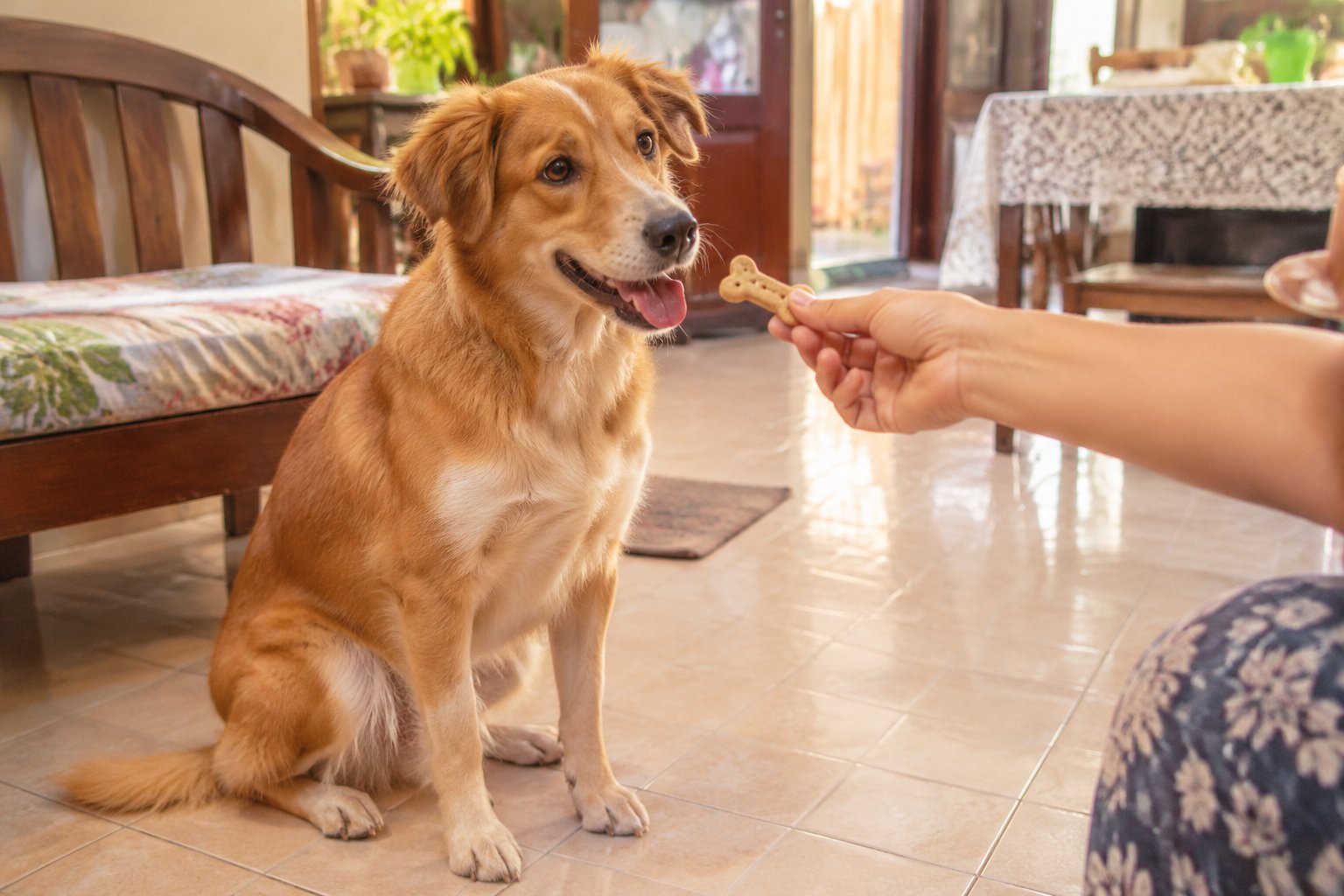
Treats should be counted, not guessed. A rough guide is that treats make up no more than ten percent of daily calories; the rest comes from a complete main diet. Read the feeding guide on the treat packet and adjust for your pet's size, age, and activity. For small pets, one biscuit can be a large share of the daily allowance — break it up. Weigh your pet regularly, especially in apartments where exercise may be limited, and watch for weight gain over weeks. In Malaysia, many pets get extra treats from family members, so agree on a daily limit at home. If your pet is on a prescription diet or has diabetes, kidney disease, or pancreatitis, do not add treats without veterinary advice. When in doubt, use part of the daily meal as rewards.
The ten percent rule is a ceiling, not a target. It exists so that the main diet — which is formulated to be complete and balanced — still supplies almost all the nutrition your cat or dog needs. Once treats creep past that share, the main meal is effectively being diluted, and over time that can matter more than many owners expect. The practical skill in this chapter is turning "a few treats" into a number you can actually track, then fitting that number around Malaysian routines: the family gathering, the mamak table, the neighbour who means well.
Turning the ten percent guide into a daily number
Start with the main diet, not the treats. Look at how much complete food your pet actually eats in a day — the amount you scoop or weigh out, not the amount printed on the bag. The ten percent guide applies to that daily intake. If your pet eats two cups of main food a day, the treat allowance is a small fraction of that total, and it is easier to picture as "a handful of small pieces" than as a separate meal.
Then read the feeding guide on the treat packet, because treat calorie density varies enormously between products. A soft, chewy treat and a hard biscuit of the same size can differ a great deal. Use the packet's guidance as your starting point and adjust for your pet's size, age, and activity. A young, active dog that walks twice a day has more room than a senior cat that naps on the condo windowsill. Adjust down for the less active pet, not up for the more enthusiastic one.
For small pets, one biscuit can be a large share of the daily allowance — break it up. A single large dog biscuit handed to a small cat or a toy-breed dog may already be most of the day's treat budget. Splitting treats into smaller pieces stretches the allowance, gives more reward moments, and costs nothing.
Treats in a Malaysian household
In Malaysia, many pets get extra treats from family members, so agree on a daily limit at home. This is the single most common place where counting breaks down. One person gives a biscuit at breakfast, another slips something under the table at lunch, a visiting relative offers a snack in the evening — and no one believes the pet has had much at all. The pet, meanwhile, has had several times the intended allowance.
Make the limit visible and shared. A small container holding the day's treat allowance works well: everyone takes from it, and when it is empty, treats are finished until tomorrow. Keep it somewhere everyone can see, and tell visitors kindly but clearly that the pet has a limit. If your household includes children or older relatives who enjoy feeding the pet, give them a job — let them be the one to break a treat into pieces or to hand out the evening portion — so they are part of the system rather than working around it.
Tropical routines matter here too. In hot, humid weather, treats that are soft, moist, or left out can spoil quickly; keep them sealed and stored as the packet directs, and discard anything that smells off or has changed texture. And because many Malaysian pets live in apartments or landed homes with limited free-running space, the treat allowance needs to stay modest — a short walk around the condo block or a play session with a toy is often a better reward than food.
Weighing, watching, and adjusting
Weigh your pet regularly, especially in apartments where exercise may be limited, and watch for weight gain over weeks. A bathroom scale works if you weigh yourself holding the pet and subtract your own weight; for cats and small dogs, a pet scale or a visit to the clinic for a weigh-in is more accurate. Record the number — memory is unreliable, and a slow drift is easy to miss. Weigh at the same time of day, ideally before a meal.
Watch body shape as well as the number. Ribs should be easy to feel under a light hand, and there should be a visible waist when viewed from above. If the ribs are getting harder to find or the waist is filling in, cut the treat allowance before cutting the main meal, and speak to your vet if the trend continues.
Checklist: daily treat routine
- Treats counted as no more than ten percent of daily calories; the rest from a complete main diet.
- Feeding guide on the treat packet read, and portion adjusted for your pet's size, age, and activity.
- Large or hard treats broken into smaller pieces, especially for small pets.
- A shared daily limit agreed with everyone in the household, including visitors.
- Treats stored sealed and checked for spoilage in the tropical heat.
- Pet weighed regularly, with the number recorded and compared over weeks.
- Body shape checked by hand and eye at each weigh-in.
- Part of the daily meal set aside as rewards when in doubt.
Common mistakes
- Counting treats as "just a little" without measuring. A handful is not a number. Use the container method so the day's allowance is finite.
- Forgetting the treats given by others. The household limit only works if everyone follows it, including the neighbour who "just wanted to say hello."
- Using treats to make up for a refused meal. If your pet is eating less, that is a reason to ask your vet, not to top up with treats.
- Rewarding with food for every behaviour. Praise, play, and a short walk are rewards too, and they do not use up the allowance.
- Assuming a "light" or "dental" treat is free. It still counts toward the ten percent.
- Changing the main diet to fit more treats. The main diet should stay complete; the treats are the part that flexes.
When to ask a vet
If your pet is on a prescription diet or has diabetes, kidney disease, or pancreatitis, do not add treats without veterinary advice. The same applies if your pet has any other diagnosed condition, is pregnant or nursing, or is a growing puppy or kitten with specific feeding needs. Ask your vet before introducing a new type of treat, especially if your pet has food sensitivities or has had a reaction before.
Seek veterinary advice promptly if you notice unexplained weight gain or loss, a sudden change in appetite, vomiting or diarrhoea after treats, or difficulty chewing. If your pet is overweight and you are unsure how much to cut back, or if the ten percent allowance feels impossible to fit around your pet's main diet, your vet can help you set a plan that suits your pet's health and your household. When in doubt, use part of the daily meal as rewards — it keeps the count simple and the nutrition complete.