
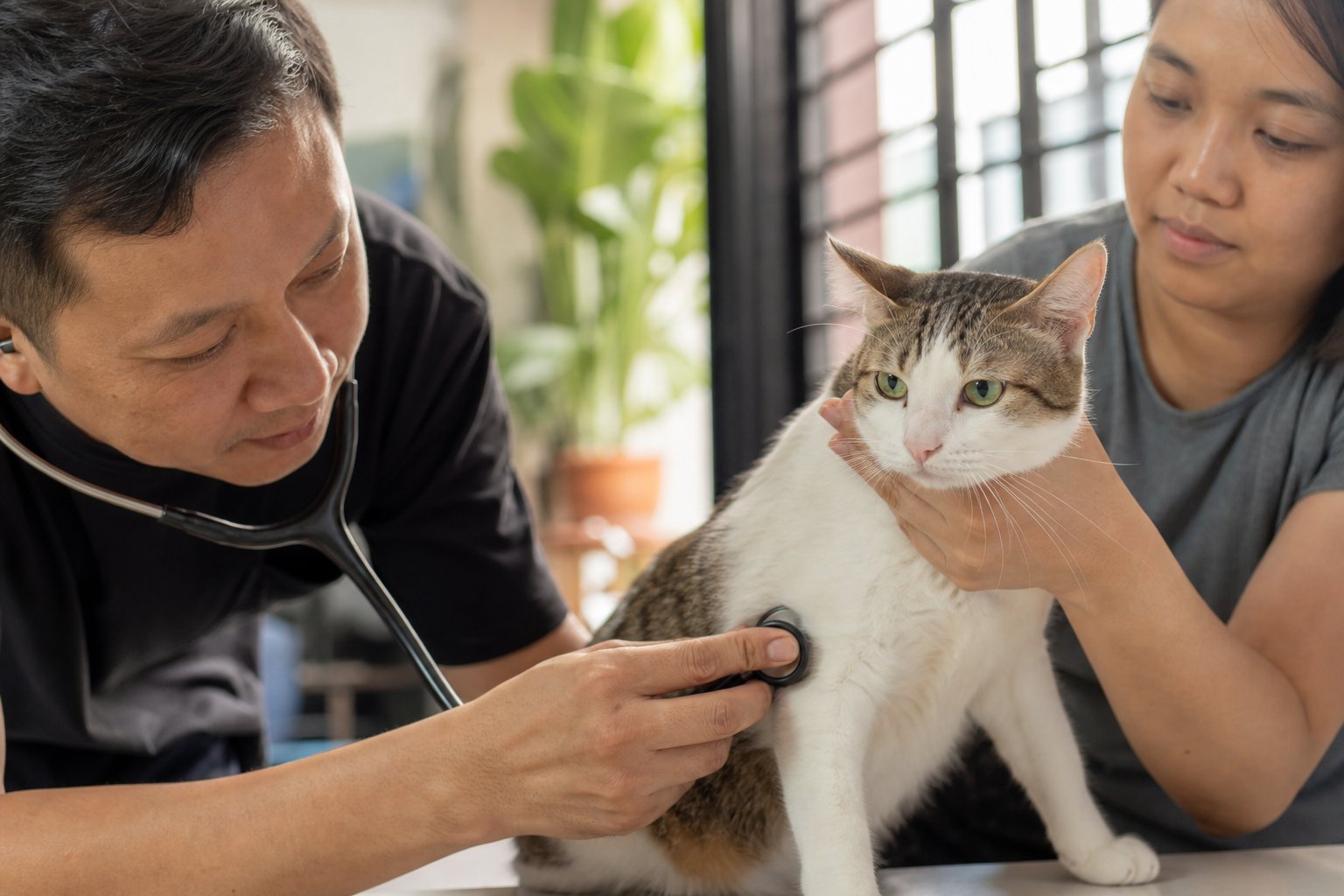
Answer first: a cat eating less during an antibiotic course is usually dealing with three overlapping problems at once — a bitter taste it hates, gut bacteria knocked out of balance, and mild stomach irritation. Most cases are worst in the first one to two days, then ease. Never stop the course early on your own. If your cat refuses food completely for more than 24 hours, or drinks nothing for 12 hours, contact a vet the same day.
Why antibiotics can switch off a cat's appetite
Reduced appetite is one of the most common things owners mention when their cat is on antibiotics. It is rarely just one cause. More often, several small irritations stack up until the cat looks at the bowl and walks away.
1. Bitter taste and learned food aversion. Cats are extremely sensitive to bitterness, so even a small amount of dissolved or crushed medicine can put them off. The trap is mixing a full dose into a whole bowl: the cat eats, feels bitter and queasy, then links that unpleasant feeling to the food itself. That learned aversion can last far longer than the course. If you must mix medicine with food, only mix a single small mouthful, and serve the rest plain.
2. Gut flora disruption. Antibiotics do not separate helpful bacteria from harmful ones. While they clear the infection, they also thin out the normal gut population, which can produce soft stools, gas, mild diarrhoea and nausea. A nauseated cat may not vomit at all — it might sniff the bowl, take two licks and stop.
3. Timing relative to meals. Some antibiotics work better with food to protect the stomach; others are absorbed best on an empty stomach. Which applies depends entirely on the product, so the feeding schedule your vet gives you is part of the prescription. Do not shift it around for convenience.
4. Direct gut or mouth effects. Different antibiotic classes cause different reactions. Some slow gut movement or irritate the stomach lining; others provoke drooling, lip-smacking or facial itching. Watch for anything that appears within minutes of dosing.
5. The illness itself, not the drug. Fever, pain, mouth ulcers, dehydration, a blocked nose that stops the cat smelling food, or general malaise from the infection can all suppress appetite independently. During a course, poor intake is not automatically a drug side effect — look for other signs at the same time.
Normal side effect or red flag?
The useful question is not "how much less did it eat", but "what else is happening alongside it". A cat that eats half its usual portion but is bright, drinking normally and interested in the household is a cat you can watch for another day. A cat that pairs poor intake with less drinking, vomiting, diarrhoea or low spirits should not be waited on.
| What you observe | Usually within normal observation | Try at home first | Contact the vet when |
|---|---|---|---|
| Sniffs and walks away, intake roughly halved | First 1 to 2 days of the course | Stronger-smelling soft food, slightly warmed, several tiny meals | Same pattern persists beyond 48 hours |
| Refuses all food but still drinks normally | Under 24 hours | Hand-feed, smear a little on the lip, log intake | Complete refusal passes 24 hours |
| Refuses food and is clearly drinking less | Not a watch-and-wait situation | Do not wait | No water for 12 hours, or skin tenting back slowly |
| Vomits straight after dosing, keeping nothing down | Not a watch-and-wait situation | Record the time and the medicine | Same day — the vet may change timing or product |
| Heavy drooling, face scratching or facial swelling after a dose | Not a watch-and-wait situation | Stop dosing, keep the packaging | Immediately — this is an allergic emergency |
| Lethargic, hiding, unresponsive | Not a watch-and-wait situation | Keep warm, prepare the carrier | Immediately |
The clock matters more than the bowl: fat liver risk
Cats metabolise differently from dogs. When a cat goes several days without eating, the body mobilises large amounts of fat to the liver for processing, and once that exceeds the liver's capacity, hepatic lipidosis — fatty liver disease — can develop, and it can be fatal. With cats, how long they go without food matters more than how much they skip in one meal.
| Length of fasting | What is likely happening | Suggested action |
|---|---|---|
| Under 24 hours | Usually still reversible | Observe closely; log food and water |
| 24 to 48 hours | Fat mobilisation begins; dehydration risk rises | Call the vet and ask whether a visit is needed |
| 3 to 5 days with no food | Fatty liver risk climbs steeply | Treat as urgent; seek care that day |
| Overweight cat, or one with liver disease or diabetes | Risk rises faster | Do not apply the "wait a few days" standard |
Weight is the second warning line. Weigh your cat once at the start of the course, then daily or every other day on the same scale at roughly the same time. A drop of more than 5% over a short period, or a visible narrowing when you look at the same spot from the same angle, means a recheck. A baby scale gives far better readings than holding the cat and subtracting your own weight.
One idea worth discarding: "leave the food out and it will eat when it is hungry". For cats this backfires — going without food further suppresses the desire to eat, and it accelerates fat mobilisation into the liver. Never use hunger as a tactic with a cat that is already off its food.
Seven ways to lift appetite, easiest first
-
Smaller, more frequent meals. Move from two or three meals a day to four or six, offering one or two tablespoons each time. Leftovers do not matter; what matters is raising the number of occasions your cat actually eats, without presenting a large bowl that feels like pressure.
-
Warm the food slightly, to about 35 to 40°C. Warmth releases aroma, which is the main signal a blocked-nose or nauseated cat still responds to. Stand the bowl in warm water or stir in a little warm water. Never microwave: heating is uneven and can scald the tongue.
-
Choose strong-smelling, soft-textured food. Wet food, broth-topped meals, pâté or mousse textures are far easier than dry kibble for a cat with mouth pain, gum discomfort or a congested nose.
-
Hand-feed, or smear a little on the lip. Pick up a small amount on a finger and place it at the corner of the mouth; most cats will lick it off reflexively. This doubles as a diagnostic: it tells you whether the appetite is truly gone or whether the cat simply does not want to walk to the bowl.
-
Keep the medicine separate from the meal. Only the small medicated mouthful carries the taste; everything else stays normal. If the cat has already turned against one flavour, switch to a different, more aromatic variety rather than insisting.
-
Change the bowl and the spot. A wide, shallow dish beats a deep one — long whiskers pressed against a bowl rim are uncomfortable for many cats. Move the bowl to a quiet corner away from other pets and foot traffic. In a small Kuala Lumpur apartment, shifting the bowl out of the kitchen, away from cooking smells and the household's busiest path, is often enough to restart eating.
-
Protect water, but add nothing unauthorised. Put out several bowls and consider a fountain. Never salt the food, never add stock powder, and keep onion, garlic and shallot-family ingredients entirely out of anything offered to a cat — these are toxic. Unsalted broth or a nutritional gel should be cleared with your vet first.
If all of this fails and the cat still eats nothing, your vet may prescribe a recovery-phase diet, a nutritional supplement, or short-term assisted feeding. Those are medical decisions and need professional assessment — do not buy a syringe and start forcing food yourself.
Course discipline: finish what was prescribed
Poor appetite is exactly the side effect that tempts owners to quit the medicine. Stopping early is the most common — and most avoidable — mistake: bacteria that are not fully cleared can cause the infection to return, sometimes needing a stronger drug and a longer course next time.
-
Dose, frequency and length all follow the vet's instructions. Do not increase or reduce them on your own.
-
Missed a dose? Call the clinic. Do not double the next one to catch up.
-
Do not save leftovers for another pet, and do not share. Different weights and different conditions mean entirely different medicines.
-
Do not add anything yourself, especially human painkillers. Paracetamol (acetaminophen) and ibuprofen are clearly toxic to cats; even a single tablet can cause serious harm.
-
Do not compensate with treats. A cat refusing its meals does not need a sudden switch to rich food or human scraps, which can upset the gut further.
-
If probiotics are approved, space them out. Roughly two hours either side of the antibiotic dose, so the medicine does not simply destroy the supplement. Probiotics support; they never replace the prescription.
-
Take records to every follow-up: the medicine's name, how far into the course you are, roughly what percentage of the usual portion is eaten, any vomiting or diarrhoea, and the weight trend. Those numbers directly shape the vet's next step.
Parasite control and the home environment during treatment
Do not start new medicines or supplements mid-course without asking. Two things should continue as normal, though: hydration, and flea and tick prevention. Flea and tick bites make cats scratch, and broken skin invites secondary infection — one of the common reasons cats end up on antibiotics in the first place. Prevention therefore should not pause simply because the cat is currently medicated.
International products such as Advantage, Frontline and Beaphar VETO are widely used, but always match the application to the cat's weight band on the label, never apply more because "more seems stronger", and check with your vet before using anything on kittens, unwell cats, or over open wounds. Local pricing and stock vary, so ask a Malaysian vet or pet retailer for current figures rather than relying on any figure quoted elsewhere. Remember these products prevent parasites; they do nothing for appetite, and the two issues should not be confused.
During the Penang rainy season, damp air and wet floors mean towels and bedding take longer to dry — keep the feeding area clean, change water frequently, and make sure the quiet corner you have chosen for the bowl stays dry and mould-free. A cat that already feels unwell will eat better in a calm, clean, draft-free spot.
When to see a vet
Contact your vet the same day, or urgently, if any of these appear:
-
Complete refusal of food lasting more than 24 hours.
-
No water at all for 12 hours, or skin that tents and returns slowly when pinched.
-
Vomiting that keeps the dose down, so the medicine is not being absorbed.
-
Heavy drooling, facial scratching, or swelling of the face or muzzle after dosing — this may be an allergic reaction.
-
Blood in the stool, black tarry stools, or repeated diarrhoea in a single day.
-
Hiding, unresponsiveness, wobbly movement, or a cat that no longer comes out to greet you.
-
Weight down more than 5% from the start of the course.
-
Still not eating two to three days after the course ends, or weight still falling.
-
Kittens, elderly cats, and cats with known liver, kidney or diabetic conditions — for these, use much shorter timelines and call early.
When you call, have ready: the medicine's name, the day of the course you are on, food intake as a percentage of normal, water intake, vomiting and stool frequency, and the latest weight. Ask directly whether to change the feeding time, adjust the product, or add supportive treatment — that is the vet's call, not the owner's.
A three-minute daily log to bring to the recheck
Vets care about the trend rather than any single day's number. Five items are enough, and they take minutes.
| What to track | How to measure it | Warning line |
|---|---|---|
| Food | Estimate as a share of the normal portion, e.g. "about half" | Below half for long, or zero intake for 24 hours |
| Water | Measure with a cup and compare day to day | Nothing for 12 hours, or a clear drop |
| Weight | Same scale, same time, ideally morning | Down more than 5% in a short period |
| Stools and vomiting | Count episodes, note consistency and any blood | Blood, black stool, or repeated diarrhoea |
| Mentation | Does the cat come out, greet, jump up? | Hiding, unresponsive, unsteady on feet |
Water is the item most often overlooked. Owners understandably fixate on food, but if a cat also stops drinking, dehydration and kidney strain can develop within about 48 hours — a more urgent problem than missing a couple of meals.
Frequently asked questions
Why does my cat eat less after starting antibiotics?
Three mechanisms combine: bitterness that cats detect strongly, gut bacteria disrupted into causing soft stools, gas and mild nausea, and stomach irritation in medicines meant to be taken with food. The dip is usually sharpest in the first one to two days.
Should I stop the antibiotics if my cat refuses to eat?
No. Stopping partway leaves bacteria behind, raising the risk of relapse and a tougher second course. Report to your vet: days completed, approximate intake, and any vomiting or diarrhoea. The vet decides whether to change timing, switch products, or add support.
Will my cat's appetite fix itself mid-course?
If taste and mild gut upset are the only issues, intake is usually worst on days one to two, better by day three, and normal within a week. Continuing refusal with weight loss, vomiting, diarrhoea or low energy requires examination and possibly testing.
Can probiotics be given alongside antibiotics?
With your vet's approval, yes — but separate them by about two hours so the antibiotic does not destroy the added bacteria. They are supportive only, cannot replace the prescribed antibiotic, and should not be used alone to treat diarrhoea.
How many days do antibiotics last, and does appetite bounce back immediately?
Your vet decides, commonly 5 to 14 days, and the course must be completed. Rebuilding gut flora takes several days to about a week, so appetite and stools return gradually. No eating two to three days post-course means a recheck.
What does longer antibiotic use do to appetite?
Extended or repeated courses make gut imbalance, soft stools and reduced appetite more likely, with side effects strongest early on. Keep the dose exactly as written, log food, water and weight, and report changes rather than adjusting the medicine yourself.
This article is for general information only and does not replace veterinary diagnosis or treatment. Never change, stop or start a medicine for your cat without your veterinarian's instruction. If your cat is not eating or drinking, contact a licensed Malaysian veterinary clinic promptly.
Related reading
- Pet Medication Safety Guide Malaysia: Dosage, Antibiotics, Deworming & Poisoning First Aid
- Why Your Cat Loses Appetite on Antibiotics: Causes, Timeline and What to Do
- Cat Ate a Grape? Emergency Steps Every Malaysian Cat Owner Should Take
- Long-Term Appetite Stimulants for Pets in Malaysia: Hidden Risks Every Owner Should Know
- Long-Term Appetite Stimulant Risks for Pets: What Malaysian Owners Should Watch For
- Positive Care vs "Magic Water": What Actually Differs for Pet Cleaning and Disinfection in Malaysia
- Pet Medication Safety in Malaysia: Doses, Antibiotics, Dewormers and Accidental Ingestion
- Pro Kolin Advanced Long-Term Use in Malaysia: Side Effects, Dosing Limits and Vet Checks
- Can You Give a Cat Anti-Vomiting or Anti-Diarrhoea Medicine? Safety Rules for Malaysian Cat Owners
- Cat Ate a Grape? Emergency Steps Malaysian Pet Owners Must Follow