
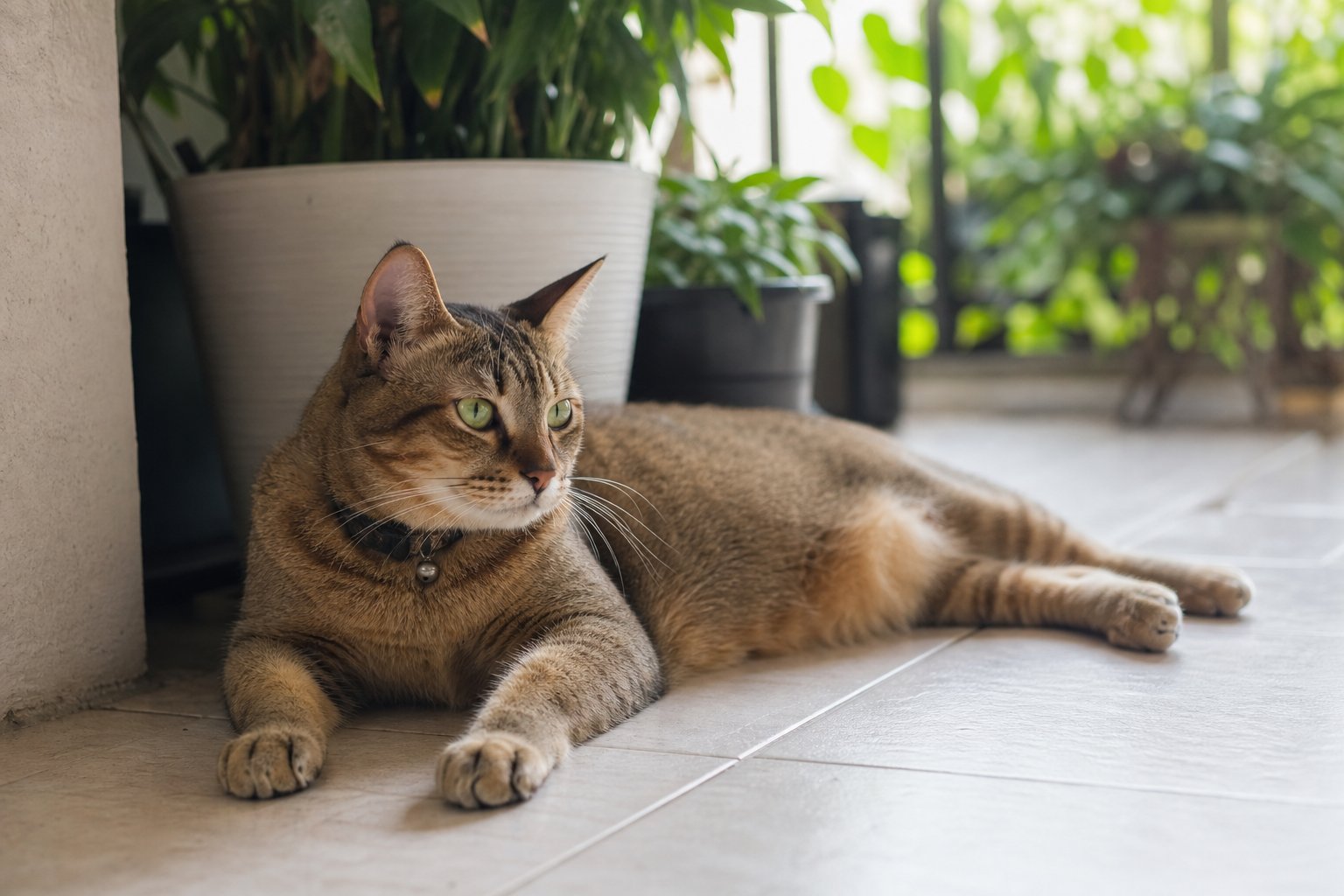
If your cat's blood potassium result comes back flagged, treat it as a signal rather than a diagnosis. High potassium becomes an emergency when the heart rate slows or the rhythm falters; low potassium usually shows up first as weakness and a fading appetite. You cannot measure potassium at home — only weight, water intake, food intake and mobility. Any supplement or restriction has to follow your vet's own blood results.
What potassium does, and what counts as abnormal
Potassium is the body's main intracellular cation. Roughly ninety-eight per cent of it sits inside cells, with only a small fraction circulating in blood and other extracellular fluid. That distribution matters, because a blood test measures the small circulating fraction, not the body's total stores. A cat can be genuinely depleted while the printed number looks normal or even high, and the reverse is also possible.
Its three jobs are maintaining cell membrane potential, carrying nerve and muscle signals (including the heart muscle), and working alongside acid-base balance. The heart is the most sensitive organ, which is why potassium problems — high or low — are dangerous mainly for cardiac reasons.
Reference ranges vary between laboratories because instruments and methods differ. Cats generally fall somewhere around 3.5 to 5.5 mmol/L, but some reports print 3.4 to 5.3 and others 3.6 to 5.2. The only correct reference is the one printed on your own report; if nothing is printed, ask your vet to explain it.
| Level | Typical reading | Common signs | Direction of action |
|---|---|---|---|
| Markedly low | Below the report's lower limit | Muscle weakness, neck held forward, stiff gait, dullness, constipation, poor appetite | Find the cause — losses, low intake, or shift into cells; do not self-supplement |
| Slightly low | Just below the lower limit | Often no obvious signs, found on a recheck | Review diet, medication and chronic disease control; reschedule per vet |
| Normal | Inside the range | Does not prove total body potassium is fine | If signs persist, add urine potassium and blood gas testing |
| Slightly high | Just above the upper limit | Often no signs; may be a sample problem | Rule out haemolysis or delayed delivery, then retest |
| Markedly high | Above the upper limit | Slow heart rate, irregular rhythm, extreme weakness, shallow breathing | Emergency — seek care at once, do not wait for the next appointment |
A normal result is not the same as a healthy cat. Cats with chronic kidney disease, diabetic ketoacidosis or severe dehydration can have a temporarily normal potassium while total body balance is already disturbed. That is why vets read potassium alongside sodium, chloride, acid-base status and kidney values rather than in isolation.
High potassium: four mechanisms to work through
Hyperkalemia means potassium above the top of your report's range. The instinctive reaction — "my cat ate too much potassium" — is only one route, and rarely the most likely one. The two most clinically significant routes are failure to excrete potassium through the kidneys, and potassium shifting out of cells.
| Mechanism | Common examples | Why potassium rises | Clues to watch |
|---|---|---|---|
| 1. Reduced renal excretion | Complete urethral obstruction, acute kidney injury, end-stage chronic kidney disease, bilateral ureteric obstruction | The kidneys are the main exit route; when output stops, potassium accumulates | Little or no urine, straining in the tray, abdominal discomfort, rapid decline in alertness |
| 2. Shift out of cells | Acidosis, diabetic ketoacidosis, severe tissue necrosis or tumour lysis, depolarising muscle relaxants | Damaged cells or acid-base change dumps intracellular potassium into the blood | Deep rapid breathing, dehydration, abnormal blood glucose and urine ketones |
| 3. Intake or drug increase | Potassium chloride salt substitutes or "low sodium" salts, potassium-sparing diuretics, some blood pressure drugs and anti-inflammatories, potassium supplements | Input exceeds what the kidneys can clear | A history that must be checked item by item, including supplements and human medicines |
| 4. Pseudo-hyperkalemia | Difficult draw causing haemolysis, sample left standing too long, very high platelet or white cell counts | Potassium leaks out of cells during handling rather than being genuinely high | Cat looks well with no cardiac signs; repeat test returns to normal |
The third route is most often overlooked in the kitchen. Some products labelled "low sodium" replace sodium chloride with potassium chloride. Harmless enough in human seasoning, but if it is sprinkled into a cat's food over weeks it becomes a hidden potassium load. When a vet takes a history, the brand of salt in the house is a fair question.
The fourth route deserves calm handling. If the cat is bright, eating normally and has no rhythm problem, and only one test shows a high value, the usual first step is a repeat sample plus a check for haemolysis. That does not mean ignoring it — the repeat result is what settles the question.
A related query that surfaces often is whether potassium aluminium sulfate (alum) in clumping cat litter or some personal care products could raise blood potassium. Alum is a potassium and aluminium salt used industrially for water treatment and in some antiperspirants, and it appears in certain crystal litters as a deodorising or clumping agent. It is not a nutritional potassium source for cats, the potassium in it is bound rather than dietary, and there is no published evidence that ordinary contact use affects a cat's blood potassium. The four mechanisms above remain what actually matters.
Low potassium: losses, low intake, and shifts into cells
Hypokalemia is in fact more common than high potassium in cats, especially in chronically ill patients. Three main routes explain most cases, with a fourth worth flagging because it involves medication.
| Mechanism | Common examples | Key clues | Notes |
|---|---|---|---|
| 1. Increased losses | Vomiting, diarrhoea, diuretics, polyuria from chronic kidney disease, poorly controlled diabetes with glucosuria dragging water and electrolytes out | Weight loss, water and urine output both rising, coat deteriorating | The most frequent route in cats |
| 2. Reduced intake | Poor appetite for several days, long-term picky eating, a diet genuinely low in potassium | Clear drop in recorded grams eaten, slight weight decline | A cat not eating for 24 to 48 hours risks hepatic lipidosis |
| 3. Shift into cells | Insulin action, alkalosis, stress or rising catecholamines | Low blood potassium without total body depletion necessarily being poor | Needs blood gas and electrolytes read together |
| 4. Drug-related | Some diuretics, some respiratory medications | Medication history | Never stop or change a dose yourself; ask the vet |
The classic presentation of low potassium is muscle weakness: hind legs that soften during walking, a cat that no longer jumps to the usual shelf, grooming that slows down. Severe cases show the neck held forward, a stiff gait, and — because the respiratory muscles weaken — shallow breathing. All of that overlaps with joint pain, ageing and muscle loss, so the difference is settled by blood testing rather than by guessing.
Two secondary connections are worth knowing. Cats with an overactive thyroid often run low potassium, because faster metabolism, muscle wasting and fluctuating appetite all disturb the balance; a cat that eats more and still loses weight should have thyroid values checked at the same time. And an older cat on steroids with new limb weakness may have more than one cause running at once.
Recovery depends on the cause. When the trigger is correctable — electrolyte loss, a dietary problem — strength usually improves steadily under veterinary care. When it has been driven by long-standing chronic disease for weeks, recovery can be slower. Potassium tablets, powders and human supplements must never be given on your own: an over-corrected dose can swing the level from too low to too high, and the heart pays for both.
Reading the report: five items alongside potassium
A single potassium number carries little information on its own. Vets read it as part of a set.
| Test | What it shows | Link to potassium |
|---|---|---|
| Sodium (Na) and the sodium-to-potassium ratio | Hydration status and endocrine clues | A distorted ratio is common in adrenal problems and severe dehydration, and both disturb potassium |
| Chloride (Cl) and acid-base status | Metabolic acidosis or alkalosis | Acidosis pushes potassium out of cells, so the measured value runs high |
| BUN, creatinine, SDMA | Kidney function and staging | The kidneys are the main exit route; impaired function is a leading cause of high potassium |
| Blood glucose and urine ketones | Diabetes or ketoacidosis | Insulin lack moves potassium out of cells, and treatment can then drop it quickly |
| Thyroid T4 | Overactive thyroid | Hyperthyroid cats commonly run low potassium, and it affects weight and follow-up medication |
Alongside the numbers, an electrocardiogram is usually paired with the blood work, because the heart muscle reacts to potassium fastest. Marked elevation produces characteristic tracing changes and a slower heart rate, and those changes reflect danger sooner than the number itself. Where blockage or acute kidney injury is suspected, abdominal ultrasound and urinalysis are added to locate the problem and confirm urine output.
The diagnostic sequence runs in six steps:
- Confirm the value against the report's reference range while reviewing sodium, chloride, BUN, creatinine, SDMA and glucose.
- Assess heart rate and ECG immediately to decide whether this is an emergency.
- Run blood gas analysis to distinguish acidosis from alkalosis, since acid-base status directly governs potassium distribution.
- Add urinalysis (specific gravity, glucose, ketones, urine potassium) and abdominal ultrasound to find obstruction, kidney disease or endocrine problems.
- Check the history line by line: salt substitute, human medication, supplements, recent vomiting or diarrhoea, and exactly how many days intake has changed.
- Rule out pseudo-hyperkalemia, repeat the test, then set the treatment direction.
Step five is where owners matter most. The answer often sits not in the analyser but in what changed at home — a new bag of food, a new supplement, a different salt. Keeping a simple written log of food brand, treats, supplements and medication turns a vague history into a usable one.
Liver disease and steroids: the indirect routes
Two questions cause the most confusion, and both deserve a clear causal chain rather than a vague statement that "liver problems affect potassium".
Liver impairment. The liver is not a potassium-regulating organ — that job belongs to the kidneys, aldosterone and insulin. What liver disease does is act through four intermediaries. First, appetite drops; a liver patient eating for less than three days is already taking in too little potassium. Second, vomiting and diarrhoea lose potassium through the gut, more than most owners expect. Third, abdominal fluid or swelling from liver disease is treated with diuretics, and some of those speed urinary potassium loss. Fourth, liver disease can shift acid-base status, and acid-base decides how potassium distributes between cells and blood — so the number reflects the distribution at that moment, not necessarily total stores. Judging which route dominates means reading potassium, sodium, chloride, blood gas, BUN, creatinine and the medication record together.
Long-term steroids. Beyond their anti-inflammatory effect, prolonged higher-dose steroids carry a mild mineralocorticoid action that increases urinary potassium loss, and they also drive increased urination and thirst, which further disturbs electrolyte and water balance. Two caveats: steroids on their own rarely produce marked hypokalemia, and clinically significant low potassium is usually multifactorial — steroid plus chronic kidney disease plus poor appetite plus a diuretic, together.
So the practical answer to "how do I assess potassium risk in an older cat on steroids" is a monitoring routine, not a single number:
- Blood potassium and electrolytes every one to three months, more frequently early in treatment.
- Regular blood pressure checks, especially with underlying kidney or heart disease.
- Weight every two to four weeks, recorded alongside 24-hour water intake.
- Any dose change, stop, or added supplement decided by the vet — never by the owner.
Diet: choosing foods and changing them safely
Diet is the most searched aspect of potassium management and the one most often oversimplified. Two opposite directions exist, and picking the wrong one moves the cat straight towards the opposite risk: restricting potassium long-term when it is already low causes hypokalemia, and supplementing when the kidneys cannot excrete it causes hyperkalemia. Direction is set by blood results and disease course, not by the packaging.
If you are holding a product labelled "low potassium, low phosphorus" and wondering whether it suits a kidney patient long term, work through four checks:
- Read the guaranteed analysis for phosphorus and potassium figures, not the front-of-pack claim. Phosphorus must be stated at minimum; a product that does not declare potassium cannot honestly be called low potassium.
- Convert to a dry matter basis. Wet and dry foods differ several-fold in moisture, so comparing label percentages directly gives the wrong answer. Divide the stated percentage by the dry matter percentage to get comparable figures.
- Check whether it is a complete food or a supplement. Only items marked complete and balanced can serve as the daily ration long term; supplements are for occasional use.
- Have your vet verify it. Take the ingredient list, guaranteed analysis and your cat's latest blood results to the appointment rather than relying on online reviews.
Prescription diets are a separate category: they are selected after veterinary assessment, and a health supplement never replaces testing and diagnosis. Prices and stock vary by retailer, so confirm current local figures with your vet or a pet retailer rather than quoting any online figure.
Transition pace also matters. For a kidney patient or a cat with unstable electrolytes, do not swap the entire ration at once. Move gradually over seven to ten days, changing about ten per cent at a time, weighing and recording intake throughout. If vomiting, diarrhoea or complete refusal appears, stop and contact your vet — those symptoms themselves further disturb potassium balance.
Home monitoring: four things you can do, one you cannot
The direct answer to "can I monitor potassium at home" is no. Blood potassium needs laboratory instrumentation; home glucose meters and similar devices are not designed to measure it and their readings are not trustworthy. What you can do is four indirect observations, and they genuinely help your vet:
- Weight. Weigh at the same time of day every one to two weeks, recorded to one decimal place. A drop of more than five per cent in a month warrants a recheck.
- Water. Use a marked bowl or fountain scale to measure actual 24-hour intake. A sudden rise is a signal worth reporting.
- Food. Log grams actually eaten each day rather than "ate or did not eat". Two consecutive days at half the usual amount should trigger a call.
- Strength and activity. Note the usual jumping height, whether the window sill is still reachable, and whether grooming has slowed. These are the earliest functional clues to low potassium.
The thing you cannot do is the blood test, so recheck intervals belong to your vet: chronic patients usually every one to three months, tightening to every one to four weeks during medication changes, diet transitions or unstable periods. Interval should follow the individual cat's disease course and should not be stretched on your own initiative.
A practical routine for a cat in a Kuala Lumpur apartment is to keep a single notebook or phone note by the feeding station: date, grams offered, grams eaten, water in, weight, and any change in jumping or grooming. A Penang rainy season brings humidity and appetite swings that can muddy the picture, so keeping the same measuring cup and the same scale across the season keeps the numbers comparable rather than impressionistic.
When to see a vet immediately
Any one of the following is an emergency. Do not wait for the next appointment, and do not search for answers first:
- No urine at all, or repeated visits to the tray with nothing produced — obstruction can raise potassium sharply within a short time.
- Clearly slow heart rate, irregular rhythm, sudden extreme weakness or inability to stand.
- Shallow or rapid breathing, or an open-mouth posture.
- Neck held forward, stiff walking, inability to jump.
- Vomiting or diarrhoea continuing beyond 24 hours.
- Not eating at all for more than 24 to 48 hours.
These all require veterinary handling. Owners should not give potassium on their own, stop medication on their own, or alter steroid or diuretic doses — and a cat that "looks better" should still not skip a recheck, because potassium can change quickly and the number often moves before the signs do.
Related reading
- Pet Medication Safety Guide Malaysia: Dosage, Antibiotics, Deworming & Poisoning First Aid
- Why Your Cat Loses Appetite on Antibiotics: Causes, Timeline and What to Do
- Can You Give a Cat Anti-Vomiting or Anti-Diarrhoea Medicine? Safety Rules for Malaysian Cat Owners
- Cat Ate a Grape? Emergency Steps Malaysian Pet Owners Must Follow
- Dog Ear Infection Drops in Malaysia: What Is Gentle, What Needs a Vet, and How to Use It
- Emergency Pet Drug Dose Calculator Malaysia: How to Work Out a Safe Dose
- Long-Term Appetite Stimulants for Pets in Malaysia: Hidden Risks Every Owner Should Know
- Long-Term Appetite Stimulant Risks for Pets: What Malaysian Owners Should Watch For
- Pet Antibiotic Side Effects in Malaysia: What to Do, When to Worry
- Pet Antibiotic Side Effects in Malaysia: What's Normal, What's an Emergency, and What to Do