
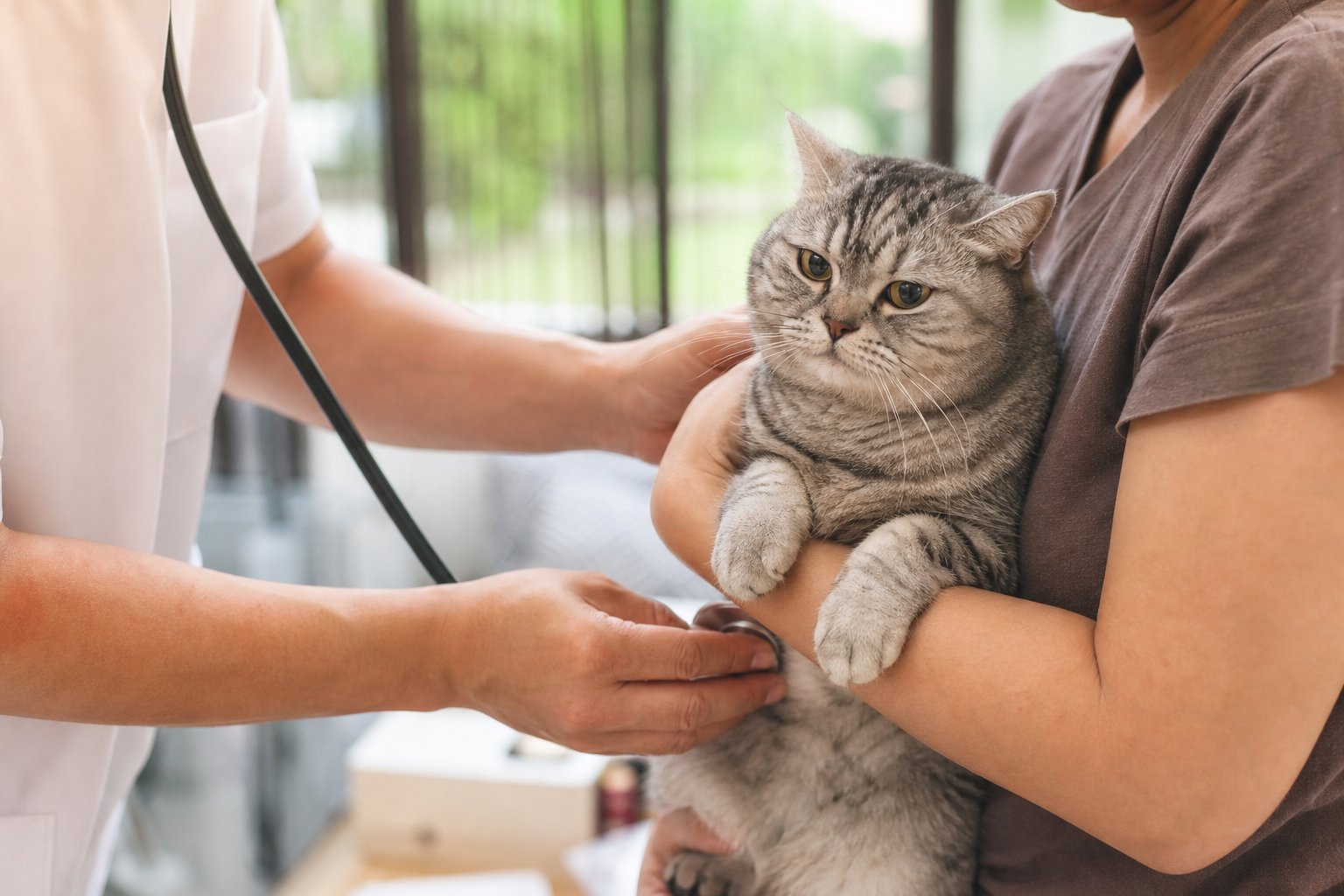
Quick answer: the three red lines
If your cat is vomiting, convulsing or losing balance, use three red lines: a single fit lasting over five minutes, two or more fits within 24 hours, or no return to normal awareness between fits. Any one means leave now. Vomiting plus heavy drooling alongside a fit or unsteadiness should be treated as possible poisoning — never induce vomiting at home. A first fit in a kitten under six months or a cat over seven years also deserves same-day attention rather than an overnight wait.
The single most common mistake owners make is the thought: "he has stopped, and he seems fine, so I'll deal with it tomorrow." A fit is a sign, not a diagnosis. Behind a first episode can sit anything from low blood sugar and poisoning to raised blood pressure or a brain problem, and the act of fitting itself raises the brain's temperature and metabolic load, so closely spaced episodes add up. The correct routine is: even after it stops, arrange a check the same day, and spend two to three minutes writing a record before you leave the house.
Triage in one minute: three questions to answer
Unlike vomiting, a fit or a stumble gives you no visual clue such as the colour of what came up, so triage runs on timing and state of mind. Answer these three within a minute. If any single one crosses a line, act on the worst one — do not average them out.
Question one: how long did it last? Start timing from the moment you first saw the collapse or abnormal twitching. Typical episodes run from 30 seconds to two minutes. Past five minutes, or if you are unsure when it began and the cat is still fitting, stop waiting: phone ahead and prepare to leave. Use your phone stopwatch. The duration you report is the first piece of data a vet uses.
Question two: how many times in 24 hours? If the cat is fully alert between episodes — knows you, walks straight — that is an intermittent pattern, and a same-day check is still required. If awareness does not return between episodes and the cat stays flat or rigid, it is an emergency even if each fit only lasted one or two minutes.
Question three: is there vomiting, drooling or loss of balance at the same time? This is what separates a single neurological sign from a whole-body problem. Fitting plus vomiting, fitting plus unsteadiness, and unsteadiness plus vomiting are all more serious than any one alone, because the causes can include poisoning, liver or kidney metabolic disease, heatstroke or inner-ear infection. These do not stay at home for observation.
The red-flag checklist: twelve signs that mean leave now
Use the table below as a triage sheet. The final column is the action window. It supports, but never replaces, a veterinary examination. If your instinct already says something is wrong, go.
| Red flag | What it may point to | Action window |
|---|---|---|
| A fit lasting more than five minutes | Status epilepticus — ongoing oxygen debt and overheating in the brain | Leave immediately; do not wait for it to end |
| Two or more fits within 24 hours | Clustered fits needing medication to break the pattern | Leave immediately |
| No recovery of awareness between fits, still flat or rigid | Ongoing seizure activity | Leave immediately |
| First fit at any age within 24 hours | Poisoning, metabolic disease, blood pressure or brain problem | Same-day vet; immediate for kittens and seniors |
| Confusion, unresponsiveness or unsteadiness lasting over 30 minutes after a fit | Prolonged recovery phase | Leave immediately |
| Fitting or unsteadiness with vomiting and heavy drooling | Poisoning (plants, spot-on products, human medicines) or metabolic imbalance | Leave immediately; do not induce vomiting |
| Sudden loss of balance, inability to walk straight, persistent head tilt, rapid eye flicking | Inner-ear or central nervous system problem | Arrange as urgent, same-day check |
| Unequal pupils, sudden blindness, walking into walls or furniture | Central nervous system abnormality or raised blood pressure | Leave immediately |
| Fast breathing, open-mouth breathing, blue or very pale gums around a fit | Oxygen shortage, heart problem or severe anaemia | Leave immediately |
| Body feeling distinctly hot to the touch, or instead ice-cold | Heatstroke, serious infection, low body temperature | Leave immediately; keep ventilation going in transit |
| Fits or unsteadiness after a fall, a blow to the head or a door closing on the cat | Head injury or internal bleeding | Leave immediately; do not jostle the cat |
| Complete inability to stand, dragging hind limbs, rigid limbs | Nervous system or spinal problem | Leave immediately |
Three practical notes on using this list. First, one row is enough — you do not need three. Owners often relax because the cat asks for food afterwards, but appetite returning does not prove the brain was unaffected. Second, records beat memory: write the start time, the duration in seconds, and what happened before and after into your phone notes. If there is more than one episode in a day, that timeline decides whether medication is used. Third, never induce vomiting and never self-medicate. If poisoning is suspected, forcing vomit can send material into the windpipe and injure the oesophus; the decision belongs to a vet. Human anti-seizure, sedative and pain medicines are categorically off limits.
Telling a real fit from a sleep twitch
Many owners are startled awake by a cat whose paws and whiskers twitch during sleep. That is not necessarily epilepsy. Four conditions look alike but are handled differently, and the deciding factors are whether awareness is lost and what the cat is like afterwards.
| Condition | Typical timing | Awareness | Usual movements | Afterwards |
|---|---|---|---|---|
| Normal sleep twitching | During sleep | Intact; wakes when called | Ears, whiskers and paws flutter, rhythm irregular | Completely normal, no vomiting |
| Epileptic-type fit | Anytime, usually sudden | Lost; does not respond | Whole-body stiffening, paddling limbs, drooling, possible loss of bladder or bowels | Confused for minutes up to a day |
| Fainting | After excitement, coughing or exertion | Briefly lost | Sudden collapse without stiffening or paddling | Recovers within seconds to a minute |
| Vestibular loss of balance | Sudden | Awake | Head tilt, circling, rapid side-to-eye movement, straight-line failure, often vomiting | Needs veterinary treatment; do not wait it out |
Three checks do the work. Call the cat's name: a sleeping cat wakes and looks at you; a fitting cat does not respond at all, and the eyes may be fixed or rolled back. Watch the aftermath: after a real fit there is usually a visible recovery phase — pacing, hiding, temporarily seeming blind, a sudden surge of appetite, or drooling — lasting minutes to hours, and sleep twitching has no such phase. Record 10 to 30 seconds on video: frame the whole cat, no flash, nothing blocking the view. That clip is the most useful thing you can hand a vet, far more accurate than any verbal description.
If the cat is fully alert immediately after and behaves normally, still arrange a check within 24 hours, because low blood sugar, low calcium, heart rhythm problems and early raised blood pressure can all produce a brief episode that only blood tests and a blood pressure reading will reveal. If confusion lasts beyond 30 minutes afterwards, it crosses into an emergency. Kittens and seniors change faster, so tighten the threshold further.
Getting to the clinic: five must-dos and six never-dos
Those fifteen minutes from your front door to the consultation room are usually the most chaotic of the whole episode. The sequence below needs no special equipment — a towel, a carrier and a phone are enough.
1. Time it. Note the clock time the episode started and stopped. Timing is the first thing a vet acts on.
2. Film it. Ten to thirty seconds is plenty. See the whole cat, keep the view clear, no flash. Stop filming to move the cat, not during the move.
3. Clear the surroundings. Move hard objects, cables, glass tables and anything near a stair head. Put a towel or mat down. Never leave the cat on a sofa, bed edge or elevated surface where a fall adds secondary injury.
4. Wrap the body, not the neck. Once the episode stops, wrap a large towel around the body for warmth and restraint, keeping the neck loose so breathing stays clear. Line the carrier with a towel first, close the door, keep it ventilated. If vomiting happens, wipe the mouth and nose and keep the head slightly to the side so nothing is drawn into the windpipe.
5. Leave within fifteen minutes. Phone your usual clinic first and say plainly: "how long it fitted, how many times, whether there was vomiting, and whether he is conscious now." If the clinic is closed, look for an animal hospital in your area offering night or 24-hour emergency cover, and confirm they will receive you before you set off. Keep the car ventilated, skip the heater, and do not drive with the cat loose on your lap or combine the trip with errands.
The following six are never acceptable, and each can cause secondary harm:
- Never give medication yourself — human anti-seizure drugs, sedatives, painkillers or anti-nausea tablets.
- Never induce vomiting, and never give salt water, hydrogen peroxide or any home "antidote."
- Never put a finger, spoon or any object into the mouth; never pull the tongue or poke the throat.
- Never pin the limbs down to stop the movement — this can fracture bones and you will be bitten.
- Never offer water, food, glucose syrup or honey while fitting; swallowing is not working and aspiration can cause pneumonia. Follow only what a vet instructs by phone.
- Never crowd, shout, flood with light, keep flashing the camera, or hold and shake the cat. Stay quiet, keep lighting soft, and give a small safe space.
What to write down before you reach the clinic
The hardest situation for a vet is an owner who can only say "my cat had a fit." If these six items are ready, consultation and triage move much faster.
| Data to prepare | How to write it | Why it matters |
|---|---|---|
| Timing of each episode | Clock time it began, duration in seconds or minutes | Distinguishes a single episode from a cluster or ongoing state |
| Warning signs before it | Hiding, relentless meowing, drooling, pacing, dilated pupils | Helps classify the episode and localise the cause |
| Recovery time | Minutes to alert, or still confused past 30 minutes | Estimates brain strain and whether overnight stay is needed |
| Anything touched in the past 24 hours | Plants, cleaners, dog spot-on treatments, human medicines, new treats or food | Rules out poisoning; several common products are genuinely toxic to cats |
| Vomiting and appetite record | How many times, what came up, last time food was eaten | Decides whether feeding and fluids are safe |
| Medicines and history | Drug names, last dose, chronic conditions, vaccination and deworming records | Shapes drug choices and which tests are ordered |
At the clinic the flow is usually three stages: stabilise (heart and breathing checks, gum colour, hydration, fluids if needed), assess (blood work covering blood sugar, electrolytes, liver and kidney values, blood pressure, imaging if indicated), and then monitor and decide on medication. The exact tests and drugs are the vet's call. Before discharge, ask three questions: when to recheck, what to watch for at home, and which changes mean returning immediately. If your cat already takes daily medication for the heart or thyroid, do not stop it or change the dose yourself because of this episode — confirm with the vet first.
When to see a vet
Book a same-day appointment — do not leave it to the next few days — if your cat has had its first fit ever, however brief; if it remains wobbly, does not recognise you, or vomits repeatedly for more than 30 minutes after a fit; if there is a sudden head tilt, circling or rapid eye flicking with vomiting; or if you notice unequal pupils, sudden blindness or walking into objects.
Go immediately if a fit passes five minutes, if there are two or more fits in 24 hours, if awareness does not return between fits, if fitting or unsteadiness comes with heavy drooling and vomiting (treat as possible poisoning — no home remedies, no induced vomiting), if the gums turn blue or very pale, if breathing is open-mouthed or rapid, if the body feels extremely hot or ice-cold, or if any of the above follows a fall or blow to the head. Kittens under six months and cats over seven years have a lower threshold: their blood values and blood pressure can shift from apparently normal to dangerous within hours, so their first fit should be treated as urgent rather than observed overnight.
A sleep twitch that wakes when you call and leaves the cat normal afterwards is not an emergency. Everything else on this list is.
Recovery: feeding, home safety, and what not to buy
After fitting and vomiting the gut is usually sensitive for a few days. Do not feed for two to four hours after an episode; once the vet confirms swallowing and mental state have recovered, start with small amounts of easily digested food, split into four to six mini-meals a day at roughly a third of a normal portion each, and watch for repeat vomiting. Three rules hold: do not introduce new foods or raw meat on your own, do not add or reduce prescribed medicines yourself, and never use "he is eating again" as a reason to skip the recheck.
For home safety, the aim is to reduce injury risk if it happens again: gate stair heads, lay non-slip mats, remove sharp table corners, switch to a low-entry litter tray, and keep water bowls on the floor rather than up high so the cat does not have to jump to elevated perches or window ledges. If the vet decides long-term management is needed, follow their recheck and blood-monitoring plan exactly.
On recovery-phase supplements, be clear about their position: probiotics and sensitive-stomach foods are dietary support during convalescence, not a treatment for fits or acute vomiting. If the underlying cause is poisoning, low blood sugar, raised blood pressure or a brain problem, swapping food and adding supplements will not fix it and will only delay care. Prescription diets are tools used after veterinary assessment, not something to start on a long-term basis unaided. Prices and availability of any cat food, probiotic or supplement vary widely between Malaysian retailers — ask your vet or pet shop what is suitable for your cat before buying, and never replace prescribed treatment with a supplement.
The digestive-health foundation matters too: steady mealtimes, gradual food transitions over seven to ten days, fresh water, and prompt attention to repeated vomiting or diarrhoea all reduce the chance that a routine gut upset escalates into something that needs urgent intervention.
Related reading
- Pet Digestive Health in Malaysia: A Practical Guide to Vomiting, Diarrhoea, Soft Stool and Probiotics
- Cat Vomiting, Seizures & Loss of Balance: Emergency Signs Every Malaysian Owner Should Know
- Cat Vomiting: When to Watch at Home and When to See a Vet
- Cat Stomach Upset: What Actually Belongs in Your Home Medicine Kit in Malaysia
- Blood or Mucus in Your Cat's Stool: What the Colour Means and When to See a Vet in Malaysia
- Cat Swallowing Noises and Vomiting in Malaysia: Causes, Home Steps and When to See a Vet
- Cat Antibiotic Diarrhea & Constipation in Malaysia: What to Do
- Cat Antibiotic Diarrhoea or Constipation: What to Do in Malaysia
- Cat Mucus in Stool in Malaysia: When It's Normal and When to See a Vet
- Cat Stool With Blood or Mucus: What It Means and When to See a Vet in Malaysia
- What Parasites Does Kangtu Dewormer Prevent in Malaysia? Coverage, Schedule and Gaps