
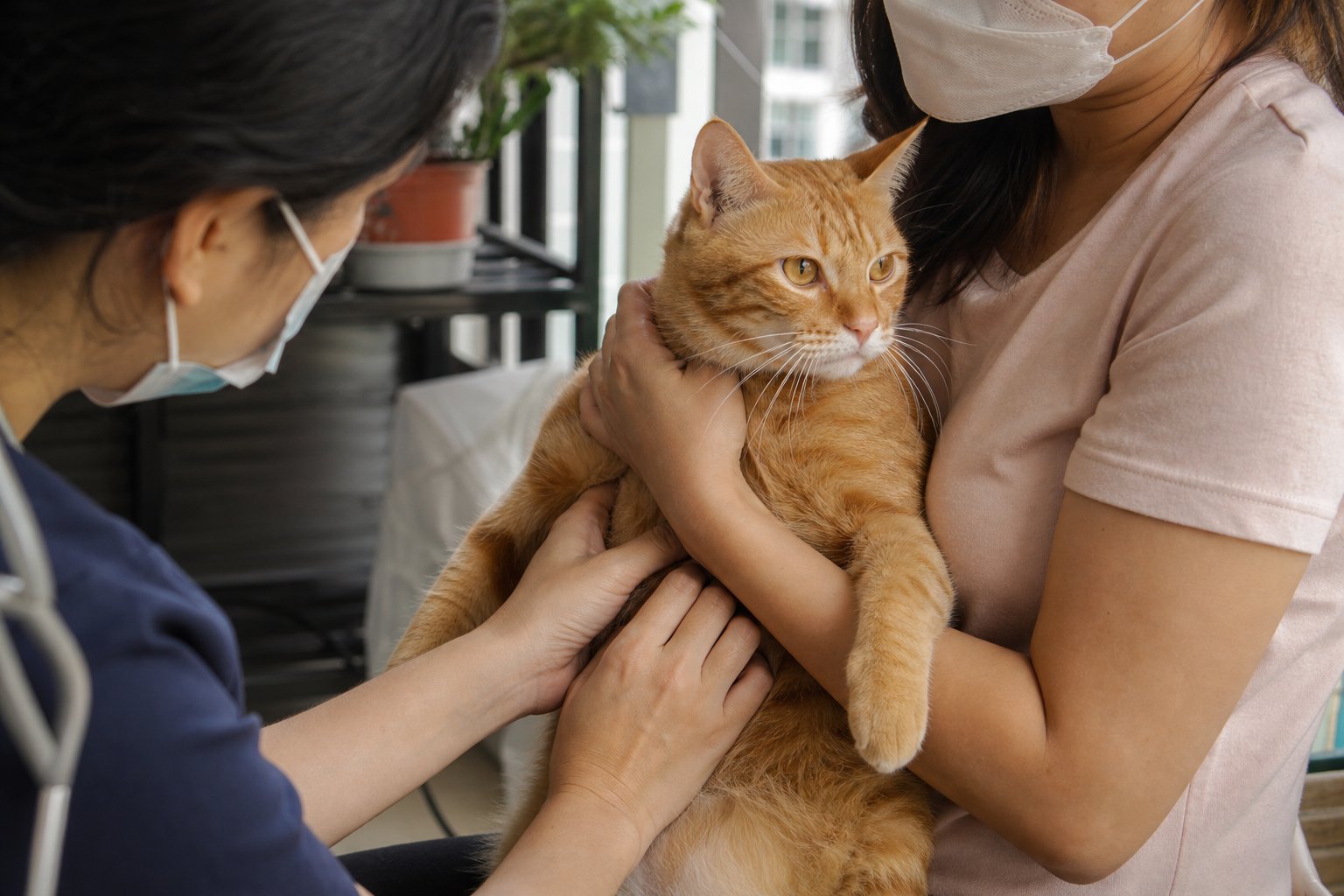
The short answer: praziquantel and fenbendazole are long-established deworming ingredients with decades of safety data, and both work mainly in the gut with limited uptake into the body. The tablets need no fasting, are scored for weight-based splitting, and the label allows use in puppies from around two weeks old. The catch: safety depends on following the label dose and course. Doubling the dose or stretching the course is a completely different risk.
What is actually in the tablet
According to the manufacturer's product information, each tablet contains praziquantel 50 mg and fenbendazole 500 mg. They are not duplicates — they handle two separate families of intestinal parasites, and that division is why a single tablet covers such a wide spread.
| Ingredient | Drug class | How it works | Main targets | Safety-related trait |
|---|---|---|---|---|
| praziquantel | Isoquinoline derivative | Damages the parasite's outer surface, causing contraction and paralysis so it is passed out | Tapeworms, including flea tapeworm and hydatid-type tapeworms | Absorbed quickly, yet research indicates it is pumped back into the gut lumen by the intestinal lining |
| fenbendazole | Benzimidazole | Binds the parasite's beta-tubulin, blocking microtubule formation so the worm cannot absorb glucose | Roundworms, hookworms, whipworms; also used against Giardia and lungworm in cats | Selective for parasite tubulin; limited oral uptake, so most of the dose stays in the gut |
Product information generally lists coverage of 14 to 18 intestinal parasites from one tablet, plus treatment uses for lungworm in cats and Giardia in dogs. Other ingredient combinations exist — praziquantel with pyrantel and febantel, for example — and they cover different species with different safety considerations. Doses are never interchangeable between products, so always read the box in your own hand.
The safety advantages, taken one at a time
1. The ingredients are old enough to be well understood. Fenbendazole was approved for dogs in the United States back in 1983, and praziquantel has been used in veterinary medicine for more than four decades. When an ingredient has been around that long, the known adverse effects, interactions and cautions for special groups are documented rather than guessed, which gives a veterinarian a solid basis for assessment.
2. Action stays mostly in the gut. Fenbendazole has limited oral absorption and most of it remains in the intestine; praziquantel is absorbed faster, but studies suggest it is returned to the gut lumen. Ideally a dewormer kills worms where they live and travels very little through the body — that is a large part of the wide safety margin.
3. It is not on the MDR1 problem list. Some herding breeds, long-haired whippets and crossbred dogs carry the MDR1 (ABCB1) gene mutation, making them unusually sensitive to ivermectin and moxidectin. Checking Washington State University's MDR1 problem drug list, neither ingredient appears on it. Even so, if your dog carries an MDR1 mutation, tell the vet before any medication is given.
4. No fasting is required. The label does not call for food withholding before or after the tablet, so there is no empty-stomach reaction and no dip in blood sugar. That matters for puppies and kittens, and for animals that become stressed when a meal is missed.
5. Scored tablets reduce dosing errors. A large share of deworming problems are dose-estimation problems rather than ingredient problems: underestimate the weight and you under-dose, overestimate and you have effectively overdosed. Scored tablets can be halved or quartered, and pairing that with an accurate weigh-in brings the dose much closer to what the animal actually needs.
6. Pregnancy and lactation have a clear framework. Some labels permit use in pregnant and lactating bitches provided the stated dose is not exceeded, while comparable formulations from other ranges advise against use in the first two trimesters. Pregnancy and lactation therefore require a vet's decision on the individual case, not a default choice.
7. Nothing is left on the coat. Topical spot-ons leave liquid on the neck that needs time to dry, separation of other pets, and hand-washing if children touch the area. An oral tablet avoids all of that, though you should still wash your hands after dosing and store tablets where children and other animals cannot reach them.
| Safety advantage | Why it exists | What it means for you |
|---|---|---|
| Long-established ingredients | Decades of accumulated safety data | The vet can judge risks and interactions from evidence |
| Gut-focused action | Limited absorption, or return to the gut lumen | Whole-body exposure stays relatively small |
| Not a listed MDR1 problem drug | Different mechanism from ivermectin-type drugs | One more option to discuss for sensitive breeds |
| No fasting, scored tablets | Practical product design | Fewer missed doses and fewer splitting mistakes |
These advantages are relative. They are not a licence to dose freely — a wide margin still narrows quickly once the dose or the course is stretched.
Who it suits — and who should ask a vet first
The answer depends on age, weight, health status and living situation. The table below is general guidance and does not replace a veterinary diagnosis.
| Subject | General position | Points to watch |
|---|---|---|
| Healthy adult dogs and cats | Can follow the label | Weigh first, then split to match the reading |
| Puppies from about two weeks | Label permits use | Infection risk is high; intervals should be vet-set |
| Kittens | Must reach the minimum weight on the label | Schedules before six months are best decided by a vet |
| Pregnant or lactating females | Label allows it only at the stated dose | Other formulations differ; the vet must judge |
| Pets already on heartworm prevention | This tablet is not a heartworm preventive | The two programs run side by side, not instead of each other |
| Chronic illness, liver or kidney issues, other medication | Ask first | Interactions with existing drugs are possible |
| Under two weeks, unweaned or very underweight | Do not dose yourself | Veterinary assessment only |
Three situations are commonly overlooked:
- Young animals are not simply 'half the dose'. Immature liver and kidney handling means dosing and intervals need to be stricter, which is exactly why labels leave the schedule before six months to a veterinarian.
- Multi-pet homes must weigh each animal separately. Three cats in one household can range from 3 kg to 5.5 kg. An average split is not a dose, and one animal may end up over-served while another is under-dosed.
- Heartworm prevention cannot be dropped. This tablet covers intestinal parasites, lungworm and Giardia, but nothing against heartworm. If your pet is on a heartworm program, keep both running on their own schedules.
If your pet currently has soft stool, diarrhoea or mucus in the stool, it is usually better to sort out the gut first and then schedule deworming, so the two problems are not confused with each other.
Seven steps for the lowest-risk dose
- Weigh properly. A home pet scale is most accurate. Without one, weigh yourself holding the pet, then weigh yourself alone and subtract. Never rely on eyeballing or an old record — weight changes fast in growing animals.
- Let the label or the vet set the tablet count. Scored tablets can be halved or quartered. Use a split piece straight away rather than returning a cut half to the box, where it dries out and loses accuracy.
- Give it directly or in a small amount of wet food. No fasting is needed. Skip the folklore additions — butter or cooking oil serves no purpose and may teach the animal to reject its normal food afterwards.
- Confirm the full dose was swallowed. In multi-pet homes, feed and observe separately so animals cannot snatch each other's portion and end up with a double dose.
- Watch for 24 to 48 hours. Note any soft stool, vomiting, change in energy or appetite. A written note is far more useful to a vet than a memory.
- Record the date and the batch number. Keep it in a phone note or a household pet log so the next round is neither skipped nor accidentally repeated.
- Wash up and clean the environment. Pick up faeces daily, keep litter trays clean, and treat any flea problem at the same time — otherwise tapeworm keeps cycling back through swallowed fleas.
What it covers, what it does not, and how side effects show up
Dewormers are often treated as all-purpose parasite killers. The actual division of labour looks like this:
| Parasite type | Covered? | Notes |
|---|---|---|
| Roundworms, hookworms, whipworms | Yes | Handled mainly by fenbendazole |
| Tapeworms, including flea tapeworm | Yes | Handled by praziquantel |
| Lungworm in cats | Label lists treatment | Needs a diagnosis first; course differs from routine deworming |
| Giardia in dogs | Label lists treatment | Therapeutic use, course set by a vet |
| Heartworm | No | Requires dedicated heartworm prevention |
| Fleas, ticks, ear mites, skin mites | No | External parasites need separate products |
| Protozoa, viral or bacterial gastroenteritis | No | Each has its own treatment; a dewormer is not an anti-inflammatory |
Side effects at label doses are usually mild and short-lived:
| Situation | What you may see | What to do |
|---|---|---|
| Generally acceptable | Soft stool, brief appetite dip, one or two vomits within a day or two | Keep water available and observe; ask the vet if it persists |
| Needs veterinary assessment | Vomiting or diarrhoea beyond 24 to 48 hours, clearly flat and off food | Contact a vet the same day |
| Emergency | Repeated vomiting, pale gums, nosebleeds, bruising or pinpoint bleeding under the skin | Seek immediate care and take the packaging with you |
The sharpest warning concerns overdosing and over-long courses. The US FDA had recorded 12 reports by October 2023 of dogs developing bone-marrow suppression or pancytopenia after receiving fenbendazole for longer than the labelled course — 5 to 14 days where the label course is three consecutive days — with some cases confirmed by bone marrow biopsy. The conclusion is straightforward: the label dose and course are the safe case, and anything beyond them needs veterinary assessment and monitoring.
Always tell the vet about other dewormers, topicals or long-term medications your pet is taking at the same time.
When to see a vet
Contact a veterinarian promptly if any of the following apply:
- Vomiting or diarrhoea that continues past 24 to 48 hours, or a pet that is noticeably flat and off its food
- Repeated vomiting, pale gums, nosebleeds, or bruising and pinpoint bleeding under the skin — treat as an emergency
- An animal under two weeks old, still unweaned, or significantly underweight for its age
- Pregnancy, lactation, chronic illness, known liver or kidney problems, or regular medication already in use
- A confirmed whipworm, Giardia or lungworm infection, which needs a prescribed course rather than the routine schedule
- Any doubt about the correct tablet split, especially for animals at the small end of the weight range
Common myths, buying and storage
Four claims circulate online, and none of them hold up:
- 'Natural ingredients are automatically safe.' Dewormers are pharmaceuticals; there is no zero-risk option. Safety comes from dose, course and the individual animal's condition.
- 'Once dewormed, never again.' A tablet kills the worms present at that moment. Fleas, eggs in the environment and outdoor contact all reintroduce parasites, so cleaning has to run alongside dosing.
- 'It works as a stop-diarrhoea remedy.' It does not. Diarrhoea has many causes and parasites are only one of them; dosing blindly just muddies the picture.
- 'No visible worms means no deworming needed.' Many infections produce no visible segments at all, which is precisely why routine deworming is preventive rather than reactive.
When buying, check that the packaging is intact and that the batch number and expiry date are legible, and purchase from a reputable retailer rather than loose or unidentified tablets. Local prices vary widely — ask a Malaysian vet or pet retailer for current figures rather than relying on figures quoted elsewhere. Store tablets in a cool, dry place; in humid conditions, including a Penang rainy season, damp tablets degrade and lose reliability. Use any split portion immediately instead of saving it for next month.
Supporting the gut after a deworming round
A dewormer kills parasites — it does not nourish the digestive tract. Some pets pass soft stool for a day or two afterwards, which usually reflects a short-lived shift in gut flora rather than a problem. During that window, keep the existing diet unchanged, offer smaller and more frequent meals, and make sure fresh water is always available.
Probiotic powders and sensitive-stomach diets can play a supporting role if a vet recommends them, but they are add-ons: they neither replace the deworming tablet nor substitute for a diagnosis. The same applies to gastrointestinal supplements sold over the counter — helpful alongside a plan, useless as one. Prices differ between outlets, so check current local pricing with a Malaysian retailer before budgeting.
For a cat in a Kuala Lumpur apartment, the practical routine is simple: weigh on a home scale, dose to the label, note the date and batch, keep the litter tray spotless, and wipe shoes at the door so outdoor eggs stay outdoors. Deworming works best as one strand of routine care rather than a once-a-year fix.
*This article is for general information only and does not replace veterinary diagnosis or treatment. Always consult a qualified veterinarian before starting, changing or combining any medication for your pet.
Related reading
- Cat Stomach Upset: What Actually Belongs in Your Home Medicine Kit in Malaysia
- Cat Vomiting: When to Watch at Home and When to See a Vet
- Cat Vomiting, Seizures & Loss of Balance: Emergency Signs Every Malaysian Owner Should Know
- What Parasites Does Kangtu Dewormer Prevent in Malaysia? Coverage, Schedule and Gaps
- Cat Antibiotic Diarrhea & Constipation in Malaysia: What to Do
- Cat Antibiotic Diarrhoea or Constipation: What to Do in Malaysia
- Cat Mucus in Stool in Malaysia: When It's Normal and When to See a Vet
- Cat Mucus Stool in Malaysia: Causes, Warning Signs and Five Home Steps
- Cat Stool With Blood or Mucus: What It Means and When to See a Vet in Malaysia
- Blood or Mucus in Your Cat's Stool: What the Colour Means and When to See a Vet in Malaysia
- Cat Swallowing Noises and Vomiting in Malaysia: Causes, Home Steps and When to See a Vet