
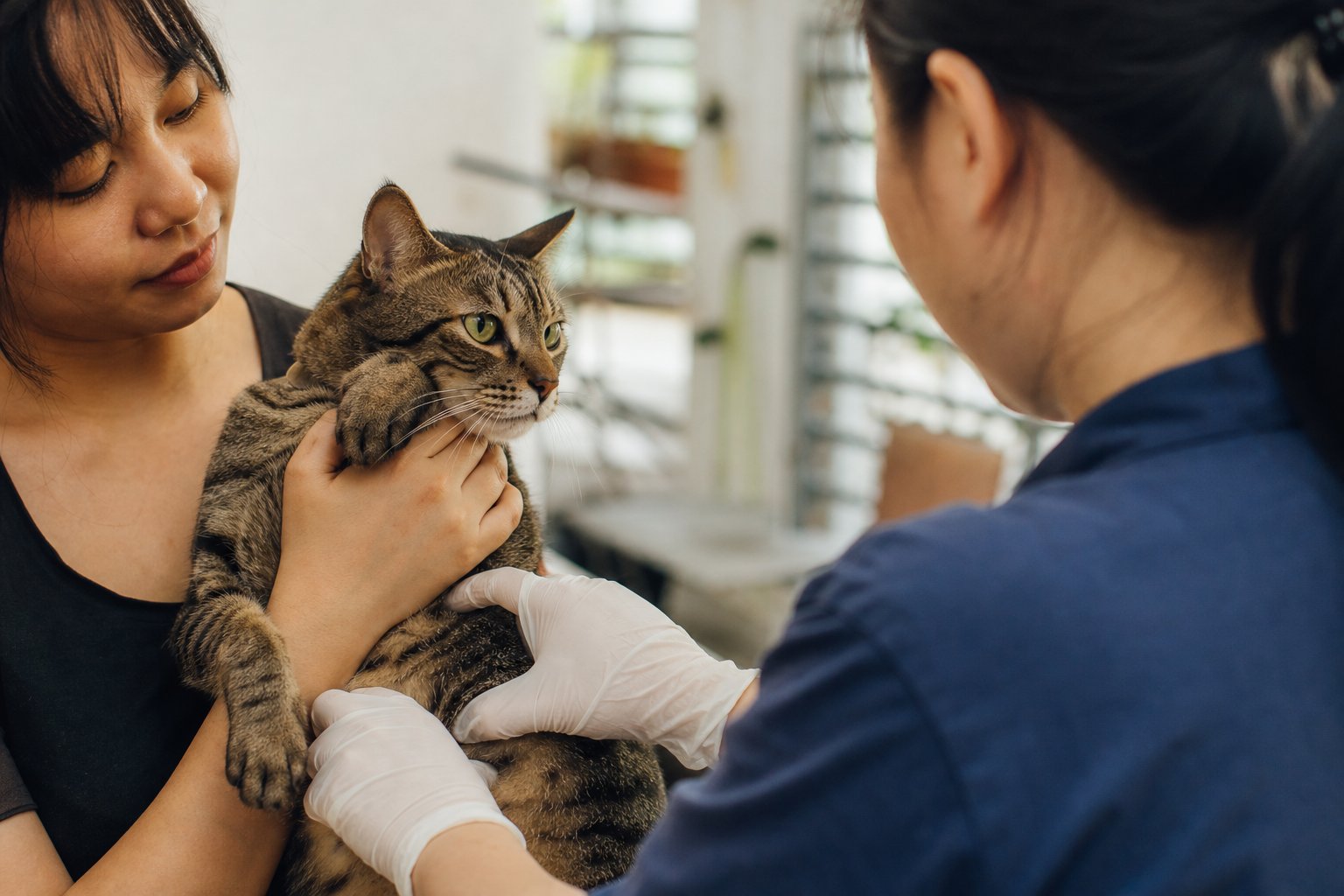
Quick answer: Most tummy upset in cats and dogs is short-lived, but jelly-like mucus, blood in vomit or stool, repeated vomiting, and any appetite or energy drop are warning signs. First steps: photograph and keep a fresh stool sample, note frequency and appearance, and never reach for human medicine. Probiotics are an aid, not a diagnosis. Give them about two hours apart from antibiotics, and confirm every change with your vet.
Why gut problems show up differently in cats and dogs
The digestive tract is one of the body systems most exposed to the outside world. Food, parasites, bacteria, medication and stress all land there directly, so it is one of the most common reasons owners end up at a clinic.
Dogs tend to present loudly: acute diarrhoea and vomiting, often after scavenging, a rushed diet change, or contact with something unhygienic on a walk. Cats tend to present quietly — soft stools, slow weight loss, and an appetite that fades so gradually that weeks pass before anyone notices.
Two factors explain the difference. First, cats are skilled at hiding discomfort and may still eat and play normally early in an illness. Second, a cat's gut often reacts more strongly to individual food ingredients and to stress, so trouble builds up in small steps instead of erupting all at once.
There is a further reason to take gut health seriously. The intestinal lining is one of the body's largest immune surfaces. Long-term irritation does not only affect digestion and nutrient absorption; it can also show up as a dull coat, low energy, and a pet that struggles to keep its weight steady.
Symptoms at a glance
The same phrase, "upset stomach", covers situations with very different urgency. Use this table to place what you are seeing, then remember it is a screening aid only — it cannot replace an examination.
| What you see | Common causes | When to act fast |
|---|---|---|
| Occasional vomit (hairballs, whole kibble) | Hairballs, eating too fast, diet change | More than twice a week, or clearly flat afterwards |
| White foam or clear stomach fluid | Long gaps between meals, stomach acid | Several days running, or drinking far more than usual |
| Yellow-green bile vomit | Biliary trouble, pancreatitis, intestinal blockage | Treat as a red flag — same-day visit |
| Vomit with blood (bright red or coffee-ground) | Stomach inflammation, ulcers, sharp foreign object | Emergency — go immediately and keep a sample |
| Watery diarrhoea but bright and playful | Diet change, food intolerance, mild gastroenteritis | No improvement within 24 hours, or energy drops |
| Well-formed stool with a mucus coating | Mild colonic irritation, parasites, stress | Persists past two or three days, or keeps returning |
| Jelly-like mucus with blood | Colitis, parasites, foreign body | Red flag — same-day visit |
| Straining with little or nothing passed | Dehydration, hairballs, low fibre, megacolon | Nothing passed for 48 hours, or vomiting while straining |
The most commonly missed row is "watery diarrhoea but bright and playful". It is tempting to relax when a pet still eats and chases a toy, but ongoing diarrhoea drains water and electrolytes quickly, and young animals have very little margin. At the other end, a single hairball vomit followed by normal play rarely needs an out-of-hours trip.
The seven-point stool score
Veterinary teams worldwide use a seven-point faecal scoring scale, from 1 (hardest) to 7 (fully liquid). You do not need to memorise it. Sorting stools into three rough groups — too hard, just right, too soft — already gives your vet the most useful objective detail you can bring.
| Score | Appearance | What it means | What to do |
|---|---|---|---|
| 1 | Dry hard pellets, no smear when picked up | Constipation | Add water and more wet food, then consult your vet |
| 2 | Firm but hard, leaves no residue | On the hard side | Increase fluids and add suitable fibre |
| 3 | Formed, soft-serve texture, slight smear | Ideal | Keep the current diet and routine |
| 4 | Soft but still holds shape | Slightly soft | Watch, and review transition speed and treats |
| 5 | Very soft, only a trace of shape | Soft stool | Review diet and parasite control; consider a probiotic |
| 6 | Watery, some residue left behind | Diarrhoea | Log it, hydrate, call your vet |
| 7 | Completely liquid, no shape at all | Severe diarrhoea | Vet soon, and watch for dehydration |
The real value of scoring is tracking a trend rather than a single moment. A cat that drifts from 3 to 4 to 5 over two weeks deserves more attention than one isolated soft stool, because a slow drift usually points to a chronic intestinal problem rather than one bad meal.
Mucus in stool: normal or warning?
Mucus is a natural protective layer secreted by the lining of the large intestine. It lubricates and shields the gut wall from irritation, so a trace of clear or pale yellow mucus on an otherwise well-formed stool is not, by itself, a disease.
Relatively normal looks like this: a thin film appearing once or twice while a food transition is under way, or a small amount at the very end of a movement, with the rest of the stool firm and the pet bright and eating normally.
Not normal looks like this: mucus thick enough to be described as jelly or snot; mucus streaked with blood or dark red; the same appearance repeating over several days; or mucus accompanied by loose stools, weight loss, a dropping appetite, or repeated straining.
Typical causes include parasites such as Giardia and coccidia, colitis, food intolerance, irritation from a swallowed foreign object, and stress-related diarrhoea. These cannot be told apart by eye — most need a stool test. The most practical routine is to photograph anything unusual, then collect a fresh sample in a clean container (ideally within two hours) and bring it along. Wash your hands afterwards.
Acute versus chronic gut trouble
Acute diarrhoea usually means symptoms lasting under one to two weeks. The usual suspects are a diet change that happened too fast, eating the wrong thing, mild gastroenteritis, or a stressful event. Many of these settle within days once diet and hydration are steady.
Chronic intestinal disease means symptoms lasting beyond three weeks or recurring in cycles. The pattern tends to include alternating loose and normal stools, gradual weight loss, a decent appetite with poor absorption, a coarser coat, and occasional vomiting. Chronic cases usually need more investigation, and some need a biopsy to separate food-responsive disease from inflammatory bowel disease or something else entirely.
The practical difference is simple: do not guess. An acute episode can be observed for a day or two. A chronic pattern should be documented properly — and good documentation starts before the appointment, not during it.
Antibiotics and probiotics: what actually helps
Antibiotics hit the harmful bacteria and the helpful ones at the same time. That imbalance is the most common reason for diarrhoea during a course, typically appearing within the first few days. It is a known side effect rather than an automatic sign to stop treatment — but equally, no one should cut a course short on their own, because stopping early can let the infection return or encourage resistance.
A four-step approach works well:
- Keep fluids up. Water and electrolytes are lost fast during diarrhoea. Offer several bowls in different rooms, consider a circulating water fountain, and raise the proportion of wet food.
- Time the probiotic. The usual guidance is to leave roughly two hours between the antibiotic and the probiotic, so the medicine does not simply wipe out what you have just given. Your vet may set a different schedule — follow theirs.
- Keep the diet boring. Stay on the food the pet already tolerates. Introducing a new diet mid-course makes it impossible to tell whether the diarrhoea comes from the drug, the food, or the illness.
- Record the changes. Note stools per day, scores, food intake and energy level each day.
Constipation during antibiotics is less often drug-driven. It usually traces back to drinking too little, eating too little so fibre drops, or moving less. Raising wet food, keeping fresh water everywhere and maintaining gentle daily play covers most of it. Nothing passed for 48 hours, straining without result, or straining plus vomiting needs a vet.
Appetite loss is the other common problem, especially in cats. The main causes are the bitter taste of a tablet (leading to drooling and refusal, and sometimes a wariness of all food), nausea or bloating from the medicine, the disrupted gut flora itself, and the underlying infection making the animal feel unwell. Warming wet food slightly, splitting the daily amount into small frequent meals, and giving a little water or a favourite bite after dosing all help. A cat that eats nothing for 24 hours risks developing fatty liver disease and should be seen promptly.
Choosing a probiotic
Probiotics are a support tool, not a medicine. They help during food transitions, antibiotic courses, mild soft stool and stress-related diarrhoea. They do not cure a parasite infection or an intestinal blockage. When comparing products, look at three things.
| Type | Strain direction to look for | Useful for | Watch out for |
|---|---|---|---|
| Feline chew or powder | Enterococcus faecium, Bifidobacterium animalis | Diet changes, antibiotics, mild soft stool | Storage temperature; space about two hours from antibiotics |
| Canine digestive chew | Lactobacillus, Bacillus species | Chronic soft stool, low appetite, sensitive gut | Dose by body weight; treats count towards daily calories |
| Prebiotic or fibre supplement | Psyllium, fructo-oligosaccharides | Large-intestinal diarrhoea, softer stools | Needs plenty of water, or it may cause more bloating |
| Prescription intestinal formula | Prebiotics plus hydrolysed or low-allergen protein | Chronic gut discomfort, food-responsive disease | Vet assessment; part of long-term diet management |
Storage is the step most owners skip. Live cultures dislike heat, damp and light, so follow the label after opening and keep the pack away from the stove and the windowsill. Effectiveness also depends on the strain, the dose and the individual animal, which is why a product that works wonders for one pet may do little for another.
As for cost, retail prices differ widely between outlets and product formats, so check with your Malaysian vet or pet retailer for current local pricing rather than relying on any figure quoted online. Whatever the price, a probiotic stays an add-on: persistent or worsening symptoms still need a diagnosis.
Beyond probiotics: fibre, water, diet transitions and stress
Fibre and water
Probiotics alone rarely fix a gut. Prebiotics — substances such as inulin-type chicory fibre and fructo-oligosaccharides — act as food for the beneficial bacteria. Fibre splits into soluble and insoluble types: soluble fibre helps adjust loose stools, while insoluble fibre supports gut motility and helps with constipation. Psyllium is a common soluble fibre, and it must be given with plenty of water or it can make things worse.
Water is the cheapest and most effective gut aid available. Cats are naturally low drinkers, so raising the share of wet food, adding water fountains, and placing extra bowls around the house reduces both constipation and urinary trouble.
The seven-day food transition
Days 1–2: about a quarter of the new food. Days 3–4: half. Days 5–6: three quarters. Day 7: fully switched. If stools soften halfway, step back to the previous ratio for a few days before moving forward. Cats usually need this slower ramp than dogs.
Three supporting habits matter as much as the transition itself. Splitting two meals into three or four smaller ones eases the load per sitting and reduces scarf-and-barf episodes. Raising the wet food proportion helps any pet that under-drinks — but transition to wet food gradually too. And count every treat towards the daily calorie total; a surprising amount of chronic "sensitive stomach" traces back to snack overload rather than the main diet.
Hydrolysed protein diets
Hydrolysed formulas work by cutting whole protein molecules into much shorter peptides, so the immune system is far less likely to recognise them and react. For confirmed food sensitivities, food-responsive disease or chronic diarrhoea, a vet may recommend a strict 8 to 12 week diet trial — during which nothing else is fed, not even table scraps or training treats.
Three points decide whether a formula suits your pet: the degree of hydrolysis (partial and extensive are not equivalent), the protein source (some use hydrolysed feather protein, others casein or soy), and whether the recipe is also low-fat and low-allergen by design. Royal Canin, Hill's, Purina Pro Plan and Farmina all publish relevant options, but prescription and non-prescription low-allergen formulas play different roles, and a long-term switch should never be made on your own initiative.
Stress-related gut problems
Emotion and digestion are directly linked. Moving house, renovation works, a new person or pet joining the household, boarding, and long car rides can all trigger diarrhoea or soft stool — sometimes called stress colitis.
Look at the timeline: symptoms usually appear within a day or two of the event, there is no fever, the pet remains reasonably bright, and things improve once the environment settles. The key response is to avoid piling on changes — for instance, do not start a new food in the middle of a move. In multi-cat households, add extra resources (bowls, litter trays, resting spots) so competition does not become chronic background stress.
Home records and when to see a vet
What a vet most wants from you is not a description like "his tummy has been off" but a short, consistent log.
| What to record | How to record it | Why it helps |
|---|---|---|
| Stools per day, with times | Quick daily note | Separates constipation, diarrhoea and frequency changes |
| Faecal score, 1–7 | One number per day | Tracks trends, far more reliable than one look |
| Vomits, with photos | Snap each episode | Shows severity and content clearly |
| Food and water intake | Measure with the same container | Catches appetite drops and increased drinking early |
| Body weight | Same time, once a week | One of the key markers of chronic intestinal disease |
A notes app or a simple spreadsheet is enough; consistency is what counts. In a Kuala Lumpur apartment where a cat is partway through a strict diet trial, this log is what proves whether the trial is actually being followed — and whether it is working. In a Penang rainy season, when humidity can spoil opened supplements faster than expected, the same notes help you notice whether a probiotic has stopped seeming to help.
See a vet immediately if
- Vomiting or diarrhoea has not improved within 24 hours
- Vomit or stool contains blood, or looks black or coffee-coloured
- The pet keeps retching with nothing coming up
- The abdomen is visibly distended or painful to touch
- The pet is flat, refuses food completely, or is drinking much more than usual
- Any gut symptom appears in a puppy, kitten, senior, or a pet with an existing chronic condition
Key takeaways
- A little mucus is normal; heavy, jelly-like, bloody or recurring mucus needs a stool test
- Score stools 1–7 and watch the trend — a slow drift matters more than one bad day
- Antibiotic diarrhoea is expected: hydrate, space probiotics about two hours apart, log everything, and never stop medication on your own
- A cat that eats nothing for 24 hours needs a vet, because of fatty liver risk
- Probiotics support; they do not diagnose. Hydrolysed diets are long-term management and need vet input
- Seven-day transitions, smaller meals and a higher wet food share prevent most avoidable flare-ups
Frequently asked questions
Is mucus in my cat's stool normal?
A thin coating of clear or pale yellow mucus on a well-formed stool is usually normal — it is the colon's own protective secretion after mild irritation. Large jelly-like amounts, blood-streaked mucus, or mucus that keeps returning over several days needs a vet check for parasites, colitis or a foreign body.
My pet has diarrhoea or constipation during antibiotics — what should I do?
Keep water available, offer small frequent meals, and space probiotics about two hours from the antibiotic, but confirm timing with your vet first. Do not stop or double any dose yourself. Blood, frequent watery stools or vomiting alongside it means contacting your vet the same day.
Why has my cat's appetite dropped while on antibiotics?
Common causes are the tablet's bitter taste causing drooling and refusal, nausea or bloating from the drug, an upset gut flora balance, and the underlying infection itself. Warm the food slightly, offer small portions, and give water after dosing. A cat that eats nothing for 24 hours needs a vet urgently.
Which brands offer hydrolysed protein diets for sensitive guts?
International brands including Royal Canin, Hill's, Purina Pro Plan and Farmina offer prescription or over-the-counter hydrolysed and low-allergen formulas. Get a vet diagnosis first, then check the protein source, degree of hydrolysis and fat level. Expect an 8 to 12 week strict diet trial before judging results.
What is the difference between soft stool and diarrhoea, and when is it urgent?
Soft stool still holds its shape and scores about 4 to 5 on the seven-point chart; diarrhoea is watery and shapeless, scoring 6 to 7. Watery diarrhoea beyond 24 hours, blood, black stool, vomiting, lethargy or refusing food needs a vet — puppies and kittens dehydrate fast.
How do I choose and store a probiotic for my pet?
Check three things: the named bacterial strain, the live count per serving, and the storage instructions. Live cultures dislike heat, damp and light, so keep the pack away from cookers and windows. Probiotics support diet changes, antibiotics and mild soft stool, but they never treat parasites, blockages or infections.
This article is for general information only and does not replace a veterinary examination. Never give human medication, change a prescribed dose, or start, stop or switch a prescription diet without your own veterinarian's advice. If your pet is unwell, contact a licensed Malaysian vet promptly.
Related reading
- Cat Antibiotic Diarrhea & Constipation in Malaysia: What to Do
- Cat Mucus in Stool in Malaysia: When It's Normal and When to See a Vet
- Cat Stomach Upset: What Actually Belongs in Your Home Medicine Kit in Malaysia
- Cat Stool With Blood or Mucus: What It Means and When to See a Vet in Malaysia
- Cat Swallowing Noises and Vomiting in Malaysia: Causes, Home Steps and When to See a Vet
- Cat Vomiting: When to Watch at Home and When to See a Vet
- Cat Vomiting, Seizures & Loss of Balance: Emergency Signs Every Malaysian Owner Should Know
- Cat Vomiting, Seizures and Loss of Balance: When to See a Vet Immediately in Malaysia