
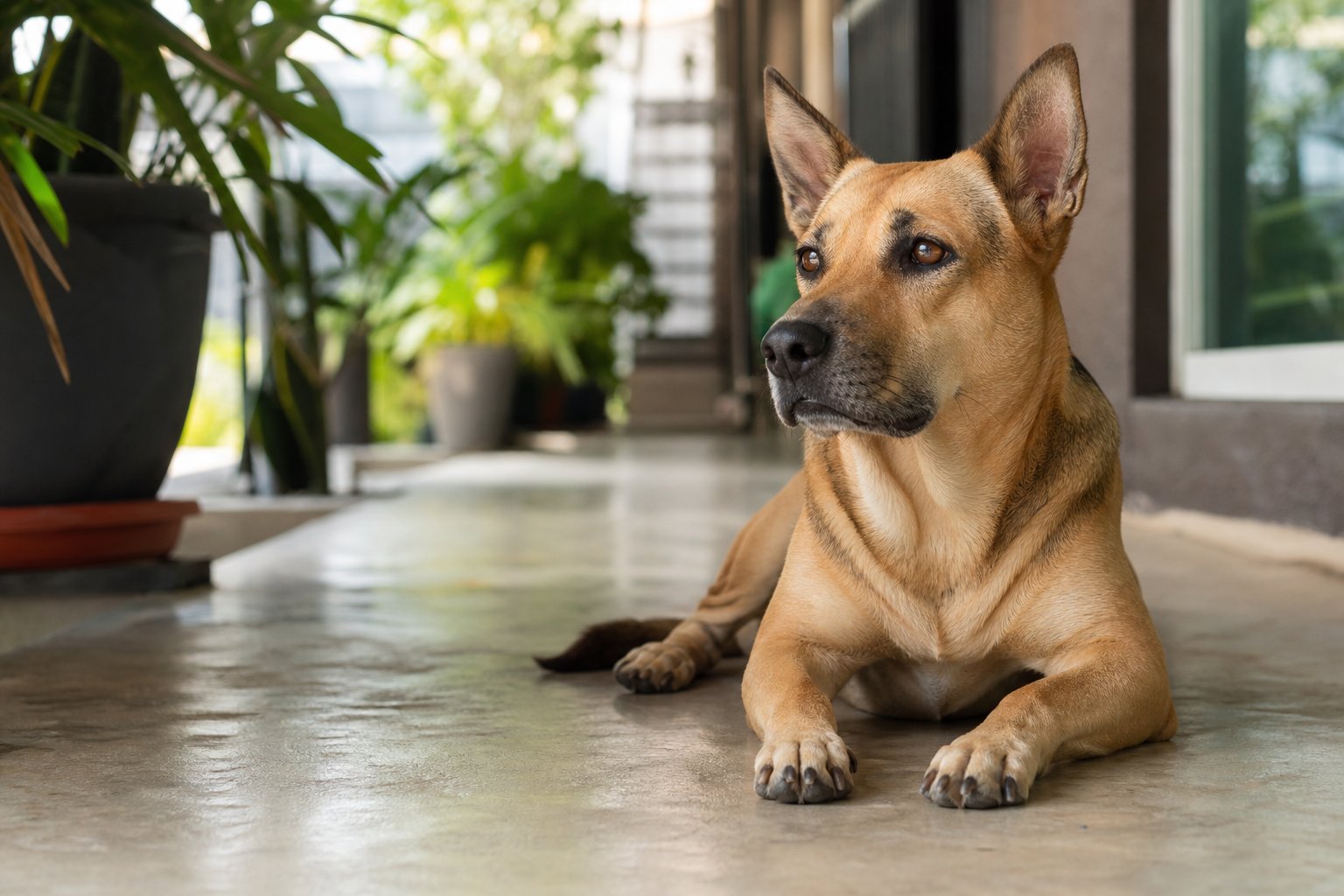
Quick answer: Start training a puppy at about 70 days old, but any age works — adult and senior dogs learn too. Keep every session to 5–10 minutes, repeated several times a day; that beats one long drill. Use positive reinforcement: reward the behaviour you want the moment it happens. Space is never the problem — a Kuala Lumpur apartment or a Penang terrace is already a training ground.
How dogs actually learn
Before you issue a single command, it helps to know what is happening in your dog's head. Training manuals describe six basic learning mechanisms, and four of them explain almost every problem a new owner faces.
Trial and error. Your dog tries something, the outcome is good, and the behaviour sticks. A useful detail: the reward does not have to arrive every time. Occasional, unpredictable rewards actually make a behaviour more durable than a perfect streak — which is why a dog that only gets a treat "sometimes" keeps trying harder.
Classical conditioning. A neutral sound keeps pairing with something meaningful until the sound alone triggers a reaction. This is why the doorbell, the lift chime or the sound of a food container can set off barking before anyone appears. Nothing moral is happening; the dog is simply making a connection.
Imprinting and early experience. Very early weeks leave a deep mark. Puppies raised around calm, varied exposure grow into dogs that read new situations easily; puppies raised in isolation or around fearful adults often struggle later. This is the strongest argument for gentle, positive early socialisation.
Latent learning. Dogs quietly absorb information about their environment — where the water bowl sits, which cupboard the treats come from, when the leash appears — even when nothing seems to be taught. Later, that quiet knowledge surfaces as "clever" or "naughty" behaviour.
Observational learning. Dogs copy other dogs. A puppy that watches an older dog wait politely at a gate often picks up the habit faster than one drilled alone.
Practical takeaway: when a dog seems to disobey on purpose, it is almost always one of the mechanisms above producing a predictable result. The way in is to change the result, not to raise your voice.
The four operations, in plain English
Every training textbook divides consequences into four quadrants. The words "positive" and "negative" here mean add and remove — not good and bad.
| Operation | What you do | Effect on behaviour |
|---|---|---|
| Positive reinforcement | Add something the dog likes — a treat, praise, a toss of the ball | Behaviour happens more often |
| Negative reinforcement | Remove something the dog dislikes | Behaviour happens more often |
| Positive punishment | Add something the dog dislikes — a loud noise, a leash jerk | Behaviour happens less often |
| Negative punishment | Remove something the dog likes — the game stops, the attention ends | Behaviour happens less often |
This guide, and the whole training approach recommended here, is built on positive reinforcement: mark and reward the behaviour you want to see. It needs no unpleasant stimuli, it builds a dog that offers behaviour willingly instead of waiting to be corrected, and the learning is more stable under distraction.
Management belongs alongside reinforcement. Before you teach anything, arrange the room so the wrong choice is unavailable: a closed door instead of a chewed sofa arm, a bin on the counter instead of a raided kitchen, a lead on before the gate opens. Prevent the mistake, then reward the alternative.
Four techniques that decide whether a session works
1. Timing — a late reward teaches the wrong thing
The single most common beginner error is reinforcement that arrives too late. Your dog sits, you fumble for the treat, and by the time you say "good boy" the dog is standing again — so what got rewarded was standing. The classic training manual Don't Shoot the Dog by Karen Pryor is blunt about this: mistimed reinforcement is the number one problem for newcomers.
Self-check: whenever training stalls, ask yourself first, "Did I reward too late?" Have a family member watch one session and time your reactions. If you cannot see the moment clearly, mark the behaviour with a consistent word or clicker and deliver the food immediately after.
2. Reward size — smaller is better
A zoo trainer once used a whole carrot to work with a panda. The animal nibbled happily and received about three reinforcements in fifteen minutes. Switched to a thin slice, the session flowed with many more repetitions and no early fullness. The same logic applies at home: a pea-sized soft treat lets you run twenty sits instead of three, and your dog stays hungry enough to keep working.
Practical rules:
- Use soft, pea-sized pieces that vanish in one swallow.
- Reserve the highest-value food (cheese, boiled chicken, commercial training treats) for hard contexts like the vet's waiting room or a busy walk.
- Keep ordinary kibble for easy reps at home.
- Vary the reward: food most of the time, but occasionally a ball, a run to the garden, or a good scratch behind the ears.
3. Shaping — work on one feature at a time
Shaping means rewarding successive steps toward a final behaviour rather than demanding perfection. Teaching "down" is a good example: first reward a slight lowering of the head and shoulders, then elbows touching the floor, then a flat belly, and only then a stay. Each step is stable before the next is added. No shouting, no pressure — just a moving target that your dog can reach.
The rule of thumb: if your dog fails three times in a row, you have moved too fast. Drop back one step and rebuild.
4. Behavioural initiative — you decide when things happen
Meals, games, walks and training sessions start on your schedule, not the moment your dog demands them. If every demand is met instantly, the dog learns that nagging works and often becomes more restless, not less. Hold the initiative firmly with a strong-willed dog; with a soft, biddable one you can relax a little. A simple version: the lead goes on before the door opens, the bowl goes down after a sit, and the game ends when you say so.
Your first week: a workable schedule
The first week's theme is settling into a new life. Do not pile on tricks. A modest, repeatable plan looks like this:
| Training task | Frequency | How to fit it into an ordinary day |
|---|---|---|
| Respond to its name | Any time — before feeding, playing or petting | Say the name once in the living room; the instant it looks, mark and treat |
| Toilet in one fixed spot | Take it to the same place after meals, naps and play | Pad or patch in one corner; walk it there on a lead so it cannot wander off |
| Comfortable in the crate or pen | Short periods daily | Door open at first; going in on its own earns a treat |
| Come when called | Every single feeding | Stand two or three metres away in the hallway and call once |
| Sit | 5–10 times a day | Before meals, before the leash goes on, before the gate opens |
| Look at me | 5–10 times a day | Practise before meeting other dogs, at the lift lobby, at the stairs |
During week one, skip the crowded weekend outing. Give the dog time to observe the new home. Visitors — especially children — should wait until the dog has settled and can approach on its own terms.
Training around Malaysian homes and weather
In a Kuala Lumpur apartment, the floor plan itself is the drill hall. Sit happens on the living room rug, recall happens down the hallway from the bedroom door, waiting happens at the lift landing before the doors open, and toilet training happens at a pad fixed in one corner of the utility area. Walls and tiles amplify sound, so keep your voice level and your rewards enthusiastic rather than loud — you have neighbours on the other side of the wall, and a barking dog learns nothing useful from an owner who is also shouting.
In a Penang rainy season, outdoor reps disappear for days at a time. Move indoors: three-minute micro-sessions in the kitchen corridor, a wait at the car porch before the lead goes on, and recall from one end of the covered porch to the other. Let the dog eliminate under cover first, then train on dry flooring — a dog that is busy avoiding wet grass cannot learn a heel. When a dry window appears, take it: five minutes of practice in good weather beats an hour of complaining indoors.
If you have a terrace or a small garden, use the gate as a permanent lesson: nobody, human or dog, passes the gate until all four feet are on the floor. Practise the same rule at the front door, the kitchen door and the fridge. One gate, one rule, learned everywhere.
Heat matters. Midday pavements are too hot for paw pads, and a dog overheating cannot focus. Train in the early morning or after sunset, keep sessions short, and always carry water. Watch for heavy panting, glazed eyes or reluctance to move — stop immediately and offer shade and water.
The mistakes beginners make
Work through this checklist after any session that feels unproductive:
- Sessions run too long. Attention is finite. Five to ten minutes, then stop while your dog still wants more — training until it checks out teaches disengagement.
- The reward came late. Ask this first whenever progress stalls.
- The treat was too big. One large biscuit ends a session after three repetitions.
- The family disagrees. One person allows jumping, another corrects it, and the dog learns that the rule depends on who is in the room. Agree on the exact word and hand signal for each behaviour, write them down, and put the list where everyone sees it.
- Steps were skipped. Add only one new requirement at a time. If a behaviour falls apart, return to the previous step and rebuild it.
- Every demand is met instantly. You hand over behavioural initiative and get a demanding, restless dog in return.
- Volume is used as a correction. Barking and pulling do not disappear because you got louder; the raised voice is often just another stimulus layered onto an already reinforced behaviour.
- Practice happens in one spot only. A dog that sits beautifully in the kitchen may have no idea what "sit" means at the gate. Practise the same cue in two or three locations, then add mild distraction.
- Correction arrives minutes after the event. Dogs link consequences to what is happening now. A scold delivered after you have walked back into the room teaches fear of your return, not cleanliness.
What you actually need
Nothing expensive. A short list covers the first month:
- Soft, strong-smelling treats in pea size, in a pouch or lidded container you keep by the door.
- A flat collar or well-fitted harness and a lead of about 1.5 metres for controlled practice.
- A crate or pen used voluntarily, never as punishment.
- A washable pee pad or a designated outdoor spot.
- A marker word such as "yes" or a clicker, used consistently by everyone.
Treat brands, toy ranges and prices vary widely between pet shops, online marketplaces and veterinary retailers across Malaysia — check current local pricing with your vet or a nearby pet supplier before you buy. Buy small to start: what your dog loves at week one may be ignored at week five, so rotate rather than bulk-buy.
When to see a vet
Training assumes a dog that is physically well. Book a veterinary visit before you try to fix behaviour if your dog shows any of the following:
- Sudden aggression, snapping or biting where there was none before.
- A dramatic change in appetite, thirst, sleeping or toileting habits.
- Limping, yelping when touched, or reluctance to sit, lie down or climb stairs — pain commonly shows up as "disobedience".
- Excessive licking, chewing or self-harm.
- Persistent anxiety, destructive panic when left alone, or non-stop barking that disturbs the household.
- Any behaviour that escalates despite consistent, patient work.
Rule out medical causes first, then involve a certified trainer or animal behaviour professional. Aggression, self-injury and persistent anxiety are not home-training projects.
This article is general information only and is not a substitute for advice from a qualified veterinarian or a certified professional trainer who can assess your individual dog.
Related reading
- Dog Care Guide Malaysia: Feeding, Grooming, Health & Daily Routine
- Dog Barking in Malaysia: 4 Reasons Dogs Bark and How to Stop It Without Shouting
- Bichon Frise Price in Malaysia 2026: What You'll Pay, Adopt or Buy, and the Costs People Forget
- Chihuahua Disadvantages in Malaysia: The 7 Drawbacks Every Owner Should Read First
- Dog Food Malaysia: How to Pick the Right Bag for Your Dog (2026 Guide)
- Dog Heat Care in Malaysia: Preventing Heatstroke and What to Do in an Emergency
- French Bulldog Malaysia: Temperament, Training and Care for Flat-Faced Companions
- German Shepherd in Malaysia: Climate, Housing and Care Guide
- German Shepherd Malaysia: Housing, Heat, Exercise and Vet Care
- Golden Retriever Disadvantages: 8 Honest Downsides Before You Buy in Malaysia
- Golden Retriever Price in Malaysia: What You Really Pay, From Buying to Grooming