
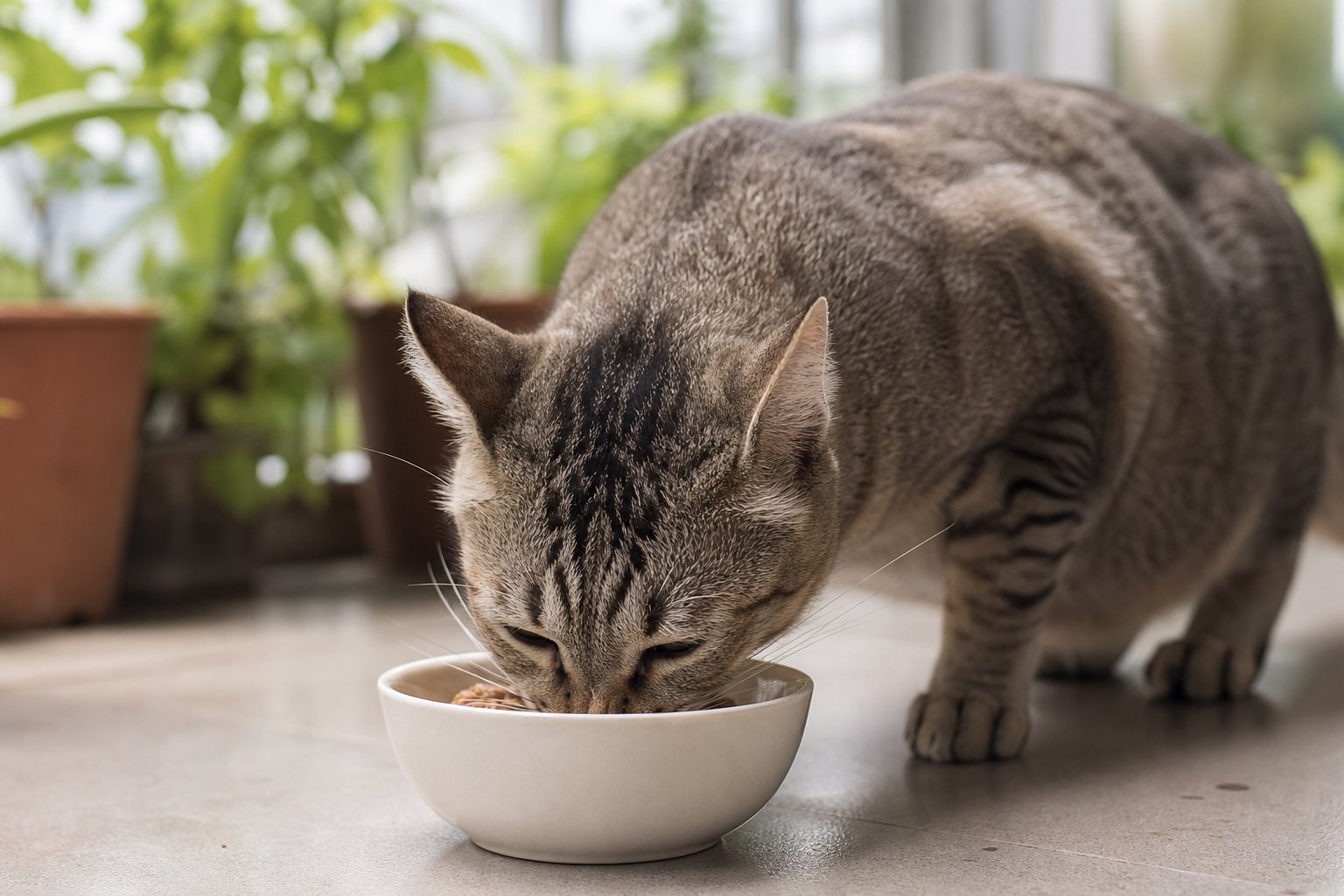
Answer first: stop asking which food is best and start reading three numbers — protein and phosphorus on a dry-matter basis, plus calories per 100 grams. Those three figures tell you whether a food suits your pet, how many grams to serve each day, and whether a diet change is safe. Brand, price and packaging slogans come afterwards.
There is no single best food for every cat and dog. The right choice depends on weight, age, activity level and medical history. What you can genuinely learn is a decision method: read the small print on the bag, calculate daily energy yourself, and understand what words like "low phosphorus" and "hydrolysed protein" actually mean. This guide walks through each step.
Read the label: three tables, three units
Most owners look only at the large print on the front. The useful information sits on the side and back, and it comes in three parts that must be read together: the guaranteed analysis, the calorie statement (kcal ME), and the ingredient list.
The guaranteed analysis lists minimum or maximum percentages for protein, fat, fibre and moisture. Those figures describe the product exactly as it leaves the factory — the "as-fed" state. That is where comparisons break down. Dry food contains roughly 10% moisture, while wet food can be 78% to 82% moisture. The same piece of meat may read 34% in a dry recipe and only 11% in a can, even though the underlying nutrition is similar.
The ingredient list is also ordered by weight, but by as-fed weight. Fresh meat is about 70% water, so a recipe opening with "fresh chicken" is not automatically the higher-protein one; chicken meal or dehydrated chicken, already dried down, may contribute more actual protein. Watch too for splitting, where one raw material appears as corn, corn meal and corn gluten in the top positions, hiding how much of the recipe it really is.
| Label wording | What it actually means | What to check |
|---|---|---|
| Guaranteed analysis | Minimum or maximum percentage, as-fed | Convert to dry matter before comparing |
| Moisture (water) | Water content of the product | Required for the dry-matter conversion |
| kcal ME/kg | Metabolic energy per kilogram | Convert to kcal per 100 g for fair comparison |
| Complete food | Meets full nutritional standards for its life stage | Suitable as the sole diet |
| Complementary food | Does not meet complete-food standards | Occasional treat only, never the main meal |
| By-products | Offal, bone and other non-muscle parts | Not automatically poor, but quality varies widely |
| Grain-free | No cereal grains used | May still be starchy; not automatically low-allergen |
Also note that "meets adult maintenance standards" and "all life stages" are different claims. Growth recipes demand higher protein, fat and calcium-to-phosphorus ratios, so maintenance food should never be fed to a growing puppy or kitten long term.
Convert to dry matter before you compare
One formula solves almost every label argument:
Dry matter percentage = as-fed percentage ÷ (100 − moisture percentage) × 100
Work it through once and it sticks. A dry food showing 34% protein at 10% moisture gives 34 ÷ 90 × 100 = 37.8%. A wet food showing 11% protein at 78% moisture gives 11 ÷ 22 × 100 = 50%. On the front of the packets the dry food looks far stronger; on a dry-matter basis the can wins comfortably. That single conversion is the most skipped and most valuable step in reading a pet food label.
The same logic applies to minerals. One dry food prints 0.8% phosphorus at 10% moisture, which converts to about 0.89%. A can printing 0.20% at 78% moisture converts to about 0.91%. Two very different-looking numbers, effectively the same phosphorus load.
Calorie statements need normalising too. You may see 3,800 kcal ME/kg or 380 kcal per cup, and one cup of dry food weighs roughly 90 to 110 grams depending on kibble size and density. Convert everything to kcal per 100 grams, because serving sizes are measured in grams. For reference, typical dry foods land between 3,300 and 4,200 kcal/kg, cans between 700 and 1,200 kcal/kg, and freeze-dried formats can exceed 4,500 kcal/kg before rehydration. Denser food means fewer grams deliver the same energy — so "how much should I scoop?" cannot be answered without the calorie density.
Work out daily calories, then convert to grams
Weight management starts with energy, and energy can be calculated rather than guessed. Veterinary practice uses resting energy requirement as the starting point:
RER (kcal/day) = 70 × body weight in kg to the power of 0.75
The 0.75 exponent reflects surface area and metabolism rather than a straight line, which is why doubling weight does not double calories. Multiply RER by a life-stage and activity factor to get maintenance energy requirement (MER).
| Weight | Cat RER (kcal/day) | Indoor neutered adult (×1.1) | Growing kitten (×2.2) |
|---|---|---|---|
| 2 kg | about 118 | about 130 | about 260 |
| 3 kg | about 160 | about 176 | about 352 |
| 4 kg | about 198 | about 218 | about 436 |
| 5 kg | about 234 | about 258 | about 515 |
| 6 kg | about 268 | about 295 | about 590 |
Useful multipliers: indoor neutered adult cats 1.0–1.2; active or unneutered adults 1.2–1.4; kittens in growth 2.0–2.5; cats losing weight about 0.8, calculated on ideal weight. Dogs generally run higher — neutered adults around 1.6, active dogs 1.8–2.0, and puppies or working dogs higher again. A 10 kg adult dog has an RER near 394 kcal, so roughly 630 kcal a day at ×1.6.
Now convert energy back into grams: grams per day = daily kcal ÷ (kcal per gram). For a 4 kg indoor neutered cat needing about 218 kcal, a dry food at 3,800 kcal/kg (3.8 kcal/g) gives around 57 g daily. The same cat on a can at 900 kcal/kg (0.9 kcal/g) needs about 242 g, roughly three 80-gram tins. That gap explains why "will wet food make my cat overeat?" is the wrong question — cans weigh far more but carry far less energy per gram.
Two rules for weight loss. First, calculate from ideal body weight, not current weight: a 6 kg cat whose ideal is 5 kg should be planned around 5 kg. Second, keep the pace slow — no more than 1% to 2% of current body weight per week. Fast or unsupervised dieting in cats can trigger hepatic lipidosis, a potentially fatal fat accumulation in the liver, so any weight-loss programme belongs under veterinary supervision.
In a Kuala Lumpur apartment where a cat gets little exercise and free-feeds on dry kibble, the common error is serving a "normal" scoop without checking kcal density. Two bags with the same scoop size can differ by 20% or more in energy. Weigh the food on a kitchen scale for one week and the picture changes immediately.
Weigh and score your pet properly
Body weight is the easiest and most honest health indicator available at home. A single number means little; the trend line means everything. Consistency matters more than the price of the scale: same device, same time of day — ideally morning before feeding — same conditions.
| Weighing method | Accuracy | Cost | Best used for |
|---|---|---|---|
| Baby scale or dedicated pet scale | High, about 10–20 g margin | Moderate | Cats and small dogs, first choice |
| Bathroom scale, weigh yourself with and without the pet | Medium, error can exceed 100 g | Low | Households without a pet scale |
| Veterinary clinic scale | High | Consultation fee | Monthly or every visit, recorded in a log |
| Tape measure around the chest | Low, trend only | Very low | Pets that refuse to stand on a scale |
Alongside the scale, learn a hands-on body condition score (BCS). On the widely used 9-point scale, 4 to 5 is ideal: you can feel the ribs but not see them, there is a visible waist when viewed from above, and a slight abdominal tuck from the side. Seven and above means overweight, 8 to 9 means obese, and 3 or below means too thin. Long-haired cats are easy to misjudge by eye, so always run your hands over the ribs and spine.
Record weight every two weeks and plot it. Unexplained loss of more than 5% within two weeks, or steady gain while the ration has not changed, both justify a veterinary check. During Penang's rainy season, indoor pets often become less active while meals stay the same; trimming the daily grams slightly, or adding indoor play, prevents a quiet slide toward overweight before you notice it.
Protein: quality matters as much as quantity
Protein is the single most important nutrient for cats, but the percentage is only half the question. The other half is quality and source.
Published minimum standards set adult cat maintenance at no less than 26% protein on a dry matter basis, and growth at no less than 30%; adult dogs at 18% and growing dogs at 22.5%. These are floors, not targets. In practice, healthy adult cat foods commonly sit at 30% to 40% dry matter, with growth and high-activity recipes higher still.
Four points worth keeping in front of mind:
- Animal-based protein comes first. Cats are obligate carnivores with absolute needs for taurine, arginine and arachidonic acid that plant proteins cannot reliably supply.
- Plant proteins can pad the figure. Pea protein and corn gluten raise the headline percentage without matching the amino acid profile of meat.
- High protein does not damage healthy kidneys. There is no established evidence that moderate higher protein harms animals with normal renal function. Animals already diagnosed with kidney disease, however, need the amount and quality of protein adjusted by disease stage on veterinary advice.
- Senior cats still need enough protein. Muscle loss is common from around seven years of age, so prematurely restricting protein can accelerate sarcopenia. Older does not automatically mean low-protein.
Phosphorus: the number kidney cats depend on
If you remember one number from this guide, make it phosphorus. For cats with chronic kidney disease, controlling phosphorus matters at least as much as controlling protein: raised blood phosphorus accelerates kidney damage and is linked with poor appetite and weight loss. International staging guidelines for chronic kidney disease use blood creatinine and phosphorus to assign stages 1 to 4, with a phosphorus intake target for each stage.
Here is the trap: "low phosphorus" is not a regulated label claim, with no universal threshold. Two bags using the same phrase can differ twofold in actual phosphorus. The only reliable approach is to read the printed phosphorus percentage and convert it to a dry-matter basis before comparing. Renal prescription diets typically land around 0.3% to 0.5% dry matter, depending on the product and the stage it is designed for.
Phosphorus source matters as much as quantity. Meat contains phosphorus naturally, while processed meat products, many treats and phosphate-based additives are absorbed particularly efficiently. Treats must therefore be counted inside the daily phosphorus budget for a kidney cat — focusing only on the main meal misses a large share of the intake.
Hydrolysed protein and elimination diets explained
"Hydrolysed protein" is another phrase widely misunderstood. The principle is straightforward: enzymatic processing cuts whole proteins into very small peptide chains, so the immune system is far less likely to recognise the original allergenic structure. In practice, manufacturers aim for molecular weights in the low kilodalton range.
Three clarifications prevent wasted money and time:
- Hydrolysis is not a guarantee of being allergen-free. If the proteins are not broken down finely enough, reactions can still occur.
- These diets target adverse food reactions — itchy skin, chronic diarrhoea, chronic gut inflammation — and they are the standard tool for a food elimination trial, which normally runs 8 to 12 weeks. No other foods or treats are allowed during the trial; a single stray snack invalidates the result.
- Novel single-protein diets are the alternative route. Venison, rabbit, crocodile and similar proteins the animal has rarely met reduce exposure to known allergens. Veterinary lines from Hill's, Royal Canin and Purina Pro Plan cover both approaches, and restricted-ingredient formulas must be used under veterinary guidance because nutritional completeness and safe duration are specific.
And a soft stool is not automatically an allergy. Many cases relate to fibre proportion, eating speed, parasites or stress, and switching to an expensive hydrolysed diet before investigating is a costly detour. Probiotic products can be useful support for digestion, but they are adjuncts, not treatment. Prices for veterinary and specialty diets vary widely by retailer, so check current local pricing with your Malaysian vet or pet retailer rather than relying on any figure quoted online.
Special-needs decisions and safe food transitions
Use this as a direction-finder before your appointment. The final column is the important one: prescription-level adjustments always follow diagnosis and review.
| Situation | Nutrition focus | Which label figure to read | Who decides |
|---|---|---|---|
| Healthy adult cat or dog | Complete food, sensible energy, adequate animal protein | Protein, fat, kcal/100 g | Owner |
| Indoor, weight-prone | Lower energy density, slightly higher fibre | kcal/100 g and the feeding guide | Owner calculates, then weighs regularly |
| Puppy or kitten | Growth formulation, DHA, calcium-to-phosphorus balance | Growth or all-life-stages claim | Owner selects, vet reviews |
| Senior cat over seven | Protect muscle mass, watch phosphorus | Protein and phosphorus (dry matter) | Vet advises after blood tests |
| Chronic kidney disease stage 2+ | Restrict phosphorus, moderate protein quality | Phosphorus 0.3–0.5% dry matter | Prescription only |
| Suspected food allergy | Hydrolysed or novel single protein | Protein source, hydrolysed claim | Vet-supervised elimination trial |
| Chronic gut inflammation | Highly digestible, limited ingredients | Ingredient list length, fat level | Prescription plus follow-up review |
| History of pancreatitis | Low fat first | Fat on a dry-matter basis | Vet assessment required |
| Heart disease | Stage-dependent, sometimes sodium restriction | Sodium, taurine | Prescription only |
| History of urinary stones | Minerals matched to stone type | Magnesium, calcium, phosphorus, urine pH target | Vet identifies stone type first |
Switching foods: never overnight. The gut microbiome needs time to adjust, and a sudden change produces vomiting or diarrhoea that leaves you unable to tell whether the new food was wrong or the switch was too fast. Standard progression over seven to ten days:
- Days 1–2: 25% new food, 75% old food
- Days 3–4: 50% new, 50% old
- Days 5–7: 75% new, 25% old
- Day 8 onward: 100% new food
If soft stool appears, step back to the previous ratio and hold it two more days. Repeated vomiting, blood in the stool, or refusing food entirely means stop the transition and contact your vet.
When to see a vet
Nutrition problems are sometimes just the surface of an illness. In these situations, stop adjusting the food yourself and seek care promptly:
- Not eating at all for more than 24 hours — especially dangerous for cats, where liver complications can develop quickly
- Repeated vomiting, or vomit containing blood
- Severe diarrhoea or blood in the stool
- Weight loss of more than 5% within two weeks with no explanation
- Sudden increase in drinking and urination
- A visibly enlarged or tender abdomen
- Persistent scratching that breaks the skin and causes hair loss
- Any plan to start, stop or alter a prescription diet or supplement
Key takeaways
- Convert every label figure to a dry-matter basis before comparing two foods, or wet food will always look weaker than it is.
- Build the daily ration from RER = 70 × kg^0.75, apply a life-stage factor, then divide by kcal/g to get grams.
- For weight loss, calculate from ideal weight and keep the rate at or below 1–2% of body weight per week.
- Weigh consistently every two weeks and pair it with a hands-on BCS; ideal is 4–5 on the 9-point scale.
- Phosphorus is the decisive number for kidney cats, and "low phosphorus" carries no regulated threshold — trust only the converted figure.
- Hydrolysed diets serve adverse food reactions over an 8–12 week trial; they are not a general cure for an upset stomach.
- Every prescription-level nutrition change requires a diagnosis and scheduled review with your vet.
Common questions
Question: Which low-phosphorus, low-protein commercial cat foods should I consider? Answer: Have your vet assess your cat first. Most options are veterinary kidney diets reaching roughly 0.3% to 0.5% phosphorus on a dry-matter basis, with protein adjusted by stage. "Low phosphorus" is not a regulated claim, so compare converted percentages rather than packet wording.
Question: Which brands offer hydrolysed protein formulas for sensitive guts? Answer: Hydrolysed diets sit in the veterinary range — Hill's, Royal Canin and Purina Pro Plan all publish lines. Novel single-protein options use venison, rabbit or crocodile. Hydrolysis produces tiny peptide chains, and an elimination trial normally runs 8 to 12 weeks before results are judged.
Question: Which weight-recording device suits my cat best? Answer: A baby scale or dedicated pet scale is most accurate, reading to about 10–20 grams. Without one, weigh yourself holding the cat on a bathroom scale and subtract, accepting larger error. Weigh at the same time every two weeks and plot the trend, not a single reading.
Question: How many calories does my cat need, and how do I turn kcal into grams? Answer: Use RER = 70 × kg^0.75, then apply a life-stage factor. A 4 kg indoor neutered cat needs roughly 200–240 kcal daily. Divide by the food's kcal density — 3,800 kcal/kg equals 3.8 kcal/g — to obtain grams per day.
Question: Must a prescription diet come from a vet? Can I feed it long term myself? Answer: Prescription diets target conditions such as kidney disease, urinary stones, allergy or gut inflammation, so their ratios differ from complete food. Long-term feeding without a diagnosis risks imbalance and delayed treatment, so start after veterinary diagnosis and review at each follow-up.
Question: How fast should I switch my pet to a new food? Answer: Over seven to ten days: 25% new food for days 1–2, 50% for days 3–4, 75% for days 5–7, then 100%. Hold the previous ratio if soft stool appears. Repeated vomiting, blood in stool or refusing food means stop and call your vet.
This article is for general information only and does not replace veterinary diagnosis. Any decision about diet, portion size, supplements or prescription food for your pet should be made with a qualified veterinarian who knows your animal's history.
Related reading
- How to Judge Pet Food Brands in Malaysia: A Repeatable Review Framework
- Cat & Dog Fruits and Vegetables: Part 2 Safety Guide for Malaysia
- Cat and Dog Fruit & Vegetable Feeding Safety in Malaysia: Portions, Poisoning Risks and Storage (Part 2)
- Cat & Dog Fruits and Vegetables Safety Part 5: Banana, Mango, Jasmine and Sweet-Smell Warning Signs in Malaysia
- Fruits and Vegetables for Cats and Dogs: What Is Safe, What Is Not (Malaysia, Part 5)
- Cat Vitamin B12 Supplement Forms in Malaysia: 6 Dosage Forms and How to Choose
- Human Food and Pets in Malaysia: What's Safe, What's Toxic, and What to Do After Ingestion