
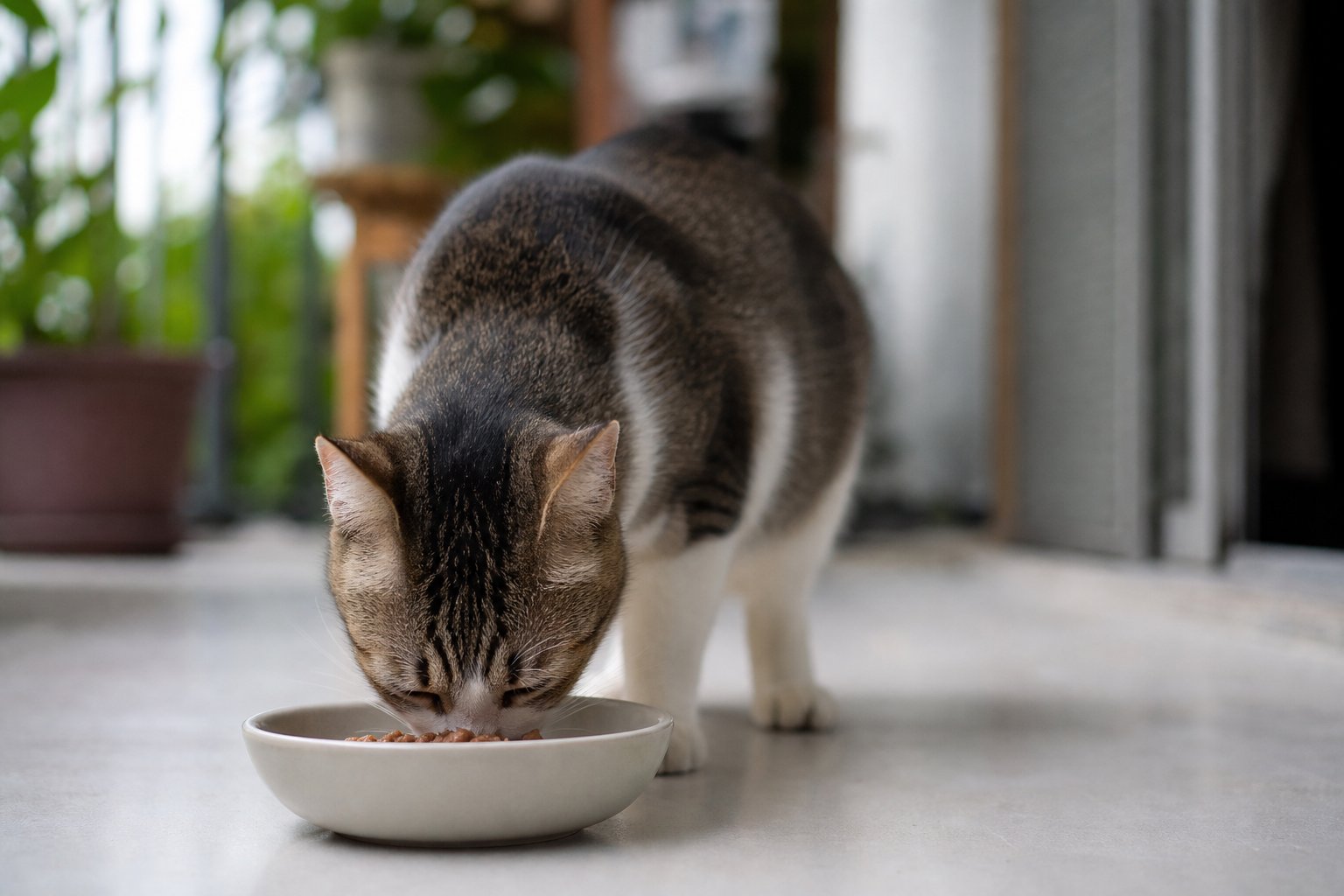
The short answer
Feeding Ciao Churu purée long term is not a problem by itself, provided it stays within 10% of your cat's daily calories and the main meal is still eaten in full. A snack stick (14 g) carries roughly 7 kcal with moisture up to 91%, so it is a low-calorie, high-moisture treat. Trouble only begins when three things coincide: five to six sticks a day, purée replacing the complete diet, and a "meow and you get it" habit. This guide walks through the label numbers, the maths, and the fixes.
Is it a snack or a complete food? Read the pack first
Before counting sticks, confirm what the product actually is. Guaranteed analysis figures on the pack are legal minimums and maximums, not laboratory averages, so treat them as a floor and a ceiling rather than a typical value. Three representative 14 g sticks show how differently the same range can be positioned:
| Product (14 g stick) | Protein (min) | Fat (min) | Fibre (max) | Ash (max) | Moisture (max) | Energy | Pack positioning |
|---|---|---|---|---|---|---|---|
| Snack version, tuna | 7.0% | 0.2% | 0.1% | 1.7% | 91.0% | about 7 kcal | Treat |
| Snack version, kitten assorted | 7.0% | 0.5% | 0.2% | 3.2% | 89.0% | about 7 kcal | Treat |
| Complete nutrition version, tuna | 7.0% | 3.8% | 0.5% | 3.0% | 85.0% | about 13 kcal | Complete food |
All three are 14 g, yet the moisture differs by six percentage points and the energy nearly doubles. The reason is straightforward: the complete nutrition version must carry a full vitamin, mineral and taurine premix, and it needs more fat to build energy density, so water has to give way.
The ingredient list tells the story even more clearly. The snack version adds only vitamin E — no full mineral and vitamin premix, and no separately declared taurine. The complete nutrition version lists calcium, copper, manganese, zinc, iodine, iron, sodium, phosphorus, chlorine and potassium, plus vitamins A, E, B1, B2, B6, K, choline, biotin and folic acid, together with taurine. That difference is the line between a treat and a meal. In a Malaysian pet store aisle, the words on the front of the pack are worth checking every single time, because both formats look almost identical at a glance.
Why dry matter comparison matters
Wet products and dry kibble cannot be compared as labelled, because water dilutes everything. Convert to a dry matter basis first:
Dry matter % = labelled % ÷ (100 − moisture %) × 100
For the snack tuna stick: protein 7.0 ÷ 9.0 × 100 = about 77.8%. Fat 0.2 ÷ 9.0 × 100 = about 2.2%.
| Product (14 g stick) | Dry matter factor | Protein (DM) | Fat (DM) | Ash (DM) | kcal per 100 g | Against AAFCO adult (26% protein / 9% fat) |
|---|---|---|---|---|---|---|
| Snack, tuna | 9.0 | about 77.8% | about 2.2% | about 18.9% | about 50 | Protein far above, fat well below |
| Snack, kitten assorted | 11.0 | about 63.6% | about 4.5% | about 29.1% | about 50 | Protein above, fat below |
| Complete nutrition, tuna | 15.0 | about 46.7% | about 25.3% | about 20.0% | about 92.9 | Both protein and fat pass |
Three practical conclusions follow.
First, the snack version's selling point is low calories and high moisture, not balanced nutrition. One stick delivers roughly 12.7 ml of water and about 0.98 g of protein, but only around 0.03 g of fat. That profile makes it a decent hydration helper and reward, yet at about 50 kcal per 100 g it is roughly half the energy density of an ordinary wet complete food — you could not fill a cat up on it even if you tried.
Second, the 2.2% dry matter fat figure is the number that matters most. Even if the real value runs one or two points above the legal minimum, you are still looking at 4–7% on a dry matter basis against a 9% adult minimum. Fat carries essential fatty acids and fat-soluble vitamins, so a chronic shortfall is not trivial.
Third, the ingredient list settles the argument. A product with only vitamin E added cannot cover a cat's daily micronutrient needs, no matter how good the protein percentage looks on paper.
The three long-term risks
These usually appear together, in this order.
1. Calorie overshoot — obesity is arithmetic. Seven kcal sounds harmless until you add it up. Four sticks a day is 28 kcal, which is 14% of a 4 kg adult's roughly 200 kcal daily need, already past the 10% line. Six sticks is 42 kcal, or 21%. Those calories do not vanish: they either displace an equal quantity of complete food or become body weight. Critically, liquid treats produce very little satiety, so a cat that eats six sticks will still eat its normal dinner. "He still had room for his food" does not prove you stayed within budget.
2. Narrow nutrition — displacement is the real danger. Every 10 percentage points that treats occupy, the complete meal loses 10. If a snack-only purée climbs to 30–40% of daily energy, then 30–40% of the cat's nutritional requirement is simply not being met by a balanced source. The common pattern is a fussy cat that will only accept purée, with the owner offering more and more to keep appetite up while the dinner portion shrinks week by week. Also worth noting: many of these products lean on tuna or bonito as the primary protein, and methylmercury in large ocean fish accumulates up the food chain. Rotating flavours and protein sources is the sensible long-term habit.
3. Behavioural conditioning — not addiction, but learning. The online talk of a "purée addiction" mislabels what is really operant conditioning. The cat learns that vocalising produces food, so the meowing becomes a tool: at midnight, before guests arrive, at dinner time. Nothing in the ingredients causes this; the feeding schedule does. Set fixed meals at fixed portions and never top up because of noise.
Two extras: purée is liquid and requires no chewing, so it contributes nothing to plaque or tartar control — a cat on mostly soft food needs a separate dental routine. And cats already diagnosed with chronic kidney disease, diabetes, heart disease or urinary conditions need the phosphorus, sodium, carbohydrate and fluid levels of any added purée reviewed by a professional first.
Working out the daily allowance
Two numbers circulate for treats:
- 10% — the figure commonly used in veterinary nutrition for treats, meaning treats supply no more than one tenth of daily energy. Conservative and suitable for most indoor adults.
- 20% — a ceiling quoted by the brand itself, and only under the condition that the main meal still delivers balanced nutrition. This is manufacturer guidance, not a clinical standard.
Neither is wrong; they are used differently. If your cat is in good body condition, active enough for an indoor life and eating complete meals, calculate at 10%. The 20% figure belongs to short-term situations — for example during illness when a highly palatable food is needed to trigger eating — and ideally with a professional involved.
| Cat weight | Daily energy estimate (50 kcal/kg) | 10% cap | Equivalent snack sticks (7 kcal) | 20% cap | Equivalent snack sticks |
|---|---|---|---|---|---|
| 3 kg | about 150 kcal | 15 kcal | about 2 | 30 kcal | about 4 |
| 4 kg | about 200 kcal | 20 kcal | about 2–3 | 40 kcal | about 5 |
| 5 kg | about 250 kcal | 25 kcal | about 3–4 | 50 kcal | about 7 |
| 6 kg | about 300 kcal | 30 kcal | about 4 | 60 kcal | about 8 |
Four steps, no special tools needed:
- Use your cat's ideal body weight, not its current weight. For an overweight cat, calculating from the current weight simply inflates the allowance.
- Ideal weight × about 50 kcal/kg × a 1.1 activity factor gives daily energy needs. Fifty kcal per kg is a common working estimate for neutered indoor adults; adjust upward for a genuinely lean or very active cat.
- Daily energy × 0.1 gives the treat allowance.
- Allowance ÷ energy per stick (about 7 kcal for snack, about 13 kcal for complete nutrition) gives sticks per day — then round down.
Worked example: a 4 kg adult needs about 200 kcal. Ten per cent is 20 kcal. Twenty divided by 7 is 2.86, so two sticks is the comfortable choice and three sits at the ceiling. One stick a day is only 3.5% of daily energy — very safe. Five sticks is 35 kcal, or 17.5%, over the line.
Budget note: prices for Ciao Churu vary widely between Malaysian online stores, pet chains and independent retailers, and pack sizes change unit cost substantially. Always divide the shelf price by the number of sticks before buying, and check current pricing with the retailer directly — never assume a bigger tin is the better deal.
If your cat will only eat the purée
This is the hardest long-term problem, and it is worth solving in order rather than in a hurry.
- Rule out a medical cause first. Sudden refusal of complete meals can signal oral pain, dental disease, kidney trouble or pancreatitis. A cat that eats nothing at all for 24 hours needs attention, not a flavour change.
- Move to scheduled feeding. Two or three fixed meals a day, each left out for 20–30 minutes, then removed. No treats in between. This step is the most uncomfortable and the most effective, typically taking one to two weeks.
- Demote purée to a topper. Instead of a standalone offering, squeeze a teaspoon over the surface of the complete meal so the aroma does the work, with the total locked inside the 10% budget.
- Step the proportion down by 5% at a time. If purée currently supplies 30% of daily energy, reduce by five percentage points every three to four days until you reach 10%. Expect the transition to take two to four weeks.
- Rotate protein and texture. Long runs of one flavour entrench fussiness. Alternate poultry, white fish and different textures — shreds, pâté, broth — to widen acceptance.
- Record weight and stick count. Weigh the cat every two weeks and note daily stick numbers. Weight gain is rarely a dinner problem; it is almost always a treat-pouch problem.
In training terms, purée is an excellent reward — the rule is simply reward the behaviour, do not reward the demand.
A Kuala Lumpur apartment routine that works well: weigh the cat on a fixed day each fortnight, keep the daily stick allowance in a small labelled container, and whatever is left in that container by evening is the hard limit. Physically running out removes the negotiation.
Buying, storing and rotating safely
Buying checklist
- Confirm the front-of-pack wording: treat versus complete nutrition food.
- Check the guaranteed analysis for a taurine declaration if you are considering it as anything more than an occasional extra.
- Divide price by stick count; compare unit prices across pack sizes.
- Buy only what your cat will finish while the product is at its best — treats are not pantry investments.
Storage, including humid weather
- Store unopened sticks in a cool, dry spot away from direct sunlight. During Penang's rainy season, high humidity makes a sealed, ventilated cupboard a better choice than an open shelf or a bathroom-adjacent cabinet.
- Once opened, do not leave purée at room temperature beyond two hours. Transfer leftovers to a lidded container, refrigerate and finish quickly.
- If a cat only eats half a stick, chill the remainder immediately; do not re-wipe or re-offer it later.
- Wipe the outer tip of the tube if it has been in contact with saliva before refrigerating, to limit bacterial carry-over.
- Discard any pack past its expiry date, or any that is swollen, sour or off-smelling. Quality cannot be assumed once the date has passed.
Life-stage adjustments
Kittens are growing, so their energy needs are high but their stomachs are small. Keep treats under 10% of calories and never let purée fill the gap where a growth-complete meal should be. Seniors have lower metabolism and activity, so even a 7 kcal stick has to be counted; if kidney disease, diabetes or heart disease has been diagnosed, the phosphorus, sodium and carbohydrate contribution must follow professional instructions rather than appetite.
A simple weekly audit
| What to check | How often | Red flag |
|---|---|---|
| Body weight | Every 2 weeks | Change of more than 5% in a month |
| Sticks per day | Daily | Consistently above the 10% cap |
| Complete meal finished | Every meal | Refusal lasting over 24 hours |
| Treat share of calories | Weekly | Above 10–20% for more than a few days |
| Dental care provided | Weekly | Soft diet with no brushing or dental support |
When to see a vet
Do not try to solve these with flavour changes or portion cuts:
- No complete food eaten for more than 24 hours, or obvious dehydration and lethargy.
- Vomiting or diarrhoea continuing past 24 hours, blood in stool, or vomiting blood.
- Repeated trips to the litter tray without passing urine — a blocked male cat is an emergency.
- Rapid weight change: more than 5% of body weight up or down within a month.
- Existing chronic kidney disease, diabetes, heart disease, pancreatitis or urinary history, when you want to change treat quantities.
- Kittens or seniors refusing food — do not paper over it with purée; get them checked.
- Any cat already on a prescription diet: ask before adding purée or other treats, because extra snacks can offset the therapeutic design of the food.
Key takeaways
- Snack and complete nutrition versions of Ciao Churu are different products; the label decides.
- Keep treats at or under 10% of daily calories and round the stick count down.
- The snack version's dry matter fat of about 2.2% is far below the 9% adult minimum — it cannot carry a diet on its own.
- Scheduled meals, purée as a topper, protein rotation and fortnightly weighing beat willpower every time.
- Local prices vary; ask your Malaysian vet or retailer for current pricing and product-specific advice.
Related reading
- Pet Nutrition Guide Malaysia: Protein, Phosphorus, Calories & Prescription Diets Explained
- Cat & Dog Fruits and Vegetables: Part 2 Safety Guide for Malaysia
- Cat and Dog Fruit and Vegetable Safety in Malaysia: Citrus Peel, Fruit Stones, Herbs and Seasonings
- Complete vs Complementary Pet Food in Malaysia: How to Read the Label Before You Buy
- Cat and Dog Fruit & Vegetable Feeding Safety in Malaysia: Portions, Poisoning Risks and Storage (Part 2)
- Cat & Dog Fruits and Vegetables Safety Part 5: Banana, Mango, Jasmine and Sweet-Smell Warning Signs in Malaysia
- Fruits and Vegetables for Cats and Dogs: What Is Safe, What Is Not (Malaysia, Part 5)
- Cat Vitamin B12 Supplement Forms in Malaysia: 6 Dosage Forms and How to Choose
- Dog Feeding Amounts in Malaysia: Daily Calorie Formula and Portion Guide
- Dog Feeding Portion in Malaysia: How Much to Feed Your Dog (Calories, Grams & Meal Chart)