
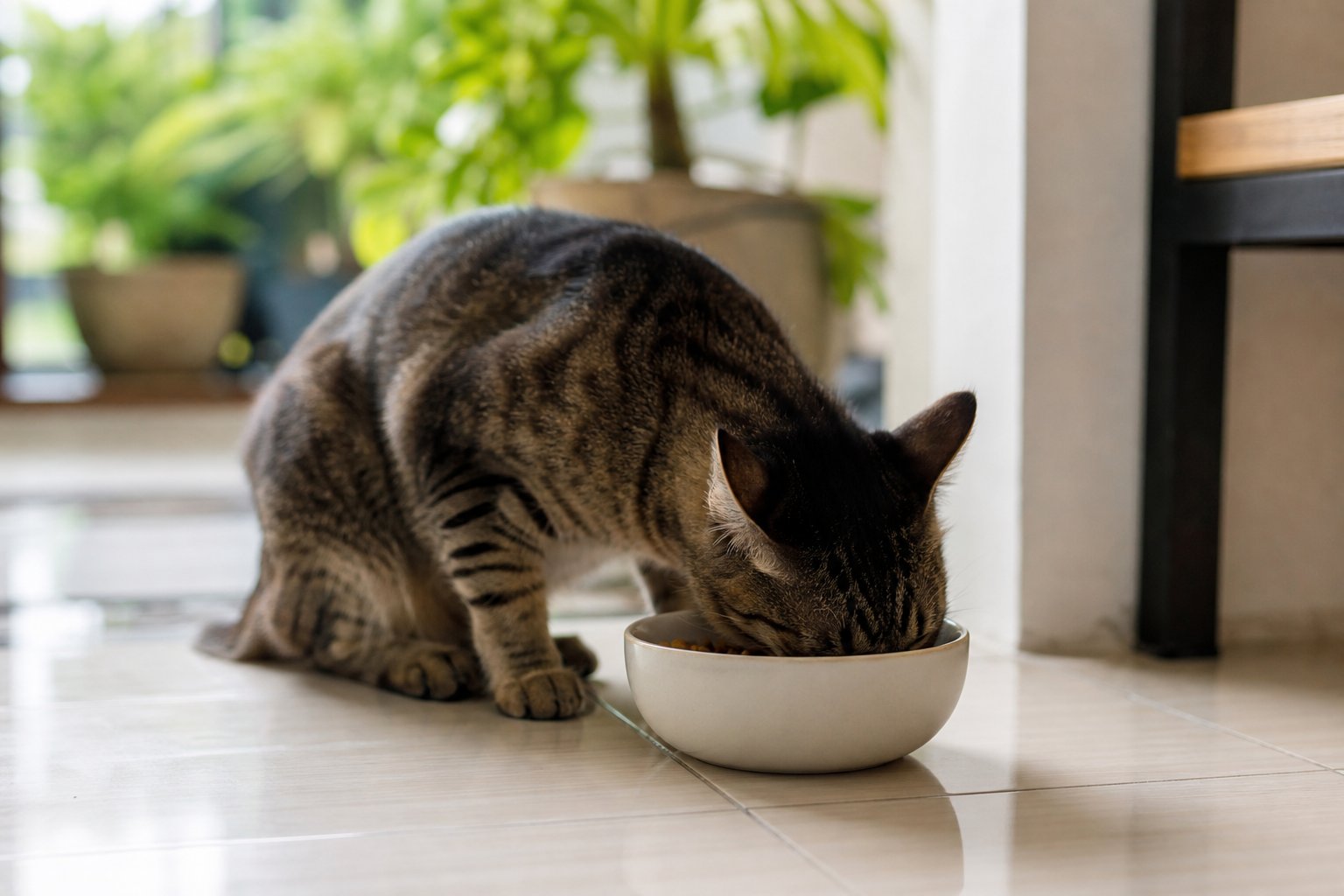
No pet food brand has a single overall rating. What matters is whether the specific product in your hand matches your animal's age, weight and health, and whether the reviews you are relying on can actually be verified. This guide gives you a repeatable framework: sort reviews into three layers, apply four authenticity checks, convert nutrition figures to a dry matter basis, calculate price per kilo, then run a seven-day trial with a written food diary.
The short answer: no brand carries one overall rating
When someone asks whether a brand is good, the honest reply is that the question is incomplete. A manufacturer may sell a kitten formula, an adult maintenance formula, a senior formula, a veterinary support diet and a line of treats under the same name. Those products have different protein levels, different energy densities and different intended uses. Rating the brand as a whole hides all of that.
Three variables decide whether a food suits your own animal: age, weight and health status. A bag that works beautifully for a healthy four-year-old indoor cat may be entirely wrong for a growing kitten with higher protein and calcium needs, or for an older cat with reduced kidney function. The same logic applies to dogs, where a small breed puppy, an active adult and a senior with joint issues need different formulations.
So this article does not rank brands and does not hand out scores. Instead it converts the vague question is this good into a series of steps you can repeat on any product, in any shop, at any time, without needing to ask a stranger for an opinion.
Sort reviews into three layers before trusting any of them
Pet food reviews are not all the same kind of statement. Once you can tell which layer a comment belongs to, you immediately know how much weight it deserves.
| Review layer | Typical example | How far to trust it | How to verify it |
|---|---|---|---|
| Official specification | Ingredient list, nutrition analysis, origin, net weight, life stage | High, because each figure is checkable, though still self-declared by the maker | Read the front and back of the pack, then compare with the brand's published data |
| Owner experience | The coat improved after two months, or the cat refused it on day three | Medium, genuine but subjective and shaped by individual variation | Look for a purchase record, sample size, feeding duration and the animal's background |
| Media or influencer round-ups | Top five lists, unboxing videos, comparison posts | Low to medium, because sponsorship or affiliate links may be involved | Check whether any commercial relationship is disclosed and whether real numbers are cited |
The first layer is the most useful because you can check each figure. The third layer is the most misleading, because it often borrows the confident tone of the first layer while delivering the content of the second. A statement such as this food lists protein at 38 percent is a specification you can confirm on the pack. A statement such as this food is excellent is a value judgement that depends on the animal eating it.
When a post claims to have tested six foods and picked a winner, ask four questions: how many animals were involved, how long was the trial, was there any comparison group, and is there a commercial relationship behind the recommendation. If those answers are missing, treat the ranking as entertainment, not evidence.
Another common mistake is assuming that majority opinion equals suitability for your animal. Palatability and digestive tolerance vary more than almost anything else. From the same bag, one cat may adjust in three days, another may need ten, and a third may refuse it completely. That does not prove a defect; it proves that individual animals differ.
Four checks that separate useful reviews from noise
You do not need to trust or distrust reviews wholesale. Apply these four filters to each one you read.
Check one: is there a purchase record or identity marker? Verified-buyer tags, order histories and accounts with a long posting record carry far more weight than an anonymous one-line complaint. An anonymous comment that only says do not buy tells you almost nothing.
Check two: how large is the sample? One or two complaints can be caused by anything, including a damaged pack, a courier delay or a stomach upset that had nothing to do with the food. Treat roughly twenty reviews as a rough working threshold; below that, do not call something a common problem.
Check three: does it state feeding duration and the animal's background? A useful review says things like fed for three months, eight-year-old cat, 4.5 kg. A review that says it was bad, with no duration, age or weight, cannot be matched against your own situation.
Check four: does it contain concrete figures? Protein 38 percent, net weight 1.5 kg, weight gain of 0.4 kg over two months are checkable claims. Poor quality is an emotion, not a measurement.
Two reverse signals are worth remembering. The same paragraph appearing word for word across several platforms usually means copied copy or a promotion. A sudden burst of reviews within a short window may indicate organised posting. Conversely, a product with mixed praise and criticism, where the reasons differ from reviewer to reviewer, looks much more like a genuine spread of experience.
The most practical cross-check of all: hold the review up against the pack. If a reviewer says the ingredients are poor, open the ingredient list and read the first three entries. If a reviewer says the cat had diarrhoea, check whether they describe how they switched food. A seven-day gradual transition and a one-day switch can produce completely different results.
What the label must tell you before you compare anything
Before you read a single comment online, read six items on the packaging: the nutrition analysis showing protein, fat and moisture percentages; the ingredient list; the complete and balanced statement; the life stage the food is intended for; the net weight; and the traceability block covering origin, manufacturer, batch code and importer.
A complete and balanced claim is the single most important line on a pack. It means the food is formulated to meet a recognised nutritional standard, most commonly AAFCO or FEDIAF, for the life stage printed on the label. Without it, treat the product as a supplement or snack rather than a daily staple. As a general reference line for cat food on a dry matter basis, adult maintenance formulations commonly target around 26 percent protein and 9 percent fat minimum, while growth and reproduction formulations target around 30 percent protein and 9 percent fat minimum.
Life stage matters as much as the claim. A food marked for kittens is energy dense for growth; a food marked for adult maintenance is not. Feeding a growth formula to a neutered indoor adult long term can lead to excess weight, while feeding an adult formula to a fast-growing puppy or kitten leaves a nutrient gap.
On origin, keep four fields separate: origin country, manufacturer, batch code and importer. A brand can be registered in one country and manufactured in another, so the two fields may legitimately differ. Barcode prefixes only identify where a GS1 company prefix was registered; they do not prove where the food was made. If a pack is missing one of these fields, rely on what is printed and ask the importer named on the pack rather than trusting an online rumour.
Two calculations that make every comparison fair
Calculation one: price per kilogram. Divide the price by the net weight in grams, then multiply by 1000. Small packs always cost more per kilo than large packs of the same formula, so without this figure you may mistake expensive packaging for a premium recipe, or mistake a big bag for good value. Prices differ between retailers and change often, so check current figures with your Malaysian retailer or vet rather than relying on a listing you saw weeks ago.
Calculation two: dry matter basis. Divide the stated percentage by 100 minus the moisture percentage, then multiply by 100. Wet food is typically 75 to 80 percent water while dry kibble is around 10 percent, so comparing the printed numbers directly is meaningless. For example, a wet food listing protein at 10 percent with moisture at 78 percent works out to 10 divided by 22, times 100, which is roughly 45.5 percent on a dry matter basis. Run the same conversion on both products before you compare them.
This is why wet and dry foods must be converted before any comparison, and why a statement such as wet food is low in protein is usually an artefact of an unconverted comparison rather than a fact about the product.
A side-by-side comparison that actually works
Lock onto the same product type first. Comparing a freeze-dried topper with a staple dry diet, or comparing food with cat litter, tells you nothing useful. Once you are comparing like with like, use these dimensions.
| Dimension | What to record | Where to find it |
|---|---|---|
| Product form | Staple wet food, dry kibble, freeze-dried, fresh food or treat | Front of pack and product name |
| Protein and fat | Stated percentages, converted to dry matter basis | Back-of-pack nutrition analysis |
| Pack size | Net weight in grams or kilograms | Net weight statement |
| Price per kilo | Price divided by net weight times 1000 | Shelf label or retailer listing |
| Life stage | Kitten, adult, senior, all life stages, or specific size | Front or back of pack |
| Complete claim | Statement of completeness for that life stage | Back-of-pack statement |
Worked example of the thinking: a 250 gram pack and a 1.5 kilogram pack of a similar formula may look close in shelf price, yet the per-kilo figures can differ by a wide margin once you divide. Record both numbers before deciding. Likewise, two foods with identical-looking protein figures can reverse positions once moisture is removed from the calculation.
Six-step buying checklist you can use in any shop
| Step | Check | What to look at | If it fails |
|---|---|---|---|
| 1 | Nutrition specification | Protein, fat and moisture percentages, plus a complete and balanced claim for the life stage | Treat it as a supplement, or ask the importer for clarification |
| 2 | Ingredient list | First three ingredients and whether animal sources are named clearly | Ask the importer what the vague term covers |
| 3 | Traceability | Origin, manufacturer, batch code and importer all present | Rely on what is printed and query the named importer |
| 4 | Size and suitability | Net weight, kibble size, life stage, feeding guide | Buy the smallest pack available for a trial |
| 5 | Value | Price per kilo, calculated yourself | Compare specifications at similar price points, not brand fame |
| 6 | Trial period | Seven-day transition plus daily records of stool and appetite | Pause for two days if stools soften, then resume slowly |
Buying the smallest available pack first is the cheapest insurance policy you can take. If the food does not suit your animal, you have wasted one small purchase instead of a month of meals. Keep the receipt and note the batch code, so that if a problem recurs you can report it precisely.
The seven-day trial and the food diary
Transition gradually: days one and two at 25 percent new food, days three and four at 50 percent, days five and six at 75 percent, and day seven at 100 percent. If stools soften at any point, hold at the current ratio for two days before moving up again. Animals with sensitive guts may need a slower schedule stretching to ten or fourteen days.
Keep a simple diary for at least the first two weeks. Record the food name and batch code, the daily gram amount, stool consistency on a simple scale, appetite, vomiting episodes if any, and body weight. Weigh your animal every two to four weeks, and more often for kittens and seniors. When you eventually consult a vet, that diary is evidence; without it you are working from impressions.
Storage deserves as much attention as selection. In a Kuala Lumpur apartment where food sits on an open kitchen shelf near a window, heat and light can degrade fats and flatten palatability within weeks of opening. Buy smaller packs, seal them properly and note the opening date. In Penang during the rainy season, high humidity shortens the life of opened kibble noticeably, so an airtight container and a smaller bag size usually work better than one large sack stored for months.
When to see a vet
See a veterinarian promptly rather than continuing to trial foods if vomiting persists beyond a day, if loose stools do not settle within two days of pausing the transition, if appetite drops noticeably, or if skin, ear or eye signs appear alongside the diet change. Chronic weight loss, increased thirst, changes in urination and persistent scratching also warrant an examination rather than another online search.
If your animal has a diagnosed condition such as kidney disease, diabetes, food allergies or pancreatitis, use only the diet your veterinarian has recommended and do not switch brands based on a review. Supplements, vitamins and probiotics should also be added only on professional advice, never as a substitute for a diagnosis. Individual animals respond differently, so what suits a friend's pet may not suit yours.
This article is general information only and does not replace veterinary diagnosis or treatment. Please consult a qualified veterinarian for advice about your own animal.
Related reading
- Pet Nutrition Guide Malaysia: Protein, Phosphorus, Calories & Prescription Diets Explained
- Pet Nutrition Hub Malaysia: Protein, Phosphorus, Calories, Weight & Prescription Diets
- Cat & Dog Fruits and Vegetables: Part 2 Safety Guide for Malaysia
- Cat and Dog Fruit & Vegetable Feeding Safety in Malaysia: Portions, Poisoning Risks and Storage (Part 2)
- Cat & Dog Fruits and Vegetables Safety Part 5: Banana, Mango, Jasmine and Sweet-Smell Warning Signs in Malaysia
- Fruits and Vegetables for Cats and Dogs: What Is Safe, What Is Not (Malaysia, Part 5)
- Cat Vitamin B12 Supplement Forms in Malaysia: 6 Dosage Forms and How to Choose
- Human Food and Pets in Malaysia: What's Safe, What's Toxic, and What to Do After Ingestion
- Pet Food Storage in Malaysia: Keep Dry Food, Cans and Fresh Meals Safe in Humid Weather