
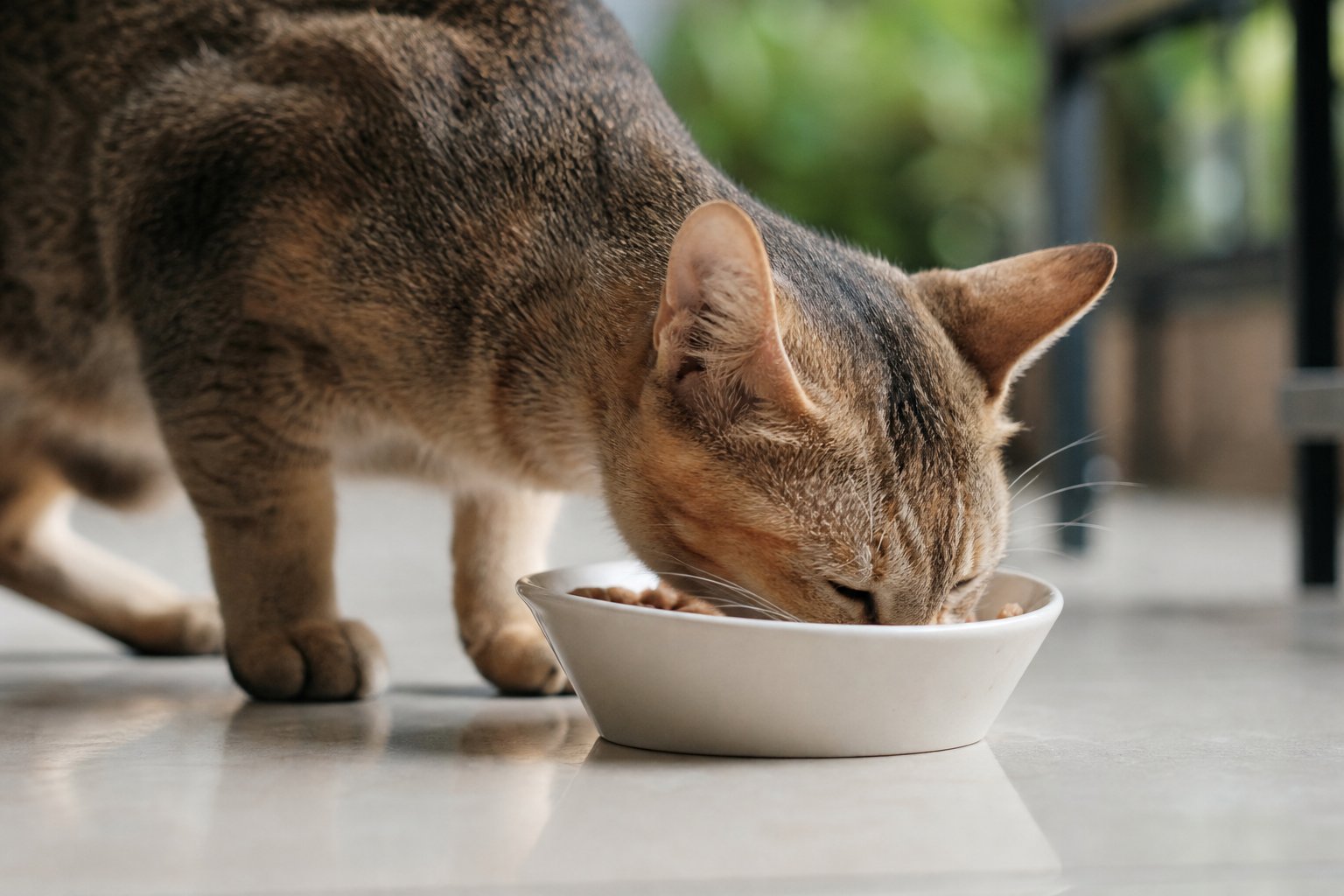
Quick answer: Turn the pack over and look for a complete and balanced statement that cites AAFCO or FEDIAF for a specific life stage. Foods with that statement can be your pet's only meal, indefinitely. Foods without it — plain meat cans, toppers, treats, most freeze-dried raw — are complementary: keep them under 10% of daily calories, never as the whole diet.
What 'complete and balanced' actually means
Two words are doing a lot of work in that phrase. Complete means every nutrient your cat or dog needs is present in the food, in the amount required. Balanced means those nutrients are present in the right relationship to each other — calcium against phosphorus, omega-6 against omega-3, protein against total energy.
A food can be complete for one life stage and not another. A maintenance formula for adult dogs is not appropriate as the only food for a puppy that is still building bone and muscle. A growth formula, conversely, delivers more energy and protein than a sedentary adult needs.
What the phrase does not mean is that the food is premium, natural, grain-free, human-grade or better than a rival. Those are marketing descriptors. Complete and balanced is a nutritional claim tied to a published standard, and it is the single most useful thing on the label.
If a bag or can does not carry that claim, you should assume the food is incomplete. That is not an accusation — complementary foods have a legitimate role. It simply means someone has to supply the missing nutrition, and that someone is you.
The three layers behind the claim
Understanding where the standard comes from makes the label far easier to read.
Layer one: NRC. The US National Research Council publishes the minimum nutrient requirements for dogs and cats — the amounts needed to sustain life and avoid deficiency diseases.
Layer two: AAFCO and FEDIAF. The Association of American Feed Control Officials and the European Pet Food Industry Federation both build their published nutrient profiles on that NRC foundation, adding details such as how the nutrients should be tested and verified in the finished product.
Layer three: the statement on the pack. The manufacturer declares which standard its formula meets, and for which life stage. That declaration is what you are checking at the shelf.
One nuance worth keeping in mind: NRC figures are minimums, not optimals. Meeting a standard is the floor, not the ceiling. A food can be perfectly adequate and still leave room for a better formulation — which is why ingredient quality, texture and your pet's individual response still matter after the checkbox is ticked.
Label wording decoder
| What the pack says | What it means | Can it be the main meal? |
|---|---|---|
| 'Complete and balanced, meets AAFCO [life stage] nutrient profiles' | Full daily nutrition for that stage | Yes |
| 'Formulated to meet FEDIAF nutrient profiles for...' | Recipe calculated to the standard | Yes, for that stage |
| 'All life stages' | Meets growth and maintenance minimums | Yes, portions adjusted by age |
| 'Complementary', 'supplement', 'topper', 'treat', 'snack' | Intentionally incomplete | No — 10% of calories maximum |
| Ingredient list only, no standard quoted | Cannot be verified | Treat as complementary |
| 'With salmon', 'added omega-3', 'balanced goodness' | Vague benefit claim | Treat as complementary unless a standard is quoted |
| Raw or biologically-appropriate formula with no statement | Not demonstrated to be complete | No — needs nutritional balancing |
A practical shopping habit: before anything else, hunt for four keywords — complete, balanced, AAFCO, FEDIAF. If you cannot find any of them within a few seconds, the food is not a staple, regardless of what the front of the pack promises about fresh meat percentages or superfoods.
The 10% rule, and the maths behind it
Complementary foods are designed to be eaten alongside a complete diet. The widely used guideline is that they should provide no more than 10% of daily calories, leaving at least 90% for the complete food.
Here is how that looks in practice. First, estimate your pet's daily energy needs:
- Resting energy requirement (RER) = 70 × body weight in kg raised to the power 0.75
- Daily energy requirement (MER) = RER × an activity factor
Typical activity factors: desexed adult cat 1.2; entire adult cat 1.4; average indoor dog 1.6; active dog 2.0; weight loss 0.8 — only under veterinary supervision.
For a 4kg desexed indoor cat: RER = 70 × 4^0.75 ≈ 198 kcal; MER = 198 × 1.2 ≈ 238 kcal per day. Ten per cent is about 24 kcal — roughly a quarter of an 85g complementary can. That quarter can is not extra. It replaces an equivalent amount of the complete food.
Grams of dry food follow from the same number: divide daily calories by the energy density printed on the pack (usually kcal/kg, so divide by 1,000 first to get kcal per gram). Wet foods are more energy-dilute, so gram portions are larger for the same calories.
These are reference figures only. Body condition, age, activity and illness all shift the answer, so treat the number as a starting point and adjust against your pet's condition over time.
Three steps to audit the food in your hand
Step 1 — Find the completeness statement. No statement, no argument: treat the product as complementary from this moment on.
Step 2 — Match the life stage. Puppies and kittens, adults, and seniors have different demands. Growing animals need roughly 2.0 to 2.5 times the resting energy requirement per day, and senior dogs often benefit from more protein than a maintenance label suggests. Choose a formula for the stage your pet is actually in, or an all-life-stage formula with portions adjusted.
Step 3 — Do the calorie split. Work out the daily total, then allocate at least 90% to complete food and at most 10% to everything else, treats included. Treats share the same 10% budget as the complementary can — they are not a separate category.
If you feed three items in a day — dry food, a wet topper and two biscuits — all three compete for that same 10%. This is where most daily calorie overruns happen, quietly, one reward at a time.
Feeding situations we see around Malaysia
| Situation | What usually happens | The risk | What to do instead |
|---|---|---|---|
| Plain meat or fish can at every meal | Pet loves it, so it becomes the staple | Short on calcium, taurine for cats, vitamins and trace minerals | Cap at 10% of calories; keep a complete food as the base |
| Kuala Lumpur apartment, 4kg cat on wet food only | Owner adds a spoon of fresh meat as a topper for palatability | Topping quietly becomes half the bowl | Measure the topper, deduct those calories from the complete portion |
| Home-cooked chicken and vegetables daily | Feels natural and fresh | Calcium-phosphorus imbalance, missing micronutrients | Get the recipe formulated and reviewed before feeding long term |
| Freeze-dried raw pieces as three meals | Convenient and less messy than raw meat | Many are formulated as toppers or treats, not complete diets | Check for a completeness statement; otherwise use as a snack |
| Johor terrace house with a growing puppy | Diet swapped between brands, home food and table scraps | Inconsistent protein and energy during a critical growth window | One complete growth formula, steady portions, minimal extras |
| Dry food plus a generous fresh topper | Owner wants to add variety | Proportion drifts until the topper is the main event | Toppers stay at or under 10% of daily calories |
Notice that none of these foods is 'bad'. Plain chicken, fresh fish and freeze-dried raw are perfectly enjoyable. The problem is proportion and duration: an occasional pleasure versus the only thing in the bowl for months on end.
Homemade and raw: where it goes wrong
Cooking for your own pet gives you full control over ingredients, and for animals with allergies or intolerances that control can be genuinely valuable. It is also expensive, time-consuming, and easy to get subtly wrong, because you are effectively guessing at a minimum nutrient requirement you cannot see.
Three principles keep homemade feeding honest:
- Equal volume does not mean equal nutrition. A bowl that looks generous can still be short of calcium, zinc, vitamin D or essential fatty acids.
- Micronutrients are the quiet failure point. Deficiencies in vitamins, minerals and fatty acids do not announce themselves. The body compensates until it cannot, and outward signs often appear only at a late stage.
- Supplements do not rescue an unplanned recipe. Nutrient premixes and powders support a formulation that has been worked out; they are not a substitute for one.
Growing puppies and kittens, pregnant and lactating females, and pets with chronic disease are the cases where a home recipe should not be attempted without a formulated, reviewed diet. For everyone else, keeping a complete commercial food as the foundation and using fresh food as a measured extra is the lower-risk approach.
Common mistakes worth checking against
| Mistake | Why it matters | The fix |
|---|---|---|
| Feeding a complementary food as the only diet | Gradual micronutrient deficiency | Switch to a complete food, or cap extras at 10% |
| Assuming 'grain-free' or 'natural' means complete | Front-of-pack claims are not nutritional standards | Look for AAFCO or FEDIAF statement |
| Treating treats as calorie-free | They share the 10% budget | Count every treat into the daily total |
| Feeding an adult formula to a puppy | Insufficient protein and energy for growth | Use a growth or all-life-stage formula |
| Homemade food with no calcium source | Skeletal and metabolic problems, especially in young animals | Formulate with a professional before starting |
| Switching brands daily for variety | Makes it impossible to spot a food intolerance | Change deliberately, one variable at a time |
When to see a vet
Nutritional deficiencies are stealthy. Dull or shedding-heavy coat, poor night vision, slow-healing wounds, repeated infections, joint or bone problems in a young animal, and sluggish growth in puppies and kittens can all have nutritional causes — but each has many other possible causes too. Do not self-diagnose from a symptom list.
Book a consultation if your pet has been eating an incomplete diet as the main food for more than a few weeks, if you are feeding a homemade recipe that has never been reviewed, or if your pet is pregnant, lactating, growing, senior or managing a chronic condition. Bring a written record of exactly what is fed, in grams, plus the product names and labels. That detail turns a vague conversation into a useful one.
Also arrange a check if your pet's weight is moving in the wrong direction despite unchanged portions, or if appetite drops sharply — both can signal that a diet is not suiting the animal.
This article is for general education only and does not replace veterinary diagnosis, treatment or individual dietary advice. Please consult your own veterinarian for guidance specific to your pet.
Frequently asked questions
Related reading
- Pet Nutrition Guide Malaysia: Protein, Phosphorus, Calories & Prescription Diets Explained
- Cat and Dog Fruit and Vegetable Safety in Malaysia: Citrus Peel, Fruit Stones, Herbs and Seasonings
- Long-Term Feeding of Ciao Churu Purée: How Many Sticks a Day Is Safe for Your Cat
- Human Food and Pets in Malaysia: What's Safe, What's Toxic, and What to Do After Ingestion
- Fruit and Vegetable Safety for Malaysian Cats and Dogs: What to Feed, What to Avoid
- Cat & Dog Fruits and Vegetables: Part 2 Safety Guide for Malaysia
- Cat and Dog Fruit & Vegetable Feeding Safety in Malaysia: Portions, Poisoning Risks and Storage (Part 2)
- Cat & Dog Fruits and Vegetables Safety Part 5: Banana, Mango, Jasmine and Sweet-Smell Warning Signs in Malaysia
- Fruits and Vegetables for Cats and Dogs: What Is Safe, What Is Not (Malaysia, Part 5)
- Cat Vitamin B12 Supplement Forms in Malaysia: 6 Dosage Forms and How to Choose