
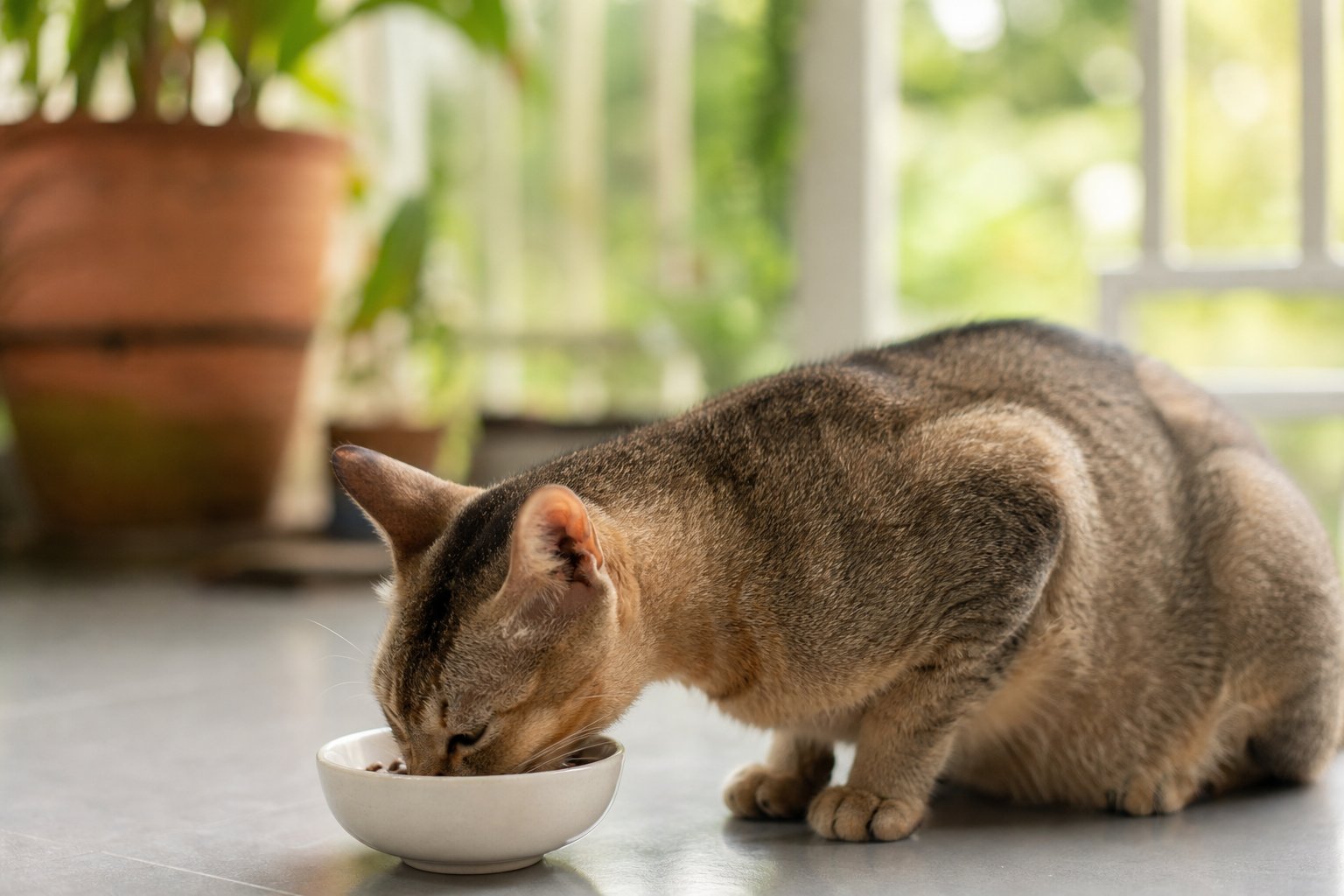
Answer first
Feed a two-month-old kitten three to five small meals a day, taper down to three meals by six months, then two meals from around ten to eleven months once you move it onto adult food. Portions follow weight: a 1 kg kitten under four months needs about 50 g of dry kitten food daily. Use the pack's feeding guide as the final word, then adjust by roughly 10% based on what your kitten actually finishes — and never leave food out all day.
Why kittens need small, frequent meals
A kitten's digestive system is still maturing. One large serving is hard to process, and it can end in vomiting, soft stools or general discomfort. That is why the working principle is little and often: split the daily allowance into four or five smaller servings rather than two heavy ones.
There is a second reason that new owners often miss. Very young kittens — especially those under three months — can drop their blood sugar if they go too long without eating. An adult cat can comfortably skip a meal; a kitten cannot. Keep the gaps between meals short, and never decide to "skip one meal to make him hungrier later".
Practical rules for this stage:
- Serve four to five portions a day for the youngest kittens.
- Keep gaps under roughly four to five hours while the kitten is very young.
- Feed at the same times daily so the routine settles fast.
- If you wake up late, feed first — do not extend the overnight gap further.
Feeding schedule by age
Use this as your default timetable, then flex it around your own household:
| Age | Meals per day | What is served |
|---|---|---|
| 4–7 weeks (weaning) | 4–5 feeds | Softened gruel or soaked kibble |
| 2 months | 3–5 feeds | Kitten kibble, possibly soaked |
| 3–5 months | 3–4 feeds | Kitten kibble, gradually reduced soaking |
| 6–9 months | 3 feeds | Morning, afternoon, evening |
| 10–11 months onward | 2 feeds | Morning and evening, adult maintenance food |
A few notes on reading the table:
- Weaning feeds are tiny. At four to seven weeks the kitten is still learning to lap and chew. Serve a thin porridge-like mixture four or five times a day.
- The drop in meals is gradual, not sudden. Move from five to four, then three, over a couple of weeks each time.
- Two meals a day is an adult rhythm. Do not push it before about ten months; a young kitten on two meals may be chronically underfed.
- Weaning itself takes time. Expect the move from gruel to solid kitten food to run across six to eight weeks of steady progress.
Daily gram portions by weight
The figures below are for dry kitten food, and are a cross-check rather than a replacement for the pack:
| Body weight | 0–4 months | 4–6 months | 7–12 months |
|---|---|---|---|
| 0.5 kg | 30 g | 25 g | — |
| 1 kg | 50 g | 40 g | 35 g |
| 1.5 kg | 70 g | 55 g | 45 g |
| 2 kg | 85 g | 70 g | 55 g |
| 3 kg | 115 g | 95 g | 75 g |
| 4 kg | 140 g | 120 g | 95 g |
Three rules for using the table:
- It assumes dry food. Wet food is mostly water, so the weight you serve will be far higher — follow the pouch or tin guide instead.
- The pack wins. Different recipes have different energy densities, so the label's grams-per-day figure is authoritative; this table simply tells you whether that figure looks sane.
- Adjust from behaviour. If your kitten licks the bowl clean and cries for more, add about a tenth at the next meal. If it walks away with food left, trim the next portion by a tenth. Within a fortnight you will land on the right amount.
Weigh your kitten weekly during the first few months and keep a simple notebook or phone note: date, weight, meals offered, meals finished. Trends beat single numbers — a kitten that is gaining steadily is being fed correctly even if the grams differ slightly from the table.
Cross-checking portions with a simple calculation
If you want to verify the numbers yourself, three formulas used in feline nutrition do the job:
- Resting energy requirement (RER, kcal) = 70 × body weight in kg, raised to the power of 0.75.
- Daily energy requirement (DER) = RER × 2.5 for kittens under four months, or RER × 2.0 for four to twelve months.
- Daily grams = DER ÷ the food's energy density in kcal per gram. Read the kcal/kg figure on the pack and divide by 1,000. Kitten dry foods typically land around 3.8–4.2 kcal/g.
Worked example one — 1 kg kitten, under four months: RER = 70 × 1 = 70 kcal. DER = 70 × 2.5 = 175 kcal. At 4.0 kcal/g, that is about 44 g a day. The table says 50 g. The roughly 10% gap is normal, because wet meals and treats contribute part of the daily energy too.
Worked example two — 3 kg kitten, four to six months: 3 kg to the power of 0.75 is about 2.28, so RER ≈ 70 × 2.28 ≈ 160 kcal. DER = 160 × 2.0 = 320 kcal. At 4.0 kcal/g, that is 80 g, against the table's 95 g — again within a sensible upper range.
These formulas are estimates for cross-checking only. They do not override the pack or your vet's advice. After each weigh-in, nudge portions to match the growth trend rather than chasing an exact figure.
Dry food, wet food and water
Malaysian pet food labels generally fall into three categories, and knowing which one you are holding prevents most feeding mistakes:
| Category | Role | Can it be the only food? |
|---|---|---|
| Complete and balanced (main meal) | Nutritionally full for daily feeding | Yes — for the first year, choose a kitten-specific version |
| Complementary (a "side dish") | Partial nutrition only | No — long-term use causes deficiencies |
| Treats | Rewards and training | No — keep under about 10% of daily calories |
Look for wording on the pack that marks the food as a complete daily ration for kittens. Anything that reads like a snack, a topper or a complementary food should never form the bulk of the diet.
A practical split: dry food as the base, because it is easy to weigh, stores well and suits automatic feeders, plus one wet meal a day for moisture. Cats are not natural big drinkers, and building the habit of taking water from food early supports good urinary health later.
Keep fresh water available at all times, in a bowl set slightly apart from the food bowl (some cats dislike water that smells of food). In warm, humid weather, a second water bowl in another room encourages more drinking. Sudden heavy drinking — a water bowl emptying fast, noticeably larger urine clumps — is worth mentioning to a vet rather than celebrating.
Dry versus wet at a glance:
- Dry: easy to portion, keeps well in a sealed container, energy-dense, convenient for timed feeders.
- Wet: high moisture content, good for hydration, highly palatable, but spoils quickly once opened.
- Mixed: the most common approach — dry as the staple, one wet meal daily as the hydration boost.
Opened wet food must be refrigerated promptly and used within about a day. Before serving, let it come to room temperature; a fridge-cold meal straight from the shelf is unappealing to many kittens.
Switching food the seven-day way
Whether you are changing from the breeder's or previous owner's food, or moving from kitten food to adult food at around ten to eleven months, the method is identical:
| Days | Old food | New food |
|---|---|---|
| Days 1–3 | 75% | 25% |
| Days 4–6 | 50% | 50% |
| Day 7 onward | 0% | 100% |
When you first take a kitten in, ask what it was eating, how much and how many meals a day. Sudden changes to an unfamiliar diet often upset the stomach. Settle the kitten for at least a week on its old food first, then start the seven-day plan. If stools turn loose, slow the transition down — extend each stage by a day or two rather than pushing through.
A routine that works for a working household
Most owners are out of the house for most of the day, but a young kitten still needs three or four feeds. A workable pattern looks like this:
- Before leaving, around 06:45: the largest meal of the day.
- Around 13:00: a small portion released by an automatic feeder set to measured servings.
- Around 19:00 on returning home: dinner.
- Around 22:30 before bed: a small top-up plus ten minutes of play.
That gives three to four feeds and fits a standard working day. Choose a feeder that can dispense small, accurate portions. If you do not have one yet, portion the midday serving into a small container in advance and ask a family member to add it, or simply shift the schedule so the kitten gets a bigger meal on days you are home earlier.
Two household details matter: feed in a quiet, fixed corner away from foot traffic, the washing machine and other pets, and remove the bowl after 20–30 minutes. A bowl left out for hours lets the food go stale from oxidation and teaches the kitten that grazing is normal.
Storing food in our humidity
Our climate is warm and humid year-round, and opened dry food degrades faster than most owners expect. Once the seal is broken:
- Clip the bag shut and keep it inside an airtight container.
- Try to finish an opened pack within about a month.
- Buy medium or small bags while your kitten is young — a large sack that sits open for months will lose flavour and your kitten may refuse it.
- Wash the container monthly; never tip old kibble on top of fresh, or the stale layer keeps circulating.
- Refrigerate opened wet food immediately and use it within about a day, warming it slightly before serving.
In damp spells — a Penang rainy season, for example — check the kibble for any musty smell or soft texture before serving, and keep the container off the floor.
When appetite suddenly drops
Appetite varies day to day, but a sharp, sustained drop deserves a systematic check. Work down this list in order:
- Teething discomfort. Between four and seven months kittens cut their adult teeth and sore gums make crunchy kibble painful. Try softened or wet food; if intake improves, teething was likely the cause.
- The food itself. How long has the pack been open? Kibble exposed to our humidity turns stale within weeks, and a kitten will reject it.
- The bowl. A bowl that is not washed regularly holds an oily film, and a bowl that is too small or too deep presses against the whiskers — an unpleasant sensation that puts some kittens off eating entirely.
- The environment. A move, a new pet, renovation noise or a change in household routine can suppress appetite for a few days.
- Illness. If everything above is ruled out, or the refusal comes with vomiting, diarrhoea, lethargy or hiding, it is time for professional help.
When to see a vet
Book a veterinary visit promptly if any of the following apply:
- Your kitten refuses food for more than 24 hours — very young kittens cannot wait longer, as hypoglycaemia can develop quickly.
- There is vomiting, diarrhoea, blood in stool, or repeated attempts to vomit with nothing coming up.
- Lethargy, wobbliness, hiding, or a kitten that seems disoriented.
- Weight is flat or dropping across two consecutive weigh-ins.
- Drinking and urinating dramatically increase.
- You are unsure about portion sizes, a food switch, or your kitten's growth — bring your weight log and the food packaging to the appointment.
Before that appointment, note the food brand and recipe, the exact daily grams offered, how many were finished, and the last time the kitten ate and passed stool. That record turns a vague "he is not eating well" into something a vet can act on.
Key takeaways
- Three to five meals at two months, tapering to two meals by around ten to eleven months.
- Portion by weight: about 50 g of dry food daily for a 1 kg kitten under four months, verified against the pack.
- Never free-feed; remove the bowl after 20–30 minutes.
- Transition any new food over seven days.
- Keep a weekly weight log and adjust portions by about 10% based on what is finished.
- Offer fresh water always, and add one wet meal a day for hydration.
- Store opened food in an airtight container and finish it within about a month.
This article is for general information only and does not replace a veterinary diagnosis or treatment. If your kitten is unwell, stop guessing and see a registered veterinarian. Feeding, vaccination and desexing schedules should be agreed with your vet.
Local references
- Department of Veterinary Services Malaysia — https://www.dvs.gov.my/
- Malaysian Veterinary Council — https://mvc.gov.my/
- SPCA Selangor — https://www.spca.org.my/
Related reading
- Kitten Weaning in Malaysia: When to Start, What to Feed and Why Cow's Milk Fails
- Best Kitten Food in Malaysia: A Practical Buying Guide (2026)
- Kitten Care Hub Malaysia: First-Year Feeding, Vaccines, Deworming and Growth Timetable
- Kitten's First Year Checklist for Malaysian Homes: Supplies, Vaccines and a Month-by-Month Plan
- Kitten Month-by-Month Guide for Malaysian Owners: Growth Milestones, Weight Checks and Care Checklist
- Kitten Month-by-Month in Malaysia: 0–12 Months, Weight Standards and Milestones
- Kitten Socialisation in Malaysia: The 3-Week to 3-Month Golden Period, Week by Week
- Kitten Weight Chart Malaysia: Week-by-Week Standards and How to Weigh at Home
- Kitten Home-Proofing in Malaysia: A Room-by-Room Safety Checklist