
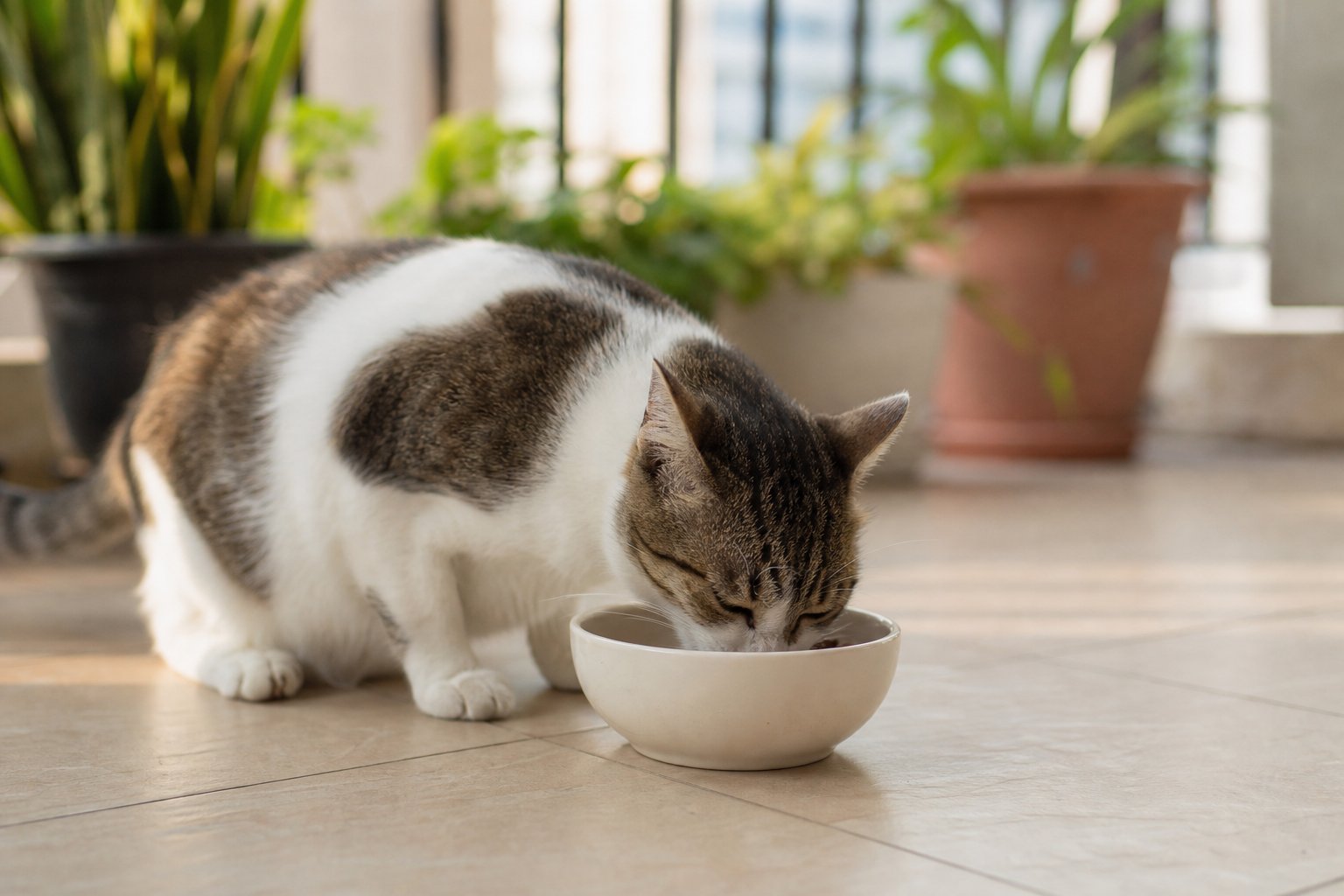
Quick answer: A 4 kg indoor cat needs roughly 198–238 kcal a day. Calculate it as RER = 70 × weight(kg)^0.75, then multiply by an activity factor (1.0–1.2 for a settled, neutered indoor cat). That converts to about 57–68 g of dry food, or 198–238 g of wet food daily. Treat these as starting points: weigh your cat every two weeks and adjust by 5–10%.
Step 1: Work out your cat's resting energy need
RER, or resting energy requirement, is what a cat burns simply staying alive — breathing, circulating blood, maintaining body temperature. It does not scale directly with body weight; it tracks metabolic body weight instead, which is weight in kilograms raised to the power of 0.75. This is the formula that has served as the standard starting point in small-animal nutrition for decades:
RER (kcal/day) = 70 × weight (kg)^0.75
| Cat weight | RER (kcal/day) |
|---|---|
| 2 kg | 118 |
| 3 kg | 160 |
| 4 kg | 198 |
| 5 kg | 234 |
| 6 kg | 268 |
A note on the exponent: cats have a much narrower natural weight range than dogs, so some nutritionists prefer an exponent between 0.4 and 0.67 for felines and argue that 0.75 slightly overshoots. At typical domestic cat weights the gap is small enough to ignore, which is exactly why 0.75 remains the most convenient everyday reference.
RER is a floor, not a feeding target. A cat that plays, patrols a staircase, or is still growing needs more. A cat being slimmed down needs less. That brings us to the multiplier.
Step 2: Multiply by an activity factor to get MER
MER, or maintenance energy requirement, is the real daily figure. Take your RER and apply the factor that honestly describes the cat in front of you:
| Situation | Factor | Example for a 4 kg cat |
|---|---|---|
| Deliberate weight loss | 0.8 | 158 kcal/day |
| Neutered, indoor, low activity | 1.0 | 198 kcal/day |
| Typical indoor adult | 1.2 | 238 kcal/day |
| Active, plays hard, roams | 1.4 | 277 kcal/day |
| Growing kitten | 2.0–2.5 | 396–495 kcal/day |
A worked example: a 4 kg neutered indoor cat at the 1.2 factor gives 198 × 1.2 = 238 kcal per day. Switch the factor to 1.0 because the cat genuinely does little beyond sleeping and watching the window, and the target drops to 198 kcal. Same cat, same weight, a 20% difference — which is why the multiplier deserves as much thought as the arithmetic.
Step 3: Cross-check the number against measured data
Formulas are tidy; animals are not. Before committing to a target, hold it against what feeding trials and maintenance studies actually report:
- Published maintenance energy for adult cats ranges from 31 to 100 kcal per kg of body weight, with most studies clustering at 37–55 kcal/kg.
- For a 4 kg cat, that is roughly 148–220 kcal/day — a range that overlaps the 198–238 kcal the formula produced. Close enough to be reassuring, wide enough to demand adjustment.
- One of the earliest recorded experiments, from 1852, found a 3 kg cat needed about 180 kcal/day to hold its weight steady.
- Young adult males and any cat under 4 kg tend to sit toward the higher end of the range.
- The effect of neutering on energy needs is genuinely unsettled. Some studies show neutered cats burn less per kilogram, but once the figure is corrected for lean tissue mass the difference disappears. Weigh the cat instead of assuming the surgery changed everything.
- The thermic effect of food — energy spent digesting — accounts for around 10% of daily expenditure, possibly a touch more in cats, whose diets are protein-rich and who naturally eat small, frequent meals.
If your cat's condition puts her outside the published window, do not panic. It means the multiplier needs tuning, not that the maths failed.
Step 4: Convert calories into grams of dry and wet food
Calories are abstract; grams go in the bowl. The two food formats differ enormously in energy density because they differ enormously in water:
| Format | Moisture | Metabolisable energy (kcal/kg) |
|---|---|---|
| Dry kibble | 6–10% | 2,800–4,050 |
| Semi-moist | 15–30% | 2,550–2,880 |
| Canned wet food | Around 75% | 875–1,250 |
Daily grams = daily kcal ÷ kcal per gram of that food.
Using a typical dry food at 3.5 kcal/g and a typical wet food at 1.0 kcal/g, with the 1.2 indoor factor:
| Cat weight | Daily kcal | Dry food | Wet food (85 g cans) |
|---|---|---|---|
| 2 kg | 141 | About 40 g | About 1.7 cans |
| 3 kg | 191 | About 55 g | About 2.2 cans |
| 4 kg | 238 | About 68 g | About 2.8 cans |
| 5 kg | 281 | About 80 g | About 3.3 cans |
| 6 kg | 322 | About 92 g | About 3.8 cans |
Check your own packaging. Most brands print metabolic energy as kcal ME/kg, sometimes as kcal per can or per cup. Energy density can differ by 20–30% between recipes, so borrowing another product's gram figure will misfeed your cat. Royal Canin, Farmina N&D and other international brands stocked locally generally carry the figure on the pack; if only a per-cup value appears, remember one cup is roughly 8 oz or 100–120 g depending on kibble size — weigh it once and note it down.
Build yourself a small reference list: record the kcal ME/kg of the two or three foods you buy regularly, and every future diet change becomes a thirty-second calculation. Food prices in Malaysia vary by brand and outlet, so confirm current pricing with your vet or a Malaysian pet retailer rather than budgeting from overseas listings.
Feeding schedules and three realistic scenarios
Dogs can often manage one meal a day. Most cats do not adapt well to a single large meal; they are built for several small ones. Just as important, leaving a bowl permanently topped up — free-choice feeding — is associated with overeating in 30–40% of dogs and cats, ending in an overweight pet.
A workable pattern is two fixed wet meals (morning and evening) plus a measured dry portion or a puzzle feeder mid-day, with the day's total split across all of it rather than each bowl being filled "until she stops".
Scenario A — a 4 kg indoor cat in a Kuala Lumpur apartment. RER 198 × 1.0 for a genuinely low-activity lifestyle = 198 kcal/day. At 3.5 kcal/g that is about 57 g of dry food: roughly 26 g at each of two meals, with 5–8 g loaded into a slow-feeder toy to buy a little activity. Weigh fortnightly on the same scale; if the weight climbs, trim 5–10%, never a third at once.
Scenario B — a 5 kg cat that needs to lose weight. RER 234 × 0.8 = 187 kcal/day. A lower-density wet food at about 1 kcal/g makes that roughly 187 g across three or four small meals. The target is losing no more than 1% of body weight per week; faster restriction in cats risks hepatic lipidosis, a serious liver condition, so discuss any diet with your vet first.
Scenario C — a three-month-old kitten weighing 1.5 kg. RER = 70 × 1.5^0.75 ≈ 95 kcal; × 2.0 for growth = about 190 kcal/day, spread over three or four meals of kitten-specific food. Kittens are a moving target: re-weigh every two weeks and recalculate rather than locking in one portion until adulthood. In a Penang rainy season, an outdoor-access cat may suddenly be indoors and far less active for weeks at a stretch — watch the trend and adjust the multiplier rather than assuming activity stays constant.
Why the formula can be wrong by half — and the mistakes that follow
Nutrition texts are remarkably blunt about this: predicted energy needs for an individual dog or cat may deviate from the true value by around 50%. The main culprits:
- Body fat proportion. Adipose tissue is metabolically quiet, so a heavier cat's true need is usually overestimated by a weight-based formula.
- Neuter status. Alters the ratio of lean tissue to fat, indirectly shifting metabolism.
- Age. Younger adults and cats under 4 kg run hotter.
- Activity and environment. Housing, temperature, play time and household traffic all move the number.
- Breed variation. Two cats of identical weight can differ substantially.
The practical conclusion: the formula is a starting point, not an answer. The real calibration loop is weigh → body condition score → adjust 5–10% → repeat.
| Common mistake | Why it hurts | What to do instead |
|---|---|---|
| Measuring in cups | Kibble density varies widely between brands | Use a digital scale and measure in grams |
| Assuming wet food is automatically low-calorie | Wet food runs near 1 kcal/g — a big bowl adds up | Calculate grams from the can's own kcal figure |
| Treating snacks as free calories | Treats can reach 20–30% of daily energy | Cap treats at about 10% of the daily total |
| Cutting food sharply for weight loss | Rapid loss can trigger hepatic lipidosis | Aim for up to 1% loss per week, vet-approved |
| Watching only the scale | Muscle and fat both register as kilograms | Score the body as well — feel the ribs, check the waist |
A two-week monitoring checklist
Run this every fortnight, at roughly the same time of day, and write the results down:
| Item | How to do it | What it tells you |
|---|---|---|
| Weight | Same scale, same spot, same time | Direction of the trend, not one reading |
| Body condition | Feel the ribs, view the waist from above and the side | Ideal sits around 3 on a 5-point scale |
| Water intake | Note the volume you add daily | A sudden rise can signal kidney trouble or diabetes |
| Stools | Observe daily | How the gut is coping after any food change |
| Mood and appetite | Log off days | Often the earliest signal that something is wrong |
If the weight drifts up, trim the daily kcal by 5–10% and re-check in two weeks. If it drifts down, add the same amount back. Small, repeated corrections beat one drastic overhaul.
When to see a vet
See a veterinarian promptly if you notice any of the following:
- Weight change — up or down — over two weeks while the diet has not changed.
- Ribs you can no longer feel, or a growing fat pad over the abdomen.
- Marked increases in drinking or appetite, which can point to kidney disease or diabetes.
- Any unplanned weight loss in a cat, because fasting and rapid loss carry a real risk of hepatic lipidosis.
- A kitten that is not gaining weight on schedule.
- A cat already diagnosed with kidney disease, diabetes or a thyroid condition — therapeutic diets must be prescribed, not calculated at home.
This article is general information only and is not a substitute for veterinary diagnosis or treatment. Energy requirements vary widely between individual cats; consult your veterinarian before changing your cat's diet, especially for kittens, overweight cats, and cats with existing health conditions.
Related reading
- Cat Food Guide Malaysia 2026: How to Choose Dry, Wet & Prescription Food
- Grain-Free Cat Food in Malaysia: What the Label Really Says (2026)
- Cat Food Recommendation Malaysia: 8 Scenarios, Label Checks and Daily-Cost Thinking
- Kitten Food Malaysia 2026: Feeding Chart, 14-Day Transition SOP and Food Format Comparison
- Phosphorus and Kidney Diets for Cats in Malaysia 2026: IRIS Targets, mg/100 kcal Conversion and Prescription Food Choices
- Wet vs Dry Cat Food in Malaysia 2026: Water Content, Drinking Habits and Daily Cost Explained
- ACANA Cat Food in Malaysia: Is This Canadian High-Protein Kibble Right for Your Cat?
- Carrageenan and Gums in Malaysian Cat Food: What the 6 Common Thickeners Actually Do
- Cat Calorie Calculator Malaysia: RER & MER Formulas, Wet/Dry Food Grams
- Cat Food in Malaysia: How to Read the Label, Compare Protein and Budget Monthly