
Quick answer: the three checks before anything else
Choosing cat food in Malaysia comes down to three checks you can do at the shelf. First, the pack must carry a "complete and balanced" nutritional statement — without it, the food is a treat or a topper, not a meal. Second, the first five ingredients should be mostly animal-based: chicken, turkey, salmon, lamb, liver. Third, the protein percentage must match your cat's life stage: around 35% or more for kittens, 30% or more for adults, 28% or more for seniors. Dry food is convenient and cheapest per kilogram; wet food is the most effective way to get water into a cat. Prices in Malaysia vary by retailer and pack size, so check current figures with your vet or pet shop before committing.
No single brand suits every cat. A food that is excellent for a healthy two-year-old may be wrong for a senior with kidney disease.
The three checks that matter most
1. The complete-and-balanced statement
Look for wording that the food supplies all nutrients a cat needs as its sole food source. Recipes intended only as treats, toppers or supplements will not carry this. If you plan to feed a food exclusively and it has no such statement, the nutrition is incomplete — no matter how premium the packaging looks.
2. First five ingredients
Ingredients are listed in descending order by weight. If the top five are named meats and meat meals, the recipe is built on animal protein. If corn, wheat, soy or vague "meat by-products" sit near the top, plant fillers and low-grade material are doing much of the heavy lifting. Cats are obligate carnivores: they need animal protein, taurine, arachidonic acid and preformed vitamin A that plants cannot supply.
3. Protein matched to life stage
An adult maintenance recipe with 30% protein will not support rapid growth in a kitten, and a calorie-dense kitten formula fed to a neutered indoor adult is a straightforward route to weight gain. Match the food to the cat, then compare prices inside that category.
A fourth check worth adding: does the pack list energy in kcal per kilogram or per can? Portion control is guesswork without it.
Reading any cat food label in 30 seconds
Turn the pack over and work through four steps.
Seconds 0–10: the statement. Confirm the food is complete and balanced for the life stage printed — growth, maintenance, or all life stages.
Seconds 10–20: the ingredients. Read the first five. Named animal proteins should dominate. Watch for carbohydrate-heavy fillers placed high up, and for artificial colours, which add nothing nutritionally.
Seconds 20–25: the guaranteed analysis. Compare protein with the targets below, check fat (a typical adult range is roughly 12–25%), and glance at magnesium and ash if your cat has a history of urinary crystals.
Seconds 25–30: energy. kcal per kilogram lets you work out grams per day properly.
One conversion worth understanding: labels on wet food show figures as-fed, which is diluted by water. A wet food listing 10% protein on an as-fed basis is roughly 40–50% on a dry matter basis. Comparing a dry figure with a wet figure without converting them is the most common mistake owners make.
Protein targets by life stage
| Life stage | Crude protein target (dry matter basis) | What else to watch |
|---|---|---|
| Kitten, under 12 months | 35% or more | Higher fat and DHA for brain and body development; small, easy-to-chew kibble |
| Adult, 1–7 years | 30% or more | Controlled calories for neutered, indoor cats; maintain body condition |
| Senior, 7–10 years | 28% or more, highly digestible | Quality of protein matters more than the headline number |
| Geriatric, over 10 years | 28% or more, with phosphorus attention | Annual blood tests; kidney or urinary disease needs a veterinary diet |
| Diagnosed kidney or urinary disease | Set by your vet | Phosphorus restricted and formula staged to the disease; never change on your own |
Two traps to avoid. First, a high protein percentage achieved partly with plant protein is not equivalent to the same percentage from meat. Second, a low number is not automatically bad: senior and therapeutic recipes are often lower because the restriction is deliberate. Read why a number is set, not just what it is.
Dry, wet, freeze-dried, air-dried and prescription: what actually differs
| Format | Water content | Strengths | Watch-outs |
|---|---|---|---|
| Dry kibble | About 8–12% | Cheapest per kilogram, easy to store, suits timed or free feeding | Low moisture; usually higher carbohydrate; needs sealed storage in humidity |
| Wet food / cans | About 75–89% | Best hydration, palatable, portioned | Costs more per feeding; opened cans must be refrigerated and used quickly |
| Freeze-dried | Very low until rehydrated | High meat content, nutrients largely intact | Most expensive; needs correct rehydration and hygienic handling |
| Air-dried | Around 12–14% | No refrigeration needed, texture close to fresh meat | Energy-dense — easy to overfeed |
| Fresh or raw-style complete packs | About 75–80% | High moisture, close to a natural diet | Must carry a complete-and-balanced statement; storage discipline needed |
| Veterinary diets | Varies | Formulated for kidney, urinary, digestive or weight conditions | Should follow a diagnosis and ongoing vet review |
The practical compromise most households land on is dry food as the calorie base plus one wet meal a day. Dry food gives you convenience and a controllable daily ration; the wet meal delivers moisture. If your cat barely drinks from a bowl, a circulating fountain is often the single change that increases water intake most.
Freeze-dried and air-dried foods sit at the premium end. They can be excellent — just weigh them on cost per 100 kcal rather than on the weight of the pack, because their low water content makes them look deceptively comparable to kibble.
What actually drives your monthly cost
Never compare sticker prices across formats. Compare cost per 100 kcal, which is the only figure that tells you what feeding that food actually costs.
| Budget approach | Feeding pattern | Trade-off |
|---|---|---|
| Tightest | Large-pack dry food as the base, one wet meal several times a week | Meets protein targets while keeping the monthly total down |
| Mid-range | Mid-tier high-protein dry food plus a complete wet meal daily | Best balance of hydration, nutrition and cost for most cats |
| Highest | Air-dried or freeze-dried base plus daily wet food | Highest meat content and moisture; the largest monthly spend |
| Veterinary diet | As prescribed | Cost is set by the condition; skimping or substituting can undo treatment |
Pack size changes unit economics more than brand does. Buying the larger bag your cat can finish while fresh almost always lowers the cost per kilogram — but a stale bag is no saving. Other regular costs that owners underestimate: litter, deworming and flea control, supplements, annual vaccinations and a monthly sinking fund for unexpected vet bills.
A useful budgeting habit: separate the one-off set-up (airtight food bin, scoop, water fountain, first stock) from the recurring monthly total (food, litter, preventive care). Mixing the two makes any feeding plan look more expensive than it is.
Feeding amounts, body condition and water
Follow the pack's feeding guide as a starting point, then adjust to the individual cat. The table on the bag describes an average cat; a neutered indoor cat with a low activity level will usually need less than the upper end of the range.
- Count calories, not cups. When you switch foods, recalculate grams per day. Reusing the old volume is a classic cause of quiet weight gain.
- Feed set meals rather than a filled bowl. Two meals a day make appetite changes obvious, and appetite is often the earliest signal that something is wrong.
- Weigh every two weeks. From above, you should see a waist; by hand, you should feel ribs without a thick fat layer. Adjust by small increments.
- Aim for moisture. Cats have a weak thirst drive. Chronic low water intake is linked to concentrated urine, urinary tract problems and added kidney workload. A daily wet meal, or more, is worth budgeting for even if everything else is dry food.
Kittens need smaller meals three to four times a day. Adults suit two scheduled meals. After neutering, energy needs fall, so review the ration within a few weeks of surgery. Seniors may eat less as they age — a persistent drop in appetite in an older cat is a reason for a check-up, not a reason to wait.
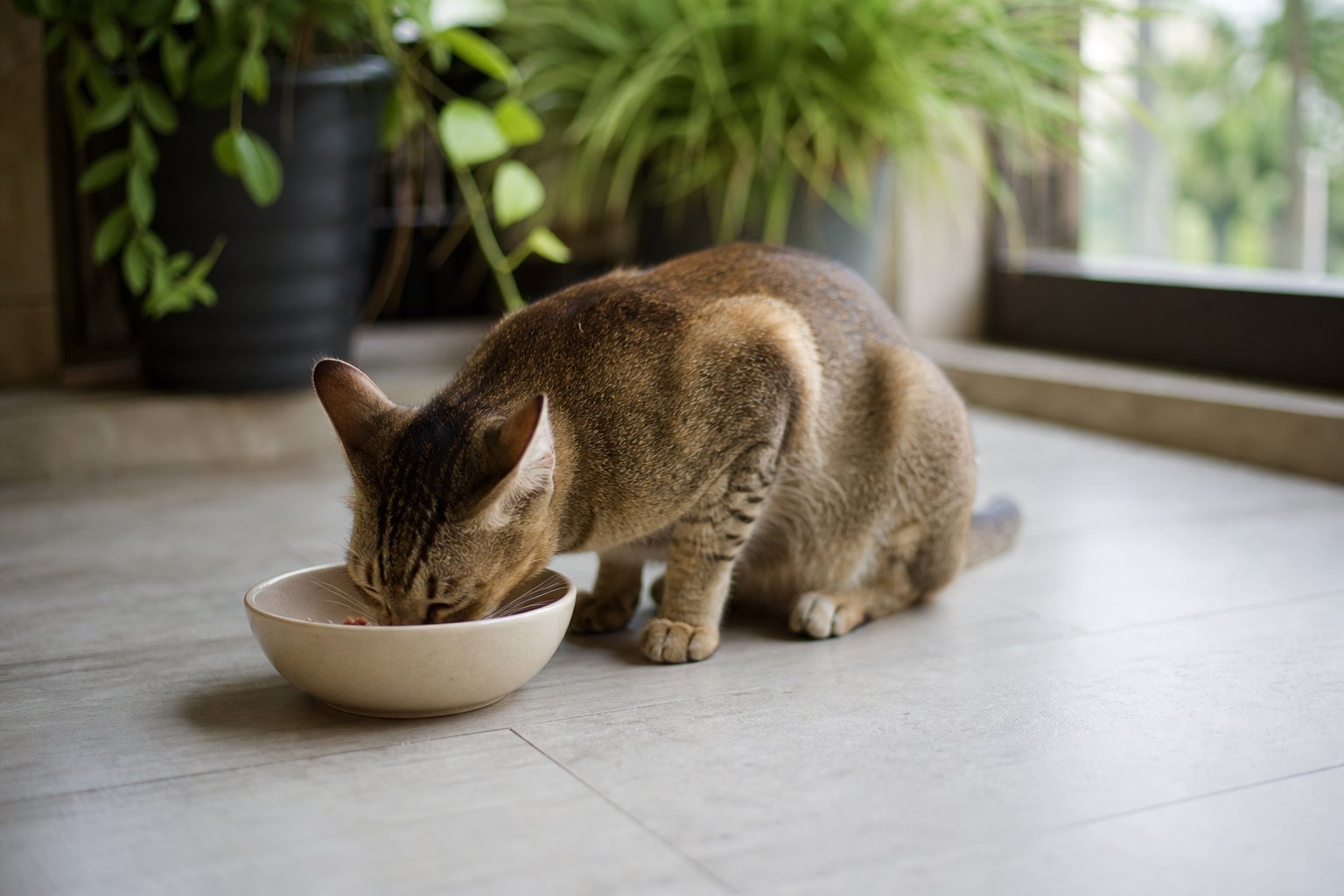
Bowls matter too: wide, shallow dishes prevent whisker fatigue, ceramic or stainless steel cleans better than plastic, and both should be washed daily. Water bowls should sit away from the litter tray and food bowl.
Storage and switching food in a tropical climate
Malaysia's heat and humidity are genuinely unforgiving on dry food.
- Transfer dry food into an airtight bin, keep it off the floor and away from direct sun, and aim to finish it within a month of opening. Leave the food in its original bag inside the bin if you can — the packaging carries the batch and expiry details.
- Reject any bag that shows oil spots, insect activity, mould, or an off smell. A cat suddenly refusing its usual food can be a spoilage signal rather than fussiness.
- Refrigerate opened wet food and use it within 24 hours; discard anything left at room temperature for an extended period.
- In prolonged wet weather, check kibble texture before every serve. Damp kibble clumps and goes rancid faster.
Switching over 7–10 days: begin with roughly 75% old food and 25% new, raise the new food every two days, and complete the change around day seven to ten. If vomiting or diarrhoea appears, step back to the previous ratio, hold it until stool normalises, then continue more slowly. A slower transition is always cheaper than a vet visit for gastroenteritis.
Common myths worth retiring
"Grain-free means low carbohydrate." Not necessarily. Potatoes, tapioca and peas can push carbohydrate higher than a modest inclusion of grain. Judge the whole panel.
"More expensive is always better." Price reflects ingredient grade and processing method — freeze-drying and air-drying cost far more to produce. Plenty of mid-priced foods meet every nutritional target when the first five ingredients are animal-based.
"Higher protein is always better." The number needs to come from animal sources and suit the life stage. Excessively high protein is not appropriate for every cat with kidney disease.
"Any canned food can be a main meal." Only complete-and-balanced cans can. Supplementary or topper cans have unbalanced calcium and phosphorus and should be mixed into food, not used as the whole diet.
"Supplements are harmless extras." A cat on a complete food needs no multivitamin. Fish oil may help skin and coat but the dose should be weight-based; over-supplementing probiotics or joint products without a diagnosis usually just wastes money.
When to see a vet
Food is health, so treat diet changes as a clinical decision in these situations:
- Persistent vomiting or loose stools lasting more than two days after a transition
- Refusal of food for 24 hours, or any refusal in a kitten
- Sudden weight loss or gain, or a coat that deteriorates despite good food
- A senior cat showing reduced appetite, increased thirst or changes in urination
- Any diagnosis of kidney, urinary tract, diabetes or chronic gut disease — therapeutic diets must follow a vet's assessment and be reviewed at follow-ups
- Before pregnancy, lactation, or feeding a cat with known allergies
Older cats should have a blood test at least once a year so dietary decisions are based on results rather than assumptions.
Do this today
- Take the bag you are currently feeding and check the first five ingredients and the protein percentage against the life-stage table.
- Confirm the complete-and-balanced statement and the kcal listing are present.
- Set a realistic monthly food budget, then shortlist two or three options and compare cost per 100 kcal.
- If your cat eats only dry food and drinks little, add one complete wet meal a day or a water fountain.
- Weigh your cat and note the score, so you have a baseline before you change anything.
- If you switch, start the 7–10 day transition today rather than tomorrow.
Vet disclaimer: This article is general nutrition information only and does not diagnose or prescribe. Always consult a registered veterinarian before changing diet, especially for kittens, seniors, or cats with kidney, urinary or other medical conditions.
Frequently asked questions
Which cat food should I buy in Malaysia?
There is no single best brand. Screen first: a complete-and-balanced statement, animal protein in the first five ingredients, and protein suited to your cat's age — kitten 35% or more, adult 30% or more, senior 28% or more. Then match the shortlist to your monthly budget.
How do I read a cat food label quickly?
Spend 30 seconds on four things: the complete-and-balanced statement, the first five ingredients (mostly meat), the protein percentage on a dry matter basis, and the kcal figure. Without a kcal listing you cannot calculate a correct daily portion.
Is grain-free cat food automatically better?
No. Some grain-free recipes swap corn or wheat for potatoes or tapioca and end up with more carbohydrate. Judge the whole panel — meat content, protein level and carbohydrate load — rather than the claim on the front of the pack.
Can I feed only dry food long term?
You can, but dry food is roughly 8–12% water while cats take much of their moisture from food. If your cat drinks little, add a daily complete wet meal or a running water fountain to support urinary and kidney health.
How long does it take to switch cat food?
Plan 7–10 days. Start with about a quarter of the new food, increase every two days, and drop back a step if you see vomiting or loose stool. Cats with diagnosed conditions should only change diet on veterinary advice.
How much does cat food cost in Malaysia?
Cost depends on pack size, format and brand; dry food per kilogram is far cheaper than wet, freeze-dried or air-dried food. Ask your local pet retailer for current prices and compare cost per 100 kcal rather than the sticker price of the bag.
Related reading
- Cat Food Guide Malaysia 2026: How to Choose Dry, Wet & Prescription Food
- Cat Food Recommendation Malaysia: 8 Scenarios, Label Checks and Daily-Cost Thinking
- ACANA Cat Food in Malaysia: Is This Canadian High-Protein Kibble Right for Your Cat?
- Cat Staple Canned Food in Malaysia: How to Pick a Complete & Balanced Wet Food
- Cat Staple Canned Food in Malaysia: How to Spot a Complete & Balanced Can
- Grain-Free Cat Food in Malaysia: What the Label Really Says (2026)
- Orijen Cat Food Review Malaysia 2026: High-Protein Kibble, Ingredient Breakdown & Feeding Guide
- Wet vs Dry Cat Food in Malaysia: Water, Cost and How to Choose