
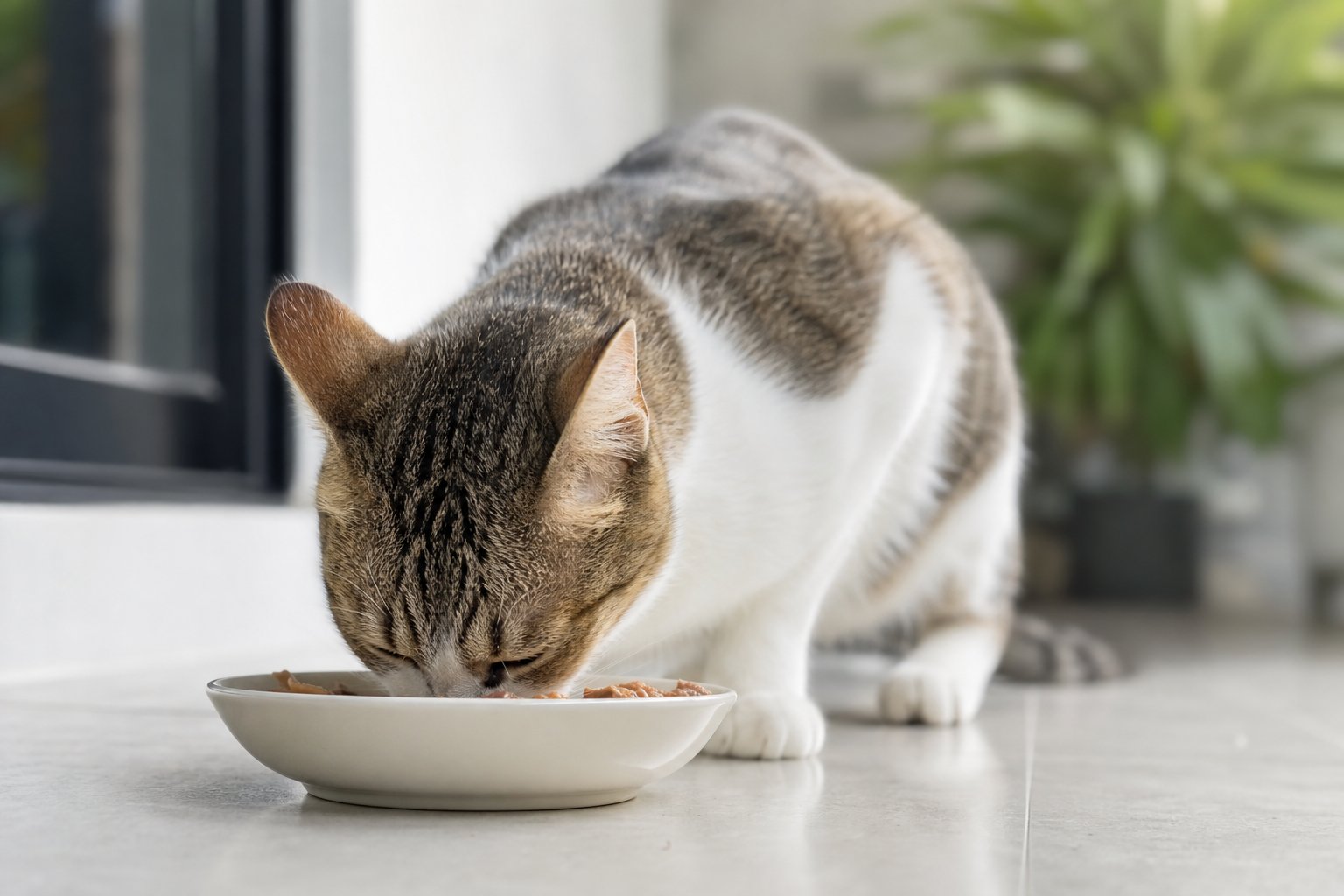
Short answer: Feed a food labelled "growth" or "all life stages" that meets AAFCO or FEDIAF kitten standards. Serve small, frequent meals that taper as your kitten grows, weigh them every two weeks, and change foods slowly over 14 days. Mixing wet food with a little dry food is the simplest balance of hydration, cost and convenience.
Why "growth" or "all life stages" matters
A kitten is not simply a small adult cat, and the food label is where that difference shows up. Growth-formula foods are built for rapid tissue building, bone mineralisation and organ maturation, so their nutrient floors are set higher than adult maintenance food. Under AAFCO's growth standard, minimum crude protein is 30 percent on a dry matter basis, compared with 26 percent for adult maintenance. Minimum fat sits at 9 percent, calcium at 1.0 percent, phosphorus at 0.8 percent and taurine at 0.10 percent, all expressed dry matter basis.
Those numbers matter practically. Protein supports lean growth, while the calcium-to-phosphorus pairing governs how safely the skeleton hardens. Taurine is an amino acid cats must obtain from diet; deficiency shows up in the heart and eyes. Adult maintenance food carries lower floors (calcium 0.6 percent and phosphorus 0.5 percent, for example), which is why feeding adult food to a growing kitten over weeks and months can quietly leave gaps.
Read the front and back of the pack before anything else. Look for the words "complete and balanced" plus a named life stage. "All life stages" is permitted for kittens, but the product must still satisfy growth requirements. "Maintenance", "adult" or "senior" claims are not suitable as a kitten's only food. If a bag shows no nutritional adequacy statement at all, treat it as a treat or topper rather than a daily staple.
A useful habit borrowed from international nutrition guidance is to ask three questions of any brand you consider: who formulated the diet, which nutritional standard it is formulated to, and whether it was tested by feeding trials rather than calculated from a recipe. Reputable manufacturers answer all three on their website or on request.
Energy is the other half of the story. Per kilogram of bodyweight, a kitten's calorie requirement is roughly two to three times that of an adult cat. That single fact explains why adult portions, adult meal timing and adult food all fall short for a young cat, no matter how healthy the brand is for grown-ups.
Feeding schedule by age
Meal frequency matters as much as meal composition. A kitten's stomach is small and its energy burn is high, so splitting the daily ration into several sittings avoids both hunger spikes and digestive upsets. Use this schedule as a starting framework, then adjust to your kitten's appetite and your vet's advice.
| Age | Meals per day | Food form | What to watch |
|---|---|---|---|
| 4-8 weeks (weaning) | 4-5 | Mashed wet food or soaked kibble | Steady weekly weight gain; transition off mother's milk |
| 8-12 weeks | 3-4 | Kitten wet food plus soaked kibble | Teething may briefly soften appetite |
| 3-6 months | 3 | Kitten wet food and kibble | Fastest growth phase; protein demand peaks |
| 6-12 months | 2-3 | Kitten or all-life-stages formula | Begin blending adult food around 10-12 months |
Practical notes for each stage. During weaning, food should be wet enough to lap and mash; dry kibble can be soaked in warm water or formula until it collapses into a porridge. From 8-12 weeks, teething can make chewing uncomfortable, so a kitten may eat less for a day or two, then rebound. Keep the offer consistent rather than introducing a new flavour every few days.
The 3-6 month window is the steepest climb on the growth curve. This is when a good diet shows itself: steady weekly weight gain, clean eyes, a glossy coat and firm stools. From 6 months, appetite often stabilises, which is the right moment to plan the switch to larger, better-value packaging.
Portions, weigh-ins and body condition
The feeding table printed on the pack is your anchor, because it is calculated for that exact recipe's energy density. A cup of one brand is not the same calories as a cup of another, so never carry portions across brands by volume alone. Convert to the weight your kitten actually has today, and re-check the table whenever weight changes.
Then verify with your own eyes and hands. Weigh your kitten every two weeks from around 4-6 weeks of age, and record it. Within the first year, a smooth upward line is normal. A flat line, a dip or a sudden steep jump are all prompts to investigate rather than to wait.
Body condition scoring complements the scale. You should be able to feel the ribs with light pressure without a visible layer over them, see a tummy tuck when viewed from the side, and feel a waist when viewed from above. Ribs sharply visible means portions are too low or a health problem is brewing. No waist at all means portions are too generous. Score every two weeks alongside the weigh-in so you catch drift early.
Two feeding-pattern traps are worth naming. First, leaving dry kibble out all day in humid weather invites staleness and encourages constant nibbling that blurs the line between hunger and boredom. Second, switching to a new flavour because a kitten seemed bored can trigger soft stools and teach your kitten that refusing food earns a new menu. Rotate deliberately and slowly, not reactively.
Hydration deserves its own line. Total daily water intake from food and drink is generally put at 50-60 ml per kilogram of bodyweight. Wet food contributes most of this automatically; a kitten eating only dry food must drink more, and kittens are not always reliable drinkers. Fresh water in a clean bowl, moved away from the food bowl and the litter tray, is a low-effort win.
The 14-day transition SOP
Changing food quickly is the most common cause of avoidable kitten diarrhoea. A kitten's gut flora is immature and body mass is small, so fluid loss escalates fast and dehydration becomes dangerous quickly. Give the change a full 14 days, and longer if the kitten is young or previously sensitive.
| Days | Old food | New food | Check in |
|---|---|---|---|
| 1-3 | 75% | 25% | Stool formed? Appetite normal? |
| 4-6 | 50% | 50% | Soft stool means drop back one stage |
| 7-10 | 25% | 75% | Weight still climbing steadily |
| 11-14 | 0% | 100% | Transition complete |
Work through it in order. Days 1-3 are the trial stage: if stools stay firm and appetite is unchanged, move on. Days 4-6 are where most kittens reveal a sensitivity, so watch the litter tray closely. Days 7-10 usually pass quietly. Days 11-14 confirm the new food is tolerated at full strength.
If soft stool appears, do not push forward. Hold or step back to the previous ratio for another two to three days before progressing again. Also pause any other dietary change at the same time: no new treats, no new toppers, no sudden portion jump. Change one variable at a time so you know what caused the reaction. Kittens tolerate slower transitions better than adult cats, so when in doubt, stretch the schedule to 18 or 21 days.
Wet, dry, freeze-dried or air-dried
Each format has a job. The comparison below uses relative cost tiers rather than price figures, because local retail prices vary by brand, pack size and outlet, and your own quote from a Malaysian pet retailer or veterinary clinic will be the reliable number.
| Format | Moisture level | Cost tier per kg | Best use | Watch-outs |
|---|---|---|---|---|
| Wet food (cans, pouches) | High, mostly water | Mid range; small tins cost more per kg | Hydration, picky eaters, weaning | Refrigerate leftovers, use promptly in heat |
| Dry kibble | Very low | Usually lowest in large bags | Convenience, measured meals, dental crunch | Goes stale in humidity; always provide water |
| Freeze-dried | Very low | High | Mixed feeding and toppers | Must be rehydrated; not a dry-only diet |
| Air-dried | Low | High | Mixed feeding, flavour variety | Rehydrate or mix; confirm complete-and-balanced claim |
Mixed feeding is the default recommendation for most kitten households: dry food for convenience and measured energy, plus one or two wet meals daily to lift water intake and add variety. If you go the mixed route, count calories across both foods rather than treating the wet meal as an extra.
Freeze-dried and air-dried products can absolutely be part of a kitten's menu, but the rules are strict. Choose a formula marked kitten or all life stages with a full nutritional adequacy statement, rehydrate it before serving, or blend it into wet food. Serving it straight from the bag as the whole diet risks both low moisture intake and incomplete nutrition.
One packaging principle applies across every format: small packs cost markedly more per kilogram than large ones, sometimes double or more. Once your kitten's appetite settles after about five months, and once you have confirmed the food suits them, moving to a larger bag is the single biggest cost lever available.
Foods your kitten must never have
Keep this checklist on the fridge:
- Adult prescription or therapeutic diets, unless your own veterinarian prescribed them for your kitten
- Dog food, which is formulated without enough taurine for cats
- Plain fish tinned as the long-term staple, which skews the calcium-to-phosphorus balance
- Seasoned human food, chocolate, onion, garlic and raisins
- Raw egg white, which interferes with biotin absorption
- A fully vegetarian diet, since cats are obligate carnivores and need animal-derived nutrients
Also resist the urge to add calcium or taurine "for extra protection" to a food that already meets growth standards. Over-supplementing calcium is not harmless; it can disturb skeletal development, with large-breed kittens especially vulnerable. Home-cooked or raw formulations need to be nutritionally balanced by a professional, not guessed from a recipe online.
When to see a vet
Arrange a consultation promptly if any of the following appear:
- Soft stool lasting more than two days, or any stool with blood
- Vomiting, low energy, or a kitten that stops eating
- Weight that stalls or drops across two consecutive weigh-ins
- Rapid weight gain, or ribs and hip bones becoming sharply prominent
- Refusal of food for a full day, or a sudden switch from eager eating to disinterest
- Persistent bad breath, swollen gums or broken eating rhythm during teething
Dehydration is the urgent risk with kitten diarrhoea, so same-day assessment is appropriate when stools are frequent, watery or bloody. For routine vaccination, microchipping, sterilisation planning and nutrition advice, work with a registered veterinary clinic near you. The Department of Veterinary Services publishes official animal health guidance, and SPCA Malaysia shares practical care and adoption resources that are useful for new kitten households.
Smart buying habits
Before committing to a full-size pack, buy the smallest available trial or sample pack and offer it for several days. Acceptance in the first week is a decent predictor of long-term success, and it saves you from being stuck with a bulk bag your kitten refuses. Once accepted, keep a photo of the ingredient panel and batch details on your phone so repurchases are exact matches.
Store dry food in a sealed container in a cool, dry cupboard, away from direct sunlight, and buy only what your kitten will finish while the food is fresh. In hot, humid weather, check kibble for stale smell or clumping before serving. Open wet food should be refrigerated and used within a day, and never left in the bowl for hours in a warm room.
Finally, keep a simple log: date, weight, meals per day, stool quality and any new food introduced. Two minutes a week gives your veterinarian a clear picture at check-ups and lets you spot trends long before they become problems.
This article is general nutrition information only and is not a diagnosis or prescription. Individual kittens differ; discuss diet, portions and any health concern with a registered veterinarian.
Related reading
- Cat Food Guide Malaysia 2026: How to Choose Dry, Wet & Prescription Food
- Cat Calorie Calculator Malaysia: RER and MER Formulas, Plus Grams of Dry and Wet Food
- Cat Food in Malaysia: How to Read the Label, Compare Protein and Budget Monthly
- Cat Food Recommendation Malaysia: 8 Scenarios, Label Checks and Daily-Cost Thinking
- Cat Weight Loss Diet in Malaysia: Safe Calories, Portions and Weekly Monitoring
- ACANA Cat Food in Malaysia: Is This Canadian High-Protein Kibble Right for Your Cat?
- Carrageenan and Gums in Malaysian Cat Food: What the 6 Common Thickeners Actually Do
- Cat Calorie Calculator Malaysia: RER & MER Formulas, Wet/Dry Food Grams
- Cat Food Transition in Malaysia: The 10% Rule, a 10-Day Plan and Loose Stool Fixes
- Cat Gastroenteritis in Malaysia: Vomiting, Diarrhoea and Probiotics That Actually Have Evidence
- Cat Picky Eater Malaysia: Why Your Cat Refuses Food and What Actually Works
- Cat Staple Canned Food in Malaysia: How to Pick a Complete & Balanced Wet Food