
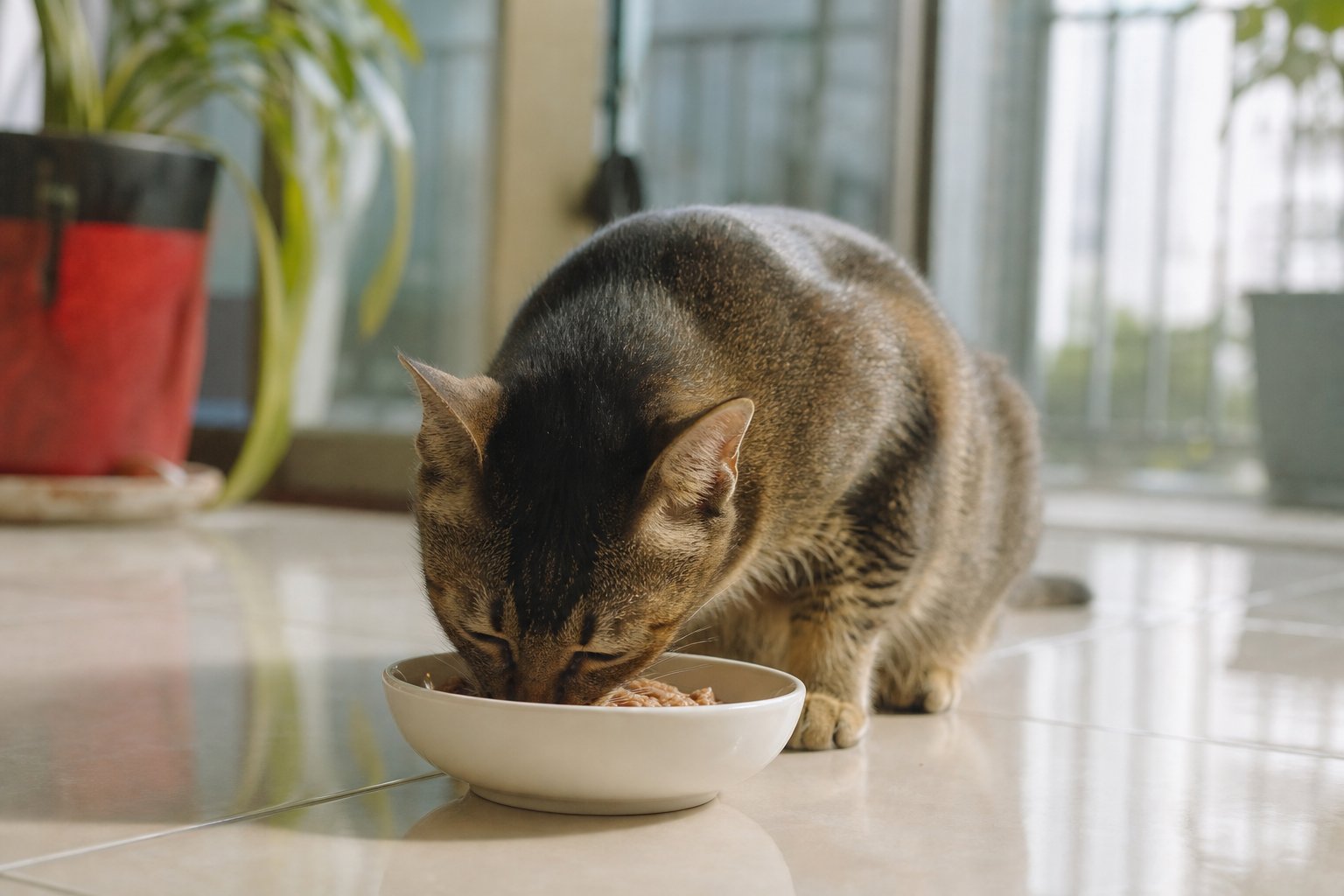
For a cat diagnosed with chronic kidney disease (CKD), phosphorus is the first number to check — not protein. International Renal Interest Society (IRIS) guidance sets dietary phosphorus density at ≤150 mg/100 kcal for stages 1–2 and ≤120 mg/100 kcal for stages 3–4. Healthy adult cats need no restriction at all. Confirm the stage with blood tests, convert the label into mg per 100 kcal, then let your vet select the diet.
Why phosphorus matters more than you think
The kidneys are the main route for getting rid of phosphorus. As kidney function declines, phosphorus starts to build up in the blood. The body responds by overworking the parathyroid glands — a situation called renal secondary hyperparathyroidism — which is widely believed to speed up further kidney damage.
That is why phosphorus control sits at the centre of CKD dietary management, and why protein restriction is deliberately a later move. Cut protein too aggressively in the early stages and the cat loses muscle instead of gaining comfort. The smart sequence is: hold phosphorus first, watch body condition, and only taper protein when uraemic signs appear.
For a healthy cat on a standard maintenance diet, phosphorus is simply not a problem to solve. Maintenance foods that meet recognised nutritional profiles already sit in a safe range, and there is no benefit in pushing phosphorus lower for its own sake.
IRIS targets at a glance
The table below is the reference your vet works from. Blood results set the stage; the stage sets both the serum target and the dietary target.
| Measure | IRIS Stage 1–2 | IRIS Stage 3 | IRIS Stage 4 |
|---|---|---|---|
| Serum phosphorus target | 2.7–4.5 mg/dL | < 5.0 mg/dL | < 6.0 mg/dL |
| Dietary phosphorus density | ≤ 150 mg/100 kcal | ≤ 120 mg/100 kcal | ≤ 120 mg/100 kcal |
| Blood recheck interval | Every 4–6 months | Every 3–4 months | Every 3–4 months |
| Diet advice | Consider a renal prescription diet | Recommend a renal prescription diet | Recommend a renal prescription diet |
| If serum phosphorus still high after 4–6 weeks | Add a phosphate binder | Add a phosphate binder | Add a phosphate binder |
Two useful calibration points: therapeutic renal prescription foods generally land between 80 and 135 mg/100 kcal, which is why they hit these targets without guesswork. And if a cat flatly refuses prescription food, vets often fall back on a palatable maintenance food with moderate phosphorus density (below 200 mg/100 kcal) combined with a binder, rather than letting the cat eat nothing.
Reading the label: percentage versus mg per 100 kcal
The percentage printed on a packet is measured "as fed", meaning it includes the water still in the food. Wet food is roughly 78–88% moisture; dry food is usually around 8–10%. So a wet food showing 0.25% and a dry food showing 1.0% are nowhere near as different as they look — and a raw percentage tells you nothing about how much phosphorus arrives per calorie.
Two other label facts worth knowing:
- Recognised nutritional standards set a minimum adult maintenance phosphorus of about 0.5% on a dry matter basis (growth and reproduction diets require more, around 0.8%).
- Typical maintenance foods for adult cats sit somewhere around 0.8–1.5% phosphorus on a dry matter basis. Nothing in that band is alarming for a healthy cat.
To compare foods properly, you need the energy figure — kcal per kg for dry food, or kcal per can or per pouch for wet food. If the packaging does not state energy, you cannot calculate mg/100 kcal at all. In that case, compare dry matter basis percentages instead, or hand the label to your vet.
A three-step conversion you can do at the shelf
Step 1 — turn the percentage into milligrams per 100 g. Phosphorus of 0.25% means 250 mg per 100 g (0.25 g = 250 mg).
Step 2 — find how many grams make 100 kcal. If the food carries 690 kcal/kg, then 100 kcal is 1,000 ÷ 690 × 100 ≈ 145 g of food.
Step 3 — multiply. 2.5 mg per g × 145 g = approximately 363 mg per 100 kcal.
That result is far above the IRIS limit of 150 — but context matters. A 363 mg/100 kcal figure from an ordinary senior maintenance tin simply means it is a maintenance food, perfectly reasonable for a healthy older cat and completely unsuitable as the sole diet for a diagnosed CKD patient.
Now try a dry food: phosphorus 1.0%, energy 4,000 kcal/kg. Step 1 gives 1,000 mg per 100 g. Step 2 gives 100 kcal = 25 g. Step 3 gives 250 mg per 100 kcal. Notice that the dry food, which looked "four times worse" on the packet, actually delivers less phosphorus per calorie than the wet food. That is exactly why the percentage alone misleads.
A quick sanity check while shopping: therapeutic renal diets typically show 80–135 mg/100 kcal; moderate-phosphorus options are marketed as under 200 mg/100 kcal. Anything you cannot convert should be treated as unknown, not as low.
Prescription renal food versus ordinary low-phosphorus food
"Low phosphorus" on a marketing panel is not a medical claim. The table below separates what each category actually does.
| Option | Typical phosphorus density | Protein approach | Who it suits | Key caution |
|---|---|---|---|---|
| Therapeutic renal prescription diet (wet or dry) | 80–135 mg/100 kcal | Controlled and stage-adjusted, high digestibility | IRIS stage 2 onwards; recommended from stage 3–4 | Chosen by vet; variants exist for joints, mobility or early disease |
| Moderate-phosphorus maintenance food plus phosphate binder | Under 200 mg/100 kcal | Usually unchanged | Cats that refuse prescription food entirely | Requires blood monitoring and a prescribed binder |
| Ordinary maintenance food | Varies; convert before comparing | Not adjusted for kidney disease | Healthy cats only | Not a treatment for CKD |
| Urinary tract prescription diet | Manages magnesium and urine pH, not phosphorus | Not kidney-targeted | Cats with a stone or urinary history | Never a substitute for a renal diet |
The last row is the mistake that causes real harm. Urinary diets and renal diets look similar in the cabinet and are sold side by side, but they solve different problems. Feeding a urinary formula to a CKD cat does nothing for phosphorus, and feeding a renal formula to a stone-prone cat may not control the mineral balance that diet was designed for. Always match the product to the diagnosis your vet gave you.
On cost: prices differ widely between retailers and formats, and wet-only feeding costs more per day than dry. Rather than quoting figures that change monthly, ask your Malaysian vet or pet retailer for current pricing on the exact formula prescribed, and compare cost per day based on the grams your vet tells you to serve — not cost per packet.
Should you restrict protein at the same time?
Early disease (stages 1–2). Aggressive protein restriction is not usually advised. The goal is to avoid excess while still providing enough high-quality protein to protect muscle. Commonly cited guidance in feline nutrition literature sits around 5–5.4 g of protein per kg of body weight per day, but the individual target depends on body condition and blood results.
Later disease (stages 3–4). Protein is then reduced gradually to take the edge off uraemic signs such as nausea and appetite loss. The reduction is stepped, not sudden.
Older cats that also have CKD. Sarcopenia — age-related muscle wasting — is already a live risk, so protein quality (animal-based, highly digestible) matters at least as much as the raw quantity. A vet has to balance kidney load against muscle preservation; this is not a number you should tune yourself on a food label.
The practical takeaway: when you and your vet are choosing a diet, settle the phosphorus question first, then discuss protein. Doing it in that order avoids the common trap of under-feeding protein early and creating a frail, muscle-depleted cat.
Water: the other half of the plan
CKD cats lose the ability to concentrate urine, so they shed more water every day and drift toward dehydration. Dehydration in turn makes blood work look worse and appetite drop further.
Wet food is the most direct lever available: moisture content of roughly 78–88% versus around 10% in dry kibble. NRC guidance puts total daily water intake for cats at 50–60 ml per kg of body weight, and the requirement rises when a cat is unwell or vomiting.
Practical hydration habits:
- Serve wet meals on a schedule rather than leaving tins out; discard uneaten wet food within a couple of hours.
- Offer several water bowls placed away from food and litter trays; cats often prefer not to drink beside where they eat.
- Stir an extra spoonful of water or unsalted broth into each wet meal.
- Try a fountain if your cat ignores still bowls, and clean it regularly so it does not become a slime reservoir.
- Track intake informally: if bowls stay full for a day, or the litter tray output visibly drops, mention it at the next visit.
Buying and transitioning: a checklist
Prices vary by retailer and format, so treat this as a decision framework rather than a shopping list.
- Get the diagnosis and stage in writing. CKD is staged from blood work, not from food choice.
- Bring recent results to the shop: creatinine, SDMA if run, serum phosphorus in mg/dL, and urine protein-to-creatinine ratio.
- Check that the pack states energy (kcal/kg or kcal/can). No energy figure, no conversion.
- Convert phosphorus to mg/100 kcal using the three steps above.
- Compare against your cat's target — ≤150 in stages 1–2, ≤120 in stages 3–4.
- Verify the product category. Renal, urinary and senior maintenance foods are not interchangeable.
- Transition over 7–10 days, mixing increasing proportions of the new food with the old, unless your vet instructs otherwise.
- Never let a CKD cat go without food for long. Cats that stop eating can develop hepatic lipidosis within days, so if a new food is refused, contact your vet the same day rather than waiting it out.
- Book the recheck. Stages 1–2 are typically reviewed every 4–6 months; stages 3–4 every 3–4 months. Diet and binders are adjusted on those results.
Local context — Kuala Lumpur apartment. In a sealed, air-conditioned flat, dry food left in a bowl can pick up humidity and stale fats within a day, and a CKD cat sharing the space with a food-motivated housemate may steal portions that were weighed out for someone else. Sealed containers, scheduled wet meals and separate feeding rooms make portion control — and therefore phosphorus control — actually measurable.
Local context — Johor Bahru terrace house. With cats moving between indoors and a compound, free-feeding a big bin of dry food is convenient but hides true intake. If your cat has been diagnosed, switch to measured meals: weigh the daily ration in grams, record it, and note any leftover. Without that record, your vet cannot tell whether the diet failed or the portion was simply too generous.
When to see a vet
Contact your vet promptly if any of the following apply:
- Your cat has not been diagnosed but you suspect kidney trouble — increased drinking, increased urination, weight loss, vomiting or a dull coat.
- Blood work has not been done recently, or you do not know your cat's IRIS stage.
- You are considering a prescription renal diet and have not confirmed the formula and daily amount.
- Food refusal lasts more than 24 hours, or vomiting and nausea reduce intake.
- Weight is falling despite eating, or muscle wasting is visible over the ribs and spine.
- Urine output changes sharply, or the litter tray output drops.
- Serum phosphorus remains above target after four to six weeks on the prescribed diet — a binder may be needed.
- You are tempted to buy or adjust a phosphate binder on your own. These are prescription medicines requiring blood monitoring.
Vet disclaimer: This article is general nutrition information and does not diagnose or prescribe. Dietary changes for a cat with kidney disease must be selected and monitored by a registered veterinarian using your cat's own blood work.
Related reading
- Cat Food Guide Malaysia 2026: How to Choose Dry, Wet & Prescription Food
- Cat Calorie Calculator Malaysia: RER and MER Formulas, Plus Grams of Dry and Wet Food
- Grain-Free Cat Food in Malaysia: What the Label Really Says (2026)
- Wet vs Dry Cat Food in Malaysia 2026: Water Content, Drinking Habits and Daily Cost Explained
- ACANA Cat Food in Malaysia: Is This Canadian High-Protein Kibble Right for Your Cat?
- Carrageenan and Gums in Malaysian Cat Food: What the 6 Common Thickeners Actually Do
- Cat Calorie Calculator Malaysia: RER & MER Formulas, Wet/Dry Food Grams
- Cat Food in Malaysia: How to Read the Label, Compare Protein and Budget Monthly
- Cat Food Recommendation Malaysia: 8 Scenarios, Label Checks and Daily-Cost Thinking
- Cat Food Transition in Malaysia: The 10% Rule, a 10-Day Plan and Loose Stool Fixes
- Cat Gastroenteritis in Malaysia: Vomiting, Diarrhoea and Probiotics That Actually Have Evidence