
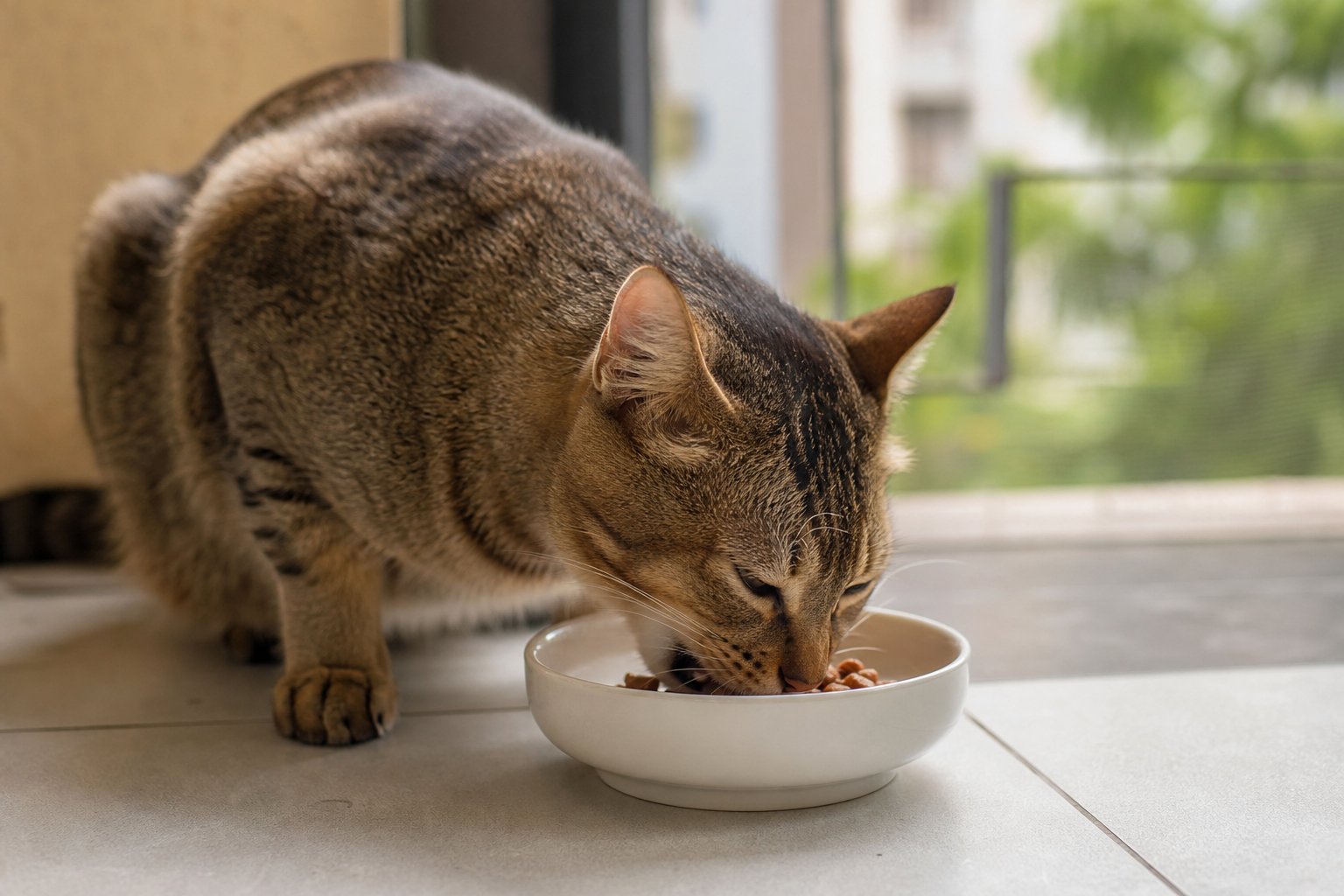
Quick answer
Canned food is roughly 75-85% water; dry kibble is only 6-12%. At the same daily calories, an all-wet diet supplies over 250 ml of water, while an all-dry diet supplies barely 6 ml. For most owners the best-value compromise is dry food as the base plus one complete canned meal a day. Compare foods by cost per 100 kcal, never by the price tag on the bag.
How much water is actually in each food?
Moisture content is not a marketing claim; it is printed in the guaranteed analysis on the pack. The gap between formats is structural, not a matter of brand quality.
| Food format | Typical moisture | Typical protein (as fed) | What that means at mealtime |
|---|---|---|---|
| Extruded dry kibble | 6-12% | 30-40% | Almost no water; the cat must drink it all separately |
| Air-dried food | about 12% | around 40% | Slightly more moisture, still a dry diet |
| Freeze-dried food | about 6% | around 38% | Very low moisture; needs rehydration if served dry |
| Semi-moist / pouches | 15-30% | 17-20% | Some water, but usually more carbohydrate and preservative |
| Complete canned food | 78-89% | 5.6-15% as fed | Delivers most of the cat's daily water in the bowl |
Because water makes up about four-fifths of a can's weight, a 4 kg indoor cat eating a full wet diet takes in roughly 330 g of food and gets about 264 ml of water from it. The same cat on dry food eats around 60 g and receives only about 6 ml. Everything else must come from the water bowl.
This matters for the urinary tract. Reference nutrition data shows that raising dietary moisture from 10% to 75% lifted average daily urine output from 63 ml to 112 ml, and that epidemiological studies list dry cat food as a risk factor for feline lower urinary tract disease. Dry food also empties from the stomach more slowly; adding water shortens that time.
Why the protein on the can reads so low
This is the single most common misreading of a cat food label. Percentages on wet food are given as fed, so they are diluted by water. Convert to a dry matter basis before comparing anything:
Dry matter % = as-fed % ÷ (100 − moisture %) × 100
A senior cat food showing 10% protein and 85% moisture works out as 10 ÷ 15 × 100 = roughly 67% protein on a dry matter basis — higher than most kibbles. Another pouch showing 8% protein at 78% moisture gives 8 ÷ 22 × 100, about 36%, comfortably in normal range.
The same rule applies to fat, carbohydrate and phosphorus. Doing the conversion takes thirty seconds and prevents you rejecting a perfectly good can, or overrating a dry food.
Nutrient standards set minimums on a dry matter basis: adult maintenance crude protein 26%, growth and reproduction 30%, and taurine at 0.10% for dry food versus 0.20% for canned (canned food needs more because of how it is processed). Use those as floors, not targets.
For context, typical composition across formats looks like this:
| Item | Dry food | Semi-moist | Canned food |
|---|---|---|---|
| Moisture | 6-10% | 15-30% | about 75% |
| Crude protein (as fed) | 16-30% | 17-20% | 7-13% |
| Crude protein (dry matter) | 18-32% | 20-28% | 28-50% |
| Crude fat (as fed) | 7-20% | 7-10% | 5-8% |
| Carbohydrate (as fed) | 41-70% | 40-60% | 4-13% |
| Metabolisable energy (kcal/kg) | 2,800-4,050 | 2,550-2,880 | 875-1,250 |
Note the energy row: canned food carries roughly one-third the calories per kilogram because most of the weight is water. That single fact explains why price-per-kilogram comparisons mislead.
One more caution from the same data: fat content, and therefore calorie count, can vary between batches of canned food because natural meat varies. Weigh your cat regularly and adjust the portion rather than assuming the stated grams are fixed.
How much water does your cat really need?
The reference figure for total daily water intake in cats is 50-60 ml per kg of body weight, counting water from food plus water drunk. A 4 kg cat therefore needs about 200-240 ml a day in total.
Work through your own cat's diet:
- All dry food: about 60 g daily at 10% moisture gives roughly 6 ml from food, leaving nearly 240 ml to be drunk from the bowl.
- All wet food: about 330 g of complete canned food at 80% moisture gives roughly 264 ml — already covering most of the requirement.
- Half and half: 30 g dry plus 170 g canned delivers about 139 ml from food, cutting the drinking burden by more than half.
Journal findings line up with this. Cats fed a diet near 75% moisture took in 145-293 ml of water a day, while those on a diet near 5% moisture managed only 103-109 ml. Researchers also found that total water intake rises as dietary moisture rises, even when the cat drinks less on its own.
That is the practical takeaway: if your cat's bowl stays suspiciously full, the fastest fix is not a second fountain. It is adding a wet meal.
Beyond the food, set up the drinking stations properly. Put bowls in several rooms, keep them away from the litter tray and the feeding spot, use wide shallow bowls so the whiskers do not touch the sides, and prefer ceramic or stainless steel over plastic. Moving water helps some cats, but it ranks below raising the wet food share.
What feeding each type really costs
Comparing a 5 kg bag to a tray of cans is meaningless. The fair unit is cost per 100 kcal, because that is what your cat actually uses.
Cost per 100 kcal = price per kg ÷ (energy in kcal/kg ÷ 100) Daily cost = cost per 100 kcal × your cat's daily kcal
Since a dry food might carry 4,000 kcal/kg while a canned food carries around 700-1,000 kcal/kg, the dry food packs four to six times more energy into each kilogram. Two products at the same price per kilogram can therefore differ several times over in real feeding cost.
First work out how much your cat needs. Resting energy requirement is 70 × body weight in kg raised to the power of 0.75; multiply by an activity factor (about 1.2 for a neutered indoor adult). For a 4 kg neutered cat: 70 × 4^0.75 ≈ 198 kcal, then × 1.2 ≈ 238 kcal a day. Slightly older, less active cats land near 200 kcal; lean, active cats run higher. Treat these as starting points and adjust to body condition score every two weeks.
Then apply the formula to the price on the pack in front of you. Retail prices move constantly across brands and pack sizes, so check current figures with your Malaysian pet retailer rather than relying on any figure quoted elsewhere.
Budget tactics that reliably work:
- Buy dry food in the largest pack your household can finish before it goes stale. Bigger packs bring the cost per kilogram down more than any other single move.
- Do not pay for water. Canned food is around 80% water by weight, so its per-kilogram price will always look higher. That is not proof it is worse value.
- Reserve the wet food for where it counts. One complete can a day delivers most of the hydration benefit at a fraction of an all-wet budget.
- Check the energy density, not just the price. A cheaper kibble needing a bigger daily scoop can cost more per month than a denser one.
Choosing dry food: four things to check
Dry food is not the villain — it is a tool with a trade-off. Judge it on these four points:
- Protein on a dry matter basis. Aim for at least 30% for adult cats and 35% for kittens, comfortably above the 26% and 30% minimums.
- Animal ingredients in the first five positions. The ingredient list is ordered by weight, so meat, organ meat and fish should appear before corn, wheat or soy.
- A complete and balanced statement. Look for wording that the food is nutritionally complete for the stated life stage. Without it you are feeding a supplement, not a diet.
- Energy printed in kcal/kg. No number means no way to calculate a portion, which leads to guessing and slow weight gain.
Also read the fat percentage. Energy-dense foods make overfeeding easy, so measure with a scale or a dedicated scoop instead of pouring from the bag.
Choosing wet food: complete versus complementary
- Complete canned food carries a full nutritional statement and can be the only food long term. This is what you want for the daily meal.
- Complementary food is usually labelled for supplemental feeding, as a topper, a treat or a soup. Calcium and phosphorus are not balanced for a sole diet, so it may only be used to top up a complete base.
- Never judge by price. Some inexpensive cans are genuinely complete; some expensive ones are only toppers. The only reliable test is reading the statement on the label.
A quick note on processing: studies on advanced glycation end products (AGEs) found the highest levels in canned food cooked at around 120°C, and describe an ordering from home-prepared and raw through freeze-dried, dehydrated, canned, air-dried, baked, extruded dry and semi-moist. That is research-level discussion, not a verdict that any single format is unhealthy. In practice weigh four things together: completeness of the diet, your cat's health status, your budget, and what you can sustain every [day.
Three feeding plans for Malaysian homes
| Plan](/articles/cat-food-transition-malaysia "mylink") | Combination | Estimated water from food daily | Budget impact | Best suited to |
|---|---|---|---|---|
| A: all dry | Dry food about 60 g | around 6 ml | Lowest | Tight budgets, cats that drink well, free-feeding setups |
| B: dry plus one can (recommended) | Dry 35 g + one 80 g complete can | around 66-70 ml | Moderate daily increase | Most households; the best balance of hydration and cost |
| C: all wet | Complete canned food about 330 g | around 260 ml | Highest | Cats with urinary history, poor drinkers, weight on vet advice |
Food water equals daily grams eaten multiplied by the moisture percentage on the pack, so you can recalculate for your own products.
Plan B in practice: measure the dry portion in the morning, then open one complete can in the evening. Stir in one to two tablespoons of warm water at about 35-40°C — it lifts the aroma for older cats whose sense of smell is fading, and adds a little more fluid. Skip the microwave; heating is uneven and can scald the mouth. Serve at room temperature and aim to finish within 30 minutes.
In a Kuala Lumpur apartment with two indoor cats and a shared feeding station, Plan B also keeps odour and food waste down, since a sealed kibble bin and a single opened can are easier to manage than several open trays.
During the Penang rainy season, ambient humidity climbs and kibble absorbs moisture faster once opened. Decant a week's worth into an airtight container, keep the rest sealed and off the floor, and finish the bag within about a month of opening.
For a Johor terrace house where a cat spends time outdoors, the outdoor cat is likely drinking pond or tap water elsewhere, so you can be more flexible on the wet share — but keep the indoor feeding schedule consistent so you can still monitor appetite and stool quality.
Transition gradually: over 7-10 days, start with roughly one-fifth new food and increase every couple of days. If vomiting or diarrhoea appears, step back to the previous ratio and slow down. Cats with sensitive stomachs often do better with dry and wet as two separate meals rather than mixed in one bowl.
Storage and food safety in a tropical climate
Dry food
- Keep it sealed, off the floor and away from direct sun.
- In humid weather, aim to finish an opened bag within a month.
- Throw it out at once if you notice rancid oiliness, a stale smell, mould specks or a colour change.
Wet food
- Unopened cans and pouches store at room temperature in a cool, dry place. Reject cans that are badly dented, bulging or rusted.
- Once opened, refrigerate the remainder for no more than 24 hours.
- In a warm kitchen, do not leave served wet food out for long: ideally the meal is finished within about half an hour, and anything left beyond an hour or two should be discarded rather than re-offered.
Hygiene
- Wash bowls daily with hot, soapy water; residue on a wet-food bowl spoils fast in heat.
- Use a separate scoop for kibble and never dip a used scoop back into the bag.
- Keep food and water away from the litter tray.
When to see a vet
See a registered veterinary practitioner promptly if any of these appear:
- Persistent vomiting, or diarrhoea lasting more than two days.
- Refusing all food for 24 hours, or drinking water suddenly far more or far less than usual.
- Straining in the litter tray, crying, or producing only tiny drops — this can be a urinary blockage and is an emergency.
- Unexplained weight loss, a dull coat, or repeated pickiness across several foods.
- Any existing kidney, urinary, diabetes or chronic gut condition, where the diet must be chosen by a vet rather than by you.
Wet food supports hydration; it is not a treatment. If your cat has already been diagnosed, let the vet set the phosphorus, protein and calorie targets, then pick the products that meet them at a price you can sustain.
Your three-step plan: first calculate your cat's daily calories, then split them between dry and wet while keeping the total intact, then watch stools, appetite and weight for seven days before adjusting anything. Recheck body weight every two weeks and fine-tune the grams.
This article is general nutrition information for cat owners in Malaysia and does not replace veterinary diagnosis or treatment. Cats with urinary, kidney or heart conditions should have any dietary change approved by a registered veterinary practitioner first.
Related reading
- Cat Food Guide Malaysia 2026: How to Choose Dry, Wet & Prescription Food
- Cat Calorie Calculator Malaysia: RER and MER Formulas, Plus Grams of Dry and Wet Food
- Cat Food Recommendation Malaysia: 8 Scenarios, Label Checks and Daily-Cost Thinking
- Grain-Free Cat Food in Malaysia: What the Label Really Says (2026)
- Phosphorus and Kidney Diets for Cats in Malaysia 2026: IRIS Targets, mg/100 kcal Conversion and Prescription Food Choices
- Wet vs Dry Cat Food in Malaysia: Water, Cost and How to Choose
- ACANA Cat Food in Malaysia: Is This Canadian High-Protein Kibble Right for Your Cat?
- Carrageenan and Gums in Malaysian Cat Food: What the 6 Common Thickeners Actually Do
- Cat Calorie Calculator Malaysia: RER & MER Formulas, Wet/Dry Food Grams
- Cat Food in Malaysia: How to Read the Label, Compare Protein and Budget Monthly