
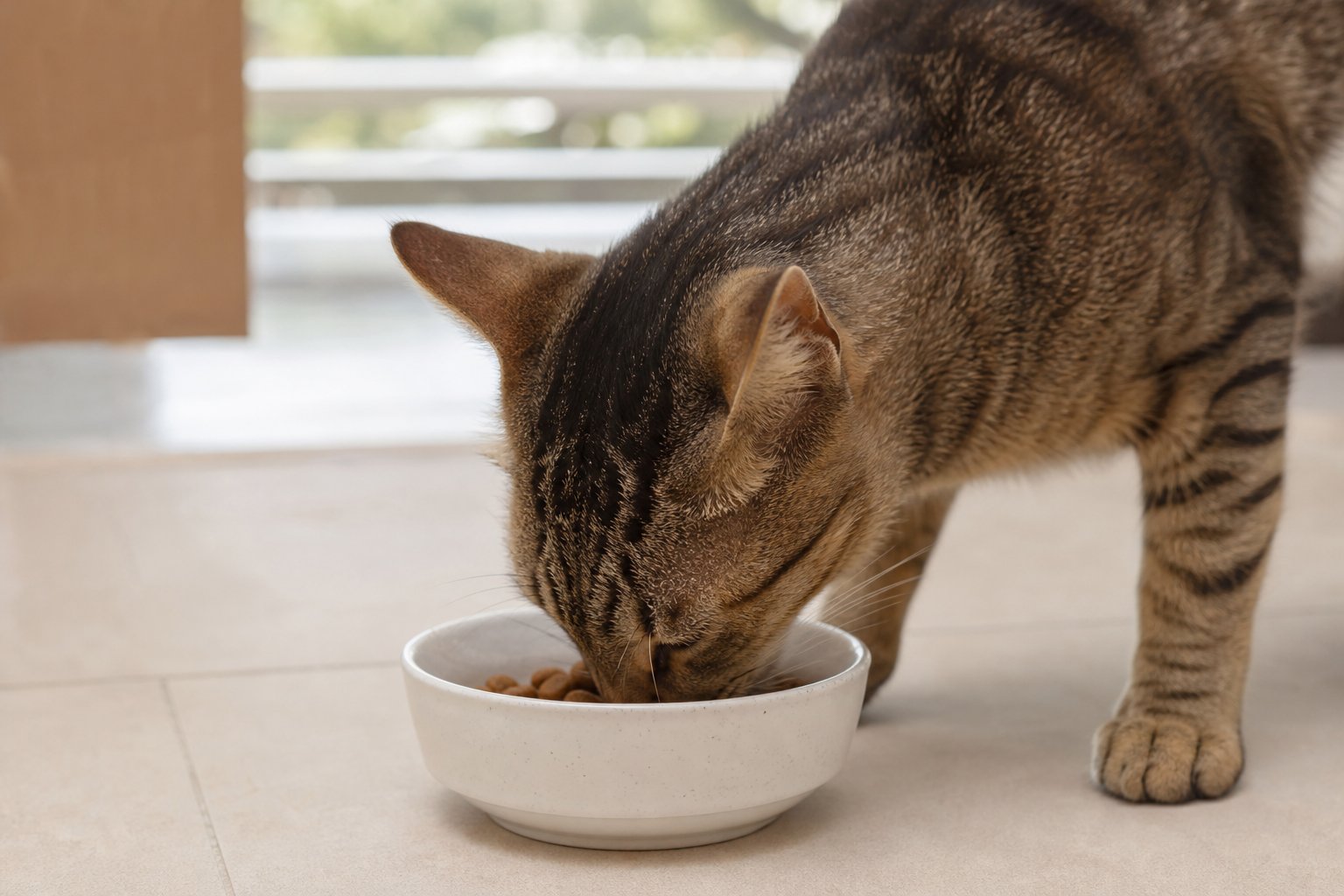
There is no single "best" cat food — only the food that fits your cat. On cost alone, a large bag of complete dry food works out cheapest per day. On hydration, wet food wins. If your cat has been diagnosed with urinary crystals or kidney disease, only a vet-prescribed diet belongs in the bowl. Decide your first requirement, then read labels rather than price tags — prices differ by brand, pack size and retailer, so ask your Malaysian vet or pet shop for current figures.
How to use this guide
Treat this as a scenario list, not a ranking. The real question is never "which food is best?" but "which food suits my cat?" — and that depends on age, health, weight, appetite, and what you can sustain month after month. Putting a budget bag of kibble head-to-head with a tub of freeze-dried nuggets on one leaderboard is meaningless: they solve different problems.
Work through four steps:
- Name your single top condition: budget, hydration, life stage, or a diagnosed condition.
- Shortlist one or two options in that scenario, then estimate what the daily feeding cost looks like.
- Run the three label checks below before you pay.
- Switch gradually and watch stools and appetite for the first two weeks.
Food types compared
| Food type | Moisture | Relative daily cost | Best for | Watch out for |
|---|---|---|---|---|
| Complete dry kibble | About 6–10% | Lowest | Tight budgets, multi-cat homes, free feeding | Low water intake; easy to overfeed |
| Complete wet/canned | About 78–88% | Mid to high | Hydration, urinary history, picky eaters | Refrigerate leftovers; use within a day |
| Air-dried | Low (sold dried) | High per kg, small portions | Owners short on storage space | Price per kg; needs airtight storage |
| Freeze-dried | Very low (around 6% on some labels) | High | Full diets or toppers for active cats | Must be rehydrated; handle as raw meat |
| Vet prescription | Varies | Vet-directed | Diagnosed urinary, kidney or metabolic conditions | Never swap types without your vet |
Three label checks before you buy
| Check | Where to look | What counts as a pass |
|---|---|---|
| Complete and balanced claim | Side or back of the pack | States it meets a recognised nutrient standard for a stated life stage |
| Life-stage fit | Pack or manufacturer website | Kitten/growth: crude protein at least 30% on a dry-matter basis; adult maintenance at least 26% |
| Taurine and phosphorus | Guaranteed analysis panel | Taurine around 0.10% (dry food) or 0.20% (wet) dry-matter basis; phosphorus figure present for cats with kidney concerns |
Words like "natural", "grain-free" and "human-grade" are marketing positioning, not nutrient standards. Do not let them substitute for the checks above.
Switching foods: allow 7–14 days — 25% new food for the first few days, 50%, then 75%, then fully new from around day 10. Kittens and sensitive cats should take longer than 14 days, and if stools soften, drop back to the previous ratio until things settle.
Scenario 1 — the budget pick: big bags of dry food
Dry kibble is the one category where a genuinely low daily cost is realistic. The economics are simple: the larger the bag, the lower the price per kilogram, because packaging is a big part of what you pay. A single cat can take months to finish a large sack, so buying in bulk usually makes sense — provided you store it well and the formulation actually matches your cat.
The trap is that "big bag" is not one product. Large packs come in indoor, sterilised, weight-control, kitten and senior versions, each with different fat and protein levels. A weight-control formula is a poor choice for a cat that is already lean, and a kitten formula is wrong for an older cat. Check the front of the pack, not just the size.
Practical habits that keep costs down without cutting corners:
- Buy a small 250–400 g trial pack first to confirm your cat accepts the food, then move to the large size. Small packs cost far more per kilogram.
- Compare price per kilogram, not price per bag — the sticker price is misleading across pack sizes.
- Keep the food in its original bag inside an airtight container, in a cool, dry cupboard away from direct sun.
- Check the best-before date you can realistically finish, especially in single-cat households.
Local prices vary widely by retailer and promotion, so ask for current figures rather than relying on any published number.
Scenario 2 — sensitive stomachs and soft stools
First, a myth worth retiring: grain-free does not mean tummy-friendly. The most common food sensitivities in cats are to animal proteins — chicken, fish and beef are the usual suspects — not to grains. Switching to a grain-free bag therefore often changes nothing.
A sensible sequence:
- Vet-guided elimination. A single-protein or hydrolysed formula trialled for roughly 8–12 weeks, with nothing else given in between — treats, flavoured supplements and table scraps all count as cheating.
- Read the gum list. Some fermentable gums used as thickeners can soften stools in sensitive cats; if the ingredient panel leads with gums, note it down.
- Consider probiotics as support, not a cure. They may help alongside a steady diet, but they will not fix an ongoing protein sensitivity.
- Stop hopping between brands. Every change restarts the clock. One variable at a time.
Keep a simple diary for two weeks: stool score, vomit episodes, appetite, and anything new your cat ate. That record is far more useful to your vet than a memory of "it has been a bit off lately".
Scenario 3 — hydration: for cats that barely drink
Many cats drink very little, especially if they eat only dry food, which is around 6–10% moisture. Complete wet food is typically 78–88% water, so swapping even part of the diet moves a lot of fluid into your cat without any coaxing. Moving from an all-dry diet to a half-wet split can take daily water from food from a few millilitres to well over 100 ml.
Nutrition researchers put a cat's total daily water needs at roughly 50–60 ml per kilogram of body weight, from food and drinking combined. A 4 kg cat therefore needs around 200–240 ml daily, and a cat eating only dry food may fall short without noticing.
Practical setup tips:
- Feed at least one wet meal a day; two is better for cats with a urinary history.
- Run a fountain away from the food bowl and the litter area — cats often avoid water that sits near their meals or their toilet.
- Use a wide, shallow bowl; whisker fatigue makes narrow bowls unappealing.
- Offer several water stations around the home.
In a Kuala Lumpur apartment with one open-plan room, a single water bowl in the kitchen corner is easy for a cat to ignore. Splitting wet meals across the day and adding a fountain beside a window seat usually changes drinking behaviour more than any brand switch.
Scenario 4 — life stages: kittens and seniors
Kittens (2–12 months). Food must be labelled for growth or for all life stages. On a dry-matter basis, growth formulas should deliver at least 30% crude protein; adult maintenance sits at around 26%. Kittens also need more energy per kilogram than adults and do best with several small meals — wet food helps them take in both calories and fluid as they transition from milk.
Senior cats (7 years and up). Two old habits cause problems here. First, dramatically cutting protein: older cats still need amino acids to maintain muscle, and a sharp drop risks sarcopenia. Phosphorus should be adjusted based on bloodwork, not on a package that says "senior". For cats with chronic kidney disease, dietary phosphorus targets are around 150 mg/100 kcal in early stages and 120 mg/100 kcal in later stages, according to international renal guidance.
Second, assuming an older cat eating less is simply ageing. Appetite decline, weight loss and increased thirst all deserve a check-up — nutrition guidelines recommend health checks about every six months for senior cats.
Practical points for both stages:
- Confirm the life-stage claim on the pack before buying.
- Weigh kittens monthly against a growth curve; weigh seniors monthly and note the trend.
- Wet food helps both groups: kittens manage the texture, seniors often have weaker thirst drives and dental discomfort.
- Re-evaluate the diet after every vet visit that returns blood results.
Scenario 5 — weight management without muscle loss
The safe rate of weight loss for an overweight cat is slow — on the order of 1–2% of body weight per month. Faster than that and the cat loses lean muscle instead of fat, which is exactly the opposite of the goal.
How to do it properly:
- Measure every meal. Eyeballing kibble is the single biggest reason diets fail. Use a kitchen scale, not a scoop.
- Use a formula designed for the job. Adult or sterilised weight-control recipes have controlled energy density. A label that says "light" in a human-food sense tells you nothing.
- Add wet food for satiety. High-volume, high-moisture meals give a fuller feeling for fewer calories.
- Weigh monthly, not daily. Day-to-day fluctuation is noise; the monthly trend is the signal.
- Keep protein adequate. Restricted calories should not mean restricted protein, or muscle is lost along with fat.
Combine the diet with environmental enrichment — climbing perches, food puzzles, short play sessions — because an unstimulated indoor cat will simply complain louder, not move more.
Scenario 6 — air-dried, freeze-dried and mixed feeding
Air-dried food is gently dried at low temperatures and is nutrient-dense, so portions are tiny. A small bag can replace a much larger volume of kibble, which is a genuine advantage in a flat where storage space is tight. The trade-off: a far higher price per kilogram. Work out the daily cost from the feeding guide before committing.
Freeze-dried food is frozen and vacuum-dried, with moisture around 6% on some labels. It can be fed as a complete diet or used as a topper to tempt a poor appetite. Always rehydrate it for kittens, seniors and cats with dental issues, and treat it exactly as you would raw meat: wash hands afterwards, use a separate bowl, and do not leave rehydrated food sitting out.
Mixed feeding is often the most balanced compromise — dry for convenience plus one or two wet meals for moisture. To portion it, set the cat's total daily calories first (a healthy 4 kg adult commonly needs around 200–250 kcal), then divide that by calories rather than by scoop: for example 70% of energy from dry and 30% from wet. If a product prints no energy value, work from its feeding guide proportions instead.
Storage matters more than owners think. In Penang during the rainy season, humidity softens an open bag within days and encourages stale fat. Keep food airtight, buy a size you will finish within a few weeks, and discard any kibble that smells off or has gone soft.
Scenario 7 — prescription diets: only under a vet
Prescription diets are formulated for a diagnosed condition, not for a symptom you have read about online. The common categories:
| Situation | Diet direction | Key note |
|---|---|---|
| Urinary crystals or stones | Urinary-specific wet or dry formula | Wet formats are often preferred for fluid intake |
| Chronic kidney disease | Renal formula with controlled phosphorus and protein | Phosphorus target depends on disease stage |
| Diabetes | High-protein, low-carbohydrate formula | Requires feeding-time consistency and monitoring |
| Ageing with multiple concerns | Senior veterinary consult formula | Reassess as bloodwork changes |
Two rules are non-negotiable. First, urinary and renal formulas are not interchangeable — using the wrong one can worsen the problem it is meant to solve. Second, you may buy prescription food, but you should not run it long term without your vet confirming the exact product, the daily portion and the schedule for rechecks. Diets work alongside treatment, not instead of it.
When to see a vet
Food choices are management, not medicine. Book a consultation if you notice any of the following:
- Repeated vomiting, diarrhoea or soft stools that persist beyond a few days.
- Straining in the litter box, crying, or blood in urine — a urinary emergency in male cats.
- Drinking noticeably more (or far less) than usual.
- Weight loss despite a normal or increased appetite.
- Refusal to eat for more than a day, especially in an overweight cat, or any refusal in a kitten.
- Dull coat, repeated hairballs, or a cat that has become reluctant to jump.
Also see your vet before starting an elimination diet, before changing any prescription formula, and for senior cats at roughly six-month intervals. Bring your food diary, the ingredient panel photo and your cat's recent weight — that trio turns a vague complaint into a useful appointment.
Vet disclaimer: This article is general pet nutrition information and does not diagnose, treat or prescribe. Any prescription diet, elimination trial or chronic-condition feeding plan must be directed by a registered veterinarian who has examined your cat.
Related reading
- Cat Food Guide Malaysia 2026: How to Choose Dry, Wet & Prescription Food
- Cat Food in Malaysia: How to Read the Label, Compare Protein and Budget Monthly
- Wet vs Dry Cat Food in Malaysia: Water, Cost and How to Choose
- Cat Calorie Calculator Malaysia: RER and MER Formulas, Plus Grams of Dry and Wet Food
- Cat Staple Canned Food in Malaysia: How to Pick a Complete & Balanced Wet Food
- Grain-Free Cat Food in Malaysia: What the Label Really Says (2026)
- Kitten Food Malaysia 2026: Feeding Chart, 14-Day Transition SOP and Food Format Comparison
- Wet vs Dry Cat Food in Malaysia 2026: Water Content, Drinking Habits and Daily Cost Explained
- ACANA Cat Food in Malaysia: Is This Canadian High-Protein Kibble Right for Your Cat?