
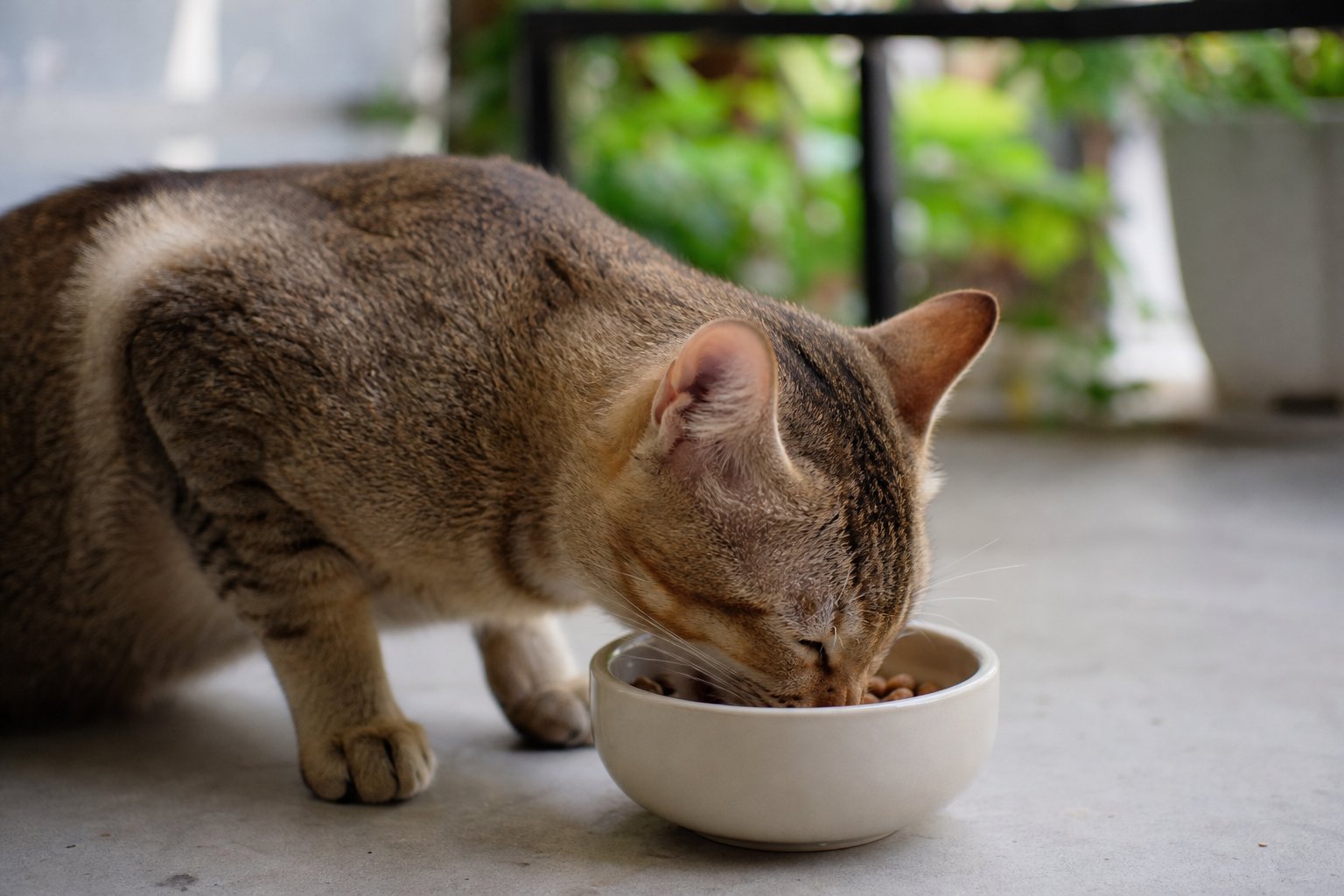
Quick answer: A staple cat can must carry a "Complete & Balanced" statement, meet published feline nutrient profiles, and deliver at least 10% protein as-fed, low carbohydrate, clear meat sources and added taurine. Most plain fish and soup cans fail that test. Price is no guide — read the can, then confirm with your vet or retailer.
Staple can vs supplementary can: the label decides
A staple can is formulated so that one can, eaten on its own, covers everything a cat needs — protein, fat, vitamins, minerals and taurine — in line with recognised feline nutrient profiles such as AAFCO's. It is built to be the everyday meal, day after day, for years.
A supplementary can is designed as an extra, not a meal. It may still be rich in meat and protein, yet remain nutritionally incomplete: calcium and phosphorus sit out of balance, some vitamins and minerals are missing, and taurine is often absent. Fed for a short while it looks harmless. Fed long term it produces nutrient deficiency, and growing kittens are the first to suffer from a poor calcium-to-phosphorus ratio.
| Staple can | Supplementary can | |
|---|---|---|
| Nutrition | Complete and balanced to published profiles | Incomplete by design |
| Daily use | Yes, as the main meal | Only as a topper or treat |
| Label wording | "Complete & Balanced" | No such statement — often just "in jelly", "in broth", "topper" |
| Long-term feeding | Suitable | Not suitable; imbalances build up over months |
The commonest trap is the plain fish can. Tuna and white-fish cans are frequently very high in protein but low in fat, comparatively high in carbohydrate from thickeners and glues, and missing added taurine. A beautiful, well-priced fish can is still a supplementary can if the label does not say it is complete. Owners who never turn the can around can feed a treat every day for years without realising it.
Five checks before it goes in the basket
- First ingredient is a named meat — chicken, salmon or tuna written plainly, not a vague "meat by-products" or "animal derivatives".
- Protein at least 10% as-fed — the basic floor for a staple can; nearer 12% is better.
- Low carbohydrate, around 5% or less on a dry-matter basis — cats are obligate carnivores, so rice, wheat, starch and gum fillers should be minimal.
- Moisture 75% or more — the built-in advantage of wet food, supporting hydration and urinary tract health.
- Taurine plus a vitamin and mineral premix — taurine is essential for cats and must appear in the guaranteed analysis or the ingredient panel.
Commit this to memory: high protein, low carbohydrate, high moisture, clear meat source, taurine present. If any one of the five fails, find out why before you pay. A can that is strong on three and weak on two is not a bargain.
Reading the guaranteed analysis (and doing the maths)
Turn the can around and find the guaranteed analysis panel. A complete product normally lists moisture, crude protein, crude fat, crude fibre and ash, with some brands adding phosphorus, magnesium and sodium. If all you can find is a single line such as "crude protein (min) 8%", the product is almost certainly a supplementary can.
Then adjust for water, because wet food is mostly water and the headline number is misleading:
Canned food showing 10% protein with 85% moisture: dry-matter protein = 10 ÷ (100 − 85) × 100 ≈ 67%.
That is a genuinely high-protein food. Always convert both products to a dry-matter basis before comparing them; otherwise you will misread a wet can as weaker than a dry one.
Taurine deserves its own line. The standard minimum for canned food is roughly 0.20% on a dry-matter basis, about double the 0.10% expected of dry food, because the high heat and pressure used to sterilise cans destroys some taurine in the process. A can with no taurine listed and no complete nutrition statement cannot be your cat's sole diet.
Choosing brands: check each can, not each shelf
International lines that come up repeatedly in this category include Kakato, Applaws, Almo Nature and Ziwi Peak. Broadly, Kakato is positioned on natural ingredients with a wide flavour range, Applaws on plain meat with minimal filler, Almo Nature on varied meat sources from different origins, and Ziwi Peak on a high-protein, low-carbohydrate recipe from New Zealand. Recipes and stock change, so treat those as starting points and read the individual can in your hand.
| Brand | Common positioning | What to verify on the can |
|---|---|---|
| Kakato | Natural ingredients, many flavours | Complete-and-balanced statement, taurine |
| Applaws | Plain meat, minimal filler | Which range: staple line or complementary line |
| Almo Nature | Varied meat sources | Nutrition statement for that specific SKU |
| Ziwi Peak | High protein, low carbohydrate | Energy density and feeding amount for your cat's weight |
Two practical rules follow:
- One brand often runs two ranges. A neighbouring SKU on the same label may only say "chicken in broth". Assume nothing; check every can you pick up.
- Rotate two or three staple flavours or brands. Protein and fat sources differ between products, so variety broadens nutrition and softens the shock of a change. Rotate gradually, never in a single day.
On cost: prices move between retailers and over time, and a higher price does not signal a staple formulation. Compare by kilogram, or by cost per 100 kcal if the pack states energy. For current local pricing, ask your Malaysian vet or a trusted pet retailer — and never assume the premium tin is the complete one.
How much to feed, and how to mix
A healthy 4 kg adult cat needs roughly 250 kcal a day, though age, activity and body condition shift that figure. On a wet-food basis, most adults take about 150–250 g of staple can daily, split across two or three meals. Total water intake sits around 50–60 ml per kilogram of body weight per day, including the water already in the food.
Mixing dry and wet is normal and practical. Estimated food moisture for a 4 kg cat on 250 kcal:
| Daily plan (energy split) | Moisture from food | Suits |
|---|---|---|
| All dry (100 : 0) | about 6 ml | Budget-first, free-feeding homes |
| Mostly dry (70 : 30) | about 85–95 ml | The common compromise |
| Half and half (50 : 50) | about 135–145 ml | Cats with urinary or kidney risk |
| All wet (0 : 100) | about 260 ml | Cats refusing dry food, or with mouth problems |
Figures assume dry food at 8–12% moisture and staple cans at 78–88%. Supplementary cans never count toward the staple portion.
Use them as intended: a flavour topper or reward, roughly a third to half a can mixed into the main meal, and no more than 10–15% of total daily calories. A bowl of complementary food quietly replacing the staple meal is exactly how nutrient deficiency starts.
Switching food: seven to ten days, and five myths to drop
Transition slowly. A workable pattern: replace one meal with wet food on day one, then lift the wet share by about a fifth every couple of days, holding steady or stepping back if stools soften. Sensitive stomachs may need longer. Mild soft stool during the change is common; if it persists beyond two weeks, review which product does not suit your cat, or ask a vet.
Five beliefs worth clearing up:
- "It's wet, so it must be good." Incomplete food still leaves a cat looking full while calcium and taurine fall short.
- "Expensive means complete." Price reflects brand, meat source and processing. Only the nutrition statement tells you the feeding class.
- "If he loves it, it must be right." Palatability often comes from fat or additives. Preference is not evidence of balance.
- "Wet food means no water bowl." Keep fresh water available at all times, especially for older cats with reduced kidney reserve.
- "Skip meals to make him eat." Withholding food is risky for cats; a cat that stops eating for long periods can develop serious liver problems. Use a gradual transition instead.
Freshness rules for opened cans
Tropical heat shortens every safe window, so handle wet food firmly:
- Serve promptly. In a Kuala Lumpur apartment without strong air-conditioning, do not leave opened wet food out beyond about an hour, and less in hot, humid weather.
- Refrigerate the remainder in a sealed container and use it within 24–48 hours. Date-label it so nothing unidentifiable lingers at the back of the shelf.
- Warm before serving. Let it reach room temperature or stir in a spoon of warm water at around 35–40°C. Straight-from-the-fridge food is often refused. Avoid microwaves — heating is uneven and can scald the mouth.
- Wash the bowl daily. Wet residue builds bacteria far faster than dry food does.
- Inspect before opening. Bulging, rust, leaks, deep dents, a broken seal or an expired date means discard, unopened. Never take the chance.
Humidity also affects the dry half of the diet. During the Penang rainy season, keep kibble in a sealed container and check for a stale smell or clumping before you serve it.
When to see a vet
Stop experimenting on your own if you notice any of these:
- Refusal of even the usual favourite food for more than a day
- Repeated vomiting, persistent soft stool or blood in the stool
- Noticeable weight loss, low energy or a dull coat over a short period
- A male cat straining, crying or producing no urine — this is an emergency
- Suspected eating of an expired, swollen or foul-smelling can, or sudden excessive thirst with a clear change in urine output
Vet disclaimer: This article is general nutrition information only and is not a diagnosis, treatment or diet prescription. Any cat with an illness, or any feeding plan for a sick cat, should be set by a registered veterinarian.
What to do this week
- Turn every can you already own around: does it say "complete and balanced"? If not, demote it to a topper today.
- Pick two staple flavours and buy small cans first; watch appetite, stool quality and vomiting for two weeks.
- Write a 7–10 day transition plan instead of switching everything at once.
- Record weight weekly on the same scale, and note body condition rather than chasing a number.
- Date-label opened cans in the fridge so you always know what is what.
- Ask your vet or a trusted retailer for current local prices and energy figures when you compare products.
- For trustworthy public pet-care reading, the Department of Veterinary Services Malaysia (dvs.gov.my) and SPCA (spca.org.my) both publish guidance for owners.
Related reading
- Cat Food Guide Malaysia 2026: How to Choose Dry, Wet & Prescription Food
- Cat Food in Malaysia: How to Read the Label, Compare Protein and Budget Monthly
- Wet vs Dry Cat Food in Malaysia: Water, Cost and How to Choose
- ACANA Cat Food in Malaysia: Is This Canadian High-Protein Kibble Right for Your Cat?
- Carrageenan and Gums in Malaysian Cat Food: What the 6 Common Thickeners Actually Do
- Cat Calorie Calculator Malaysia: RER & MER Formulas, Wet/Dry Food Grams
- Cat Calorie Calculator Malaysia: RER and MER Formulas, Plus Grams of Dry and Wet Food
- Cat Food Recommendation Malaysia: 8 Scenarios, Label Checks and Daily-Cost Thinking
- Cat Food Transition in Malaysia: The 10% Rule, a 10-Day Plan and Loose Stool Fixes