
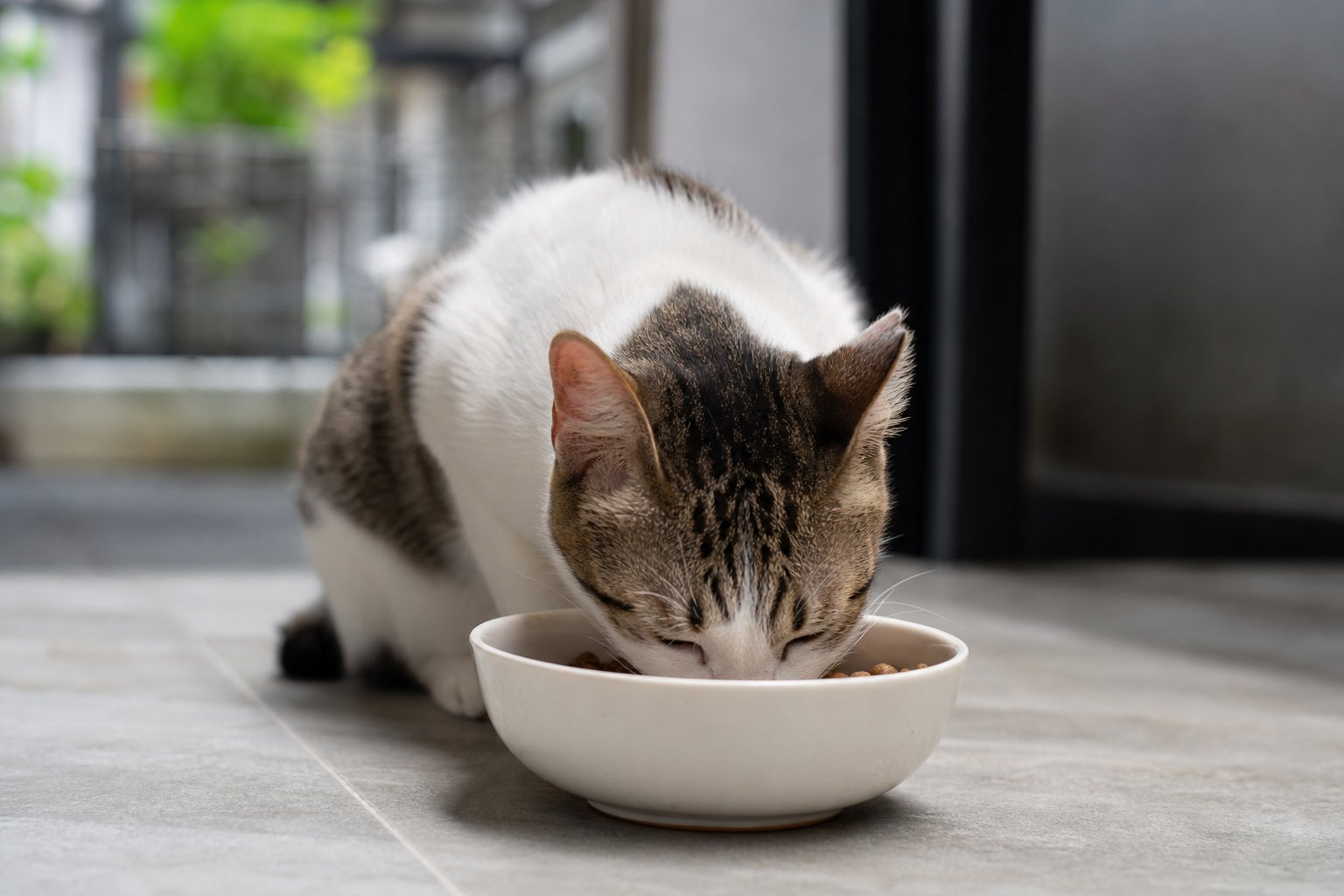
Grain-free is a marketing phrase, not a nutrition standard. It tells you that a recipe leaves out wheat, corn, rice, barley and oats, and nothing more. It does not mean low carbohydrate, it does not mean allergy-proof, and it does not mean the food is complete and balanced. What actually matters is the quality of the protein, the estimated carbohydrate load, the taurine level, and whether the bag carries an adequate nutrition statement for your cat's life stage.
What "grain-free" actually means on the bag
Start with the ingredient list. When a food is labelled grain-free, the recipe has no cereal ingredients listed: no wheat, no corn, no rice, no barley, no oats. That is a statement about what was left out, not a statement about what went in.
Something always has to take the place of the cereal, and in most grain-free dry foods those replacements are starchy vegetables and legumes. Potato, sweet potato, lentils, peas and tapioca are common. They are not grains, so the grain-free claim stays true, but they are still carbohydrate sources that raise the total carbohydrate load of the finished diet.
The second thing to notice is what the label does not say. There is no regulated category called grain-free in the recognised pet food nutrient profiles. Grain-free is not a grade, not a certification and not a nutritional tier. Two foods can both be grain-free and be completely different in protein content, carbohydrate content, moisture and price.
For cats, the underlying point is simple: cats are obligate carnivores. Their diet is built around animal protein and fat. The numbers that decide whether a diet suits a cat are the protein level, the protein quality, the fat level, the carbohydrate estimate, moisture content and mineral balance. Whether a cereal appeared anywhere in the recipe is, by itself, close to irrelevant.
| Label claim | What it really tells you | What it does not tell you |
|---|---|---|
| Grain-free | No wheat, corn, rice, barley or oats in the recipe | Nothing about carbohydrate level, protein quality or completeness |
| Low carbohydrate | The carb estimate is below the stated threshold | Nothing about whether the diet is balanced or palatable |
| High protein | Crude protein percentage is high | Nothing about digestibility or the amino acid profile |
| Complete and balanced | The food meets a recognised nutrient profile for a life stage | Nothing about marketing claims such as grain-free |
| Veterinary / prescription | Sold through clinics for specific dietary management | Not automatically better for a healthy cat |
Grain-free is not the same as low-carbohydrate
This is the single most common misunderstanding in the pet food aisle. A grain-free recipe can carry exactly the same carbohydrate load as a recipe containing brown rice, because the grains were simply swapped for other starches.
You can work out a rough carbohydrate figure yourself from the guaranteed analysis printed on the pack. Take the percentages for crude protein, crude fat, crude fibre, moisture and ash. Add them together, then subtract the total from 100. What remains is an estimate of the nitrogen-free extract, which is a proxy for carbohydrate content.
Worked example: a dry food states crude protein 38 percent, crude fat 18 percent, moisture 10 percent, ash 8 percent. Those add up to 74 percent, leaving roughly 26 percent as carbohydrate-related material. Now check a grain-free dry food with the same figures. The result is identical. The absence of rice changed nothing about that number.
A second worked example: a wet food states crude protein 10 percent, crude fat 5 percent, moisture 80 percent, ash 2.5 percent. The total is 97.5 percent, leaving about 2.5 percent. That low figure comes from the high water content, not from the grain-free claim. Water dilutes everything, which is precisely why canned food usually looks better on a carbohydrate estimate and why moisture is a genuine nutritional advantage for cats that do not drink enough.
Useful rules of thumb when you compare:
- Dry foods typically land in a higher carbohydrate range than wet foods, grain-free or not.
- A grain-free dry food and a rice-based dry food in the same price tier often sit within a few percentage points of each other.
- If reducing carbohydrate is your actual goal, wet food, frozen-dried or air-dried formats get you there more directly than any label claim.
- Percentages on the pack are minimums and maximums as declared, so treat your calculation as an estimate, not a laboratory result.
The practical habit to build: ignore the front of the pack, turn it over, and do the arithmetic. Two minutes of subtraction tells you more about the food than the words grain-free ever will.
Grain-free and AAFCO are two separate questions
Nutritional adequacy is judged against a published nutrient profile. In international practice that profile is defined by AAFCO, and the same minimums are widely referenced by manufacturers and veterinarians. The profile sets floors for crude protein, crude fat, essential amino acids such as taurine, minerals, vitamins and other nutrients, for specific life stages: growth and reproduction on one side, adult maintenance on the other.
None of those floors mention grains. A recipe can contain rice and still meet every requirement. A recipe can be grain-free and miss one. This is why the phrase complete and balanced, together with the life stage it applies to, is the only adequacy claim worth reading closely.
What to check on the pack, in order:
- Is there a complete and balanced statement, and which life stage does it name?
- Is your cat in that life stage? A growing kitten needs a growth-stage diet; an adult neutered cat needs an adult maintenance diet.
- Does the manufacturer state who formulates and quality-controls the diets, and is contact information provided? Reputable companies answer questions about their feeding trials and nutrient testing.
- Are taurine levels declared or guaranteed? Cats cannot synthesise enough taurine themselves, so it must come from the diet.
If a bag of grain-free food carries no adequacy statement at all, treat it as a snack or complementary food no matter how premium the ingredient list looks.
The heart question: DCM, peas and taurine
In 2018 the United States FDA began investigating a possible link between certain diets and dilated cardiomyopathy, a heart muscle condition. The diets under review were characterised by being grain-free and by having ingredients such as peas, lentils or potatoes listed high in the ingredient deck. Subsequent updates made clear that a cause had not been established and that more research was needed. The agency explicitly advised against panic-driven diet changes.
Two points keep the discussion proportionate for cat owners.
First, the investigation centred largely on dogs. The feline picture is different, and in cats dilated cardiomyopathy has historically been most strongly associated with taurine deficiency. Cats have a limited ability to produce taurine from other amino acids, so they depend on dietary supply. Recognised nutrient profiles therefore set taurine minimums for cat food, expressed on a dry matter basis, around 0.10 percent for dry food and 0.20 percent for canned food.
Second, the useful response is not to fear legumes. The useful response is to verify that the food you feed meets a recognised profile with adequate taurine, and to keep your cat at a healthy body condition. A grain-free label neither raises nor lowers your cat's cardiac risk on its own.
If your cat already has a heart condition, diet decisions belong entirely with your veterinarian, who may recommend specific cardiac or renal-support formulas and monitoring.
Why grain-free costs more, and what you are paying for
Prices differ between brands, formats and stores, and they change over time. Local retail prices vary, so check current pricing with your Malaysian vet or a pet retailer near you rather than relying on any figure quoted online.
The direction of the difference is consistent, though. Grain-free dry foods usually sit at a higher price per kilogram than comparable cereal-based foods in the same tier. Three forces push the price up:
- Ingredient cost. Lentils, peas, sweet potato and certain meat meals cost more than rice or corn, and grain-free recipes often emphasise named meat sources.
- Marketing and positioning. Grain-free is sold as a premium benefit, and packaging, sampling and shelf placement reflect that.
- Format. Canned, frozen-dried and air-dried foods are inherently more expensive per kilogram than extruded dry food, and most of them are grain-free anyway, so the premium blends together.
A smarter way to compare is cost per day, not cost per bag. Divide the price per kilogram by the daily grammes your cat actually needs. A more energy-dense food means your cat eats fewer grammes a day, so a pricier bag can work out closer than it first appears. Conversely, an expensive grain-free food that your cat will not eat is simply expensive food that goes stale in the cupboard.
Ask retailers for the price per kilogram, compare like formats with like formats, and decide whether the ingredient changes are worth the difference for a healthy adult cat. In many cases, a well-formulated cereal-containing food at a lower price is entirely adequate.
Which cats genuinely benefit from grain-free
Not every cat needs it, and not every cat is helped by it. Use this as a discussion guide rather than a prescription.
| Situation | Practical approach |
|---|---|
| Documented reaction to a specific cereal ingredient | Grain-free is a reasonable option, but still confirm the complete and balanced statement and overall formula |
| Goal is lower carbohydrate or higher meat proportion | Judge by protein and fat percentages and the carb estimate, not the grain-free label; wet or dried formats help more |
| Healthy adult cat, budget-conscious | There is no need to pursue grain-free; an adequate profile diet can be perfectly suitable |
| History of urinary or kidney issues | Base the choice on phosphorus, magnesium, sodium levels and your vet's instructions, never on a grain-free claim |
| Kitten or senior cat | Check the life stage standard and protein quality; grain content is a separate issue |
| Fussy or underweight cat | Palatability and calorie density matter more than the label; a diet the cat actually eats wins |
If you suspect a genuine food allergy, the correct tool is a structured elimination trial: a single novel protein or a hydrolysed protein diet, fed exclusively for 8 to 12 weeks under veterinary supervision, followed by a deliberate rechallenge. Simply swapping one grain-free brand for another rarely identifies anything, because the trigger is usually a common animal protein rather than a cereal.
How to switch foods without upsetting the stomach
Whether you are moving from grain-free to a cereal-containing food, or the other way round, the process is the same. Cats are creatures of habit, and abrupt changes are a common cause of vomiting and diarrhoea at home.
A simple transition plan:
- Days 1 to 3: 75 percent current food, 25 percent new food.
- Days 4 to 6: 50 percent each.
- Days 7 to 9: 25 percent current food, 75 percent new food.
- Day 10 onwards: 100 percent new food, provided stools stay normal.
Extend the timeline if your cat is sensitive, or if the change is driven by a medical reason. Watch three things: stool consistency, vomiting frequency and appetite. Soft stools for a day or two are common; persistent diarrhoea, refusing meals, or vomiting more than once a day is not normal.
Two extra points for Malaysian households. Warm, humid weather shortens the shelf life of opened dry food, so store it sealed, cool and dry, and discard food that has gone stale or oily. And if your cat is used to a specific bowl position or feeding time, keep those constant while the diet changes so you are testing one variable at a time.
When to see a vet
Food choices become medical decisions quickly. Arrange a veterinary consultation if you notice any of the following:
- Repeated vomiting, diarrhoea or constipation lasting more than a day or two
- Itching, hair loss, scabs or recurrent ear infections that might point to a food allergy
- Sudden weight loss or weight gain, or a cat that has stopped eating
- Increased thirst and urination, which can signal kidney or metabolic problems
- Lethargy, hiding, or any change in behaviour alongside a diet change
- Any cat with heart, kidney, urinary or diabetes history before you change diet
Bring the packaging or a photo of the ingredient list and guaranteed analysis to the appointment. That gives your vet concrete information instead of guesswork, and makes the conversation much faster.
Frequently asked questions
Is grain-free food automatically better for my cat? No. Grain-free describes an ingredient exclusion, not nutritional quality. A complete and balanced cereal-based diet can be more suitable than a poorly formulated grain-free one. Judge foods on their nutrient profile, protein quality, moisture and your cat's individual health needs.
How can I estimate the carbohydrate content at home? Add protein, fat, fibre, moisture and ash percentages from the guaranteed analysis, then subtract from 100. The remainder is a rough carbohydrate estimate. Remember this is an approximation, and wet foods will always look lower because of their water content.
My cat eats only dry food. Is that a problem? Dry food is convenient and economical, but it provides little moisture. Encourage drinking with multiple water bowls away from the food, a fountain, and consider adding wet food to the diet. Discuss urinary and kidney health with your vet if intake seems low.
Should I rotate between different foods? Some owners rotate to reduce the risk of developing intolerances, but abrupt changes cause stomach upset. If you rotate, do it gradually, stick to foods that meet the same nutritional standard, and keep a written record of what your cat tolerated well.
Do expensive imported brands guarantee better nutrition? No. Price reflects ingredients, format, marketing and distribution. What matters is the nutrient profile, the manufacturer's quality control and whether your cat does well on it. Ask your vet or a knowledgeable retailer for the guaranteed analysis rather than judging by the shelf price.
Where can I check official guidance in Malaysia? Start with the Department of Veterinary Services Malaysia for animal health and import requirements, and the SPCA for general pet care education. Your own veterinarian remains the best source of advice tailored to your cat.
This article is general nutrition information and is not a diagnosis or a prescription. Every cat is different. If your cat has symptoms, is on a special diet, or you are unsure which food to choose, please consult a registered veterinarian.
Related reading
- Cat Food Guide Malaysia 2026: How to Choose Dry, Wet & Prescription Food
- Cat Calorie Calculator Malaysia: RER and MER Formulas, Plus Grams of Dry and Wet Food
- ACANA Cat Food in Malaysia: Is This Canadian High-Protein Kibble Right for Your Cat?
- Carrageenan and Gums in Malaysian Cat Food: What the 6 Common Thickeners Actually Do
- Cat Food in Malaysia: How to Read the Label, Compare Protein and Budget Monthly
- Cat Food Recommendation Malaysia: 8 Scenarios, Label Checks and Daily-Cost Thinking
- Orijen Cat Food Review Malaysia 2026: High-Protein Kibble, Ingredient Breakdown & Feeding Guide
- Phosphorus and Kidney Diets for Cats in Malaysia 2026: IRIS Targets, mg/100 kcal Conversion and Prescription Food Choices
- Cat Calorie Calculator Malaysia: RER & MER Formulas, Wet/Dry Food Grams