
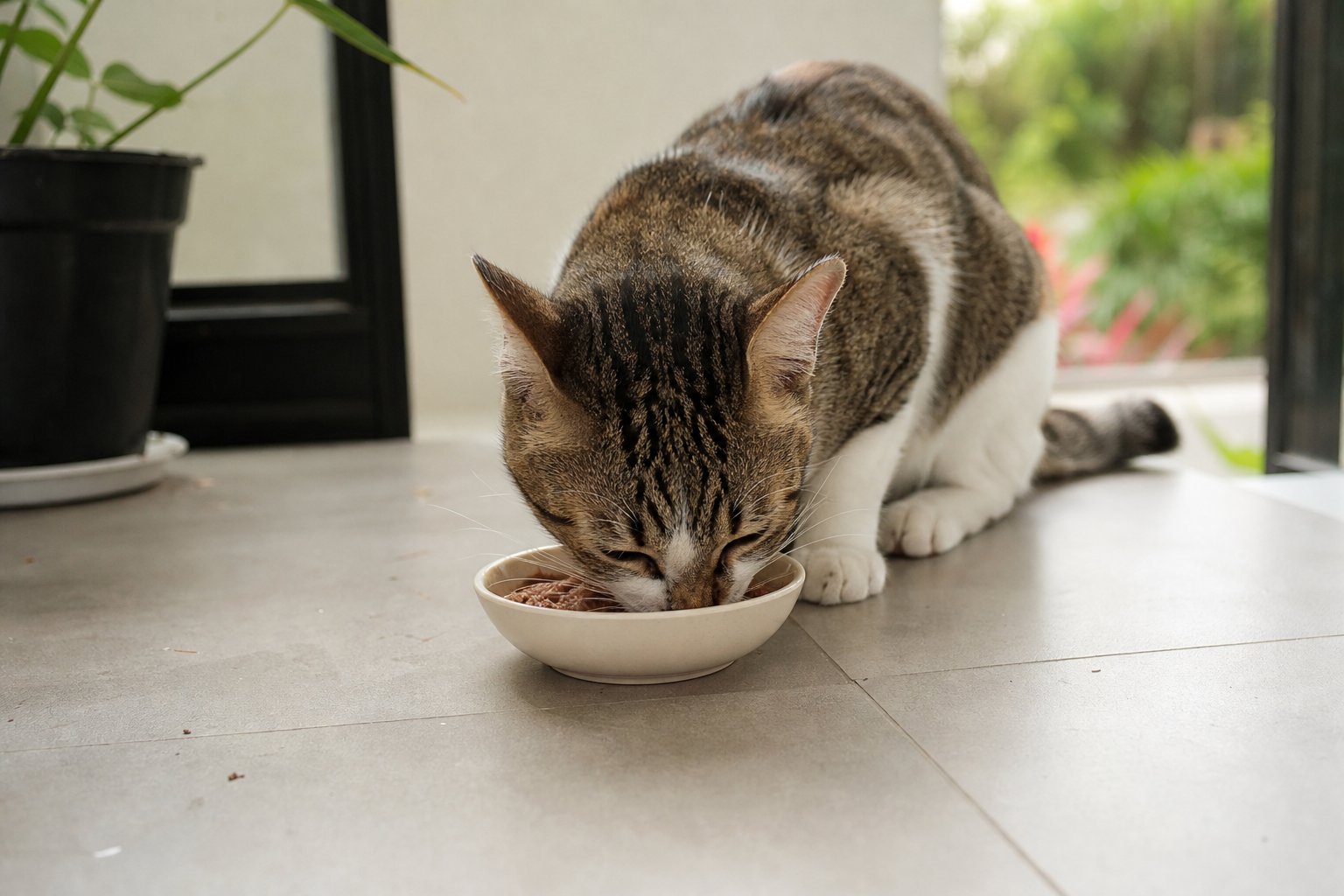
Quick answer: switch your cat's food gradually. Replace only 10% of the old food with the new one at a time, then add 5–10% more each day as long as the stool stays firm. Most healthy cats finish in 7–10 days; sensitive stomachs need 2–4 weeks. The moment stools soften, stop increasing and hold your position. Slow and steady wins this race every time.
Why a gradual change protects your cat's gut
Your cat's digestive tract runs on a settled community of gut microbes that have learned to break down the food currently in the bowl. Swap the diet abruptly and that community has no time to adjust — the result is often soft stool, vomiting or a bout of diarrhoea within a day or two. Abrupt dietary changes are one of the most common avoidable triggers of gastrointestinal upset in cats.
The same principle applies beyond the main meal. Every new protein, new can, new treat or new topper is a dietary change, and each one deserves the same cautious introduction. Done properly, slow transitions do something useful in return: they build a repertoire of foods your cat tolerates. A cat that has calmly accepted several proteins and textures over the years is far easier to feed if a brand is discontinued or a formula is reformulated.
One precondition matters: if your cat's stools are already unreliable before you start, deal with that first. A transition layered on an unsettled gut makes the cause of any problem impossible to identify. Stabilise the current diet, confirm normal stools for several days, then begin.
The 10% rule: your day-by-day plan
Decide the ratio first, then weigh out the food. Each step lasts 24 hours, and each day you read one clear signal — the litter tray. Firm stool means you may increase; soft stool means you hold.
| Days | Old food | New food | Action |
|---|---|---|---|
| Day 1–2 | 90% | 10% | Start here; check every stool |
| Day 3–4 | 80% | 20% | Increase only if firm |
| Day 5 | 70% | 30% | Common point to pause |
| Day 6 | 60% | 40% | Keep monitoring appetite |
| Day 7 | 50% | 50% | Halfway milestone |
| Day 8 | 35% | 65% | Increase by small steps |
| Day 9 | 20% | 80% | Nearly there |
| [Day 10 | 0% | 100% | Transition](/articles/kitten-food-malaysia "mylink") complete |
For a sensitive cat, stretch every row to cover double the time — that turns the plan into a 2–4 week project. When the change involves a big shift in texture or moisture, such as dry to wet food or the reverse, allow at least two weeks because the gut is adjusting to more than one variable at once.
Practical preparation prevents rushed decisions. Buy the new food before the old bag runs out; running empty forces a sudden switch. Store the new pack sealed, in a cool spot away from direct light — in a Penang home during the rainy season, humidity is the real enemy of dry food, so an airtight container and a quick smell check before every scoop are worth the habit.
Mixing by calories, not by volume
This is where most transitions quietly go wrong. Dry food delivers roughly 3.5 kcal per gram; wet food delivers about 1.0 kcal per gram. Same weight, more than three times the energy. Scoop for scoop, you are not mixing what you think you are mixing.
Worked example: a 4 kg neutered indoor cat needs about 238 kcal a day (resting energy requirement 70 × 4^0.75 ≈ 198 kcal, multiplied by an activity factor of 1.2). On day 7 at a 50:50 ratio, each food must supply 119 kcal:
| Food | Energy share | Grams to serve |
|---|---|---|
| Old dry food (3.5 kcal/g) | 119 kcal | 119 ÷ 3.5 ≈ 34 g |
| New wet food (1.0 kcal/g) | 119 kcal | 119 ÷ 1.0 ≷ 119 g |
Now compare the careless version: 50 g of dry food plus 50 g of wet food gives 175 + 50 = 225 kcal, which is actually a 78:22 split — and the cat is quietly receiving less total energy than planned. To keep the maths simple, read the energy figure on the label (often printed as kcal/kg; divide by 1000 for kcal/g) and use one kitchen scale for both foods.
Loose stool: the four-step reset
Soft stool during a transition is information, not a disaster. Follow these four steps in order.
- Stop increasing. Hold the current ratio for 2–3 days and wait for stools to firm. Do not add more new food, and do not reduce back either unless diarrhoea develops — in that case, return to the last ratio that worked.
- Add plain pumpkin. About one teaspoon of 100% pure pumpkin per 4.5 kg of body weight — roughly one teaspoon for an average adult cat — can firm things up. Use plain steamed pumpkin or plain canned pumpkin with no seasoning, salt or syrup.
- Audit the treats. Soft stool is sometimes caused by something other than the bowl. Suspend every treat, topper and chew for three days and reassess. Treats still containing the old formula blur the picture further.
- Consider a probiotic. Adding a probiotic or digestive enzyme before you diversify the diet can make the gut more accepting of new foods. Ask a Malaysian vet or pet retailer which product suits your cat — brands, formats and prices vary locally, so check rather than assume.
Keep the rest of the household completely unchanged during this period: same litter, same routine, same people. If anything else changes at the same time, you will never know what caused the problem.
When to see a vet
Most transition hiccups resolve on their own within a couple of days. These do not:
- Diarrhoea lasting more than 24 hours, or any blood or mucus in the stool
- Repeated vomiting, or a cat that has eaten nothing for 24–48 hours
- Lethargy, hiding, or a noticeably flat attitude
- Straining in the litter tray, especially in a male cat — treat as urgent
- Any cat with kidney disease, diabetes, a urinary history, inflammatory bowel disease or a confirmed food allergy
A cat that stops eating entirely needs fast attention, because prolonged fasting in felines can lead to hepatic lipidosis, a serious liver condition. If your cat has a known medical condition, agree the transition plan with your vet before you start rather than after a problem appears.
Special situations
Kitten to adult food. Puppy-style logic applies here too: growth formulas are more energy-dense, so a direct swap can reduce total calories even though the bowl looks fuller. Take 10–14 days and recalculate daily portions against the cat's current adult weight.
Senior cats (7 years and older). Older guts tend to adapt more slowly. Plan 3–4 weeks, and watch weight and water intake alongside stool quality — unintended weight loss in a senior cat should never be written off as 'picky eating'.
Food reaction history. Introduce one new protein at a time, allow 2–3 weeks per protein, and record both skin condition and stool quality. Multiple proteins at once makes it impossible to identify the trigger.
Multi-cat households. Feed in separate rooms or at staggered times so one cat cannot finish another's portion. In a Kuala Lumpur apartment where two cats share a small kitchen, a closed bedroom for 20 minutes at mealtime is usually enough to make monitoring honest.
Meal-count changes. Moving from two meals to three, or the reverse, is a separate change. Leave at least two weeks between a completed food transition and a schedule change.
Dry to wet, or wet to dry. Moving to wet food means bowl drinking will drop — that is expected when roughly 75% of the meal is water. Moving to dry food means actively checking that drinking increases, since cats are not always reliable drinkers by nature.
Common mistakes that derail a transition
| Mistake | What goes wrong | What to do instead |
|---|---|---|
| Finishing within a week | Gut never establishes a new rhythm | Allow 7–10 days; 2–4 weeks if sensitive |
| Mixing by volume | Ratios and calories are both off | Weigh by grams after converting to kcal |
| Ignoring treats | Old ingredients mask the cause of soft stool | Pause all treats for three days |
| Changing several things at once | You cannot identify the trigger | One change at a time, two weeks apart |
| Starving a refusing cat | Risk of liver problems | Never go beyond 24 hours without eating |
| Adding probiotics while pushing on | Symptoms are masked, not solved | Stabilise first, then reassess |
Track it: the transition log
A two-minute daily note turns guessing into a pattern. Use a score of 1–5 for stool consistency, where 1 is watery, 2 is soft, 3 is well-formed, 4 is hard and 5 is dry pellets — aim for 3.
| Date | Old % | New % | Stool (1–5) | Appetite | Notes |
|---|---|---|---|---|---|
| Day 1 | 90 | 10 | 3 | Normal | Started |
| Day 3 | 80 | 20 | 3 | Normal | Increased |
| Day 5 | 70 | 30 | 2 | Normal | Soft → hold 2 days |
| Day 7 | 70 | 30 | 3 | Normal | Resumed increasing |
You have succeeded when three indicators line up: one to two well-formed stools a day, normal appetite, and stable weight. Hold the new food for at least four weeks afterwards, and note the brand and batch number so you can repurchase the same product or trace it if anything changes later.
If stools have never been stable, resolve that with your vet before attempting any change at all.
This article is general information only and does not replace veterinary diagnosis or treatment. If your cat has persistent diarrhoea, vomiting or refuses food, please consult your own veterinarian.
Related reading
- Cat Food Guide Malaysia 2026: How to Choose Dry, Wet & Prescription Food
- Cat Picky Eater Malaysia: Why Your Cat Refuses Food and What Actually Works
- ACANA Cat Food in Malaysia: Is This Canadian High-Protein Kibble Right for Your Cat?
- Carrageenan and Gums in Malaysian Cat Food: What the 6 Common Thickeners Actually Do
- Cat Calorie Calculator Malaysia: RER & MER Formulas, Wet/Dry Food Grams
- Cat Calorie Calculator Malaysia: RER and MER Formulas, Plus Grams of Dry and Wet Food
- Cat Food in Malaysia: How to Read the Label, Compare Protein and Budget Monthly
- Cat Food Recommendation Malaysia: 8 Scenarios, Label Checks and Daily-Cost Thinking
- Cat Gastroenteritis in Malaysia: Vomiting, Diarrhoea and Probiotics That Actually Have Evidence
- Cat Staple Canned Food in Malaysia: How to Pick a Complete & Balanced Wet Food