
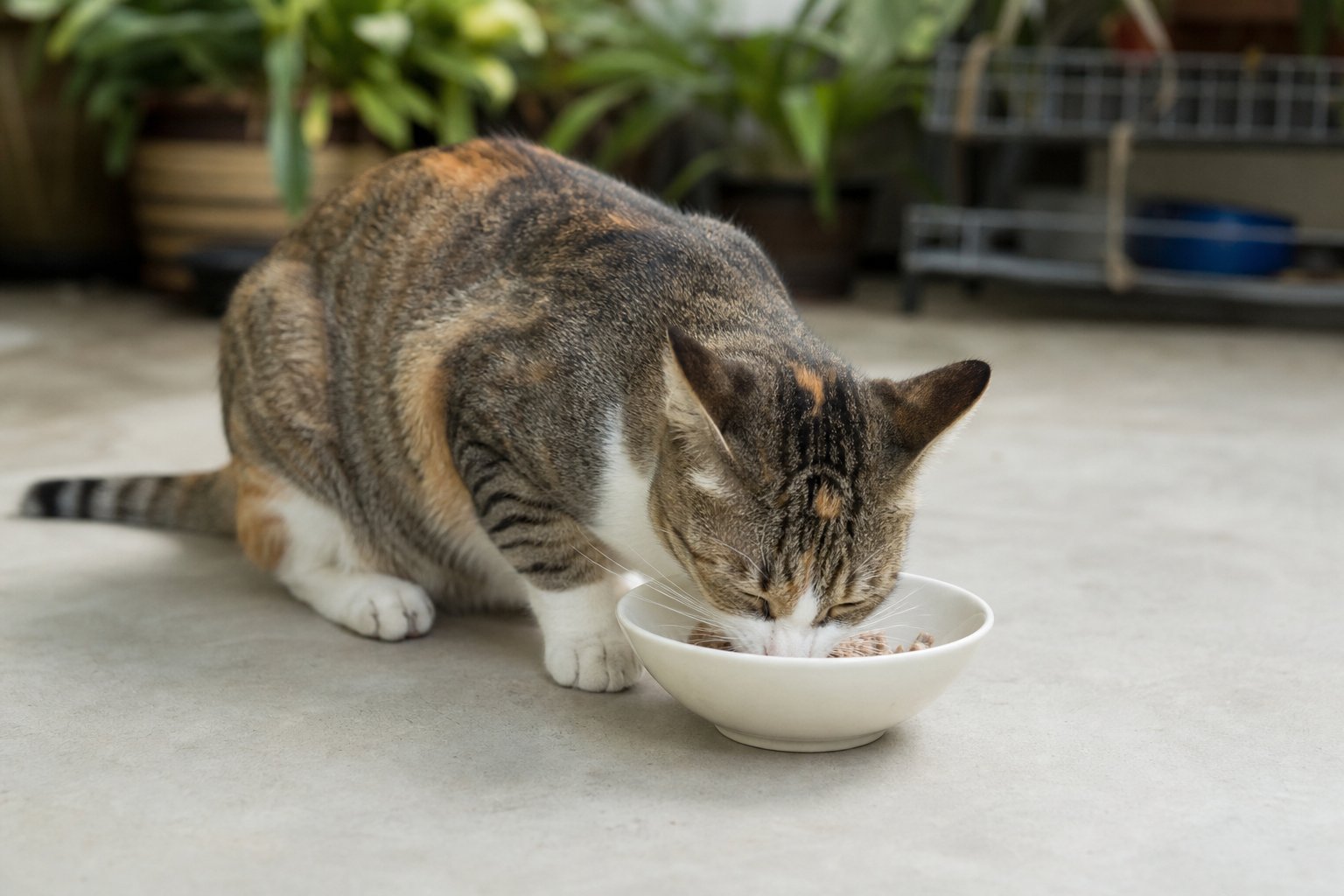
The short answer
Most picky eating comes down to smell, texture and routine — not attitude. Cats decide at the nose, so food that has gone cold, dried out or sat too long smells like nothing to them. Warm it slightly, change one variable at a time, feed on a fixed schedule, and rule out pain or illness first. A cat that stops eating for more than about a day needs a vet, not a new brand.
Why your cat judges food at the nose
Before a cat bites, it sniffs. Cats carry around 200 million olfactory receptors, far more than humans, so aroma does most of the work in deciding whether a bowl is food or a non-event. A bowl that has been sitting since morning has already lost most of its volatile aromatics; to a cat, that reads as stale. A freshly opened pouch wins not because the cat sees meat, but because the aromatic compounds are at their peak.
Taste is the second gate. Cats cannot detect sweetness — there is no reward in it for them — while bitterness is detected strongly, which is why medicated food can be rejected so quickly. They are also obligate carnivores with high needs for protein and fat, so a recipe that smells thin or low in fat can fail the aroma test even when its nutrition panel looks perfect.
The practical takeaways are simple:
- Aroma beats flavour. Design the smell first.
- Temperature controls aroma release. Warmer food smells stronger.
- Anything that dulls aroma dulls appetite — long bowl time, fridge-cold food straight from the container, powder sprinkled on top, or an old, half-empty pack stored badly.
This also explains a common complaint: the same recipe can be accepted in a mousse but refused as a kibble, or accepted on day one and ignored on day four. Palatability is not a brand property. It is a match between one cat and one format, at one temperature, on one day.
Medical or behavioural? Screen six causes first
"Not eating" is a symptom with many different causes. Sort the cause before you change the food, or you will keep testing brands at random.
| Possible cause | Clues to look for | What to do first |
|---|---|---|
| Mouth or tooth pain | Eats two mouthfuls then stops, chews on one side, drools, bad breath | Vet check of the mouth; do not self-prescribe pain relief |
| Blocked nose / upper respiratory | Sneezing, discharge, no interest in any food because nothing smells | Follow veterinary treatment; use strongly aromatic food short-term to encourage intake |
| Upset stomach or nausea | Stares at the bowl, lip-licking, vomits after eating, loose stools | Seek veterinary care within 24–48 hours; note what was fed |
| Chronic illness (kidney, thyroid, diabetes) | Weight or drinking changes, appetite swinging up and down | Blood tests for a diagnosis; adjust diet only on veterinary advice |
| Habit and training | Only one brand, only dry or only wet, waits for treats | Scheduled meals, 10% transition method, treats capped at 10% of calories |
| Stress or environment | Move to a new home, a new person or pet, bowl in a busy area | Quiet corner, separate feeding for multi-cat homes, fixed meal times |
Keep a three-day record: grams or pouches eaten, stool quality, any vomiting, energy and interaction. After three days, most owners can tell whether the change was sudden (leans medical) or long-standing (leans behavioural). Sudden refusal combined with low energy, vomiting or weight loss means stop trialling new foods and contact a vet.
In a Kuala Lumpur apartment, stress causes are frequently overlooked: the bowl may sit beside a washing machine, a busy kitchen passage or the litter tray. Simply relocating the bowl to a quiet, low-traffic corner — and moving it away from the litter area — can restore interest without changing a single product.
Three levers: aroma, temperature, texture
Palatability is not magic. It breaks into three variables you can adjust, one at a time.
Lever one — aroma. Aroma sources generally fall into four groups: meat broths, hydrolysed proteins, yeast extracts and animal fats. Labels carrying words like broth, hydrolysed or yeast usually signal deliberate aroma design. Fat matters too, because fat carries aroma; a noticeably low-fat recipe often smells flat. Storage matters as much as formulation — once a pack is open, aromatics fade, so reseal properly, keep it in a cool dry place, refrigerate wet food if the pack says so, and use it within the stated period.
Lever two — temperature. The single cheapest fix is warming. Bring food to about 30–35°C, warm to the touch but not hot. For kibble, stir in one to two tablespoons of warm water. For wet food, stand the closed pouch or tin in warm water for two to three minutes. Avoid microwaves: they heat unevenly, create hot spots that can burn a cat's mouth, and degrade both texture and aroma. Never use boiling water, and do not leave watered-down food sitting longer than 30 minutes, especially in humid weather.
Lever three — texture. The same protein delivered as pâté, mousse, shreds in gravy or a crunchy kibble can score completely differently. Cats with sore teeth generally prefer soft, smooth textures; cats that love licking the gravy respond to broths and jelly-topped foods; some cats genuinely want the crunch of kibble. Change texture gradually too — never swap the whole format in a single day.
The rule that makes this system work: change only one lever at a time. If you switch brand, texture and feeding spot in the same week and your cat improves, you will never know what helped. If it worsens, you will never know what caused it.
The 10% transition plan for fussy cats
Cats with sensitive stomachs and short food memories need a slow swap. The base method: replace 10% of the old food with the new, then add another 5–10% per day as long as stools stay normal, until the swap is complete.
| Day | Old food | New food | What to watch |
|---|---|---|---|
| 1–2 | 90% | 10% | Does the cat eat through the mix or push the new kibble aside? |
| 3–4 | 80% | 20% | Stools still formed? |
| 5 | 70% | 30% | Total intake down by more than 10%? |
| 6 | 60% | 40% | Selective eating — only the old pieces? |
| 7 | 50% | 50% | The hardest day; most refusals happen here |
| 8 | 35% | 65% | Stools and energy still normal? |
| 9 | 20% | 80% | Old food nearly finished |
| 10 | 0% | 100% | Maintain the new food for at least four weeks before judging |
Adjustments for fussy cats:
- Keep about 30% of the old food as a comfort zone early on. The familiar smell lowers suspicion.
- If it stalls, step back. Return from 50% to 30% and hold for 3–5 days rather than pushing daily.
- Do not change meal frequency at the same time. Separate the food switch from the schedule change by about two weeks, or you will not know which change caused a problem.
- Mix by calories, not by volume. Kibble and wet food differ greatly in energy density; equal weights give very different calorie totals, and a wrong ratio can quietly cut intake.
- Reorder before you run out. Forced, rushed transitions are the classic trigger for refusal and vomiting.
Soft stool during a transition usually means slow down, not give up. Hold the current ratio until stools firm up, then check whether treats — not the new food — were the real trigger. Persistent diarrhoea, vomiting or a refusal lasting more than 24 hours belongs in a consultation room, not a probiotic trial.
Ten fixes you can do today
- Warm the food to about 30–35°C to release aroma.
- Add one to two tablespoons of warm water to kibble — aroma and hydration in one step.
- Stir through a little broth or gravy to coat food that has gone uninteresting.
- Switch to a wide, shallow bowl. Whiskers touching a deep bowl can put some cats off eating.
- Serve 15–20 minutes, then remove the bowl. This is the foundation of everything else.
- Cap treats at 10% of daily calories and hand them out after meals, never instead of them.
- Place the bowl in a quiet corner away from foot traffic, appliances and the litter tray.
- Feed multi-cat households separately, in different rooms or at staggered times, so you can actually measure who ate what.
- Try the same protein in a different texture — kibble to mousse to pâté to broth — one step at a time.
- Weigh weekly, or daily during a change, so "eating less" never quietly becomes "losing weight".
Steps 1, 2, 5 and 6 are free, fast and usually the most revealing. Many owners discover the food was never the problem — the bowl had simply been sitting out too long, too cold and aroma-less.
In Penang's rainy-season humidity, bowls left out absorb ambient moisture and lose their crispness faster; kibble that softens and clumps in the heat will be rejected by cats that happily ate the same bag in drier weeks. Discard uneaten portions rather than topping up.
Trial feeding and how to read a label
Price does not equal palatability, but small-size trialling is the cheapest way to control risk. Buy one or two single sachets or tins of a candidate food, run a 3–5 day trial, record daily intake, refusals and stool quality, and only commit to a larger pack after three clean days. Local prices and pack sizes vary widely — check current pricing with your nearest Malaysian retailer or vet clinic rather than relying on any figure quoted online.
When comparing labels, look at four points:
- The first three ingredients. Meat or named meat meals listed first usually mean a stronger aromatic base.
- Protein and fat levels. Fat is the aroma carrier; very low-fat recipes tend to smell flat.
- Aroma-related wording. Broth, hydrolysed protein or yeast extract suggest the maker designed for smell, not just nutrition.
- Format and kibble size. Pâté and mousse suit seniors and dental cases; larger crunch suits cats that need texture variety.
This guide takes no position on any brand, and it is not a stockist, authenticity or endorsement statement. Product data and prices change; treat official labels and current retail listings as the authority. International names such as ZiwiPeak or Country Naturals appear widely in the market, but availability and pack formats differ by store.
Meals, snacks and the two-week reset
Free-feeding is the hidden engine of fussy eating. A cat with food available all day has the luxury of waiting for something better, and it will. Adult cats generally do best on two to three scheduled meals a day; kittens and seniors often need three to four smaller servings, with total calories kept adequate.
Place each meal for 15–20 minutes, then remove it. Within roughly two weeks of consistent scheduled meals, most cats stop holding out for treats and start eating what is served — provided you weigh them during the process so you can see intake is sufficient.
Snack discipline follows the same logic: keep treats under about 10% of daily calories, hand them out after meals, and stop using them to "make up" for a refused dinner. In a Johor terrace house with several cats, one fussy eater is often a cat that has learned to wait while another cat's bowl stays available — separate rooms and staggered meal times fix this faster than any product change.
When to see a vet
Picky eating and being too ill to eat are different problems. Take your cat in — rather than continuing to change food — if any of these appear:
- No food at all for more than 24–48 hours. Prolonged fasting in cats carries a real risk of hepatic lipidosis (fatty liver).
- Refusal accompanied by vomiting, diarrhoea, low energy, hiding or no interest in people.
- Drooling, one-sided chewing, marked bad breath, or flinching when the face is touched.
- Drinking and urinating much more than usual, or producing much less urine than usual.
- Eating more but steadily losing weight — a classic sign of an overactive thyroid and a reason to request blood work.
- Rapid weight loss, or a coat that deteriorates noticeably within weeks.
Follow veterinary advice on medication and diet: never add or stop medicines on your own, never use appetite stimulants without a prescription, and never accept "at least it is eating" as a reason to ignore an underlying cause. If a prescription diet is prescribed, the transition schedule may differ from a normal food switch — confirm it with your vet.
Before the appointment, bring seven days of notes: food offered and amounts eaten, water intake, stool descriptions, vomiting episodes and weight trend. That single sheet usually saves a consultation's worth of guessing.
Vet disclaimer: This article is general information for cat owners and does not diagnose, treat or replace a veterinary examination. Any change involving illness, medication or prescription diets should be confirmed with your own veterinarian.
Related reading
- Cat Food Guide Malaysia 2026: How to Choose Dry, Wet & Prescription Food
- Cat Food Transition in Malaysia: The 10% Rule, a 10-Day Plan and Loose Stool Fixes
- Cat Wet Food in Malaysia: How Many Cans a Day, Water Tips & Storage
- ACANA Cat Food in Malaysia: Is This Canadian High-Protein Kibble Right for Your Cat?
- Carrageenan and Gums in Malaysian Cat Food: What the 6 Common Thickeners Actually Do
- Cat Calorie Calculator Malaysia: RER & MER Formulas, Wet/Dry Food Grams
- Cat Calorie Calculator Malaysia: RER and MER Formulas, Plus Grams of Dry and Wet Food
- Cat Food in Malaysia: How to Read the Label, Compare Protein and Budget Monthly