
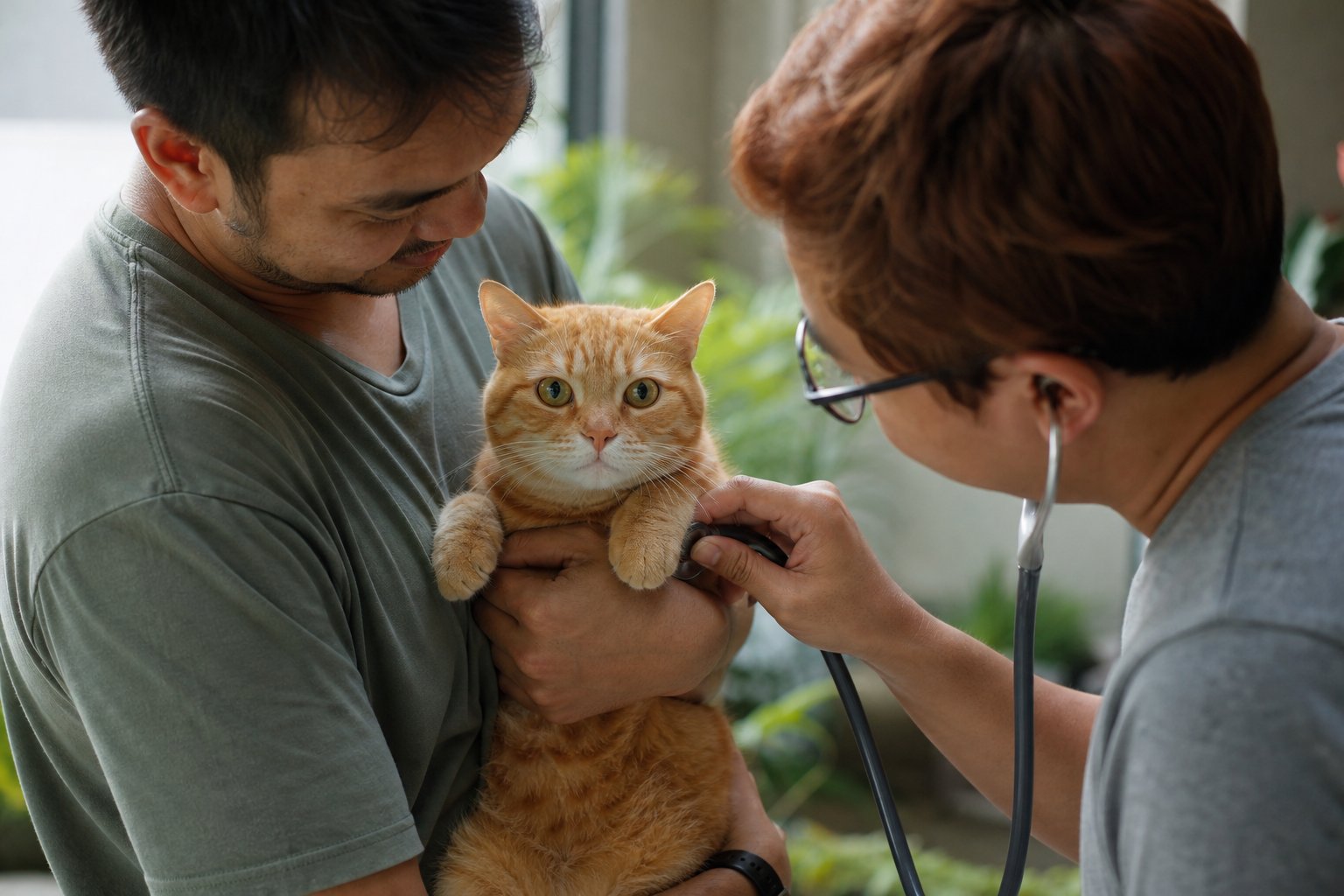
Quick answer: A healthy kitten adds about 10–20 grams a day through the first two months. Weigh on a kitchen scale at the same time daily, write the number down, and treat two flat days in a row as a signal to call a vet. Overweight begins at 15% above ideal weight.
Why weight is your kitten's health dashboard
A young kitten cannot tell you it feels unwell. It will not complain about an upset stomach, a low-grade infection or a feeding problem. What it will do is fail to grow.
Healthy milk-fed kittens that are eating well put on weight every single day. That consistent daily climb is the clearest outward sign that everything — intake, digestion, energy use — is working. When the climb stops, something has changed, and often weight stalls before any other symptom appears.
This is why weighing is not a cute diary exercise. It is monitoring. A scale reading is objective: it does not care whether your kitten was playful last night or whether its coat looks fluffier this week. For a creature that hides discomfort by instinct, the growth curve is the closest thing you have to a daily vital sign.
Keep the habit even after the frantic early weeks. The same routine that catches a failing appetite in a three-week-old will later catch the slow creep of post-desexing weight gain in an adult.
Standard kitten weight chart, birth to one year
These figures are population averages, not pass/fail marks. Individual kittens vary, and larger breeds such as Maine Coons will sit above the range while most domestic shorthairs fall inside it. What matters is the direction of your own kitten's line.
| Age | Typical weight | What is happening at this stage |
|---|---|---|
| Birth | 100–120 g | Eyes closed, finds milk by smell |
| Week 1 | 200–250 g | Navel area dries, rapid early gain |
| Week 2 | 250–300 g | Eyes open, hearing begins |
| Week 3 | Around 500 g | Milk teeth emerge, weaning starts |
| Week 4 | 500–700 g | Deciduous teeth nearly complete |
| 2 months | 700–1,000 g | Weaning finished |
| 3 months | 1,000–1,500 g | Adult teeth coming through, first vaccinations |
| 3 months–1.5 years | 1–5.5 kg | Growth phase, fastest early, slowing later |
| 1.5–7 years | 3.5–5.5 kg | Frame and weight settle |
Read the table alongside three rules of thumb:
- Daily gain matters more than the absolute number. A kitten slightly under the range but climbing 10–20 g a day is usually doing fine.
- Growth slows naturally. Gains are fastest before 3 months, steadier from 4–5 months, and essentially finished by 10–11 months.
- One reading proves nothing. A single low weigh-in after a hot afternoon or a skipped meal means little; a trend over a week means a lot.
Local prices for feeds, scales and supplements vary — check current figures with your Malaysian vet or a pet retailer before budgeting.
How to weigh your kitten at home
You do not need clinic equipment. A digital kitchen scale that reads to 1 gram is enough, and it will catch changes a bathroom scale cannot (bathroom scales are typically accurate only to about 100 g — useful for adult trends, useless for daily kitten gains).
Set-up
- Place the scale on a hard, level counter — never on a mat or carpet, which softens the reading.
- Put a shallow bowl or a folded towel on it and press tare/zero so the weight of the container disappears.
- Weigh at the same time each day, ideally before the first morning meal, so food in the gut does not skew the comparison.
If your kitten will not sit still
- Wait for a calm moment and read once the numbers stop jumping.
- If it refuses entirely, weigh yourself holding the kitten, then subtract your own weight. It is less precise, but far better than no data.
- After about six months most kittens no longer fit comfortably on a kitchen scale — switch to the hold-and-subtract method.
Log it immediately. A note on your phone or a simple spreadsheet with date, grams, appetite and any odd event is enough. After a month you will have a genuine growth curve instead of a vague impression.
Reading the growth curve: three calculations
Once you have a few days of numbers, three sums turn them into a verdict.
- Daily gain = today's weight − yesterday's weight. Target: +10 to +20 g per day in the early weeks.
- Weekly gain = day 7 weight − day 1 weight. Target: +70 to +140 g per week (10–20 g × 7).
- Overweight line = ideal weight × 1.15. An ideal 4 kg cat becomes overweight at 4.6 kg.
Worked example for the third sum: the top of the 3-month range is 1,500 g, so 1,500 × 1.15 = 1,725 g. A kitten at 1,650 g is above the average range but not yet past the obesity line — judge it by gain speed and waistline, not by one number, and do not rush to cut food.
How to interpret what you see:
- Steady +10–20 g daily: normal. Keep going.
- Gaining slowly but consistently: check portions. If the bowl is licked clean every time, raise the next meal by roughly a tenth.
- Two consecutive flat days: raise your alert level and check appetite, stool and energy.
- Any loss: do not wait and observe — contact a vet.
The other side: kittens can be too heavy too
Most new owners worry about thin kittens and forget the opposite risk. A cat more than 15% above its ideal weight is classified as obese, and obesity raises the risk of diabetes, heart disease, joint problems and certain cancers.
Practical checkpoints:
- Ribs should be findable with light pressure — you should not have to press hard.
- Viewed from above, a waistline should be visible; viewed from the side, the belly should tuck upward rather than hang flat.
- Growth is essentially complete around 10–11 months. Continued climbing after that point is usually fat, not frame.
- Desexing is the classic turning point. Metabolism slows after the surgery, so portions must be reviewed rather than left unchanged.
Self-audit questions: is your cat heavier than it was at one year? Are you unsure of its correct weight? Unsure of how many grams it eats daily? Can you not feel ribs or see a waist? Answering yes to more than one means it is time to discuss a weight plan with your vet.
Treats count. High-calorie training and lickable treats add up quickly — keep them to about a tenth of daily calories, and reduce the main meal to compensate.
When weight stalls: a troubleshooting order
Two flat days in a row should trigger a sequence, not panic. Work through it in order:
- Intake. Did the kitten finish the food? Still licking the bowl means the portion is too small — increase the next serving by about 10%.
- Food condition. Any recent switch to a new food? During weaning, is the gruel soft enough for a kitten with baby teeth?
- Stools. Diarrhoea or constipation? The litter tray is evidence — note it down.
- Energy. Is the kitten still playing? A kitten that has stopped playing has moved beyond a feeding issue.
- Environment. A move, a new person, a different litter brand or a disrupted routine can suppress appetite on its own.
If adjustments to points 1 and 2 produce no improvement within 48 hours, or if any of points 3 to 5 apply, stop experimenting and take the weight log to a vet. Appetite loss in a small kitten deteriorates quickly — a couple of days is not a safe waiting period.
Common weighing errors and multi-cat homes
Readings that look alarming are often measurement problems:
- Different times of day. Morning-before-food versus evening-after-food can differ by a noticeable margin. Fix the time.
- Unstable surface. Soft flooring or a wobbly shelf distorts the reading.
- Movement. Read only once the kitten is settled and the digits stop changing.
- Forgotten tare. If you placed a towel or bowl on the scale, you must zero it — otherwise you are weighing the towel as well.
Households with more than one cat have two extra traps:
- Feeding separation. Kittens and adults need different foods — feed in separate rooms, or place one bowl on a high surface the other cat cannot reach. Feeding everyone from one bowl shortchanges the kitten's nutrition density and overfeeds the adult.
- Identity mix-ups. Give each cat its own towel on the scale so the same familiar surface reduces resistance, and record the name next to the number straight away.
Weather also plays a part in tropical conditions. Hot, humid spells can soften kibble and dampen appetite; as long as the curve keeps rising, there is no need to panic — but a weather-related dip and a sickness-related dip are distinguished only by whether the line keeps moving.
When to see a vet
Contact your vet promptly if any of the following apply:
- Two or more days without gain, or any weight loss
- Refusal to eat, or eating far less than usual
- Lethargy, hiding, or a kitten that has stopped playing
- Vomiting, diarrhoea or constipation
- A kitten below the range for its age, or one that was previously on track and has stalled
- Breathing trouble, discharge from the eyes or nose, or apparent pain — these do not wait for a weight check
Do not attempt to force-feed or change medication without advice. Bring your written log: dates, grams, portions and notes. A curve tells a vet in seconds what an owner's verbal description cannot, and it makes the consultation far more productive.
Building a record your vet will thank you for
A simple four-column log is enough:
Date | Weight (g) | Portion eaten | Notes
05-10 | 1050 | Full | -
05-11 | 1058 | Full | New food introduced
05-12 | 1055 | 70% | Quieter than usual
Log the date, the grams, how much was actually eaten, and anything unusual — a deworming, a vaccine, a visitor, a litter change. The principle is the same for kittens, adults and older cats with chronic conditions: record first, interpret second.
When to step down the frequency: daily weighing to about 2 months, weekly from 3 months, monthly from 6 months, quarterly once adult — plus a return to weekly weighing for three months after desexing to catch early regain.
The real value of a weight chart is never the single number on a Tuesday morning. It is the line. Ten minutes with a scale each day gives you a running answer to the question every cat owner asks privately: is my cat actually doing well today?
This article is for general information only and does not replace veterinary diagnosis or treatment. Feeding amounts, vaccination and desexing schedules should be discussed with your own vet, and any kitten that stops eating, loses weight or becomes lethargic should be examined promptly.
Related reading
- Kitten Care Guide Malaysia: 0–12 Month Feeding, Vaccination, Deworming & Growth Timeline
- Kitten Month-by-Month Guide for Malaysian Owners: Growth Milestones, Weight Checks and Care Checklist
- Kitten Month-by-Month in Malaysia: 0–12 Months, Weight Standards and Milestones
- Best Kitten Food in Malaysia: A Practical Buying Guide (2026)
- Kitten Care Hub Malaysia: First-Year Feeding, Vaccines, Deworming and Growth Timetable
- Kitten Feeding Schedule Malaysia: Meals per Day and Grams by Weight
- Kitten Vaccine Schedule in Malaysia: First Shot at 2–3 Months, Then Every Year
- Kitten Weaning in Malaysia: When to Start, What to Feed and Why Cow's Milk Fails
- Kitten Feeding Schedule in Malaysia: How Many Meals and How Much Per Day
- Kitten First Year Checklist in Malaysia: Supplies, Vet Schedule and Monthly Milestones
- Kitten's First Year Checklist for Malaysian Homes: Supplies, Vaccines and a Month-by-Month Plan