
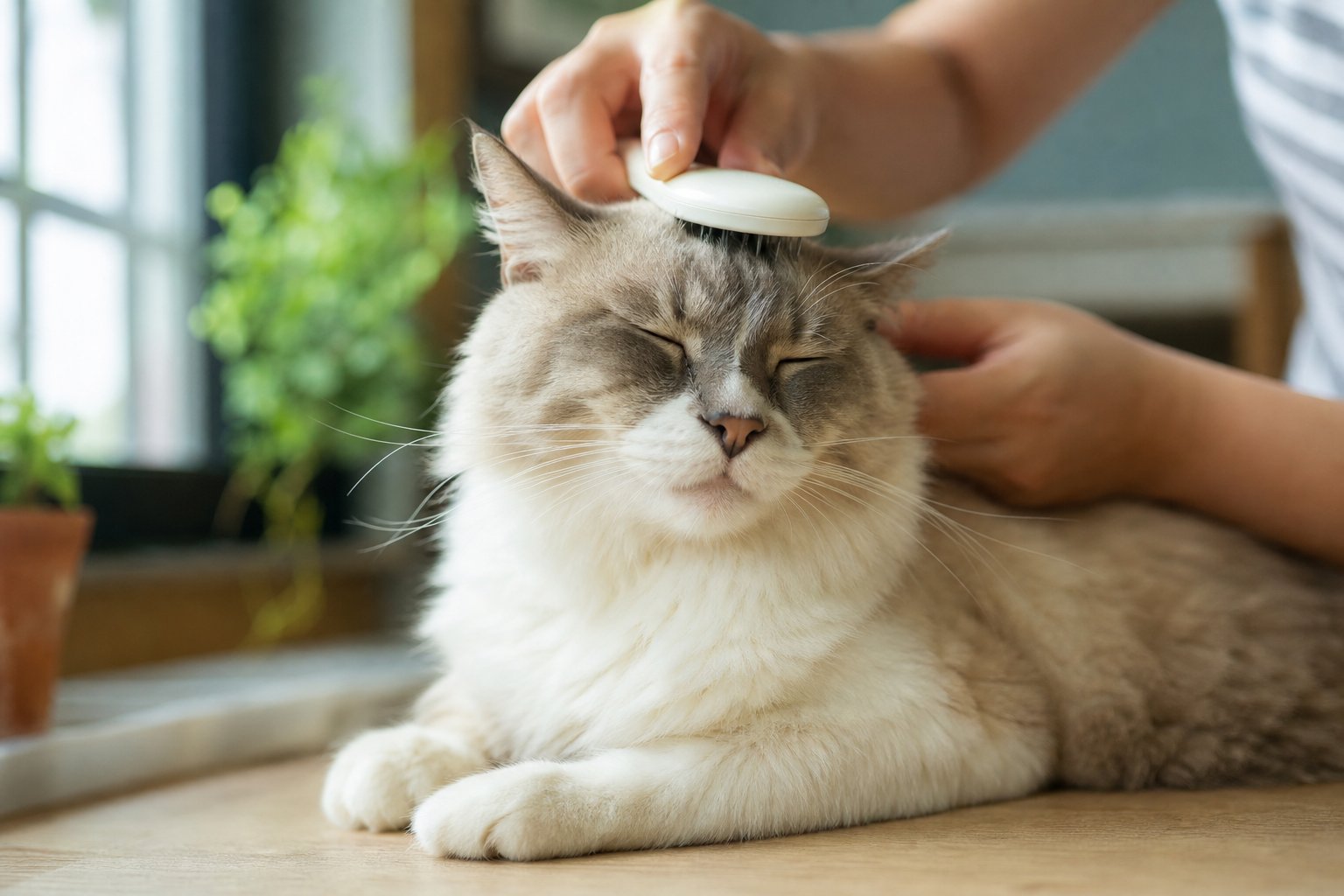
Quick answer: Probiotics are live "good" bacteria you add to a cat's or dog's food to support gut balance. They earn their place mainly during a food transition, after an antibiotic course, through stressful periods and while mild soft stool settles. They are a wellness aid, not an anti-diarrhoea medicine. Persistent vomiting, bloody stool or weight loss means a vet visit first.
What probiotics actually do for cats and dogs
A pet's gut holds thousands of microorganisms, and the helpful ones are constantly competing with the less helpful ones for space and food. A probiotic supplement simply adds more of the helpful kind back in. The practical effects pet owners notice are a steadier gut environment, easier digestion and firmer stools during periods of change.
Four mechanisms explain why this matters:
- Balance. When good bacteria outnumber the others, harmful populations struggle to gain a foothold.
- Digestion. Gut bacteria help break down food and keep the intestinal environment stable.
- Barrier support. The intestinal lining is the body's first defensive wall, and a stable flora helps maintain it.
- Competition. Organisms that already occupy the lining leave nowhere for invaders to attach.
Gut bacteria also take part in producing several vitamins — including B12, thiamine, riboflavin and vitamin K — and in building various metabolites. One widely used pet health reference goes further, describing around 70–80% of the immune system as sitting along the gut wall, which is why gut condition and overall health are so closely linked. These are descriptions of how gut flora work in general; they are not evidence that any particular product treats an illness.
Worth repeating: a probiotic is a support product. Expectations should be managed. Any visible improvement usually takes a week or two, varies between individual animals, and never replaces diagnosis or treatment.
Prebiotics, synbiotics and digestive enzymes
Three related terms show up on labels, and it helps to separate them before you shop.
- Probiotic — the live organisms themselves.
- Prebiotic — the "food" those organisms eat, typically fibres such as inulin or fructo-oligosaccharides (FOS).
- Synbiotic — a product combining both, so the good bacteria arrive with rations already on board.
Many pet formulas are synbiotics already. You do not need to agonise over the terminology; check the strain, the CFU figure and the storage requirement instead.
Digestive enzymes are the other companion product. Three commonly discussed types are amylase (helps break down carbohydrates), lipase (fats) and protease (proteins). Some owners use enzymes alongside probiotics when a pet is being introduced to a wider variety of foods, on the reasoning that extra digestive support reduces bloating and discomfort while the gut adjusts. If you plan to use enzymes over a long period, rotating between different products is a reasonable way to avoid relying on a single formulation.
The situations where probiotics genuinely help
Timing matters more than brand. This is where a supplement is most likely to make a visible difference:
| Situation | Why it helps | Typical duration |
|---|---|---|
| Food transition | The flora must adapt to a new protein source and recipe | About a week before and after the switch |
| After antibiotics | Antibiotics reduce good and bad bacteria together | Space doses 2 hours apart; continue about a week after the course ends |
| Mild soft stool | Supports recovery once other causes are ruled out | Until stools are consistently firm |
| Stress periods | Moving house, a new pet, travel or boarding | Start a few days beforehand |
| Sensitive gut constitution | Ongoing maintenance rather than a fix | Intermittent cycles rather than non-stop |
Antibiotics and probiotics must be separated in time. Giving them together means the antibiotic kills the bacteria you have just paid for. Keep at least two hours between doses, then carry on with the probiotic for roughly a week after the course finishes. The gut ecology can take days to weeks to rebuild after antibiotics, and topping up during that window is one of the most common reasons a vet suggests a probiotic in the first place.
Soft stool during a food change is not automatically the new food's fault. Often it simply means the flora has not caught up with a new protein. Unless the stool is severe or bloody, keep the transition schedule running and add a week of probiotics; most cases settle on their own. If every single switch triggers diarrhoea, food sensitivity becomes the more likely explanation and deserves a vet's assessment.
A useful mental model: probiotics handle wellness and mild disruption. Anything beyond that needs investigation.
How to choose a product: three checks and one question
- Check the strain. Lactobacillus, Bifidobacterium and enterococcus-type organisms are common in pet products. A label that names the species and the strain number is far more informative than one promising a "proprietary blend" of unnamed cultures.
- Check the live count. A higher CFU number is not automatically better, but the figure should be printed clearly and stated at the end of shelf life, not just at manufacture. Pay attention to whether the maker claims acid resistance or encapsulation — those techniques are what get the organisms past stomach acid.
- Check format and storage. Powders are the most common format. Some need refrigeration; others are shelf-stable. Single-serve sachets stay cleaner and lose less viability than a large tub opened repeatedly.
- Ask the right question. "Can I use a human probiotic instead?" The short answer is no. Human strains are not selected for a cat's or dog's gut, the dose is hard to convert, and some human products contain additives that are outright unsafe for pets.
Format comparison at a glance
| Format | Strengths | Watch out for |
|---|---|---|
| Powder sachets | Precise dosing, easy to mix, good shelf life | Must be sealed and kept dry |
| Paste or puree | Handy for fussy eaters, easy to hide in food | Shorter freshness once opened |
| Capsules | Pre-measured, no mess | Some pets object to swallowing; check if it can be opened |
| Large tubs | Usually cheaper per serving | Repeated scooping introduces moisture and air |
Red flags to walk away from: no strain names, no CFU figure, sweeping "cures everything" wording, or a product that only works at very large doses. Price points vary widely between retailers, so compare per-serving cost rather than pack price, and ask your vet or a trusted pet retailer what is currently available locally.
Feeding technique: small details, big difference
- Temperature. Mix with room-temperature food or water. Anything hotter than body temperature kills the live organisms — let hot food cool completely before adding the powder.
- Serve immediately. Mixed wet food should not sit longer than about 30 minutes.
- Start at half dose. The first two days at half the recommended amount lets you watch for gas or looser stools before moving to the full amount.
- Same time daily. A consistent routine is easier on the gut than random timing.
- Never force-feed powder. Dry powder can damage trust and poses a choking risk. Mix it into food or hide it in a small treat — a little meatball, a dab of peanut butter (xylitol-free) or a spoon of plain yoghurt all work.
- Track the stools. Keep a simple daily record — firm, soft, watery — for a week and compare it with the starting point. That removes the guesswork from "is this working?"
How long to continue? Work backwards from the goal. A food transition needs roughly a week either side. Post-antibiotic support runs about a week. A chronically sensitive gut often does better on an intermittent pattern, such as two weeks on and one week off. If two full weeks produce no improvement at all, do not simply increase the dose — book a vet appointment instead.
Daily gut care matters more than any supplement
Probiotics are an assistant, not the foundation. Long-term intestinal health rests on three habits, and all three are cheap:
- A stable diet. Feed at fixed times in fixed quantities, and avoid adding human table scraps. The gut copes least well with sudden large changes in what arrives.
- Clean feeding gear. Wash bowls daily and scrub water bottles regularly. Hygiene applies to pets just as much as to people.
- Regular parasite screening. A faecal check about twice a year catches worms and other organisms that are a classic, easily overlooked cause of recurring soft stool — including in pets that never go outdoors.
Get those three right and a surprising amount of so-called "sensitive stomach" improves on its own. Whatever remains is what probiotics are for.
When to see a vet
Do not waste time trialling supplements if any of the following apply. See a professional instead:
- Diarrhoea lasting more than 48 hours, or stool that is bloody, mucous-covered or black
- Vomiting and diarrhoea occurring together, especially in a kitten or puppy — dehydration develops fast in small young animals
- Loss of appetite, lethargy or noticeable weight loss
- Suspected swallowed object, or a gut reaction after possible poisoning
- Long-term, repeatedly returning soft stool — parasites, food allergy or pancreatic insufficiency all need testing
- Any pet already on prescription medication or facing surgery
Gut symptoms are often just the visible tip of something deeper, and "the probiotic didn't work" is itself a useful diagnostic clue. In a multi-cat household, if one animal keeps passing soft stool, bring a fresh stool sample to the appointment so parasites and infections can be ruled out.
Tell your vet about every supplement your pet is currently taking before starting a new prescription, and again before surgery.
Your practical seven-day plan
- Day 1: Check your pet's stool and note the normal baseline — firmness is the reference point for everything that follows.
- Day 1: Audit your current probiotic. Is there a named strain and a CFU figure? If not, replace it.
- Day 1: Keep a small, trusted supply at home so you are not caught out during a food change or antibiotic course.
- Day 2: Lay out a 7–10 day food transition schedule and add a probiotic week on each side.
- Day 2: Set a phone reminder to separate antibiotics and probiotics by two hours, plus a follow-up reminder for one week after the course ends.
- Day 3: Start a stool diary — one word per day is enough.
- Day 7: Review. Stools improving? Continue. No change? Stop increasing the dose and call the vet.
- Ongoing: Schedule a faecal parasite check roughly every six months for each pet.
Putting it into a Malaysian home
In a Kuala Lumpur apartment where a cat is moving from one dry food to another, the practical sequence is simple: spread the switch over 7–10 days, start a probiotic a week before the first mixed meal, keep the bowl in a cool spot away from direct afternoon sun, and record stool quality daily. If the apartment is shared with other cats, use separate bowls so you know exactly whose stool you are tracking.
During the Penang rainy season, heat and humidity are the enemy of powder viability. Keep sachets sealed, store them exactly as the label directs, and never decant them into a damp container. Humid weather also makes bowls and water bottles spoil faster, so daily washing becomes even more important while you are trying to judge whether a probiotic is helping.
Bottom line: Choose a labelled strain, feed it correctly, keep expectations modest, and let the daily habits — steady meals, clean bowls, regular parasite checks — do the heavy lifting.
This article is for general information only. Probiotics are nutritional supplements and do not replace veterinary diagnosis or treatment. Always consult a registered veterinarian before starting, stopping or combining supplements, especially if your pet is unwell, pregnant, very young, elderly or on medication.
Related reading
- Pet Health Guide Malaysia: Annual Checkups, Blood Tests and When to Worry
- Pet Gut Health in Malaysia: Probiotics, Antibiotics and Slow Food Transitions (Part 3)
- Pet Skin Allergy and Itch in Malaysia: Flea, Food and Environmental Triggers
- Cat Dental Care in Malaysia: Brushing, Tartar, Bad Breath and Gum Disease Guide
- Cat Diabetes in Malaysia: Warning Signs, Blood Sugar Control and Remission
- Cat Fleas in Malaysia: Symptoms, Treatment and Year-Round Prevention
- Cat Hyperthyroidism in Malaysia: Early Signs, Tests and Treatment Options
- Cat Neutering in Malaysia: Timing, Surgery Prep and a 7-Day Recovery Plan
- Cat Stomatitis (FCGS) in Malaysia: Symptoms, Full-Mouth Extraction and Recovery