
Answer first
Three numbers settle most daily-care questions: a dog's back length taken three times, a litter depth of 5 to 7 cm, and one litter tray per cat plus one. Everything else comes from watching trends rather than single readings — weight curves, water intake, appetite and litter use, recorded at the same time each week.
Measure your dog before buying anything sized
Start by deciding which category the product belongs to. Sized goods — harnesses, coats, beds, carriers, crate mats — need measurements. Goods sold by quantity — supplements, powders, tins, litter — need only the pack size, so reading the label correctly prevents the common mistake of buying the wrong variant of the right product.
To measure back length, run a soft tape from the point just behind the shoulder blade (where the collar sits) along the spine to the base of the tail. The dog must stand square on all four legs, head forward. The tape should lie against the coat without pressing into it. Take three readings, keep the largest, then add about two fingers of room for movement.
At the same sitting, measure girth at the widest point behind the front legs, and neck circumference where the collar rests plus two fingers. Hand all three numbers to the retailer or hold them against the size chart. Guessing from body weight is the single most common error: two dogs of identical weight can differ by several sizes in back length, and a long-backed, short-legged dog often needs a size up even at a light weight.
| Class | Typical adult weight | Examples | What to prioritise |
|---|---|---|---|
| Small | Under 10 kg | Poodle, chihuahua, terrier types | Girth and neck first; keep accessories light |
| Medium | 10 to 25 kg | Shiba, cocker, border collie | Measure all three: back, girth, neck |
| Large | 25 to 40 kg | Golden retriever, Labrador, husky | Full-length measurement; choose supportive bedding |
| Extra large | Over 40 kg | Great Dane, St Bernard, mastiff | Add shoulder height and paw width; check load limits |
Weight class is only a starting point. Condition is judged by a body condition score: you should feel the ribs under a light layer of fat and see a waist from above. If the ribs cannot be felt or the belly hangs, the answer is a vet-guided diet change, not a larger harness.
Puppies are sized on their expected adult weight, not today's figure. Ask your vet for an estimate based on breed and parentage, then choose an adjustable design such as a Velcro harness so it can be tightened as the puppy grows rather than buying the next size up immediately.
Large-breed puppies have no universal "normal" gain, because breed, sex and food energy density all shift the numbers. What works is a weekly record: same time, same scale, same posture, empty stomach. As a rough reference, a large puppy reaches about half its adult weight at four to five months and is close to adult weight at a year, though growth continues to eighteen to twenty-four months. Two consecutive weeks of flat or falling weight deserves a call to the vet. Never add calcium powder or bone supplements on your own — mineral balance in fast-growing dogs has to be matched to growth rate by a professional.
Three changes that get cats drinking
Cats are drawn to moving water because still water in nature is a poor source. The cheapest effective change is a circulating fountain; the second is switching to ceramic or stainless steel, which does not hold food smells and does not scratch the way plastic does. Scratched plastic keeps odours even after washing, and a sensitive cat will refuse it.
The third change is the one most often overlooked: bowl shape. A deep, narrow dish forces whiskers against the rim every time the cat leans in, a discomfort commonly called whisker fatigue. A shallow, wide bowl — at least 12 cm across, with water only 2 to 3 cm deep — removes the problem entirely.
Colour is secondary but not irrelevant. Cats discriminate blue and green tones better than red, and a dark bowl makes the waterline hard to see. Light-coloured bowls show the water level clearly but also show grime, so they need washing more often. The reliable method is a simple trial: place two bowls of different material or colour in the same spot for three days, log each visit, and keep the clear favourite.
Placement follows three rules. Keep water at least a metre from food bowls, never beside a litter tray, and provide more than one station in a multi-cat home so no cat has to cross another's territory to drink. Refresh daily and wash bowls weekly in plain water with a soft brush; skip scented dish detergents. A sudden jump or drop in drinking is not a shopping problem — treat it as a health signal.
Litter maths instead of guesswork
Litter volume depends on two variables only: how many trays, and how deep. The standard is one tray per cat plus one, spread across different rooms or levels rather than grouped together. Sharing a single tray is one of the most frequent causes of inappropriate urination and tray refusal.
Depth at opening is 5 to 7 cm. Too shallow and clumps stick to the base, urine seeps through, and the tray smells within days. Too deep and you waste material and it tracks out across the floor.
Volume can be calculated: litres approximately equals floor area in square metres, times depth in centimetres, times 10. A 60 by 40 cm tray is 0.24 square metres; at 6 cm that is about 14.4 litres to start. A smaller 45 by 35 cm tray needs roughly 9.5 litres. After opening, scoop daily and return an equivalent amount so depth stays constant.
| Cats | Trays | Depth | Ongoing notes |
|---|---|---|---|
| One | One to two | 5 to 7 cm | Full change every 2 to 4 weeks |
| Two | Three, in two locations | 5 to 7 cm | Clumping doubles; top up more often |
| Three or more | Four or more, one set per zone | 5 to 7 cm | Zone the trays to prevent guarding |
| Senior or kitten present | Add a low-entry tray | 4 to 6 cm | Avoid high-sided enclosed models |
Litter type changes consumption. Clumping mineral litter stays predictable; tofu, wood and paper litters absorb fast but clump loosely, so they usually need slightly more depth and more frequent top-ups. Trays should also be long enough for the cat to turn around — roughly one and a half times the cat's body length — with enough floor area to dig.
Small pets, honest space requirements
A pet suits a small home when its space need matches what you can provide, not because the animal itself is tiny. Cats suit compact living because their activity is vertical: shelving, a cat tree and a window perch genuinely expand usable area. Small dogs work if you commit to two outdoor walks daily, with indoor play as the fallback during heavy rain.
For hamsters, compare continuous floor area, never the number of levels. A multi-storey cage with a small footprint still leaves too little ground. Aim for roughly 45 by 30 cm for a dwarf hamster and 60 by 40 cm for a Syrian, more if possible. Wheels must be wide enough to keep the spine straight — around 16 cm for dwarfs and 20 cm for Syrians — with a solid running surface rather than rungs that trap feet. Bedding should be at least 5 cm deep and ideally 15 to 20 cm, because digging is normal behaviour, not a luxury.
Rabbits are not difficult, but they are not decoration. The core of the diet is unlimited hay, such as timothy, alongside measured pellets and a little leafy green, with fresh water changed daily. Teeth grow for life, so inadequate hay leads directly to dental and gut problems. Never house a rabbit on wire flooring: their feet lack pads, and prolonged standing on wire causes sore hocks. Run cable management as you would for a puppy, and treat heat as the bigger risk — a rabbit tolerates cool rooms better than a hot, still one. Do not lift by the ears or hold the belly unsupported, and discuss neutering with your vet for adults.
| Option | Space need | Daily time | The one thing you cannot skip |
|---|---|---|---|
| Cat | Vertical levels and hiding spots | Two to three play sessions | Tray count and placement |
| Small dog | A daily walking route | Two walks, 20 to 30 minutes each | Exercise and daylight |
| Hamster | Continuous floor area | Night-time observation and cleaning | Floor area and wheel diameter |
| Rabbit | A safe free-roam zone | Hay change and exercise time | Unlimited hay and cable protection |
| Parrot | Tall cage plus out-of-cage time | Daily interaction and cleaning | Noise affecting neighbours |
Treat timing and storage
The best slot for a treat is not a clock time but a rule: one to two hours after a main meal, at a consistent time of day. This protects appetite for complete food, builds expectation that reduces nagging behaviour, and turns the treat into a training tool. Use it around cooperation events — nail trims, brushing, medication, entering the travel carrier — so the event predicts something good. Avoid treats within an hour of bedtime, especially for sensitive cats.
Keep total treat calories to roughly a tenth of daily intake, adjusted for weight and the energy in the main food, so confirm the figure with your vet. A 14 g lickable stick can be split into two or three portions, and mixing it with water adds moisture at the same time. Canned toppers count towards the day's energy and cannot be treated as calorie-free.
Storage matters as much as timing. Keep unopened packs in a cool, dry place away from direct sun and check the printed date. Once opened, any unused portion goes straight into a sealed box or bag in the refrigerator and must be finished within 24 hours. In warm weather, anything left out for an hour or two is finished. Discard immediately if the packaging bulges, the smell changes, the colour shifts, or liquid separates out. Cats with chronic conditions or weight issues need veterinary approval before a long-term lickable treat habit.
Cleaning wounds at home
Physiological saline at 0.9 percent is the best everyday rinse because it matches body fluid, so it does not sting tissue or damage new cells, and it is suitable near eyes, mucosa and the mouth. Clean tap water is not forbidden — for an initial bulk rinse that flushes away grit and dirt, room-temperature tap water is acceptable, ideally finished with saline. Two cautions: do not mix your own saline, since the concentration is easy to get wrong, and discard any opened bottle within 24 hours.
Technique outranks the liquid. Rinse from the centre of the wound outwards so debris is not driven inward; a syringe without a needle gives gentler pressure than pouring. Pat dry with sterile gauze rather than rubbing. If the animal keeps licking, use an Elizabethan collar — never a human ointment meant for people.
| Product | Suitable for | Notes |
|---|---|---|
| Saline 0.9% | Open wounds, near mucosa | Discard within 24 hours of opening; do not DIY |
| Room-temperature tap water | First bulk rinse of dirt | Follow up with saline |
| Povidone-iodine | Skin around the wound | Follow label; do not use continuously for weeks |
| Iondine tincture with alcohol | Unbroken skin only | Too harsh for open wounds and mucosa |
| Alcohol, hydrogen peroxide, bleach | Not for wounds | Destroys new tissue and delays healing |
So the practical rule is saline first, povidone-iodine as a secondary antiseptic on surrounding skin, and alcohol-based iodine only on intact skin. Deep wounds, bleeding that persists past a few minutes, pus or foul odour, spreading redness, and cat bite wounds all need professional assessment — bites look small but tunnel deep and readily form abscesses.
Noise, calming aids and reading fear
A pheromone diffuser is an environmental aid, not medication. It covers roughly one room, so larger or multi-level homes need one unit per zone, and it works best on mild to moderate stress caused by change — a move, a new household member, renovations, or furniture being rearranged. For tension already established between cats, the effect is limited, because the real driver is resource competition. Redistribute food, water, resting spots and trays using the plus-one rule, spread them across zones so each cat can reach them without crossing another's space, and add vertical territory and visual barriers. Stop the diffuser if you notice coughing or skin irritation.
During renovation works, plan rather than react. Agree with the tradespeople to concentrate the loudest tasks into one block so a predictable quiet period follows. Set up one room away from the work zone as a refuge containing water, food, a tray and a hiding spot, with the door closed and the gap sealed. Start white noise, a fan or a radio before the hammering begins rather than after. Use a barrier to keep the animal out of the work area entirely, since dust and tools are hazards in themselves. If the project is long or extremely loud, consider temporary boarding somewhere quiet.
Reduced appetite is a normal reaction to noise. It becomes an emergency when nothing is eaten or drunk for more than 24 hours, or when vomiting, refusal to come out, or rapid breathing appears.
Reading a dog's fear requires the voice and the body together. Low, slow, repeated barking usually signals guarding; high-pitched, rapid, clipped barking signals tension; a sharp yelp followed by retreat means genuine fright. Supporting evidence: ears pinned back, tail tucked between the legs, body lowered, backing away, repeated nose licking, trembling, dilated pupils. A play bow — front down, rear up — is not fear. Reduce the stimulus, offer cover, and never grab or punish, because punishment deepens the fear.
Coats, air and household cleaning
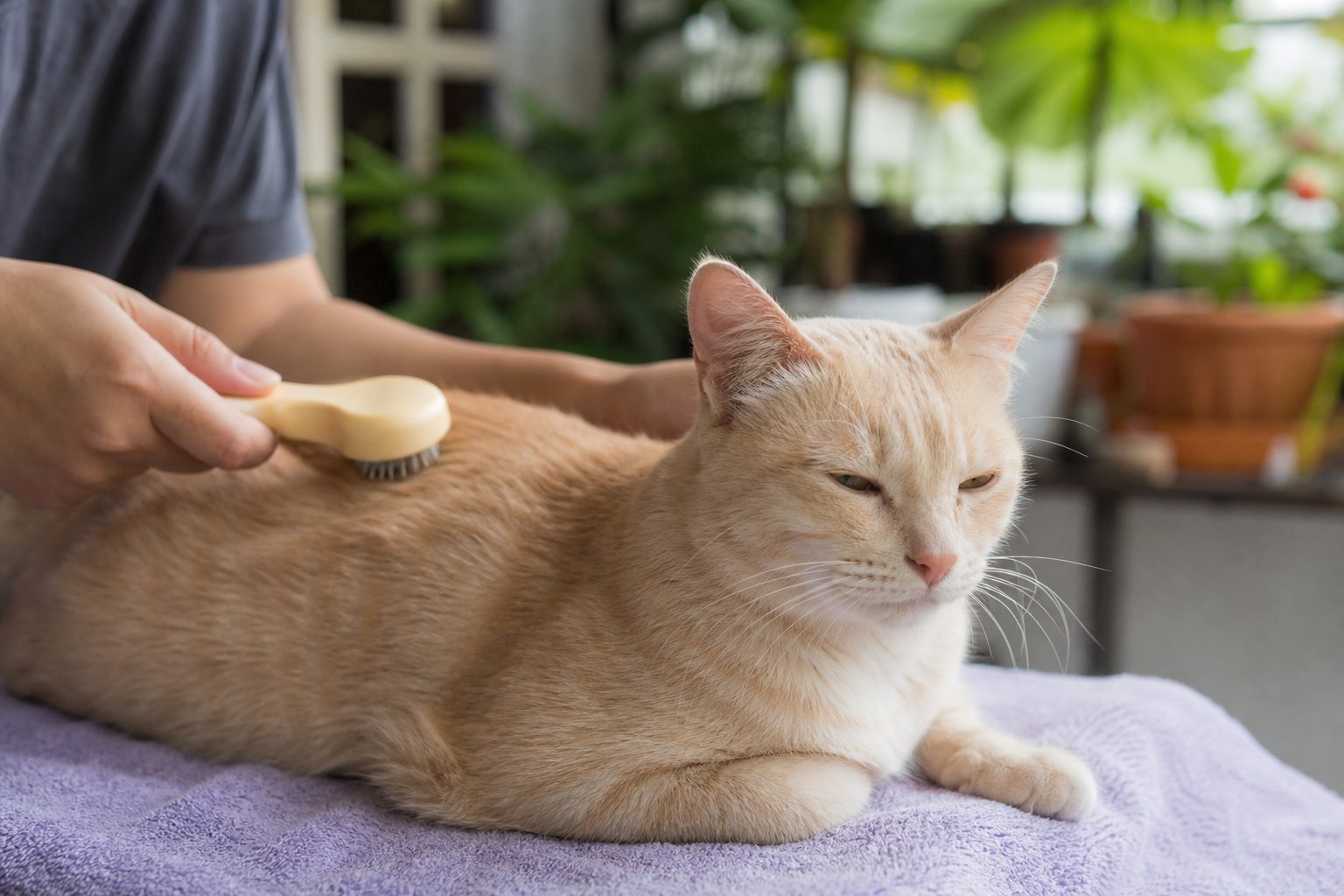
A glossy coat reflects overall health more than any single product. The working order is: a complete and balanced main food with adequate protein and fat; omega-3 supplementation only on veterinary advice; regular brushing that detangles before removing undercoat; parasite control and treatment of any skin disease; and avoiding excessive bathing, which strips natural oils and dulls the coat.
Cat and dog shampoos are not interchangeable. Cat skin has a thinner outer layer and a different pH, and cats are sensitive to fragrance and essential oils. Dog shampoo used repeatedly on a cat can cause dryness, itchiness and flaking, which then triggers over-grooming. Use a product labelled for cats, or one explicitly marked for both species, with lukewarm water and thorough drying. Cats groom themselves; frequent bathing is unnecessary without a medical reason.
Washing dog toys depends on the label. Fabric toys with no squeaker and no electronics can go in a laundry bag on a cool cycle below 30 degrees with a fragrance-free, pet-safe detergent, no softener and no bleach, then dried fully — surface-dry is not enough, because damp interiors grow mould. Leave out squeakers, batteries, rope toys that unravel (ingestion risk) and hard plastic or leather items; wipe those with a damp cloth and a pet-safe cleaner. Replace any toy with tears, missing chunks or an exposed squeaker, since fragments are a common cause of intestinal blockage.
In humid weather, aim to keep indoor relative humidity around 40 to 60 percent with a dehumidifier or air-conditioning, backed by a fan for air movement and daily ventilation. Avoid scented sprays and candles anywhere the cat spends time, and never allow a cat to sit directly in a cold air-conditioning blast.
When to see a vet
Do not wait if any of the following appears:
- Nothing eaten or drunk for more than 24 hours, or continued hiding combined with refusal to eat after a move or noisy works.
- Breathing changes: visibly faster at rest, open-mouth breathing, pale or bluish gums, or persistent coughing.
- A wound that will not stop bleeding, produces pus or a bad smell, spreads redness, or a deep bite wound.
- Urine retention, repeated vomiting or diarrhoea, or a sudden change in tray habits.
- Sudden behaviour shifts: panting while curled up, new aggression, unresponsive dullness, seizures or unsteady walking.
- Senior-cat warning signs: sudden vision change, unequal pupils, reluctance to jump, marked weight loss, or abnormal water intake.
This article is for general guidance only and does not replace veterinary diagnosis, prescription or treatment. Please consult a licensed veterinarian about your own pet's condition.
Local context and further reading
Malaysian owners can check current guidance on pet ownership, licensing and responsible care through the Department of Veterinary Services Malaysia at https://www.dvs.gov.my/, and welfare and handling advice from the Society for the Prevention of Cruelty to Animals at https://www.spca.org.my/.
Related reading
- Pet Daily Care Guide Malaysia: Brushing, Nails, Ears, Eyes, Teeth and Weight (2026)
- How to Clean Pet Toys and Stop Bacteria Growing in Malaysia
- Cat Hypoglycaemia First Aid: 5 Mistakes to Avoid (Malaysia)
- Cat Nail Trimming in Malaysia: A Calm, Step-by-Step Guide for Indoor Cats
- Cat Nail Trimming in Malaysia: Frequency, Technique and Quick Bleeding First Aid
- Cat Toy Cleaning and Care Tips for Malaysian Homes: A Practical Maintenance Schedule
- Cat Tree and Home Pet Device Safety in Malaysia: Coatings, Carbon Sachets, Microchips and Smart Gadgets
- Iodine Tincture vs Povidone-Iodine for Pets in Malaysia: When It's Actually Needed (and When It's Not)
- Iodine Tincture vs Povidone-Iodine: Where It's Safe to Use on Pets in Malaysia
- Litter Box Cleaners in Malaysia: Safe Choices That Won't Irritate Your Cat
- Pet Behaviour & Training Part 1: Toxic Plants, Fruit & Veg Portions, Oils and Anxiety Panting
- Pet Daily Care, Behaviour Signals and Seasonal Supplies in Malaysia (Part 1)