
Quick answer
Iodine products have a narrow role in pet care: they are skin disinfectants, not cleaning agents. They kill microbes on a surface; they do not wash dirt away. In practice, three situations justify iodine — and all three start with a vet's diagnosis. For everyday cleaning of floors, litter trays, beds, food bowls, toys, ears and the eye area, plain water or a pet-safe cleaner is enough. This article covers how the two iodine products differ, the six places you should never apply them, why cats need extra caution, iodine-free cleaning routines you can start today, and the red flags that mean a same-day vet visit.
Iodine tincture and povidone-iodine: what's actually in the bottle
Iodine tincture (often called iodine solution or 'tincture of iodine') is iodine plus potassium iodide dissolved in an alcohol base. Consumer-strength bottles are commonly labelled around 2%. Alcohol means it dries fast and leaves a dry surface, but it also stings noticeably on broken skin and irritates inflamed tissue — which can slow healing rather than speed it. That is why most vets do not recommend owners reach for tincture on an open wound.
Povidone-iodine is iodine bound to a polymer carrier in a water-based solution. The carrier releases free iodine gradually, so it stings far less and carries no alcohol sting. It is the form vets reach for most often. Read the label carefully: you may see 'povidone-iodine 10% w/v' on one bottle and '1% available iodine' on another — these describe the same product in different terms, not two strengths ten times apart.
Also note that iodine products come in different formulations — plain solutions, ointments, and surgical scrubs containing surfactants. A clinic scrub is not the same as a household bottle of povidone-iodine, and the two are not interchangeable.
A useful principle to carry into every decision: disinfection is not cleaning. If dirt, crust or pus sits on the skin, the disinfectant never reaches the surface underneath. The correct order is always: remove debris the way your vet showed you, then disinfect if instructed — never pour iodine straight onto the mess.
| Item | [Iodine tincture | Povidone-iodine](/articles/iodine-tincture-povidone-pet-cleaning-malaysia "mylink") solution |
|---|---|---|
| Main ingredients | Iodine, potassium iodide, alcohol | Povidone-iodine, water |
| Common consumer labelling | Around 2% iodine | Around 10% w/v (about 1% available iodine) |
| Sting / irritation | Higher; stings open wounds, irritates inflamed tissue | Lower; the form vets use more often |
| Staining | Dark brown; stains light fur and fabric badly | Pale yellow-brown; still stains pale fur |
| Dilution before use | Rarely used undiluted on pet skin | Usually diluted per label or vet instruction |
| Main limitation | Alcohol irritation on open wounds | Large-area or long-term use raises absorbed and licked intake |
| Typical setting | Intact skin prep — not everyday cleaning | Vet-directed local disinfection, rinsing or medicated baths |
These concentrations are typical label figures only. Brands, formulations and strengths differ — always read the bottle in your hand and follow your vet's directions rather than a number from an article.
The only three situations where iodine genuinely helps
All three share one precondition: the vet has already diagnosed the problem, and iodine is a tool used afterwards. Skipping the diagnosis and going straight to the bottle means skipping the most important step.
-
Vet-directed care of a very small surface wound. The usual criteria are a shallow scrape that is clean, not oozing, not smelly, and smaller than a coin. Your vet will specify the product, the dilution, how many times daily and when to stop. Your job is to keep the pet from licking it (a soft cone helps) and to photograph the area daily — not to add extra swabs or stronger concentrations on your own.
-
Skin preparation before and after a procedure. Clipping and pre-surgical scrubbing happen in the clinic. Once home, follow the discharge sheet. If there are stitches, a drain or a bandage, only your vet decides when it comes off, when rinsing is allowed and whether any disinfectant is needed. Adding iodine mid-recovery is a common way owners accidentally set healing back.
-
Prescribed rinses or medicated baths for a diagnosed skin condition. For certain fungal or bacterial skin problems, a vet may prescribe a specific iodine strength for local rinsing or even a full-body bath. Concentration and soak time are calculated against body weight and skin condition — too dilute does nothing, too strong burns. Never copy a ratio off the packaging yourself.
Beyond these three, one misconception causes most of the damage: the belief that 'more disinfecting is better'. The opposite is true. Repeated antiseptic use destroys the skin's normal bacterial balance and the delicate new tissue forming underneath, making the wound close more slowly. Even when your vet has prescribed povidone-iodine, stick to the stated frequency and course length — do not swab extra times 'to be safe'.
Six situations where you should never apply iodine yourself
Iodine is a topical disinfectant, not a cure-all. In the situations below, home use does not just fail to help — it hides what is really going on.
| Situation | Why it does not work | What to do instead |
|---|---|---|
| Iodine tincture on an open wound | Alcohol stings and inflames tissue, delaying healing | Let your vet choose the product; do not pick a disinfectant yourself |
| Deep or puncture wound (for example a cat bite) | Two tiny holes on top; bacteria are already sealed under the skin | See a vet within 24 hours to assess drainage or antibiotics |
| Eyeball, eye area, deep ear canal, mouth, nostrils | Mucosa absorbs fast and stings hard; ear flushing can damage the eardrum | Use only vet-recommended eye or ear cleaners |
| Pus-filled, rotting or foul-smelling wound | Pus and dead tissue block contact, and signal spreading infection | Same-day vet visit; never squeeze or cut tissue yourself |
| Large skin areas or prolonged use | Total absorbed and licked dose rises sharply; cats are especially sensitive | The vet decides scope, concentration and course length |
| Swallowed, added to water, or mixed into an ointment | Doses become guesswork; human ointments may not suit animals that lick | Only vet-prescribed oral iodine or ointments, at stated doses |
If your pet licks or swallows an iodine product: wipe the residue off the skin with clean water immediately, keep the packaging (the vet needs the ingredient list and concentration), and phone your vet. Do not induce vomiting and do not wait to 'see if anything happens' — cats lick fur as a matter of routine, so the real exposure is often higher than owners expect.
Why cats need far more caution than dogs
The same action that is acceptable for a dog must be narrowed for a cat, for five practical reasons:
- Grooming frequency. Cats spend a large part of the day working over their coat, especially anywhere something was applied. Swallowing a topical product is the norm, not the exception. Dogs mainly lick paws and the treated spot, so exposure stays concentrated.
- Thinner skin. A cat's skin and outer barrier layer are thinner than a dog's, so irritating substances and iodine penetrate more readily.
- Body weight gap. A 4 kg cat and a 30 kg dog receiving the same drop over the same patch of skin differ by roughly 7.5 times in exposure per kilogram of body weight.
- Thyroid involvement. Iodine is a raw material for thyroid hormones. Veterinary guidance notes that excessive iodine exposure — topical or oral — has been associated with thyroid abnormalities. Cats should therefore never receive large-area, long-term or frequent applications, and treated patches must be out of tongue reach.
- Metabolism and history. Kittens and puppies have immature skin barriers and weaker metabolism. Animals with known thyroid disease, kidney problems or iodine sensitivity need veterinary assessment before anything is applied.
In practice, if your vet does prescribe an iodine product for a cat, keep the cat from licking it — usually by leaving a soft cone on until the skin is completely dry and your vet says it can come off. Do not speed drying with a hairdryer on hot, and do not immediately let the cat groom. Both are among the most common owner mistakes.
Household cleaning without iodine: an eight-step routine
Most situations where owners feel an urge to use iodine are handled perfectly well by physical cleaning. None of these steps involve medication, so you can start today.
- Remove debris first. Using a damp pet-safe wipe or a clean soft cloth, wipe from the outside of the dirty patch towards the centre so you do not spread contamination across surrounding skin.
- Follow with plain water. Residue from wipes or cleansers is an extra burden for an animal that licks its fur — go over the area once more with a water-damp cloth.
- Dry and ventilate. Prolonged dampness causes skin problems; pay special attention to between the toes, neck folds and the groin area.
- Wash fabrics weekly. Beds, blankets and car mats go through the wash once a week and must dry completely to reduce bacteria and dust mites.
- Ears: no iodine. Clean only the visible outer ear flap during routine care. If there is heavy discharge, a smell, or frequent head shaking, see a vet rather than reaching for a bottle.
- Mouth: no iodine. Iodine never goes in the mouth. Dental care comes from brushing and vet-approved oral products.
- Tools: wash, dry, air-dry. Nail clippers, combs and forceps are cleaned with water, dried and air-dried after every use — no iodine soaking required.
- Record the wound daily. Photograph it at the same time and in the same light, noting size, discharge, and your pet's appetite and energy. Show the series to your vet at the follow-up.
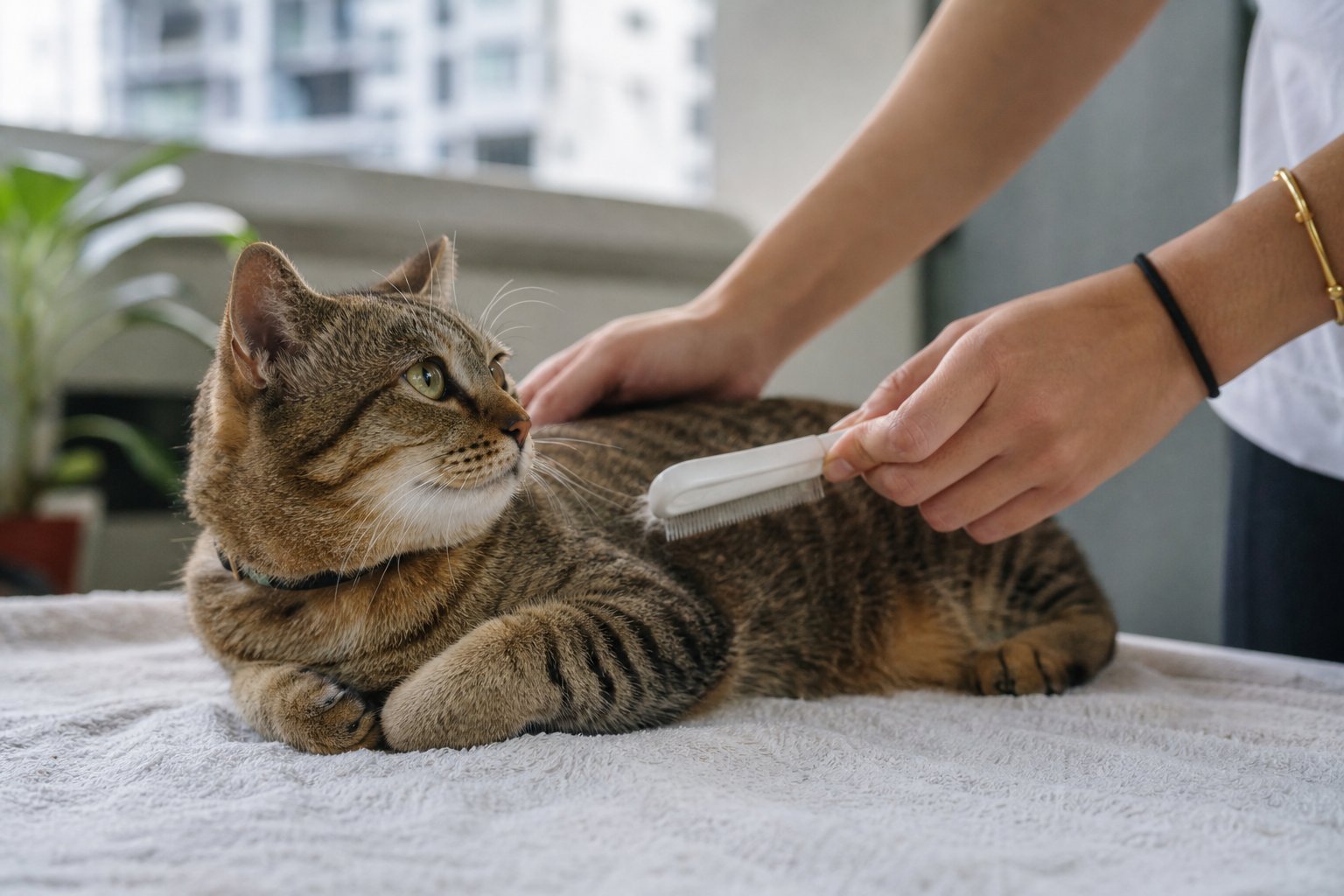
Useful everyday items that involve no medicinal ingredients at all: a pair of nail clippers with a safety guard (regular trimming reduces scratch injuries), a grooming or deshedding brush (which lets you spot skin changes early), and pet-safe wipes (step one above). Prices and stock vary by retailer — check current listings with a Malaysian pet retailer or your vet, and follow each product's label directions.
When to see a vet
Stop observing and stop self-medicating if any of the following appears. Book a vet visit the same day:
- Bleeding that will not stop after 5 to 10 minutes of firm pressure, or blood that spurts or soaks through several layers of gauze.
- A wound that grows more than 1 cm wider within 24 hours, or redness spreading outward from the wound edge.
- Discharge continuing after day three, yellow-green pus, a rotting smell, or obvious heat on touch.
- Body temperature above 39.4°C, refusing food for more than 24 hours, dullness, or hiding away in a corner.
- Visible foreign material, exposed tissue, or tissue turning black or grey; persistent crying out in pain or refusing to walk.
- Suspected licking or swallowing of an iodine product: drooling, vomiting, a red or swollen mouth, or declining energy — contact your vet immediately and take the packaging along.
Remember that animals are built to conceal pain. Often by the time an owner notices a pet has stopped eating, the infection has been developing for days. Rather than debating which disinfectant bottle to buy, do the two things with the highest value first: fit a cone to stop licking and biting, and start a daily photo record of the area.
Related reading
- Pet Daily Care Guide Malaysia: Brushing, Nails, Ears, Eyes, Teeth and Weight (2026)
- Cat Hypoglycaemia First Aid: 5 Mistakes to Avoid (Malaysia)
- Cat Nail Trimming in Malaysia: A Calm, Step-by-Step Guide for Indoor Cats
- Cat Nail Trimming in Malaysia: Frequency, Technique and Quick Bleeding First Aid
- Cat Toy Cleaning and Care Tips for Malaysian Homes: A Practical Maintenance Schedule
- Cat Tree and Home Pet Device Safety in Malaysia: Coatings, Carbon Sachets, Microchips and Smart Gadgets
- Litter Box Cleaners in Malaysia: Safe Choices That Won't Irritate Your Cat
- Pet Behaviour & Training Part 1: Toxic Plants, Fruit & Veg Portions, Oils and Anxiety Panting
- Pet Daily Care, Behaviour Signals and Seasonal Supplies in Malaysia (Part 1)
- Pet Daily Care in Malaysia: Measuring Your Dog, Getting Cats to Drink, Litter Maths and Small-Pet Basics
- Pet Daily Care Hub: Grooming, Nails, Ears, Teeth and Weight for Malaysian Owners