
The short answer
Bathe only when it is genuinely needed. A healthy cat rarely needs a bath at all, while dogs typically need one every few weeks to every few months depending on coat, activity and skin condition. What protects the skin more than frequency is using lukewarm water, a proper pet shampoo, a complete rinse and a fully dried coat.
How often should you bathe your cat or dog?
There is no universal schedule, and the "once a month" rule is a poor guide.
Cats. A healthy cat that grooms itself does not need routine baths. International Cat Care states plainly that if a cat is healthy there is no reason to bathe it, and most cats dislike the experience anyway — forcing it adds stress and damages the relationship between you and your cat. Daily care should be about brushing instead: long-haired cats ideally every day, short-haired cats at least once a week. Baths are reserved for special situations — the coat has picked up grease, oil or a substance the cat cannot lick off, or a vet has prescribed a medicated bath as part of skin treatment.
Dogs. Frequency depends on four things: coat type, activity level, skin condition and your home environment. Double coats, long coats and curly coats hold more dirt and oil. A dog that joins hikes, visits dog parks or walks in the rain often will need more frequent baths than a short-haired indoor dog. Dogs with allergic or constantly itchy skin should have their bathing schedule set by a vet, not by the calendar. As a broad starting point, an indoor short-coated dog may only need a bath every few weeks, while long-coated, heavily active or medicated dogs are washed more often or strictly on vet instruction.
Smell is not a schedule. In humid weather, owners often reach for the shampoo the moment a dog smells. But washing too often, leaving shampoo residue and failing to dry the coat fully are the three factors that together damage the skin barrier. Before you bathe, check the sources of odour first: the mouth, the ears, the anal glands and the skin folds. A smelly dog with a clean mouth, clean ears and dry folds may need its bedding washed rather than another bath.
Spot cleaning instead. For light, localised dirt you can skip the full bath: use a pet-safe dry shampoo powder or pet wipes on the affected area, then brush the powder out so nothing is left sitting on the skin long term. This is useful after a muddy walk or for a cat that tolerates wiping but not water.
In a Kuala Lumpur apartment with limited bathroom space, a spot-clean plus a thorough brush often solves the problem without the stress of a full tub session.
Water temperature: warm, never hot
The correct temperature is simple: warm to the touch and not hot. Test the water on the inside of your wrist or your elbow before it touches your pet. If it feels hot to you, it is already too hot for their skin.
Water that is too hot strips the natural oils from the skin surface, leaving it drier and itchier afterwards, and long-coated breeds carry a scald risk where the coat traps heat against the skin. Water that is too cold makes pets shiver, resist and chill — puppies, kittens, senior dogs and senior cats are especially vulnerable.
A few technique points during the bath:
- Never run water directly onto the face. Wipe the head with a damp cloth so water does not enter the ears, eyes or nose.
- Brush before wetting. A tangle that is already tight becomes tighter once soaked, and it also traps dirt.
- Rinse long enough. Keep rinsing until the coat no longer feels slippery and the water runs clear. Leftover shampoo is one of the most common causes of post-bath itching.
- Do not let the coat air-dry. Press with a towel to pull out water, then blow-dry. A damp coat left to dry on its own is where most skin troubles begin.
In a Penang rainy season stretch, close the windows before the bath and keep the room at a steady temperature, with dry towels ready within arm's reach, so your pet does not sit wet in cool, moving air.
Bath step-by-step checklist
| Step | What to do right | Common mistake |
|---|---|---|
| Before the bath | Brush the coat through, trim the hair around the paw pads, lay out towels, dryer and shampoo | Bathing an unbrushed coat, which tightens every existing tangle |
| Rinsing | Test on your wrist, start at the back and hind legs, avoid the face and ears | Guessing the temperature and running the hottest tap straight onto the coat |
| Applying shampoo | Dilute with water first, lather in your hands, follow the contact time on the label | Pouring concentrate onto the skin or leaving it on far too long |
| Final rinse | Rinse repeatedly until no foam remains and the coat is not slippery | Stopping early, leaving residue trapped in the undercoat |
| Drying | Towel-press first, then dryer on the lowest heat with the nozzle constantly moving | High heat held in one spot, air blown into the ear canal, or releasing a half-dry pet to roam |
Choosing shampoo: cat, dog or shared
The main difference between cat and dog shampoos is the skin and coat they are formulated for. Dog formulas are generally built for stronger cleansing — cutting oil, body odour and outdoor grime. Cat formulas lean towards gentleness and moisture, because a cat will lick its coat afterwards and any residue left on the skin ends up swallowed.
Can you share one bottle? Only if the label says it is suitable for both cats and dogs. A dual-purpose formula is designed to balance the needs of both species, but it still has to be rinsed until no foam remains. A product labelled for dogs only should not be used on cats, especially anything built around strong deodorising action or high concentrations of essential oils such as tea tree.
Three habits worth forming:
- Never substitute human products. Human shampoo, shower gel and bar soap are formulated for a different skin pH, cleaning strength and fragrance load. Used repeatedly they weaken the skin barrier of cats and dogs.
- Do not judge cleaning power by scent. A strong fragrance usually signals more additives, not a cleaner pet.
- Do not keep switching products while a skin problem is unresolved. A vet needs to identify the cause — parasites, fungal or bacterial infection, allergy or hormonal disease — and changing shampoo every week while watching and waiting only drags the diagnosis out.
Reading the label: look for clear species labelling, a short and readable ingredient list, instructions for dilution and contact time, and a fragrance that is light rather than heavy. Oatmeal-based international formulas, such as Dermcare Aloveen, are commonly chosen for dry or easily irritated skin because they clean gently while soothing. Local prices differ between vet clinics and pet retailers, so ask a Malaysian vet or pet shop for current pricing rather than relying on any figure you have seen elsewhere.
Drying: the part most owners rush
Drying matters more than the bath itself. A coat that is only partly dry, followed by a cold air-conditioned room or a spot on your bed, is the most common starting point for skin problems.
Temperature. There is no single safe degree that applies to every machine. Start on the lowest heat setting, use warm rather than hot air, and check with the back of your hand against your pet's skin as you go. If it feels hot to you, drop the setting or increase the distance. Follow the manufacturer's instructions for your specific model.
Technique:
- Keep the nozzle at a distance and keep it moving. Never hold it still over the back or one flank.
- Never aim air into the ear canal, eyes or nose. Handle only the outer ear flap.
- Dry in stages: belly, armpits, inner hind legs and between the toes first — these are the last places to dry and the first to go musty — then the back and tail.
- Take breaks. Panting, shivering, attempting to escape, red skin or compulsive paw-licking all mean stop, cool down and switch to towel blotting and a room-temperature fan.
- Do not chase time with the high heat setting. That is how burns happen and how a dog becomes permanently frightened of dryers.
Fearful pets. If your pet cannot tolerate a dryer, wrap them in a towel and dry in several short sessions, or use a low-noise pet dryer box. Whichever device you use, someone must stay present — never leave a pet unattended inside a dryer box or crate.
Brushing: the real daily care
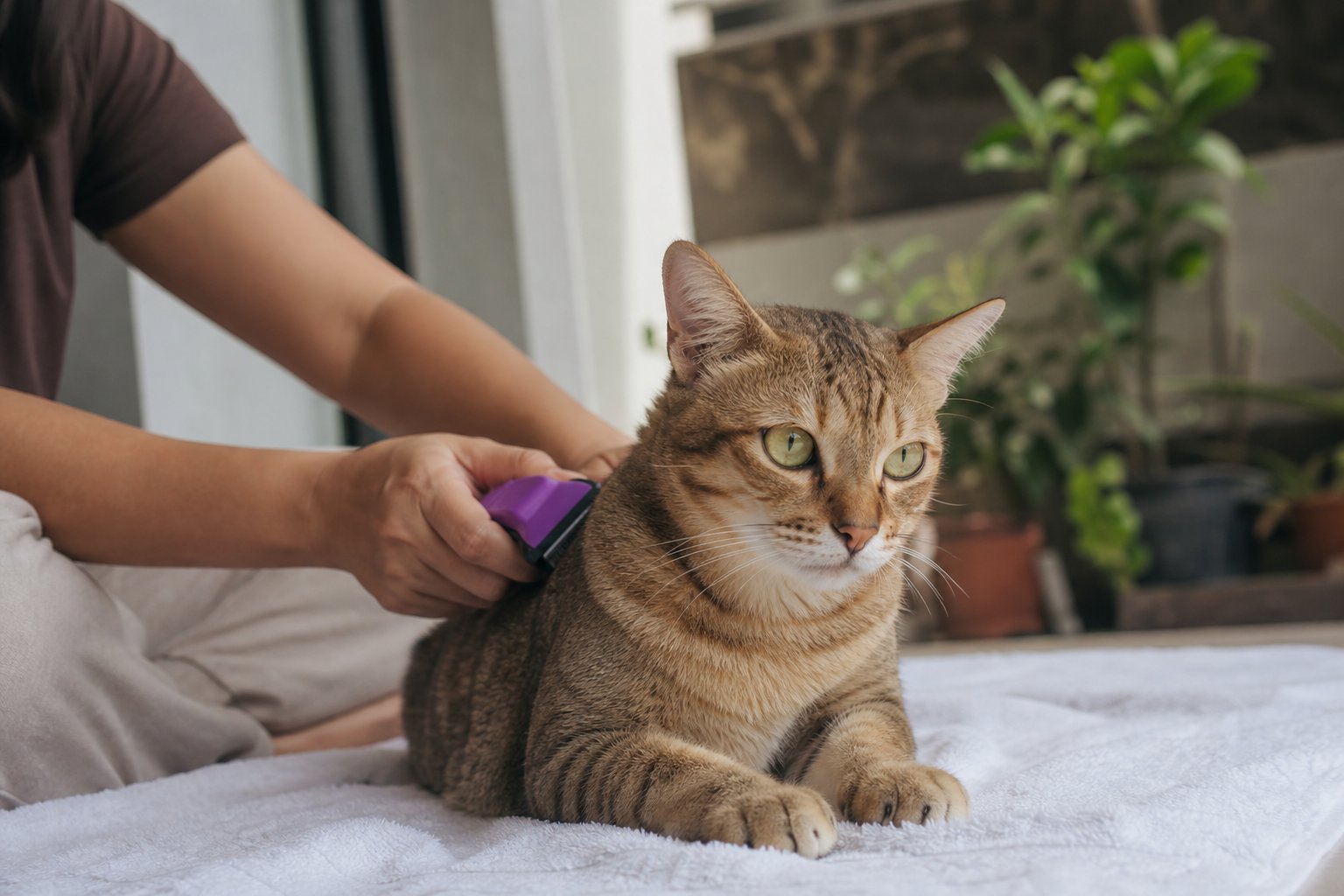
For cats especially, brushing is the routine and bathing is the exception. The principle for long-haired coats is de-tangle first, remove dead hair second, smooth last — which is why one brush is never enough.
| Tool | Main use | When and how |
|---|---|---|
| Wide-tooth comb | Opens tangles and checks the undercoat | Daily; work from the tips upward in small sections, never drag one stroke root to tip |
| Round-tipped slicker brush | Neatens the topcoat, adds fluff, lifts loose hairs | Skip it over any red or broken skin to avoid scratching |
| De-shedding or undercoat rake | Removes loose undercoat during moult | Once or twice a week at most; overuse strips too much protective undercoat |
| rubber grooming glove | Final smoothing, light massage, surface hairs | Good for finishing and for cats that object to metal tools |
The spots that mat first are the armpits, the inner hind legs and between the toes — check each one every session. Work a tight knot apart slowly with your fingers from the base towards the tip. Do not cut it out with scissors. When a mat is tight against the skin you cannot see where the skin ends and the knot begins, and cuts happen easily. Matting that has formed into a pelt against the body should be left to a vet or professional groomer, where it can be clipped out safely, sometimes with sedation.
For short-haired cats, a weekly session is usually sufficient; for long-haired cats, aim for daily. Dogs with double or curly coats benefit from a regular routine too, particularly through moulting season.
After the bath: ears, skin, toes and anal glands
The bath is only half the job. What you check afterwards decides whether skin stays healthy.
- Skin. Part the fur section by section and look for redness, flaking, crusts, hair loss or flea dirt. In humid weather, pay attention to the folds under the neck, around the armpits and along the groin — they must be dry and airy.
- Ears. Clean only the outer flap and the entrance of the ear canal, using a pet ear cleaner and a cotton ball. Never push a cotton bud down the canal. Odour, dark brown discharge, constant head shaking or ear scratching is beyond home care.
- Paws and nails. Dry between the toes thoroughly. Trim nails clear of the pink quick; if you are unsure where it starts, leave it to a groomer or vet.
- Anal glands. Do not squeeze them yourself — most dogs empty them naturally during a bowel movement. Scooting, licking the rear end or a lingering smell are reasons for a vet check, not for home squeezing.
- Final brush. Once fully dry, brush through again to remove shed hair, check the skin and leave the coat smooth.
Good ownership also covers the basics beyond the tub: keeping the body clean and the coat brushed, keeping the living space clean, and having preventive care and any illness handled by a registered veterinarian. Home grooming supports that; it does not replace a professional assessment.
When to see a vet
Stop changing shampoos and book a consultation if any of the following appear:
- Skin that is red, weeping, crusted or malodorous, especially if it has worsened after a product change.
- Persistent scratching, or licking and chewing that has led to hair loss or bleeding — that level of itch needs a diagnosis.
- Ear odour, dark discharge, or continuous head shaking and head tilting.
- Hard lumps, wounds or swellings found while brushing or bathing. Do not squeeze, lance or treat them yourself.
- Lethargy, appetite loss, fever or rapid breathing. These are medical signs, not grooming issues.
- Breathing difficulty, heavy drooling or an unsteady gait during or right after a bath or drying session — seek help immediately.
Home care products, including medicated-looking shampoos, are grooming and care items rather than medicines. They clean and soothe; they do not identify or treat the cause of a skin disease.
This article is for general guidance only and does not replace a veterinary examination, diagnosis or treatment. Consult a registered Malaysian veterinarian for any skin, ear or coat condition.
Related reading
- Pet Grooming, Bathing & Coat Care in Malaysia: A Practical Guide for Cats and Dogs
- Cat Hypoglycaemia First Aid: 5 Mistakes to Avoid (Malaysia)
- Cat Nail Trimming in Malaysia: A Calm, Step-by-Step Guide for Indoor Cats
- Cat Nail Trimming in Malaysia: Frequency, Technique and Quick Bleeding First Aid
- Cat Toy Cleaning and Care Tips for Malaysian Homes: A Practical Maintenance Schedule
- Cat Tree and Home Pet Device Safety in Malaysia: Coatings, Carbon Sachets, Microchips and Smart Gadgets
- Iodine Tincture vs Povidone-Iodine for Pets in Malaysia: When It's Actually Needed (and When It's Not)
- Iodine Tincture vs Povidone-Iodine: Where It's Safe to Use on Pets in Malaysia
- Litter Box Cleaners in Malaysia: Safe Choices That Won't Irritate Your Cat
- Pet Behaviour & Training Part 1: Toxic Plants, Fruit & Veg Portions, Oils and Anxiety Panting
- Pet Daily Care, Behaviour Signals and Seasonal Supplies in Malaysia (Part 1)