
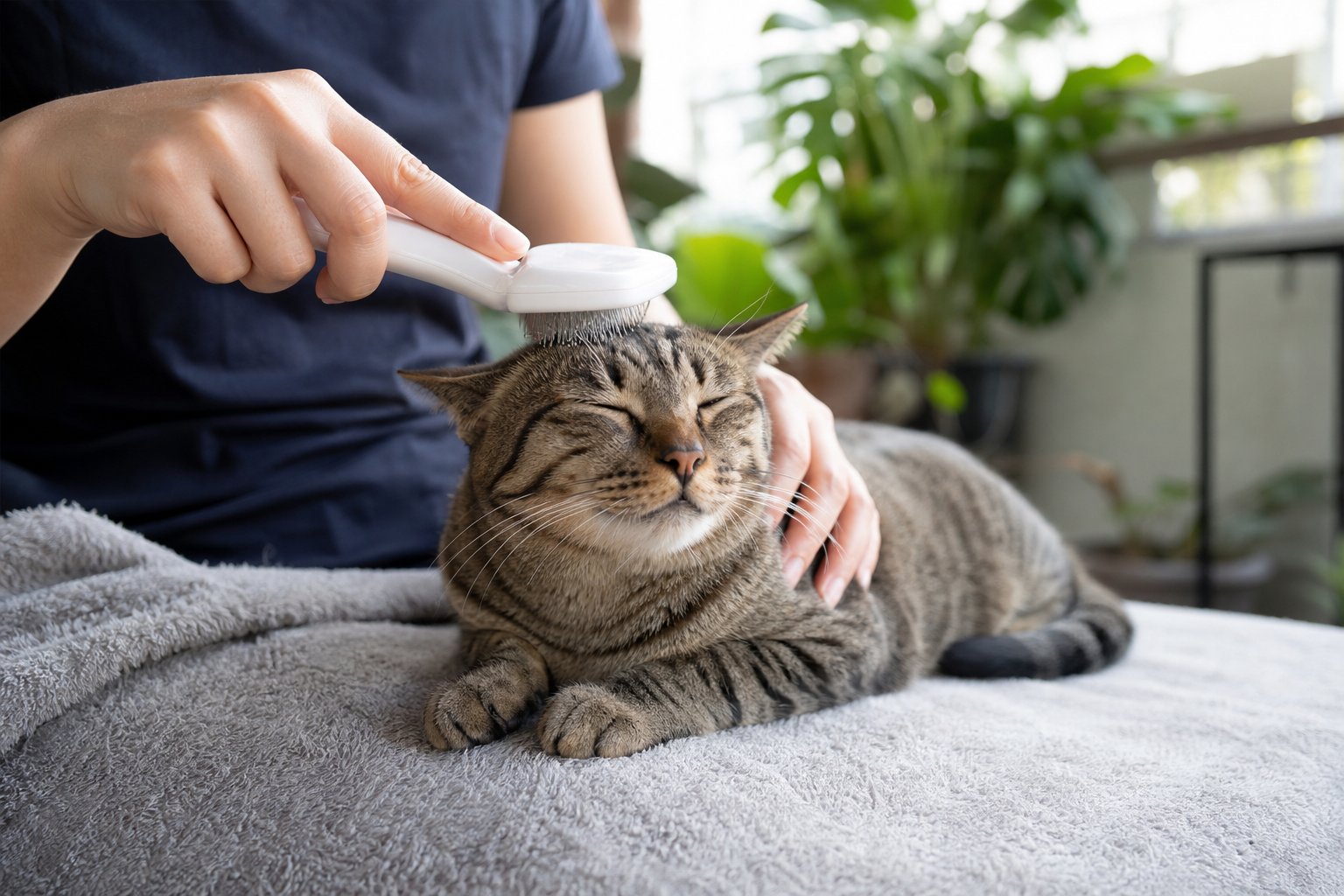
Your cat is not rejecting its bed — it is doing thermodynamics and risk assessment. A cat's comfortable temperature band sits near 30–38°C, well above the 18–25°C most people enjoy, so cool tile works like a heat sink in a warm house. The floor also offers clear sightlines and more than one way out. If your cat has stopped climbing altogether, pain may be the real reason.
Quick answer: three reasons a cat picks the floor
- Heat. A domestic cat's thermoneutral zone — the range where the body works hardest to do nothing — is roughly 30–38°C. On a warm afternoon, tile and stone dump body heat far faster than a cushioned bed can.
- Security. Good resting spots need cover, more than one exit, and a view of household traffic. In a compact home, the floor beside a cabinet edge or an open box often meets all three at once.
- Comfort, or pain. Hard, flat ground is easy to push up from. An older cat with stiff joints or lost muscle may abandon a soft bed because standing up from it hurts.
Most floor sleeping is ordinary choice. The signal to watch for is change: a cat that suddenly avoids every high perch, hesitates before a jump, or rises slowly should be seen by a vet.
Temperature: your comfort zone is not your cat's
Reference figures from the US National Research Council put a cat's thermoneutral zone at about 30–38°C. Dogs sit lower, around 20–30°C, and humans are happiest at 18–25°C. That gap explains an apparent contradiction: the same room that feels pleasantly cool to you can feel a little chilly to your cat, while the tile you find hard and cold in the morning is, to your cat, a perfectly good radiator in reverse.
Air-conditioning sharpens the effect. Most rooms are set around 24–26°C — below the lower edge of a cat's comfort band. So on the same day you may see your cat flattened against cool tile in the living room, then later squeezed into a patch of sunlight or parked on a warmed mat. Both behaviours are the same project: finding a surface that requires no extra effort from the body.
The practical fix is to stop guessing. Take one thermometer and, at the same time, read three numbers: the air about a metre off the ground, the floor surface itself, and the surface of the bed. They rarely match. Once you know which spot is genuinely warmer or cooler than the air, you can place beds deliberately instead of buying a more expensive one and hoping.
How cats cool down, and why the floor wins
Cats are not efficient sweaters. Sweat glands sit mainly on the paw pads, so spreading out on a cool surface does most of the work. The full toolkit looks like this:
- Conduction. Stretching the whole body flat against tile, stone, metal or a bathroom floor transfers heat straight out of the body. This is the big one.
- Posture. Side-lying with legs extended, or belly-up, exposes areas where the fur is thinner and heat escapes faster.
- Grooming. Saliva left on the coat evaporates and cools the skin. A cat grooming heavily in the heat is working, not just tidying.
- Doing less. Reduced movement means less metabolic heat. Long daytime naps are part of the cooling strategy.
- Panting — a red flag. Cats are not built to cool by panting. If you see open-mouth breathing, treat it as an emergency rather than a warm-day quirk.
Running the list in reverse explains winter behaviour too. When the environment drops below the comfort band, the only options left are finding a heat source, curling into a ball, and letting a soft bed trap warmth. That is why the same cushion can be a lifesaver in one season and an oven in another: the problem is not the bed's design, it is the match between surface conductivity and room temperature.
Damp weather complicates matters. A bed that stays damp because the air never dries out is a bed your cat will avoid, and a dehumidifier helps — but it also pulls moisture from the air, so keep fresh water available in at least two spots.
Security: shelter, exits and sightlines
Environmental guidelines from the International Society of Feline Medicine and the American Association of Feline Practitioners describe five pillars of a healthy cat environment. The first is a safe perch: a private, secure area, usually raised, where a relaxed cat can settle. The second is multiple, separated key resources — food, water, litter, scratching, play and rest should each exist in more than one place, with at least two resting spots per cat, never clustered together.
Elevation is the general description. In practice, cats score a sleeping spot on three points:
- Cover. Something blocking three sides is ideal. The cat does not need to be hidden — only unable to see a potential threat.
- More than one exit. A spot whose single opening can be blocked by another cat, a child or a vacuum cleaner is a trap, not a bed.
- A view. Clear sight of doorways and household movement, so nothing approaches unseen.
In a small apartment with few raised platforms, the floor beside a cabinet, a wall corner or an open cardboard box frequently satisfies all three at once. Meanwhile, many beds sit in exactly the wrong place: the middle of the living room, open on four sides, with one exit. In that situation the cat is not refusing the bed — it is refusing the position. Repositioning costs nothing.
Multi-cat households add one more layer. If a single bed sits in a main walkway, the most confident cat claims it and the rest settle on the floor out of the way. The guideline is straightforward: resting spots should be at least equal to the number of cats, spread apart, ideally with two ways in and out.
Floor versus soft bed: side-by-side comparison
| What you are comparing | Hard floor (tile, stone, timber) | Soft padded bed | What it means for your cat |
|---|---|---|---|
| Heat transfer | Fast; heat leaves the body continuously | Slow; the bed holds warmth | When the room is warm, the floor wins; when it is cool, the bed wins |
| Firmness | Rigid and flat; standing up needs no effort | Cushioned; the cat must push out of a dip | Older or stiff cats often choose the firm surface deliberately |
| Height and view | Lowest point, but usually open all around | Wherever you place it — including raised | Height gives a view, but the route up and down must be safe |
| Shelter and escape | Needs furniture, corners or a box to feel enclosed | Raised sides, or add a partial cover | Both can work; placement decides it |
| Warmth retention | Almost none | Good | In cool or air-conditioned rooms, the bed is clearly better |
| Cleaning and scent | Wipe and dry in minutes | Needs washing and full drying | Familiar scent reassures; dampness and strong fragrance repel |
Three practical lessons come out of that table.
Firmness is the most underestimated row. A soft bed is lovely for a young, strong cat. For a cat losing hind-leg muscle or carrying joint changes, sinking into padding means a bigger effort to stand — so the cat switches to the floor and the owner reads it as fussiness. When an older cat abandons its bed, ask first whether getting up has become harder.
Scent and washing matter more than you think. A bed that keeps the cat's own smell is reassuring. But wash it every other day with fragranced detergent and you remove that reassurance along with the dirt, and the cat may permanently prefer a smell-neutral tile. Wash only as needed, air-dry fully — six to twelve hours minimum, completely dry before it goes back — and keep two sets in rotation.
It is not an either-or choice. The goal is two contrasting spots: one hard and cool, one soft and warm, ideally at different heights, so your cat can pick by feel each day. Two well-placed budget spots beat one perfect bed in the wrong corner.
Setting up rest spots in a Malaysian home
Warm, humid conditions shape feline resting choices here year-round, and air-conditioning creates two climates under one roof: a chilled room at 24–26°C and a room that stays warm and close. To your cat those read as two different seasons, so the most useful thing you can do is leave one warm zone and one cool zone available permanently rather than switching everything on and off.
In a Kuala Lumpur apartment, space is usually the limiting factor. Compact layouts mean few raised platforms, so the floor beside a cabinet edge, with an open box alongside, becomes the default safe spot — and that is fine. What you can improve is the bed: raise it 40–60cm on a sturdy stool or low shelf with a step or small stool so your cat hops up in one move, keep it out of the direct air-conditioning stream, and place a stone or cooling mat nearby as an alternative cool zone. Two separated spots, one cool and one warm, cover most of the year. For current pricing on mats, steps and beds, ask a Malaysian pet retailer — costs vary by brand and outlet.
In a Penang rainy season, dampness is the enemy of bedding. A padded bed that never fully dries breeds musty smells your cat will refuse. Use washable covers, keep a second set so rotation never leaves a bare frame, dry thoroughly before returning it, and skip fabric softener. A dehumidifier near the sleeping area helps, and hard floors stay drier, which is often why cats retreat to tile during prolonged wet weather. Fresh water should sit in two separate spots, away from the litter tray.
Two placement rules apply everywhere: never put a resting spot beside the litter tray — resource-separation guidance is explicit that cats want food, water and rest away from toileting — and never point a fan or air-conditioning vent straight at a bed.
When floor sleeping signals pain
Most floor sleeping is normal. What deserves attention is a sustained change in pattern. International cat-care bodies list 'sleeping lower than before or in an unusual place' and 'reluctance or refusal to jump up or down' as recognised signs of musculoskeletal pain, alongside stiffness after waking. Cats are skilled at hiding discomfort, so short videos of everyday movement are genuinely useful evidence for your vet.
| What you notice | Normal preference or possible problem? | What to do |
|---|---|---|
| Sprawls on tile during the day, moves to the bed when it cools | Normal | Keep one cool spot and one warm spot available |
| Always preferred the floor but still jumps onto shelves and cat trees | Normal | Fix bed placement and height; no further action needed |
| Three or more days without touching any high perch | Possibly pain | Film it and book a vet exam of the joints and hind legs |
| Pauses, backs off, or climbs instead of jumping | Possibly pain | Add a step or ramp, and book a vet visit |
| Rises stiffly, slow for the first few steps after waking | Possibly joint pain | See a vet; add non-slip mats on smooth floors |
| Hunched posture, head low, constant repositioning, crying at night | Possibly pain or illness | See a vet promptly |
| Lying on tile while panting, drooling, with hot ears and paw pads | Emergency | Get to a vet immediately — possible heatstroke |
| Floor resting plus reduced appetite, changed drinking or urination, weight loss | Needs investigation | Arrange a vet appointment within the week |
When to see a vet
Book a consultation if your cat avoids its usual perch for three days or more, hesitates before jumping, wakes stiff, or you notice appetite, thirst, urination or weight changes alongside the floor sleeping. Bring video of jumping up and down. Also check the claws: less-active cats wear their nails down less, and overgrown nails curve into the pads, making every step sore and every jump less appealing — trimming should follow your vet's or groomer's guidance, stopping at the point where the pink quick shows.
Never give a cat human pain relief. Some common human medicines are severely toxic to cats, and even appropriate medication must be prescribed, dosed and stopped by a veterinarian.
Seven steps to win the bed back
These steps change the conditions rather than trying to change your cat's habits. Run them for a week and most cats redistribute their own sleeping spots.
- Measure before you place. Read air, floor and bed-surface temperatures at the same moment. Move the bed to a spot that is cooler than the floor in warm weather, or warmer when the aircon runs, avoiding direct vent flow and single-sided sun.
- Raise it 40–60cm. The target height is reachable in one hop, with a stool or step so the descent is safe. Height helps only if the route up and down is easy.
- Add cover on one side. Push the bed against a cabinet, wall corner, or fit a partial cover so the cat gets that three-sides-blocked feeling without being enclosed.
- Keep familiar scent. Skip a brand-new bed that smells of factory and detergent. Put in a towel your cat has slept on, or a worn piece of your clothing underneath.
- Two spots per cat, spread apart. One cool and one warm, in different parts of the home, not side by side. In multi-cat homes, match or exceed the number of cats.
- Prepare the floor too. Add a rug or non-slip mat where the floor is cold or slippery; leave a stone or cooling mat as the warm-weather option so your cat does not have to camp in the bathroom to stay cool.
- Handle the supporting details. Trim overgrown claws on schedule, keep floors non-slip, and place litter trays away from both sleeping spots. Mobility, grip and hygiene all feed back into willingness to climb.
If the cat still avoids every high spot after a week of these changes, and the other signs in the table are present, the next call is to a vet rather than to another bed purchase.
Frequently asked questions
Why does my cat sleep on the floor instead of its bed? Three factors: heat, security and comfort. Cats are comfortable around 30–38°C, so cool tile pulls heat away faster than a soft bed. An open floor also gives clear sightlines and several exits. If your cat has stopped climbing as well, soreness may be involved — book a vet check.
Is my cat sleeping on the floor because it is too hot? Often yes. Cats release heat mainly by pressing their body against a cool surface, so sprawling on tile is normal cooling on warm days. Offer a cooling mat or stone pad and fresh water in two spots. Panting, drooling, or hot ears and paw pads need a vet immediately.
How do I get my cat to use its bed again? Change the conditions, not the cat. Put the bed somewhere cooler in warm weather and warmer when the aircon runs, raise it 40–60cm with a step nearby, add cover along one side, and keep a worn towel inside for scent. Provide at least two separated resting spots.
Should I worry if my cat suddenly stops climbing and sleeps on the floor? Possibly. International cat-care guidance lists 'sleeping lower than before' and reluctance to jump as signs of musculoskeletal pain. If your cat avoids its usual perch for three or more days, hesitates before jumping, or rises stiffly, film the movement and see a vet.
Is it normal for my cat to sleep on the floor with the aircon on? Yes, but aircon usually runs at 24–26°C, below a cat's comfort floor of about 30°C, so your cat may seek warmth. Give it a choice: a warm padded spot away from the vent, and a cool tile or stone spot. Never point airflow at the bed.
How should I arrange resting spots in a multi-cat home? Provide at least as many resting spots as cats, spread around the home rather than clustered, each with more than one exit and some cover. A confident cat will claim a single bed in a busy corridor, leaving the others to settle on the floor instead.
This article is for general information only and does not replace veterinary diagnosis. If your cat shows signs of pain, breathing difficulty, heat distress or unexplained changes in appetite, drinking, urination or weight, please consult a licensed veterinarian.
Related reading
- Pet Daily Care Guide Malaysia: Brushing, Nails, Ears, Eyes, Teeth and Weight (2026)
- Cat Toy Cleaning and Care Tips for Malaysian Homes: A Practical Maintenance Schedule
- Cat Hypoglycaemia First Aid: 5 Mistakes to Avoid (Malaysia)
- Cat Nail Trimming in Malaysia: A Calm, Step-by-Step Guide for Indoor Cats
- Cat Nail Trimming in Malaysia: Frequency, Technique and Quick Bleeding First Aid
- Cat Tree and Home Pet Device Safety in Malaysia: Coatings, Carbon Sachets, Microchips and Smart Gadgets
- Iodine Tincture vs Povidone-Iodine for Pets in Malaysia: When It's Actually Needed (and When It's Not)
- Iodine Tincture vs Povidone-Iodine: Where It's Safe to Use on Pets in Malaysia
- Litter Box Cleaners in Malaysia: Safe Choices That Won't Irritate Your Cat
- Pet Behaviour & Training Part 1: Toxic Plants, Fruit & Veg Portions, Oils and Anxiety Panting
- Pet Daily Care, Behaviour Signals and Seasonal Supplies in Malaysia (Part 1)
- Pet Daily Care in Malaysia: Measuring Your Dog, Getting Cats to Drink, Litter Maths and Small-Pet Basics