
Short answer: build three daily habits — a ten-second breathing check, a change-from-normal behaviour log and a seasonal gear swap — and most health problems surface before they escalate. Judge patterns over several days rather than one odd moment, keep indoor conditions steady all year, and see a vet the same day for urinary blockage, 24 hours without food or drink, or open-mouth breathing. This is part one of a Malaysian pet owner's daily-care series.
How to read stress signals in cats
A stress response is a whole-body reaction, not simply a cat being moody. Behaviourally, cats first show avoidance and watchfulness, which can progress to compulsive grooming, litter box accidents or aggression. Physiologically, the surge in adrenaline and cortisol shows up as quicker breathing and heart rate, slightly warmer skin, dilated pupils and digestive upset. International guidance on feline health consistently treats environment and behaviour as part of the clinical picture, because mental strain shows up in physical measurements.
The trick is not to fixate on a single action. Ask instead: has this changed from the last few weeks, and has it lasted more than a day or two? A cat that always hides when guests visit is predictable; a normally confident cat that disappears for two days is not.
| Severity | Typical behaviour | Physical signs | What you can do at home | When to involve a vet |
|---|---|---|---|---|
| Mild | Ears flattened, tail tucked, brief hiding, slightly reduced appetite | Breathing and heart rate a little faster, pupils wider | Cut down noise, offer a hideaway, keep feeding times fixed | Usually settles within a day or two; keep observing |
| Moderate | Over-grooming, frequent lip licking and swallowing, urinating outside the box, avoiding touch | Persistently fast breathing, hot ears, drooling, soft stools | Remove the trigger, try a pheromone diffuser, separate food, water and litter zones | No food for over 24 hours, or signs lasting more than two days |
| Severe | Continuous panting, aggression, crouching motionless, refusing all food | Abnormal temperature, dehydration, blocked urination, vomiting | Do not force-hold or hand-feed; prepare the carrier | Contact a vet at once; blockage and 24-hour fasting are emergencies |
Counting lip licks properly. Licking the lips is normal on its own, but a cluster of licks in a short window usually signals nausea or pressure. Pick a quiet moment, count how many happen in ten minutes, and note what was going on — a loud noise, a stranger, another animal passing. A count well above baseline combined with wide pupils, a twitching tail or refused food is a complete stress signal, not a cat being difficult.
A typical case is a household that has just added a new pet or moved flats. The newcomer often hides and eats less, and appetite normally returns gradually over 24 to 72 hours. Keep the same food and bowls, drop a towel that already carries the animal's scent into the sleeping spot, and keep water bowls away from litter trays. If nothing is eaten or passed for more than 24 hours, or panting continues, that is not adjustment — it is a veterinary visit.
Pheromone diffusers, catnip and enrichment such as vertical perches, several hideaways and food puzzles all help, but they support rather than replace the two core fixes: remove the pressure source and stabilise the daily routine. Ongoing tension, such as a multi-cat conflict that never quite resolves, deserves a professional assessment of the whole household setup.
Building a breathing and heart-rate baseline at home
Respiration and pulse are the cheapest monitoring tools you own. An adult cat at rest typically breathes 16 to 30 times a minute and drops to 15 to 25 while deeply asleep, with a resting heart rate of 120 to 240 beats per minute. A resting rate sustained above 40 breaths a minute is reason to book a check-up.
Kittens breathe faster than adults because of a higher metabolic rate and a larger surface area relative to weight, so instead of forcing them into an adult range, build an individual baseline: measure at the same time of day for three to five days and record it. Senior cats sit in a similar adult range but swing more widely from day to day.
| What to monitor | General reference | Numbers that should worry you | How to measure at home |
|---|---|---|---|
| Adult cat, resting breaths | 16 to 30 per minute | Sustained above 40 | Count abdominal rises for 15 seconds while asleep, multiply by four |
| Adult cat, asleep breaths | 15 to 25 per minute | Sustained above 30 | Same method, averaged over several days |
| Cat heart rate | 120 to 240 per minute | Below 100 or above 260 | Palm lightly on the left chest for 15 seconds, multiply by four |
| Kitten breaths | Usually faster than adults; baseline is individual | Sudden sharp increase, mouth open | Measure while fully asleep and log the baseline |
| Senior cat breaths | Broadly adult range, wider fluctuation | Faster breathing at night, refusing to lie on its side | Measure at the same time each evening |
Measurement details matter. One rise and one fall of the abdomen counts as a single breath — do not count the up and the down separately. Skip days when the cat is purring, because the sound masks the rhythm. Wait about ten minutes after exercise, a fright or a hot spell before measuring, or the reading reflects the event rather than the baseline. Temperature, humidity, stress, pain, anaemia, heart or lung disease, thyroid problems, fever, obesity and poor indoor air quality all shift the numbers, which is why a trend beats any single figure.
Posture is a separate warning. Sudden hind-leg weakness, dragging, hesitation on stairs, or a cat that stops lying on its side and instead props itself up on both front legs is not deep sleep — it needs same-day attention. Sudden hind-leg paralysis in particular should be treated as a circulatory emergency.
Log activity with two numbers only: total minutes of active play in a day, and how many times the cat jumps to a high perch. Healthy adults usually manage two or three play sessions of 5 to 10 minutes. Seniors do less, so the flag is a sudden change — a cat that stops using the window ledge for several days and stays glued to the floor should have pain and joint problems ruled out.
Seasonal gear: cooling in heat, warming in the wet season
The governing principle is simple: close-fitting items change with the season, environmental conditions are maintained all year. Aim to keep indoor air around 26 to 28°C with decent airflow, and place fresh water in several rooms. Cats are comfortable roughly between 25 and 29°C, so over-cooling makes young, elderly and short-coated individuals uncomfortable.
| Item type | Season | Correct use | Avoid |
|---|---|---|---|
| Aluminium or gel cooling mat | Warm months | Position in shade with airflow, confirm it does not feel hot to your hand, pair with a fan | Direct sun, aircon vents blowing straight onto it |
| Elevated mesh bed | All year, especially warm months | Raises the pet above floor heat for convective cooling | Sagging fabric, gaps where paws can catch |
| Marble or tile spot | Warm months | One cool surface available while a warm bed also stays | Offering only cool surfaces, leaving no warm retreat |
| Washable fleece pad and blanket | Cool months | Machine-washable, checked daily for dampness | Returning a damp pad to the sleeping area |
| Pet heating pad | Cool months | Lowest setting with a towel as a barrier; skin checked regularly | High setting, or long unsupervised use |
| Bed material | Seasonal swap | Warm months: aluminium, rattan, mesh, corrugated cardboard. Cool months: fleece, cotton, insulated fills | One bed type used all year round |
Summer has three cooling routes: conductive items (aluminium mats, marble, bare tile) that a pet can sprawl on; raised mesh beds that move air underneath; and environmental measures such as fans, cross-ventilation and shading of sunny windows. Long-haired cats should never be shaved bare — the coat itself insulates against heat. Instead, brush out dead undercoat daily, trim hair between the paw pads and on the belly, and keep the room cool.
Winter gear follows the same three-part logic: washable padded mats and blankets, low-temperature heating pads, and basic room temperature control. The non-negotiable rule for heat pads is low setting plus a fabric barrier, because cats and dogs lying on a hot surface for hours can develop low-temperature burns that appear hours later. Elderly animals with stiff joints benefit from thicker, damp-proof bedding placed where it gets light without becoming hot.
Does an indoor cat need sunlight? Look for three signs: a dull or greasy coat, a day-night rhythm that has flipped, and long stretches spent in dark corners. If two or three appear, offer 15 to 30 minutes of gentle daylight near a window, avoiding harsh midday sun, and always leave an escape route to shade. Glass filters ultraviolet light, and an afternoon-facing window can push a small flat several degrees hotter within minutes — a real consideration in a Kuala Lumpur apartment with strong west sun. Never lock a pet on a balcony or against a sealed window; if panting, drooling or hot ears appear afterwards, cool the animal down and call a vet.
Humidity changes the other half of the year. During the Penang rainy season, bedding that never quite dries becomes a breeding ground for mould and skin problems — air the bed daily, wash covers weekly and consider a raised bed that lets air pass underneath.
When a black dog's coat turns brown, or a white dog turns yellow
Colour problems always start with one question: is this staining from outside, or a sign of something internal? The deciding detail is whether only the tips changed colour or the roots did too.
| Situation | Likely cause | Home care | See a vet when |
|---|---|---|---|
| Black fur tips brownish, roots still black | Sunlight bleaching or saliva staining | Shift walks away from midday, treat any itch, use a gentle dog shampoo every 2 to 4 weeks | Persistent licking in one spot, odour or flaking |
| Roots also changing colour | Follicle or hormone problem | Do not start copper or zinc supplements on your own | Symmetrical hair loss, weight change, cold intolerance |
| Yellow tear staining | Tears soaking and oxidising over time | Wipe eyes daily, trim hair around the eyes | Thick discharge, yellowing of eye whites or gums |
| Whole white coat yellowing | Saliva, urine pigment, sebum oxidation, sun | Bath every 4 to 6 weeks, rinse and dry fully | Accompanied by odour, itching, hair loss or thickened skin |
Brown tips on a black coat are usually sun exposure or repeated licking. Adjust the timing of walks to avoid the hottest hours, use a mild dog shampoo, and deal with whatever is driving the licking — boredom, allergies or discomfort. Saliva staining in one spot is rarely cosmetic; it points at itch or pain that needs sorting out. If the roots themselves change colour, the coat is brittle, or hair is falling out, that is a skin and endocrine work-up for a vet. Never self-supplement trace minerals, since excess copper or zinc can cause poisoning.
Yellowing on white dogs comes mainly from tears, saliva and urine pigment that sit on the fur and oxidise, plus natural oil oxidation and sun. The routine is keep it dry: wipe the eyes, mouth and all four paws with plain water or pet wipes for about five minutes daily, and bathe every four to six weeks with thorough rinsing and full drying. Already oxidised tips will not wash back to white — trimming is the only route, and colour-restoring or bleaching products should never be used on a pet.
Choosing brushes for long-haired cats
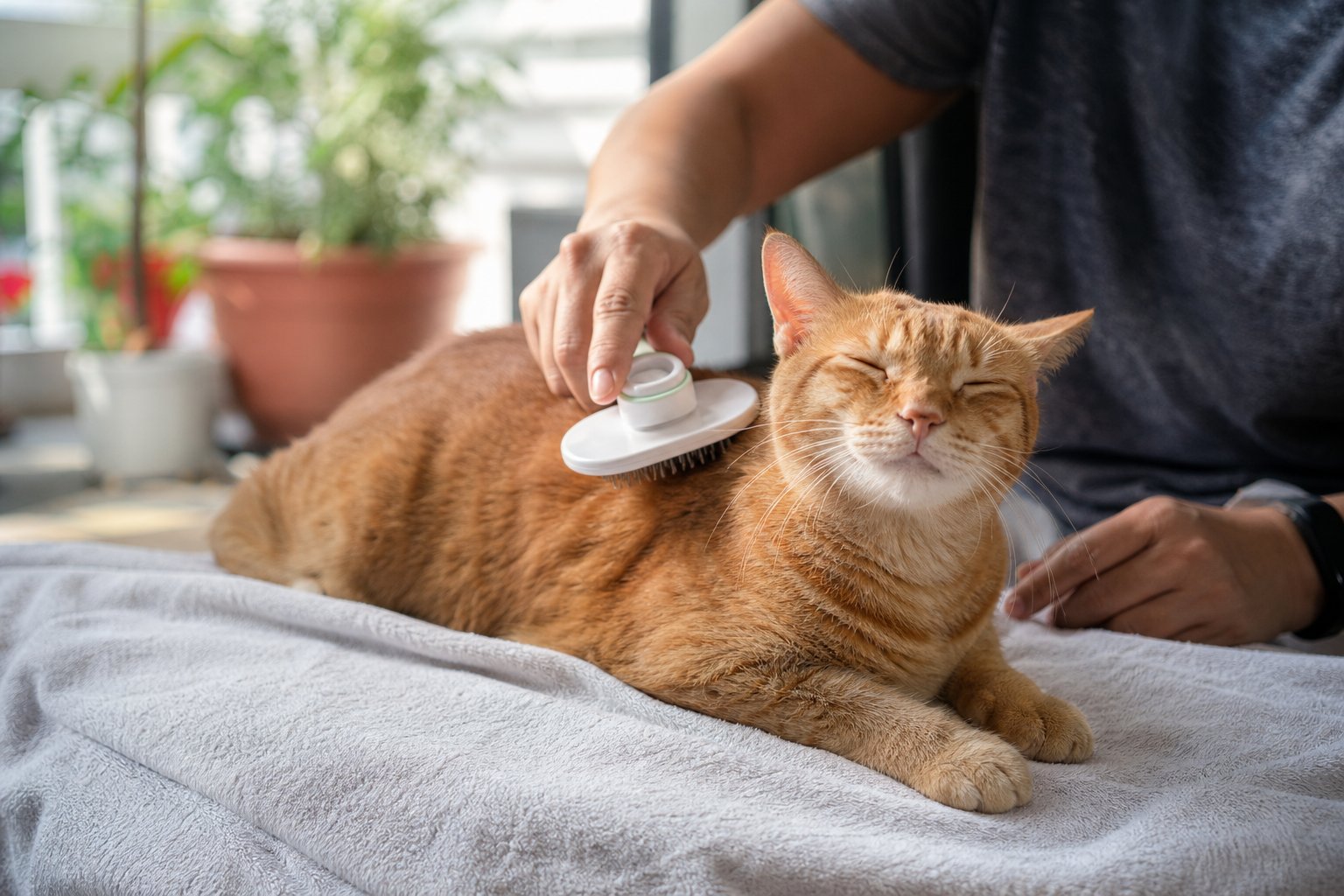
For long coats, three brush types work as a sequence rather than a choice. Comb first, clear the undercoat second, remove floating hair third. Getting the order wrong is what turns a routine groom into a torn mat and scratched skin, which then triggers over-grooming in the same spot.
| Brush | Purpose | Frequency | Notes |
|---|---|---|---|
| Greyhound-style comb, 2 to 3 mm tooth spacing | Works out mats layer by layer, smooths the topcoat | First step, daily | Start at the tips and work toward the skin; never pull through a knot |
| Slicker brush, 1.5 to 2 cm pins with rounded tips | Lifts the fine undercoat, adds fluff | Only after mats are cleared | Rounded tips prevent scratching the skin |
| Undercoat rake | Collects loose hair during moult | Once or twice weekly; every other day in moulting months | Three to five strokes per area is plenty |
Moulting typically peaks twice a year, in spring and again in autumn, so schedule the rake more often during those windows. If a mat sits tight against the skin, or the skin underneath is red, stop and let a professional groomer handle it — pulling hurts, and a painful experience makes the cat resist all future grooming. Regular combing is also the cheapest way to prevent hairballs from swallowed loose fur.
Stopping dogs from chewing cables and chargers
The order of attack is: make it unreachable first, then work out why the dog wants it. Chewing through insulation exposes live metal, so the risk is a burnt mouth, heart rhythm disturbance and fluid in the lungs — not just a ruined appliance. Most cases stack three factors together: a teething puppy aged roughly three to six months with itchy gums, a cord that resembles a tug toy, and an owner who chases and grabs the cable, turning it into a rewarding game.
| Tactic | How to do it | Frequency | Common mistake |
|---|---|---|---|
| Cable management | Plastic trunking or conduit for every cord under one metre; power strips inside a closed box | Set up once, inspected weekly | Taping cords down loosely, which a dog peels off in seconds |
| Alternative chewing | Three or four chew toys of different textures rotated | 10 to 15 minutes, several times a day | One toy left out permanently, which loses appeal fast |
| Energy release | Two walks daily of 20 to 30 minutes with plenty of sniffing | Daily | Using running instead of sniffing, which leaves the dog more wired |
| Pet-safe bitterant | Wipe the cord, spray from about 15 cm, let it dry completely before use | Reapply every 2 to 4 weeks | Chilli powder, mustard, camphor or human deterrents, which are dangerous |
| Swap training | The instant the dog touches a cord, offer a toy and reward the exchange | Short daily sessions | Wrestling the cord away, which makes it a game |
Bitterant is a backup, not the plan, because dogs habituate to the taste. Test any spray on an old cord for 24 hours first and watch for drooling, vomiting or eye irritation. If destruction begins within half an hour of you leaving the house, look at separation issues rather than chewing.
If a cable has already been chewed, phone a vet even when the pet seems fine and shows no burn marks. Swallowed fragments of insulation and wire can cause intestinal blockage or mouth lacerations, and electrical burns to the mouth plus lung fluid may only show up 12 to 24 hours later as rapid breathing, coughing and drooling. Do not induce vomiting; follow the vet's instructions and monitor closely through that window.
Picking a bed for a senior dog
Older dogs need different support from adults because joints, muscle mass and temperature regulation have all shifted. Before shopping, do two things: measure the dog from nose to tail base while fully stretched (size up rather than down), and watch how it actually sleeps — a dog that sprawls on its side wants a flat mattress, while one that curls or rests its head needs low bolsters.
| Selection point | What a senior dog needs | Typical error |
|---|---|---|
| Support | Memory foam or a layered base that spreads joint pressure | Cheap fill that flattens immediately |
| Edge height | Low lip for easy entry, enough height to support the head | High sides the dog cannot climb over, risking a fall |
| Base | Non-slip, plus a mat or runner underneath | Bed sliding on smooth tile or laminate |
| Cleaning | Removable cover washed weekly | Sealed construction that stays damp and mildews |
| Size | Measured nose to tail base, generous | Guessing from body weight alone |
| Access | A step or small ramp; no awkward drop, no tight corner | Bed placed too high or wedged where the dog cannot turn |
The room matters as much as the bed. Put non-slip runners along the main walking route, set food and water bowls on the ground floor and raise them 5 to 10 cm, and swap tall-sided beds for low-entry versions. Thick, damp-proof bedding helps in cool weather, while a flat cool surface stays available in the heat. Memory-foam beds and soft senior warming pads from international brands such as PETKIT and Petio are typical starting points — prices vary between retailers, so ask your local pet shop or vet what is currently stocked.
When to see a vet
Everything above is for catching problems early. None of it replaces a diagnosis. Contact a veterinarian, or an emergency clinic after hours, immediately if any of these appear:
- Breathing: more than 40 breaths per minute while resting, mouth open, gums turning purple or pale, or the abdomen heaving with obvious effort.
- Circulation and heart: a heart rate persistently below 100 or above 260, sudden hind-leg weakness or dragging, or an unusual cry — treat sudden hind-leg paralysis as an emergency, not something to leave overnight.
- Behaviour and intake: nothing eaten or drunk for over 24 hours, urinary blockage (especially dangerous in male cats), continuous panting while hunched, or a dull animal that does not respond.
- Heat and cold injuries: panting, drooling and hot ears after hot weather (heatstroke), or red, blistered skin where a heating pad sat (low-temperature burn).
- Coat and skin: discoloured patches spreading fast within a day, pus, a strong odour, or skin licked raw.
- Cable or foreign-body chewing: call the vet straight away, then watch for rapid breathing, coughing or drooling over the next 12 to 24 hours.
This article is for general information only and does not substitute for veterinary diagnosis, prescription or treatment. Please consult a licensed veterinarian about your own pet's condition.
Related reading
- Pet Daily Care Guide Malaysia: Brushing, Nails, Ears, Eyes, Teeth and Weight (2026)
- Pet Daily Care Hub: Grooming, Nails, Ears, Teeth and Weight for Malaysian Owners
- Cat Hypoglycaemia First Aid: 5 Mistakes to Avoid (Malaysia)
- Cat Nail Trimming in Malaysia: A Calm, Step-by-Step Guide for Indoor Cats
- Cat Nail Trimming in Malaysia: Frequency, Technique and Quick Bleeding First Aid
- Cat Toy Cleaning and Care Tips for Malaysian Homes: A Practical Maintenance Schedule
- Cat Tree and Home Pet Device Safety in Malaysia: Coatings, Carbon Sachets, Microchips and Smart Gadgets
- Iodine Tincture vs Povidone-Iodine for Pets in Malaysia: When It's Actually Needed (and When It's Not)
- Iodine Tincture vs Povidone-Iodine: Where It's Safe to Use on Pets in Malaysia
- Pet Behaviour & Training Part 1: Toxic Plants, Fruit & Veg Portions, Oils and Anxiety Panting
- Pet Daily Care in Malaysia: Measuring Your Dog, Getting Cats to Drink, Litter Maths and Small-Pet Basics