
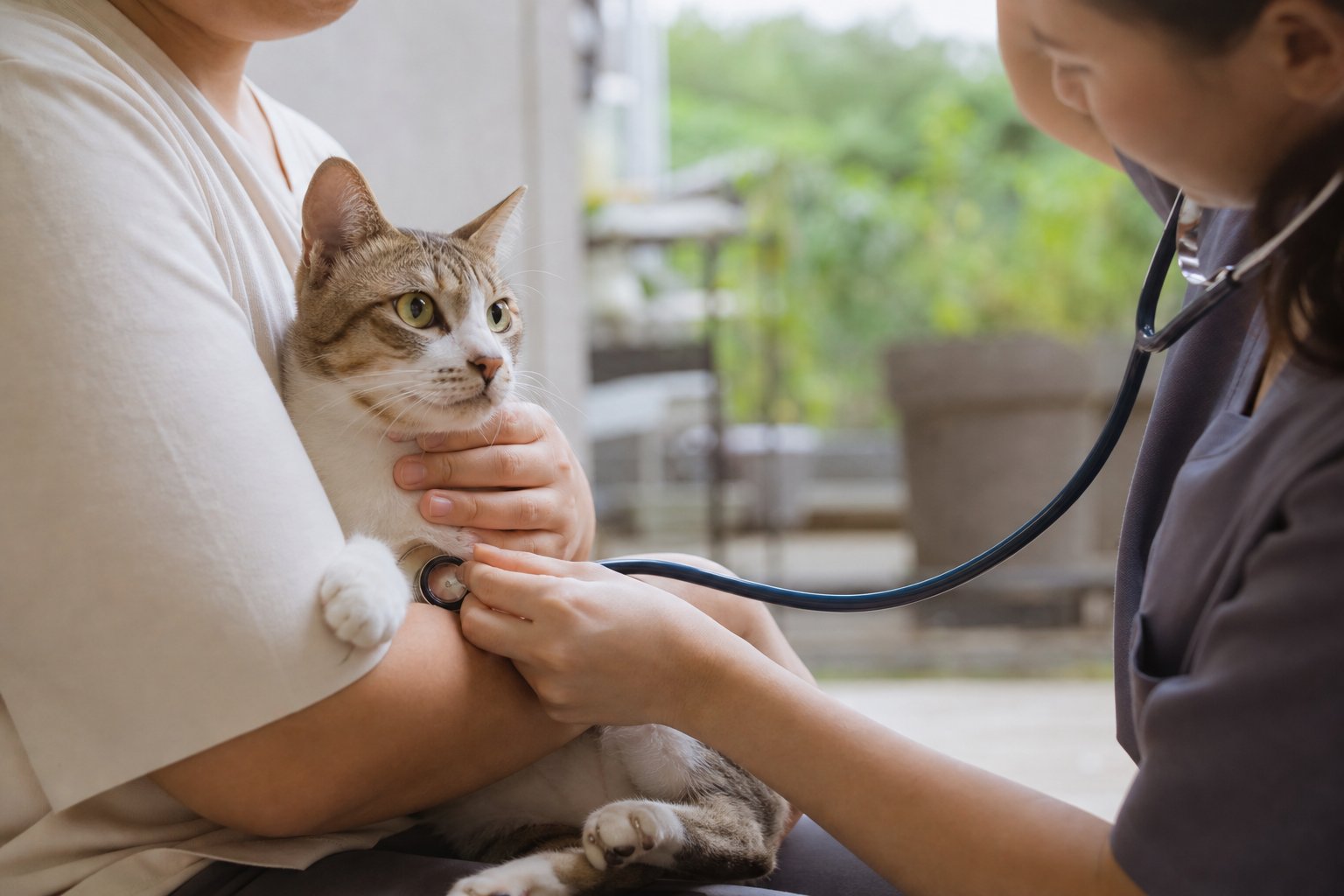
Quick answer: The most common feline heart problem is hypertrophic cardiomyopathy (HCM), where the heart muscle thickens and the chamber fills poorly. Early cases are almost silent, so the most useful thing an owner can do at home is count breaths during deep sleep — under 30 per minute is the usual reference, while a sustained 40-plus, open-mouth breathing, or sudden hind-leg weakness all mean the same thing: get to a veterinary clinic now.
Why heart disease in cats is so easy to miss
HCM is the cardiac condition vets encounter most often in cats. The left ventricle wall thickens, the chamber holds less blood during its filling phase, and over time this can lead to heart failure, fluid in the chest or abdomen, or a blood clot. Because the change happens gradually inside a species that masks illness instinctively, an affected cat can look completely normal at home for months.
Breed does matter. Maine Coons, Ragdolls and British Shorthairs have documented family tendencies toward the condition, which is why responsible breeders screen breeding stock. But a cat with no pedigree is by no means safe — plenty of mixed-breed and community cats develop the same disease, so "my cat is just a kampung cat" is not a reason to skip cardiac checks.
There is also dilated cardiomyopathy (DCM), historically linked to taurine deficiency. Once mainstream commercial cat foods were formulated to meet taurine requirements, reported cases fell sharply. The risk has not disappeared for cats fed long-term on unbalanced home-prepared meat-only diets or a single unsuitable food, which is a good argument for feeding a complete, balanced commercial diet unless a veterinary nutritionist has designed a recipe.
Age is the other factor. Risk climbs after around seven years, so a senior cat's annual health screen should include listening to the heart and, when indicated, measuring a resting breathing rate at home between visits.
Early warning signs: what to track before anything looks wrong
Cats rarely present with a dramatic symptom. Instead, the changes are small enough to be explained away as "just getting older". Keep a simple monthly log so you can compare rather than guess.
| What you observe | Early signal worth noting | When it becomes a concern |
|---|---|---|
| Activity | Fewer jumps, avoids the usual high perch | Clear change sustained over about two weeks |
| Breathing at rest | Breathing count rises during deep sleep | Persistently above 30 per minute |
| Stamina | Tires after short play, needs to pause | Recurs after every session |
| Weight | Unexplained loss (often with heart failure) | Around 5% or more lost in a month |
| Hind limbs | Unsteady gait, cold paw pads | Any sudden weakness or dragging = emergency |
| Appetite | Eating less, especially alongside breathing change | Reduced intake for more than a day |
One trap worth flagging: coughing is far less common in cats than in dogs. Owners frequently assume a repeated retching or "hairball that never comes up" is harmless stomach trouble, when it can point to airway or cardiac disease. If your cat makes that motion regularly, record a short video on your phone and show it at the appointment — vets act on footage far faster than on a verbal description of something that did not happen in the consulting room.
The 30-second home check: counting sleeping breaths
This is the single most practical monitoring tool available to owners, and it works in any home, regardless of floor space or budget.
- Wait until your cat is genuinely deeply asleep — flat on its side or curled with slow, regular movement, not merely dozing with its head up.
- Watch the chest and abdomen rise. One inhalation plus one exhalation equals one breath.
- Time 15 seconds and multiply by four, or count a full 60 seconds for accuracy.
- Write the number down in your phone notes or a notebook, ideally at the same time each day — bedtime works well.
Interpret the numbers this way: under 30 per minute is the normal reference range; 30 to 40 sustained means book a vet appointment promptly; above 40, or any open-mouth breathing or obvious abdominal effort, means do not wait until morning.
Two common counting errors inflate the result. Counting during a dream (twitching, running paws) rather than still sleep, and counting each chest movement as an exhale rather than a full cycle. If a number looks alarming, recount once calmly before panicking — but if it stays high twice in a row, act on it. These figures are a home reference, not a diagnosis, and they never replace an examination.
Trends matter more than single readings. A cat that has always run at 28 and now sits at 36 every night has given you useful information even though neither number is technically an emergency on its own.
From murmur to diagnosis: what the pathway looks like
Most owners discover the problem by accident — a routine check reveals a murmur or an irregular rhythm. What follows usually follows a standard sequence:
- Auscultation. The vet listens for a murmur or arrhythmia, and may already have noted a higher-than-expected breathing rate.
- Blood screening. Cardiac biomarkers such as NT-proBNP can support the suspicion and help decide how urgently an ultrasound is needed.
- Echocardiography. This is the test that confirms HCM: it measures wall thickness, chamber size and blood flow, and it is what separates true disease from an innocent murmur. It is commonly performed at a larger practice or by a visiting specialist.
- Chest X-rays and ECG. These assess fluid accumulation and rhythm abnormalities that ultrasound alone may miss.
- Staging and medication. Your vet decides whether to monitor or start treatment — drugs such as beta-blockers or anticoagulants may be involved. All of these are prescription-only. Never buy cardiac medication over the counter or split tablets belonging to another pet.
Fees vary enormously between practices and regions, and ultrasound or specialist referral represents a meaningful cost. Ask in advance what each stage involves, whether fasting is required, what the follow-up interval will be, and what the total is likely to be. Clinics in Malaysia set their own rates, so get a written estimate rather than relying on figures you find online.
Bring your breathing log to every appointment. A trend line tells the vet far more about whether medication needs adjusting than a single reading taken while the cat was stressed in a carrier.
Home environment changes that genuinely help
A heart-affected cat copes best with two things removed from its life: sudden intense exertion and sharp environmental swings.
- Stable temperature. Keep the indoor climate steady and avoid directing air-conditioning straight onto the cat's resting spot. Coming home to an aggressively cooled room after a hot outing is a shock worth avoiding.
- Managed humidity. During prolonged wet seasons, a dehumidifier can reduce the work of breathing, but it does not replace fresh water — keep bowls clean and full.
- Fewer big jumps. Add a stool or step beside the sofa or bed so one large leap becomes two smaller ones. This protects both the heart and the joints.
- A quiet retreat. Give the cat a resting place where children and other pets cannot repeatedly disturb it, so it can self-regulate its activity.
- Calmer interactions. Chasing games, sudden grabbing or unfamiliar visitors arriving in a rush can spike the breathing rate. Gentle handling matters more than most owners realise.
- Safe medication storage. Keep tablets somewhere cool and dry — not in a steamy bathroom or a hot kitchen cabinet — and check remaining quantities before each refill visit.
For someone living in a Kuala Lumpur high-rise apartment, the practical version of this is simple: a step stool under the bedroom window ledge, the air-conditioner set to a consistent moderate temperature rather than switched off all day, and a feeding spot in a corridor away from the lift lobby traffic that keeps startling the cat.
Food, weight and the routine of follow-up
Weight management is the core of daily care. Extra kilos make the heart work harder, so measuring portions beats buying anything labelled "heart support". Complete commercial foods formulated to meet feline nutritional requirements already supply taurine in adequate amounts; a separate taurine supplement is rarely needed unless your vet has identified a specific deficiency.
Sodium matters most once heart failure has been diagnosed, where a veterinary low-sodium or cardiac diet may be prescribed. For a cat that is merely stable with a murmur, the priority is keeping the cat eating — appetite loss in a cardiac patient is more dangerous than a slightly less restrictive formula. Small, frequent, strongly aromatic meals help senior cats with a reduced sense of smell.
Supplements can support a plan but never substitute for prescribed medication. If someone offers you a "natural heart remedy" that claims to replace tablets, the safest response is to ask your vet before buying it.
Recheck intervals are commonly three to six months for a stable cat, and considerably shorter once heart failure has appeared. Each visit should include the breathing record, a weight check, and a review of remaining medication.
Myths and facts, side by side
| Myth | Reality |
|---|---|
| "Coughing means a hairball" | Coughing is uncommon in cats and may indicate cardiac or airway disease — record a video for the vet |
| "No murmur means no heart disease" | Some HCM cats have no obvious murmur; ultrasound may still be advised, especially with family history or a rising breathing count |
| "Supplements can replace heart medication" | Supplements are, at best, an addition — never a replacement for prescription drugs |
| "Panting is just the heat" | An elevated count during deep sleep points toward cardiac involvement and should not be dismissed as weather |
| "Only pedigree cats get heart disease" | Mixed-breed cats are affected too; breed changes risk, not certainty |
When to see a vet
Treat these as emergency signs — do not wait for daylight hours:
- Breathing over 40 per minute while fully asleep
- Open-mouth breathing, which is never normal in a cat
- Restlessness, or refusing to lie down because breathing is easier upright
- A visibly distended abdomen, which may indicate fluid buildup
- Sudden hind-limb weakness, cold paws, loud crying or dragging of the legs (thromboembolism)
- Total refusal to eat alongside any breathing abnormality
Book a prompt, non-emergency appointment if you notice: reduced jumping or play stamina over two weeks, a sleeping breathing count that has crept above 30, gradual weight loss of around 5% in a month, or repeated retching without producing anything.
Preparation saves precious minutes. Before an emergency ever happens, identify which nearby clinics offer after-hours or emergency cover, save their numbers in your phone, and know where the nearest one is from your home. Keep the carrier accessible, the medication list updated, and your breathing notes in one place so you can hand the vet a clear history on arrival.
Bring to the appointment: your breathing-rate log, current weight trend, a video of any coughing or retching episodes, the exact names and doses of any medication or supplements, and a list of questions written down in advance.
Key takeaways
- ✅ HCM is the most common feline heart disease, and it is usually silent early
- ✅ Under 30 breaths a minute during deep sleep is the general reference
- ✅ Sustained 40-plus, or open-mouth breathing, means same-day emergency care
- ✅ Sudden hind-leg weakness is a clot emergency — do not delay
- ✅ Weight control, a stable environment and scheduled rechecks form the backbone of care
- ❌ Never start, stop or adjust cardiac medication on your own
- ❌ Never assume a mixed-breed or young cat is exempt from cardiac checks
This article is general information only and is not a diagnosis. If your cat has persistent symptoms, an abnormal breathing rate, or any emergency sign above, please see a qualified veterinarian promptly.
Related reading
- Cat Health Guide Malaysia: Symptom Check, Red-Flag Triage & When to See a Vet
- Cat Arthritis in Malaysia: 5 Home Signs Your Cat Is in Pain — and What to Do
- Cat Chronic Kidney Disease in Malaysia: The Daily Care Routine That Actually Slows It Down
- Cat Constipation in Malaysia: The 48-Hour Rule, Red Flags and What Actually Helps
- Cat Kidney Disease in Malaysia: Early Signs, Prevention and Everyday Care
- Cat Chronic Disease Early Signs in Malaysia: 7 Daily Checks and a 4-Week Log
- Early Signs of Chronic Disease in Cats: 7 Daily Checks and a 4-Week Record Sheet
- Cat Pancreatitis in Malaysia: Symptoms, fPLI Testing, Treatment and Home Recovery
- Cat Ringworm in Malaysia: Symptoms, Treatment and Home Cleaning Guide
- Cat Ringworm in Malaysia: Signs, Treatment and Home Cleaning Guide
- Cat Symptom Checker Malaysia: 12 Common Signs and a Green-Amber-Red Triage Table