
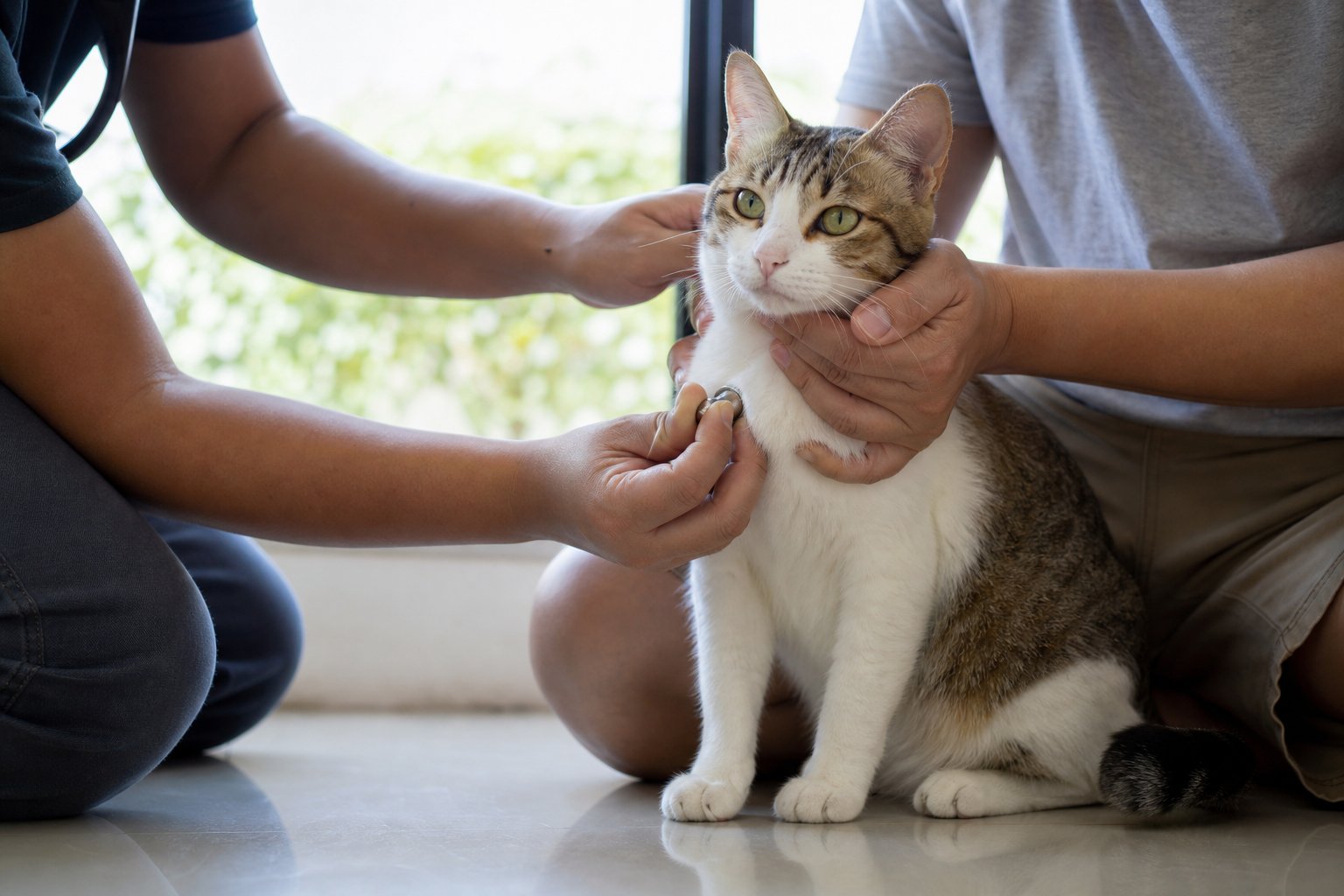
The fastest home check is the skin-turgor test: gently tent the skin between your cat's shoulder blades and let go. If it snaps back immediately, hydration is likely fine. If it settles slowly or stays peaked, your cat is losing water. If your cat has refused all water for more than 24 hours, has dry sticky gums, sunken eyes, weakness or unsteady legs, see a vet immediately.
Dehydration in cats is rarely dramatic at the start. It creeps in over days — a bowl that goes untouched, a litter clump that gets smaller, a cat that naps a little longer than usual. By the time most owners notice, the cat is already well past the early stage. That is exactly why a thirty-second home check, done regularly, matters more than any product you can buy.
This guide covers how to run that check properly, why cats are wired to run dry, the seven most common causes, which rehydration methods actually work at home, and the clear red lines that mean stop reading and go to a clinic.
The three-step home check
Do all three steps in one sitting, at roughly the same time each day, so your observations are comparable. Keep it calm and brief — a stressed cat gives you misleading readings.
Step 1: Skin-turgor test. With your thumb and forefinger, lift a fold of skin on the midline of the back, between the shoulder blades, about 1–2 cm up, then release it.
- Skin returns instantly: water balance is probably normal.
- Skin returns slowly, roughly one to two seconds: mild to moderate dehydration is likely.
- Skin stays peaked like a tent and does not flatten: severe dehydration — treat as an emergency.
Work gently. Repeatedly pinching the same spot inflames the skin and makes the next reading unreliable.
Step 2: Gum check. Lift the upper lip and press a clean finger or cotton bud lightly against the gum, then release.
- Moist and slippery, pink, with colour returning within about one second: normal.
- Dry to the touch with a tacky or sticky feel: a dehydration sign.
- Pale, bluish, or a press that stays white for more than two seconds: a circulation problem, not just dehydration — this is urgent.
Step 3: Track intake and output. Use a water bowl with volume markings and record the level daily. Then count the urine clumps in the litter tray and note their size. A sudden jump in drinking and urinating points toward kidney disease, diabetes or an overactive thyroid. A sudden drop in drinking plus smaller, fewer clumps suggests your cat is already dehydrated or feeling unwell.
If you own a digital scale, weigh your cat at the same time each week. A loss of more than 5% of body weight in a short period is a meaningful warning sign and warrants a check-up.
Grade the severity at a glance
Use this table to decide how quickly to act. It is a triage aid, not a diagnosis.
| Sign | Mild — hydrate at home and monitor | Moderate — see a vet soon | Severe — get emergency care now |
|---|---|---|---|
| Skin-turgor test | Snaps back immediately | Sluggish return, around 1–2 seconds | Stays tented, no return |
| Gums | Moist, pink | Slightly dry, tacky | Dry and sticky, pale or whitish |
| Eyes | Bright, no recession | Sockets look slightly sunken | Clearly sunken, dull expression |
| Alertness | Normal | Tired, slow to respond | Weak, flopped over, hard to rouse |
| Urination | Normal | Noticeably reduced output | No urine for 12–24 hours |
| Appetite | Normal | Reduced | Refusing food entirely, or repeated vomiting/diarrhoea |
| Breathing and pulse | Normal | A little faster | Rapid breathing, fast weak pulse |
A single row in the middle column is a reason to book a same-day appointment. Two or more rows, or anything in the right-hand column, means go now rather than wait for morning.
Why cats are so prone to running dry
Three built-in factors work against your cat.
Desert ancestry. Domestic cats descend from a desert-living ancestor with a naturally low drive to drink. In the wild, most water came from prey, which is around 70% water. A cat fed only dry kibble — roughly 6–10% moisture — is therefore running on a permanently low water budget compared with its ancestral diet.
A blunted thirst mechanism. Cats do not feel thirst the way humans do. The signal often arrives only after the body has already been short of water for a while, and the reflex weakens further with age. An older cat may be quietly dehydrating without ever approaching the bowl with urgency.
Small bodies, small reserves. Because a cat carries relatively little total body water compared with a large animal, losses from vomiting, a hot afternoon or a missed meal take proportionally more out of it. Kittens and seniors are the most vulnerable.
Veterinarians express dehydration as a percentage of body weight. At around 5% or less, skin turgor may still look normal, which is why a normal pinch test never fully rules out a problem. As the percentage climbs, the return visibly slows. That is the value of the home test: it catches early change, but it cannot replace a clinical assessment.
The seven most common causes
| Category | What it looks like in practice | What it means for you |
|---|---|---|
| Insufficient intake | Dry food only; too few bowls; bowls left dirty; water bowl placed next to the litter tray or food bowl | The commonest and most fixable cause |
| Vomiting or diarrhoea | Acutе gut upset, swallowed foreign material, worms | Large fluid and electrolyte loss over hours |
| Chronic kidney disease | Common in older cats; urine output climbs as concentration fails | Sustained mild dehydration, day after day |
| Diabetes | Excess blood sugar pulls water out through the urine; drinking and urinating heavily | Requires blood and urine testing to confirm |
| Hyperthyroidism | Raised metabolism, weight loss despite a good appetite, more drinking and urinating | Common in older cats; treatable once diagnosed |
| Fever or infection | Higher body temperature accelerates water loss | The underlying illness must be treated |
| Heat or enclosed spaces | Hot afternoons, no airflow, a car left parked | Can turn fatal quickly — an emergency |
Notice that four of these seven are medical conditions rather than lifestyle problems. This is why a cat that starts drinking noticeably more, or noticeably less, deserves attention even if it otherwise seems bright. Changes in water behaviour are often the first visible clue to a disease that is otherwise silent.
Rehydration options, from gentlest to medical
| Method | How to do it | Best suited to |
|---|---|---|
| Multiple water stations | Three to five bowls spread across the home, away from food and the litter tray | Every cat, as daily prevention |
| Running-water fountain | Fresh filter, cleaned on schedule | Cats with a low interest in still water |
| Wet food or canned food | Moisture content around 75–80%, versus 6–10% in dry kibble | The single most effective everyday hydration move |
| Extra water in food | Stir one to two tablespoons of clean water or unsalted broth into the meal | Cats already eating wet food |
| Syringe offered water | Tiny volumes, slowly, against the inside cheek, watching for coughing | Mild cases only, with care |
| Subcutaneous fluids | Given under the skin after a vet has demonstrated the technique | Usually long-term kidney patients |
| Intravenous fluids | Delivered at the clinic | Moderate to severe dehydration, ongoing vomiting or diarrhoea |
Rehydrate before you feed. For a mildly dehydrated cat, offer water or a moisture-rich meal first rather than a dry biscuit. If the skin does not rebound, the gums are dry and sticky, or there has been no urine for 12 to 24 hours, skip home efforts and get to a clinic.
On quantities: a useful reference figure is 50–60 ml of water per kg of body weight per day, counting the moisture already present in food. But the practical approach is better than the arithmetic — measure your own cat's normal daily intake for a week and treat any sharp deviation as the trigger to investigate.
Two mistakes that cause real harm
Do not force water into the cat's mouth. squirting liquid quickly past the teeth can be inhaled into the windpipe. The result is aspiration pneumonia, a serious complication that turns a dehydration problem into a respiratory one. Slow, small, side-of-mouth offerings only — and stop the moment your cat coughs, chokes or struggles.
Do not buy injectable fluids on your own. Subcutaneous rehydration uses a balanced electrolyte solution, and both the type and the volume are chosen by a veterinarian according to body weight, kidney values and electrolyte results. Too much fluid, or the wrong composition, can destabilise a cat with compromised kidneys. Buy the needles and the fluid only after the clinic has prescribed them and shown you the technique.
Also resist the urge to add human electrolyte sports drinks, salt solutions or sugary broths to a cat's water. Cats handle sodium and potassium far more narrowly than humans do.
What subcutaneous fluids involve
For cats with chronic kidney disease or another condition needing regular support, a vet may teach you to give fluids at home. A fine needle goes into the space beneath the skin between the shoulder blades — not into a vein — and the fluid is absorbed gradually over the following hours. A small lump forms and disappears on its own.
Owners often expect the worst and are pleasantly surprised. Most cats tolerate the process better than anticipated, particularly with a fine-gauge needle, a relaxed hold and a treat waiting at the end. The discomfort is usually a stretching sensation rather than a sharp pain. Sessions still need periodic review so the clinic can check hydration, weight and blood values and adjust the volume.
If your cat fights every single session, say so. There is no virtue in a routine that both of you dread; your vet can suggest alternative schedules, solutions or supportive treatments.
Heat, humidity and the risk of heatstroke
A warm, humid climate adds a constant background load. Cats cool themselves through grooming and, only to a limited degree, through panting — they are poor heat dissipators compared with dogs.
- Keep rooms ventilated. Avoid leaving a cat shut for hours in an unventilated space with no water.
- Never leave a cat in a parked vehicle. Even a few minutes is enough for the interior to climb to dangerous levels.
- Higher-risk cats include long-haired breeds, flat-faced breeds, seniors and cats with heart disease.
- Recognise heatstroke: rapid open-mouth panting, heavy salivation, bright red gums, a hot body, unsteady stance. Cool the cat with cool (not ice-cold) water on the extremities and get to a clinic immediately.
- Air-conditioned rooms dry the air too. If your cat seems less interested in drinking during a long stretch of indoor air-conditioning, add moisture-rich food rather than waiting.
In a Kuala Lumpur apartment during a long dry spell, the practical fix is environmental: several water stations in shaded corners, a fountain kept scrupulously clean, and wet food served at the cooler parts of the day. In a Penang rainy season stretch, the opposite risk appears — humidity suppresses appetite and water intake while mould grows in stagnant bowls, so change water more frequently and wash bowls daily.
When to see a vet
Arrange a consultation promptly if any of the following applies:
- Your cat has not taken any water for more than 24 hours.
- Gums feel dry and sticky, or a gum press stays pale for over two seconds.
- The skin-turgor test leaves a persistent tent.
- The eyes look sunken or the expression is dull and flat.
- There is no urine in the litter tray for 12 to 24 hours, or clumps have shrunk dramatically.
- Vomiting or diarrhoea continues beyond a day, or blood appears.
- Your cat refuses food, is unusually weak, or cannot stand steadily.
- Weight has dropped more than 5% in a short period.
- You suspect heatstroke — this is a same-hour emergency, not a wait-and-see.
Bring notes if you have them: daily water intake, number of urine clumps, appetite changes and when the behaviour shifted. Those details save the vet time and often point straight at the cause.
Fees for consultation, blood tests, fluids and hospitalisation differ widely between clinics and depend on what is required, so ask your chosen Malaysian veterinary clinic for a current estimate before treatment begins. The same applies to hydration products — check with a local pet retailer rather than assuming a price.
Key takeaways
- Run the three-step check regularly: skin turgor, gum moisture, then intake and output records.
- Cats are biologically predisposed to low water intake — desert ancestry, a blunted thirst reflex and small body reserves.
- Seven causes: low intake, vomiting or diarrhoea, chronic kidney disease, diabetes, hyperthyroidism, fever or infection, and heat exposure.
- Wet food at roughly 75–80% moisture is the most effective everyday hydration tool; dry kibble sits at 6–10%.
- Red lines: no water for 24 hours, dry sticky gums, tented skin, sunken eyes, no urine for 12–24 hours, suspected heatstroke.
- Never force water into the mouth, and never start injectable fluids without veterinary demonstration and prescription.
Disclaimer
This article is general pet health information and is not a substitute for veterinary diagnosis or treatment. The degree and cause of dehydration, and any rehydration plan — including fluid type, volume and frequency — must be determined by a registered veterinarian for your individual cat. The skin-turgor and gum checks are home screening tools only. If your cat has gone more than 24 hours without water, shows dry sticky gums, sunken eyes, marked lethargy, no urine, or suspected heatstroke, attend a veterinary clinic or emergency hospital immediately.
Related reading
- Cat Constipation in Malaysia: The 48-Hour Rule, Red Flags and What Actually Helps
- Cat Pancreatitis in Malaysia: Symptoms, fPLI Testing, Treatment and Home Recovery
- Cat Ringworm in Malaysia: Signs, Treatment and Home Cleaning Guide
- Cat Symptom Checker Malaysia: 12 Common Signs and a Green-Amber-Red Triage Table
- Gut Health, Probiotics & Food Transition Part 2: Practical Malaysia Guide
- Pet Gut Health in Malaysia: Probiotics, Food Transitions and Stool Troubles (Part 2)
- Pet Health in Malaysia: A Practical Prevention Guide for Cats and Dogs