
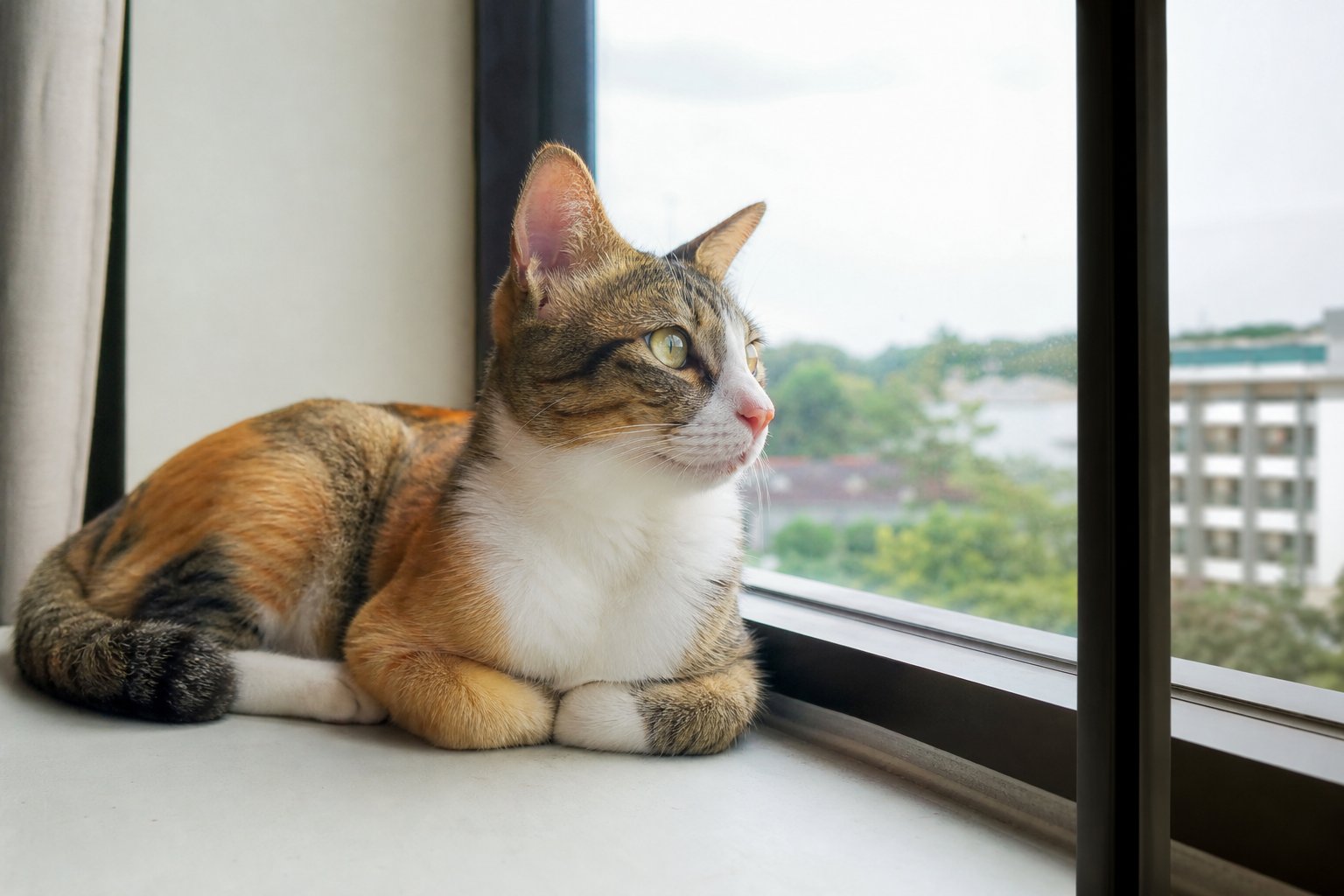
Quick answer: read cat behaviour in four steps — context, meaning, correct response, and when to worry. A single action such as rolling onto the back or biting mid-pet can signal relaxation or stress, so always check the tail, ears, pupils and body tension together. Use the triage table below to work out what your cat is telling you in about 30 seconds.
How to decode any cat signal in four steps
Cats cannot explain themselves in words, but they send signals every second. The trouble is that owners often read those signals through human logic: kneading means love, a belly-up roll means rub me, a hand bite means revenge. Every one of those readings is incomplete, and acting on them usually raises the cat's stress rather than lowering it.
Decode in a fixed order:
- Context first. Where is the cat, what just happened, who else is in the room, how long has the interaction run?
- Combine signals. Tail position, ear angle, pupil size and muscle tension together. One signal alone is rarely enough.
- Choose the response. Usually that means changing what you are doing — stopping, retreating, or adjusting the environment.
- Check the calendar. When did this start, and how often does it appear? A behaviour that has quietly shifted from normal to concerning is rarely about attitude; it is usually about health or surroundings.
Three principles hold across everything in this guide. Behaviour equals context multiplied by a combination of body signals, never a single movement. Triage every observation as normal, watch-and-adjust, or get-help. And rule out pain first — when behaviour changes suddenly, the first visit is to a veterinary clinic, not a training class.
Quick-reference table: 30 signals and what they mean
| Behaviour | Typical context | What it usually means | Triage |
|---|---|---|---|
| Kneading | On your lap, on a blanket | Recurring kitten instinct for comfort, plus scent marking | Normal |
| Purring | Being stroked, sometimes at the vet | Usually contentment, but also self-soothing under stress or pain | Read context |
| Slow blinks | Making eye contact, slowly closing eyes | Trust and relaxation — a genuine social signal | Normal |
| Head tilt | Hearing a sound, watching you | Curiosity, or locating where a sound comes from | Normal |
| Head tilt with loss of balance | Persistent tilt, wobbly walking | Possible inner ear or neurological problem | See a vet |
| Rolling belly-up | Lying down in a safe environment | Relaxation combined with readiness to defend — not an invitation | Watch closely |
| Tail held high | Approaching you, walking through the home | Friendly, confident greeting | Normal |
| Fast tail lashing | While being held or stroked | Overstimulation; the cat wants you to stop | Stop now |
| Tail tucked or wrapped around the body | New environment, new household member | Fear and an attempt to look smaller | Act if persistent |
| Flattened ears | During petting, near a dog or stranger | Alertness, fear, preparation to defend | Stop interaction |
| Dilated pupils | Normal light, still wide | Excitement, anxiety, possibly pain | Read context |
| Head bunting | Bumping your forehead or your leg | Marking you with facial glands — social closeness | Normal |
| Rubbing on objects or you | Door frames, chair legs, your ankles | Scent marking to claim territory | Normal |
| Quivering rear, poised to spring | Spotting a bird or toy | Pre-pounce hunting posture | Normal |
| Gentle nipping, no broken skin | Mid-interplay | Play biting, or a social boundary saying that's enough | Read the signal |
| Hard biting during petting | Mid-session, escalating excitement | Over-petting, play gone too far, or pain | Evaluate if frequent |
| Ambush attacks on your ankles | As you walk past | Hunting practice, with your moving legs as the target | Redirect with a toy |
| Night-time zoomies | Late at night, after using the tray | Normal release of built-up energy | Normal |
| Following you to the bathroom | You leaving its sight | Social companionship and curiosity | Normal |
| Sniffing your shoes | You arriving home | Reading information from outside — a social act | Normal |
| Sitting on your keyboard or papers | When you are busy | Seeking attention and claiming a valued resource | Normal |
| Suckling a blanket, with kneading | After early weaning, during stress | Recurring nursing behaviour used for self-comfort | Watch for swallowed fabric |
| Scratching furniture | After waking, near doorways, sofa corners | Nail care, stretching and scent marking — a necessary behaviour | Adjust placement |
| Bringing you a toy | While meowing at you | Sharing a catch, practising delivery | Normal |
| Flehmen response, tongue out | After smelling something unusual | Analysing scent molecules with the vomeronasal organ | Normal |
| Open-mouth panting | Not hot, not after hard exercise | Possible pain, overheating, or heart and lung trouble | See a vet |
| Head pressing | Resting the head against a wall or furniture | A classic sign of neurological abnormality | Urgent vet visit |
| Over-grooming to bald patches | Belly, inner thighs | Stress, skin disease or pain — behavioural or physical | See a vet |
| Eliminating outside the tray | New home, new litter, multiple cats | Urinary disease or environmental pressure; rule out illness first | See a vet |
| Hiding for over 48 hours | Moving house, renovations, a new arrival | Extreme unease, and possibly illness | See a vet |
How to use the table: look at the triage column first, then ask when the behaviour started and when it happens most. If a behaviour moves from normal to watch-or-escalate, the change is almost never the behaviour itself — it is the cat's health or environment that has moved.
Six signals people misread, and the right response
These are the signals most often misread. The point is not to wonder why your cat does that, but to change what you are doing straight away.
- Tail lashing fast. The first warning that emotions are rising. Response: stop and let go immediately — do not try one more stroke to see what happens.
- Ears flattened. Alertness or fear. Response: break eye contact and leave a clear escape route rather than holding on.
- Wide pupils with the body leaning back. Preparation to defend. Response: don't approach head-on; turn sideways and back away slowly.
- Biting partway through a petting session. Usually meaning that's enough. Response: note the trigger spot — belly, base of the tail, hind legs — shorten sessions, and swap one long cuddle for several short ones a day.
- Actively avoiding you, detouring around you, hiding for long stretches. A stress signal. Response: add high perches and hiding spots, and cut down noise and foot traffic near the cat.
- Changes in appetite or toilet habits. Not a dislike of you, but a hard signal from the body or the emotions. Response: veterinary check first, then review recent changes at home.
One widespread misunderstanding deserves clearing up: a cat sitting with its back to you, rear end facing you, is not rejecting you. It usually signals relaxation and trust — the cat feels no need to keep you under watch. What deserves attention is avoidance of you, not turning away from you.
Biting, scratching and the 3am sprint
Biting. Nearly all hand bites fall into one of three buckets: the petting session ran too long, a forbidden zone was touched, or a stop signal was ignored. Cats warn before they strike — the tail begins to lash, the skin over the back twitches, the ears press down. Stopping at that moment is far more effective than reacting after teeth land. Keep sessions short and frequent, and let the cat end them.
Ankle ambushes. This is hunting practice, and your moving ankles are a perfect target. Redirect with a wand toy dragged along the floor, and never play with hands — a cat that has been taught that hands are prey keeps treating them as prey.
Scratching. Scratching combines nail care, a full-body stretch and scent marking. It is a required behaviour, not revenge. The fix is to make a scratching post more attractive than the sofa: sufficient height for a full stretch, both horizontal and vertical options, and placement beside the sleeping area, the main entrance and the corner of the sofa the cat already targets. Punishment does not work; it teaches the cat that you are a threat.
Night zoomies. Dusk to late night is a cat's natural hunting peak, so suppressing it wastes effort. About 20 minutes before bed, run a wand toy through the complete sequence — chase, pounce, capture — then offer a meal. Satisfying the hunting drive through a mechanism beats scolding afterwards.
Environment first: seven changes to make
International feline guidelines describe five pillars of environmental need: a safe refuge, multiple and separated key resources, opportunities for play and hunting, predictable and positive human-cat interaction, and respect for the value of scent. Here is how that looks in an ordinary home.
- Build at least three safe refuges. High up, partly enclosed, with a view of the entrance. When visitors arrive or renovations start, your cat does not have to socialise.
- Separate the key resources. Food, water, litter and resting places should not all sit in one corner. Apply the cats-plus-one rule for quantities.
- Add vertical space. A cat tree, shelves, a window perch. The landing spot needs to be long enough for the cat to stretch its whole body — in a compact home, building upwards is the most practical investment.
- Place scratching surfaces with a formula. Beside the sleeping area, at the main entrance, and at the sofa corner; at least one horizontal and one vertical option, both tall enough for a full stretch.
- Run two hunting sessions a day. Ten minutes each, following chase, pounce, capture, then eat — finishing with a small meal or treat closes the hunting loop properly.
- Manage scent. Avoid strong air fresheners. Catnip and pheromone products are assistants, not substitutes for environmental change.
- Give advance warning of change. For two weeks around a move, renovation or a new household member, set up one safe room with everything the cat needs so there is always a way out.
Environmental change is the front line for behaviour problems, and it comes before any training method.
When to see a vet
Take your cat in if you notice any of the following:
- Behaviour changes suddenly — a friendly cat becoming fearful, a quiet cat becoming aggressive
- Head pressing, open-mouth panting, or a persistent head tilt with unsteadiness
- Over-grooming down to bald patches, reddened skin, symmetrical hair loss
- Eliminating outside the litter tray — urinary disease must be ruled out first
- Aggression toward family members, or bites that break the skin
- Hiding continuously for more than 48 hours, or refusing food for more than 24 hours
- Day-and-night yowling, or obvious night-time anxiety
The order matters. A veterinarian rules out pain and illness first, then you make environmental changes, and only then behaviour modification — ideally guided by a vet with behaviour training. Pain is the single most common physical reason a cat's behaviour shifts, which is why a sudden change is a medical question before it is a training question.
Malaysian living: flat life, humidity and household traffic
A Kuala Lumpur high-rise apartment. Compact units make vertical space the highest-value upgrade you can buy. A cat tree, a shelf run and a window perch cost far less floor area than they give back in territory. Multi-storey homes have the same advantage: cats treat stair landings and upper levels as separate zones, so give each level its own water station and resting spot rather than one crowded corner.
A Penang terrace house during the wet season. Humid months raise mould and dust mite levels, and itchy skin shows up as extra scratching and over-grooming. Keep fabric beds and blankets washed and thoroughly dry, run a dehumidifier in the rooms where the cat rests, and check the skin folds and inner thighs weekly. If bald patches appear, treat it as a health question rather than a grooming habit.
Window watching. Daylight through large windows is a genuine enrichment, but a cat that watches street birds or other animals from close range can slip into over-alertness — constant calling, charging the glass, unable to settle. Partially block the line of sight with a film or screen while keeping the light, and give the cat a high perch facing into the room instead.
A busy household. Frequent visitors and constant foot traffic add pressure that no amount of soothing afterwards will undo. Prepare a safe room and high escape routes before the crowd arrives, not after your cat has already retreated under the bed.
What not to do
Never hit, spray with water, shout at or lock a cat up as punishment. Punishment teaches only that humans are dangerous, so the cat hides its warning signals and strikes earlier — the problem behaviour gets worse, not better. The effective route is to change the environment, change the rhythm of the day, and change how you interact, redirecting the underlying need toward a suitable outlet.
Likewise, resist the urge to label a cat good or bad. A cat that stops responding when you call is not sulking; feline social timing is self-directed, and the cat may simply choose not to come. A predictable daily rhythm of play and feeding builds more response than repeated calling ever will.
Disclaimer: This article is educational information on cat behaviour and does not constitute veterinary diagnosis or treatment. If your cat's behaviour changes suddenly, consult a registered veterinarian first; for persistent problems, ask about veterinary behaviour specialists or qualified animal behaviour practitioners.
Related reading
- Cat Behaviour Guide Malaysia 2026: Decode 30 Signals, Fix the Environment First
- Cat Anxiety in Malaysia: A 2-Week Checklist and 7 Home Fixes That Actually Work
- Cat Anxiety in Malaysia: Chronic-Anxiety Scorecard and 7 Home Fixes
- Cat Belly-Up in Malaysia: What It Really Means, and When You Can Touch
- Cat Belly Up in Malaysia: 4 Meanings & Whether You Can Touch
- Do Cats Hold Grudges? How Cat Memory Works and How to Rebuild Trust
- Cat Purring Meaning in Malaysia: Happy, Stressed or Hiding Pain?
- Why Does My Cat Purr? How to Respond the Right Way in Malaysia
- Cat Tree Malaysia: Size Formula, Buying Checklist and Small-Home Placement