
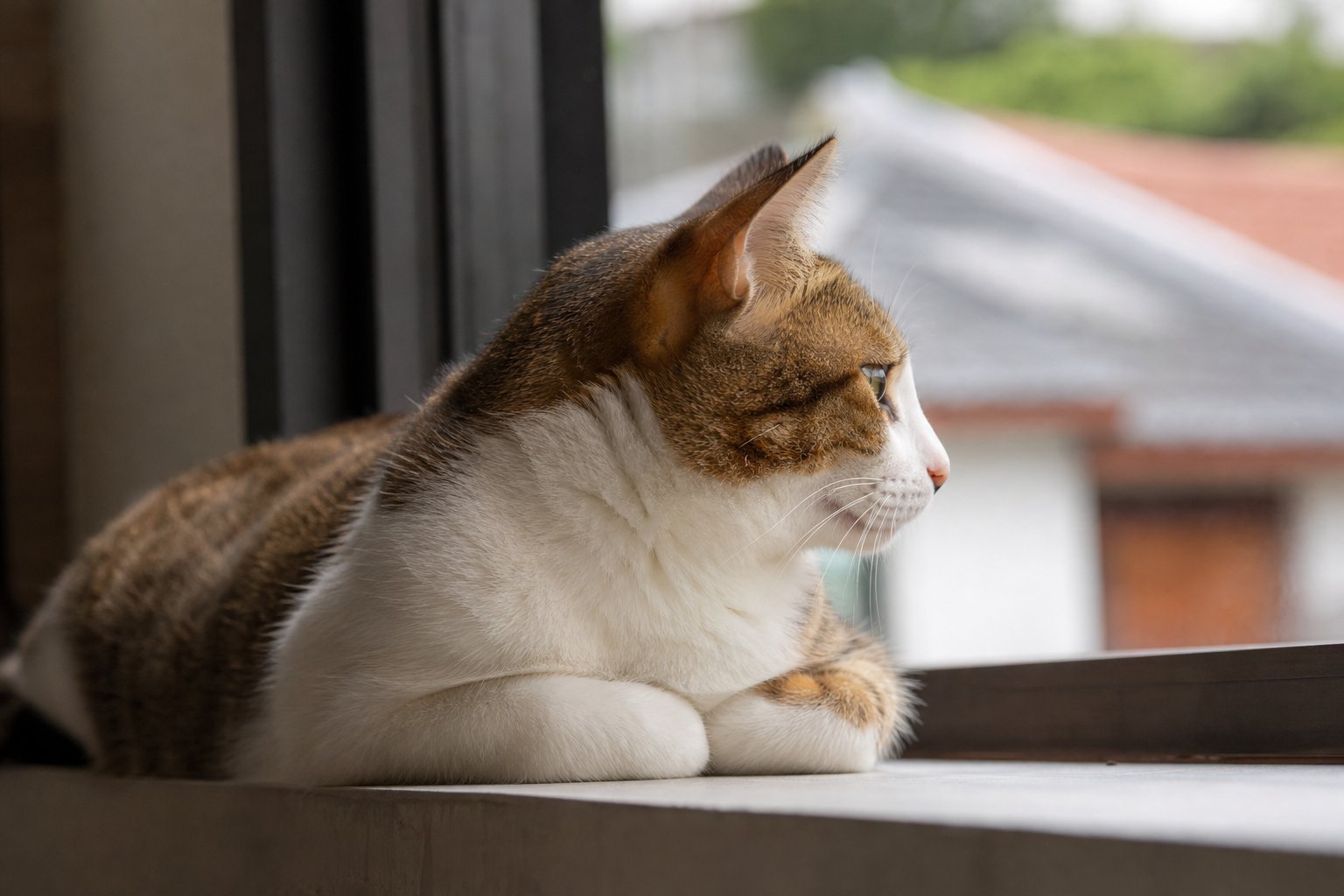
Quick answer: Multi-cat peace in a Malaysian home is a layout problem far more than a personality problem. Borrow height instead of floor area, give every cat at least two ways out of any spot, and spread litter trays, food, water and beds into separate zones. When cats can pass each other without being cornered, most space-related tension disappears on its own.
How cats measure space (it is not square metres)
Human beings judge a home by its floor area. A cat judges the same rooms on three completely different axes:
- Height equals safety. Ground level is the exposed layer. The higher the vantage point, the more of the room a cat can survey before committing to anything. A cat forced to live permanently at floor level carries a heavier background stress load than one with a rooftop of its own.
- Exits equal choice. For a cat, a dead end is a trap. Every sofa, every cat tree, every shelf should offer at least two ways down or away, so that no animal can ever be cut off by another.
- Resource spread equals the social map. A cat's day is a circuit: bed, water, food, litter tray, back to bed. When that circuit is squeezed through a single point, you have effectively built a conflict generator into the floor plan.
The practical test when you walk through your own home is simple: if two cats do not want to meet, can they still get where they are going? If the answer is yes, most of the design work is already done.
Picture a compact Kuala Lumpur apartment with a narrow hallway linking the bedroom to the living room. If the only litter tray, the only water bowl and the only route to the kitchen all pass through that one doorway, then every pair of cats must negotiate the same chokepoint several times a day. Widen the circuit instead of the corridor: put a tray in the bedroom corner, a water bowl in the living room, and a shelf route above the hallway so a nervous cat can simply travel overhead.
Vertical routes: five ways to borrow height without renovating
Renovation is the last resort, not the first. In a compact condo or a shared terrace house, the cheapest extra floor area is the one already above your head.
- Wall-mounted shelves. Boards roughly 25 to 30 cm deep, spaced 30 to 40 cm apart, with a thin cushion or carpet strip for grip, become a legitimate cat highway. Leave stepping heights from the floor up to about 60 cm so kittens and older cats can join the route rather than watching from below.
- Activate the tops of cabinets. Wardrobes, bookcases and tall storage units can become a continuous second storey with non-slip shelf liner laid across them. This costs almost nothing and behaves like a mezzanine that nobody had to build.
- Door-top openings. A cut-out or a fitted cat flap above an interior door means rooms are genuinely connected for the animals even when the door is shut for humans. This matters most in homes where one cat prefers to retreat and sleep in a bedroom.
- Window perches. A suction hammock or a widened window board gives an outdoor view without occupying floor space. Keep it away from the feeding station so the view stays a decompression spot instead of a contested dining room.
- Sofa-back runway. A non-slip strip along the top of the sofa back turns the living room's largest piece of furniture into an elevated corridor linking two sides of the room in one leap.
The non-negotiable rule: every high point needs a way back down. A jump-only setup with no ramp or intermediate step traps a timid cat halfway up and converts a safe retreat into a panic spot. Design the descent before you design the climb.
Also check the supports. Shelves fixed into plasterboard alone will loosen over months of hard landings, and a shelf that shifts under a jumping cat teaches that cat to avoid the whole route. If you rent, prefer tension poles, door-frame brackets and stacked furniture; if you own the place, anchor into studs or solid frames.
Budget tiers and renter-friendly fixes
You do not have to do everything in one weekend. A sensible order is:
- Zero cost: clear the cabinet tops, lay liner, angle a bookcase so its top shelf faces a window, add a folded blanket along the sofa back.
- Low cost: no-drill bracket shelves, second-hand solid-wood bookcases stacked and stabilised, a tension-pole cat tree that fits floor to ceiling without touching the wall.
- Higher cost: bespoke built-in running routes along a wall, and this should always come last, after you have watched which paths the cats already prefer.
For homes where drilling is off the menu, the tension-pole tree, the door-frame shelf and the stacked-bookcase route are all workable. The acceptance test is identical for each of them: the structure must not wobble or tip when two cats land on it at the same time. If it moves under that load, it is not finished.
Do not buy a large cat tree first and hope it solves the problem. One tall tree gives one cat the throne and leaves the other on the floor. Two moderate perches placed at opposite ends of the room solve far more arguments than a single showroom piece.
Litter trays: spread them out, never line them up
The first principle of multi-cat litter placement is distribution. Three trays pushed together against one wall function as one tray, because a subordinate cat cannot use any of them while a dominant one occupies the entrance.
Practical placement rules:
- Put trays in different rooms or different corners, not one block.
- Keep them away from loud appliances such as the washing machine, and away from single-exit alcoves where a cat can be cornered while squatting.
- Keep them well away from food and water. Cats do not like to eat beside a toilet; when a tray ends up next to the food bowl, the usual results are rushed meals, holding on, or toileting somewhere else entirely. A surprising number of sudden bed-wetting complaints trace back to a tray that was quietly shifted closer to the feeding station.
- Choose open trays for anxious cats. A hooded tray reduces odour for you but reduces visibility for them.
- Give the tray a clear view of its own entrance. A cat likes to see who is approaching while occupied.
The ideal arrangement: food in an open area with two ways out, litter in a quiet spot that can still see its own entrance. The two needs are almost opposite, which is exactly why they should never share a corner.
Food, water and sleeping spots
Feeding stations. Serve meals in separate places, then collect the bowls. Feeding individually does two jobs: it stops one animal from guarding another's dinner, and it gives you an instant daily read on appetite, the earliest warning system you have during a new-cat introduction.
Water. Keep water bowls away from food, since many cats dislike the mixed smell, and well clear of any litter tray. Add a second bowl in a different corner rather than one large bowl in the middle; cats drink more when water is offered in more than one location. In humid weather, refresh it more often and wipe the bowl rim daily so nothing slimy builds up.
Beds. Every cat deserves at least one cushion that belongs to it alone, placed at a different height and in a different room from the others' beds. Resist the human instinct to line up every bed in one tidy cat corner: a neat cluster of beds is a territorial flashpoint, not a design feature.
Human-shared spots. Decide in advance whether the cat may sit under the desk, on the dining chair or behind the monitor. A rule the household agrees on beats a rule the cats invent for you at 2 a.m.
Scent: the invisible dimension of the floor plan
A cat's sense of security rests heavily on the message that this whole place smells like home. That is why aggressive cleaning can occasionally backfire.
- When you wash bedding, do it in rotation. Strip half the beds, leave the rest, swap a week later, so familiar scent is always present somewhere in the house.
- Never replace everything at once when a new cat arrives. Old beds, old blankets and an unwashed carrier towel should stay put so the two scent profiles can mingle gradually instead of the newcomer arriving to a blank, unmarked house.
- Go easy on strongly scented cleaners, air fresheners and fresh paint fumes. Overpowering the existing scent map is like erasing a noticeboard; every cat then spends days re-checking corners to re-establish who lives where.
This is also why a big weekend deep clean can trigger a fresh round of spraying or door-scratching. Clean thoroughly, but leave anchors of the old scent behind.
Three layout templates
| Home type | Core configuration | What to watch |
|---|---|---|
| Compact apartment, two cats | One wall route plus activated cabinet tops, three litter trays split across two rooms, food at opposite ends | Two travel routes at all times — one elevated, one at floor level |
| Mid-size condo, three cats | Complete resource set (tray, water, bed) on each level of the home, plus a cat door between bedroom and living area | Prevent cross-traffic fights over a single shared resource |
| Larger or multi-storey home | Tray and water on every floor, plus one permanently closed-off safe room for retreat | Reserve a zone that can stay separate long-term |
Small-home warning: do not relocate every cat item to the balcony to save indoor space. To a cat, an isolated balcony is a place of exile, and whoever controls the only route to it controls the resource. In hot weather it becomes an oven; in wet weather it is a damp, draughty box. Trays and beds belong inside the shared living space.
The same logic applies to a terrace house with a long back yard: the far end of the garden is not automatically a good litter spot if reaching it means crossing territory that another cat patrols.
Common layout mistakes
Run through this checklist before buying anything new:
- Trays lined up in a row — three together equal one. Split them across the home.
- Single corridor syndrome — if the only path to food or the tray runs through one doorway, a shy cat can be blocked indefinitely.
- Resources facing each other — a food bowl staring at a litter tray, or a water bowl parked at the entrance of a cat tree, scrambles the scent circuit.
- Replacing instead of adding — bringing in new gear while removing the old beds forces the cats to re-mark territory from scratch.
- Only one prime lookout — a single best perch forces a contest for the throne. Build two, at different heights, at different ends of the room.
- Ignoring human-shared spots — leaving the desk and dining-table question undecided means the cats decide for you.
- Overpowering scents — strong disinfectants, candles or fresh paint can wipe the scent map and send every cat on a re-verification patrol.
- Everything on one side of the house — clustering all resources near the living room leaves the bedrooms as an empty dead zone where a cornered cat has nowhere to go.
Staggered living: when sharing is not the goal
Not every multi-cat home becomes a cuddly household, and it does not need to. Accept staggered use of shared rooms: food served at two points, beds stacked at different heights, two routes kept open at all times. Cats that never groom each other but move around each other politely are a perfectly successful arrangement.
The same applies during a new-cat introduction. Expect a slow blending period measured in days to weeks rather than hours: separate feeding points, separate trays at first, scent exchanged through bedding before any face-to-face meeting, and progress judged by relaxed body language rather than by how quickly they sit together.
When to see a vet
If you have rearranged the home and the following continue, the problem has moved beyond furniture:
- a cat that refuses to spend any time on the floor, living entirely on shelves or wardrobe tops;
- repeated bladder inflammation — frequent straining, small volumes, blood in the urine;
- sudden toileting in the same wrong spot;
- steady weight loss in one cat while the others look fine;
- a male cat straining at the tray and producing no urine — this is an emergency. Contact a vet immediately.
Behavioural redesign supports veterinary treatment; it never replaces it.
What you can do this evening
- Walk the home at cat height and count dead ends and single-exit spots.
- Move one litter tray into a different room this week.
- Clear a cabinet-top route and lay non-slip liner: an afternoon's work that behaves like a new half-floor.
- Add a second water bowl in a different corner, with a mat underneath.
- Settle the desk and dining-table question before the cats settle it for you.
- Wash half the bedding, not all of it.
This article is general information only. For any health concern, please consult a registered veterinarian.
Related reading
- Cat Behaviour Guide Malaysia 2026: Decode 30 Signals, Fix the Environment First
- Cat Anxiety in Malaysia: A 2-Week Checklist and 7 Home Fixes That Actually Work
- Cat Anxiety in Malaysia: Chronic-Anxiety Scorecard and 7 Home Fixes
- Cat Belly-Up in Malaysia: What It Really Means, and When You Can Touch
- Cat Biting Behaviour in Malaysia: 6 Types, 5 Fixes & When to See a Vet
- Do Cats Hold Grudges? How Cat Memory Works and How to Rebuild Trust
- Cat Tree Malaysia: Size Formula, Buying Checklist and Small-Home Placement
- Cat Belly Up in Malaysia: 4 Meanings & Whether You Can Touch
- Cat Biting in Malaysia: A 6-Type Triage Table and a 5-Step Fix
- Cat Purring Meaning in Malaysia: Happy, Stressed or Hiding Pain?
- Why Does My Cat Purr? How to Respond the Right Way in Malaysia