
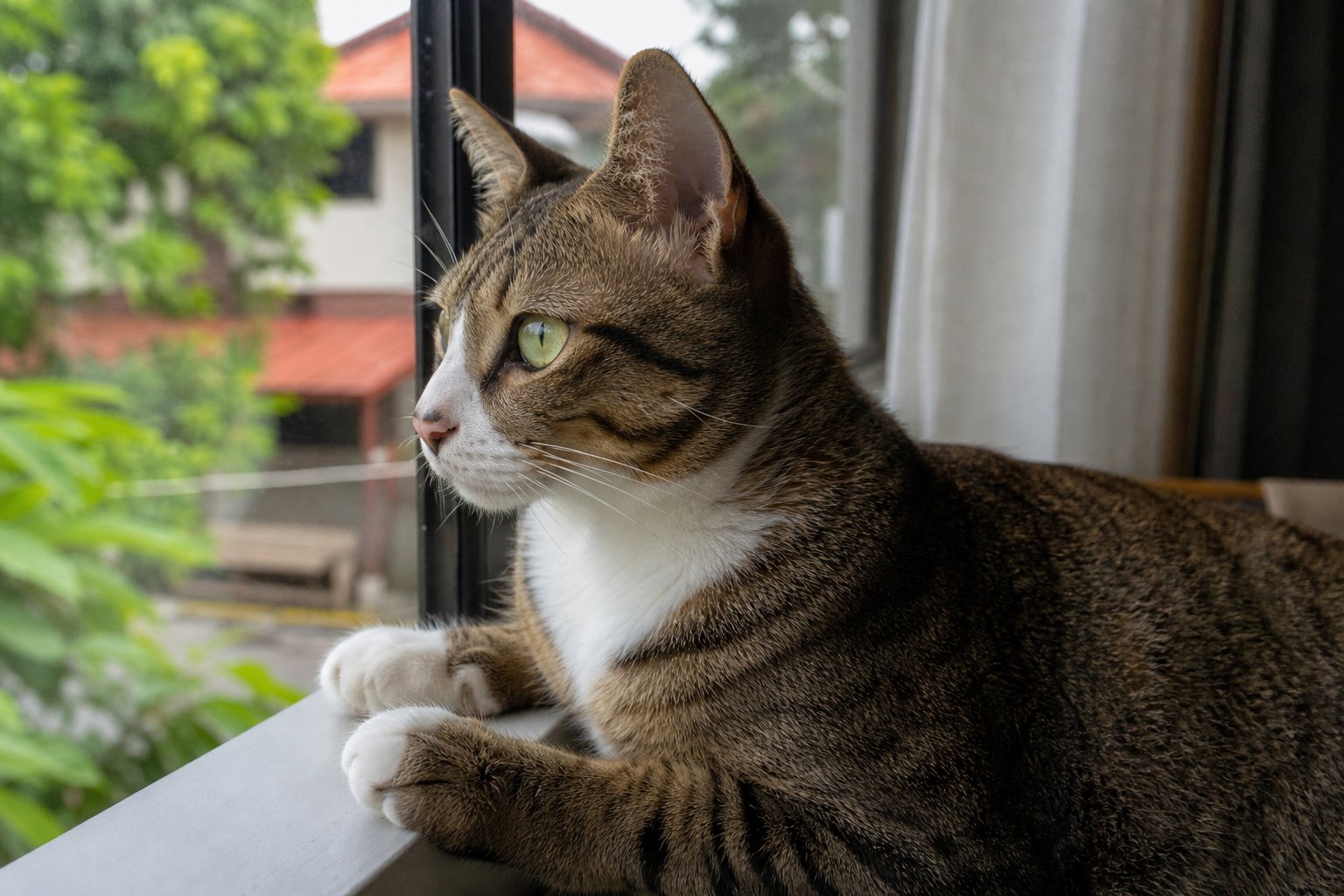
Quick answer: When your cat starts purring, pause for three seconds and read the body. A floppy cat with ears forward and eyes half-closed wants contact — offer ten seconds of chin and behind-the-ear strokes and slow-blink back. A half-asleep cat should be left undisturbed. A tucked-up cat with flat ears needs space, not cuddles. Getting this one step right decides whether every purr becomes a bonding moment or a setback.
What a purr actually is
Purring is a low-frequency vibration produced by rapid muscle twitches in the throat, usually around 25 to 150 cycles per second, and it can happen while a cat breathes in and out. Most owners treat every purr as a green light for petting. That assumption is wrong often enough to cost you trust.
The same sound covers at least two very different emotional states: contentment and self-soothing. A cat that is relaxed on your sofa and a cat that is squeezed into a corner during a thunderstorm can both purr. The sound alone never tells you which one you have. The body does.
Think of the purr as the tone of voice and the body language as the actual sentence. You would not reply to a whispered apology and a cheerful greeting in the same way, and you should not reply to these two purrs the same way either.
This guide skips the background theory and goes straight to action: what to do the moment you hear it, where to touch, how long to touch, what to say, and exactly when to stop.
The three-second test: identify the purr type
Before your hand moves, run a quick scan. It takes about three seconds and it saves you from misreading the moment.
Relaxed purr. The body is spread out, muscles feel heavy, the eyes are squinting or fully closed, and the ears point forward. Some cats add a headbutt into your palm, which is essentially a consent button. This is the only category that is actively asking for interaction.
Sleepy purr. The cat is lying down, possibly dreaming, with occasional twitching of the paws or whiskers. The purr continues without any awareness of you. The correct response is no response — do not stroke, lift or call.
Tense purr. The body is compressed, the ears are rotated sideways or flat, the pupils are wide, and touching is unwelcome even though the purr continues. This is a cat comforting itself. Reach out here and you push a nervous animal further away.
The handling differs completely: the first you receive, the second you protect, the third you release. If you pounce on every purr with kisses, you systematically misread the second and third types.
Cats that are newly adopted or recently moved home usually start in categories two and three. Holding back during that period is the fastest route to trust. Owners who cannot resist touching a frightened new cat often take weeks longer to earn headbutts.
Common scanning errors to avoid:
- A slow tail sweep is not happiness; it is overstimulation.
- Exposed belly is not an invitation; most cats punish a belly touch.
- Loud purr is not always happier purr; volume tracks vibration, not joy.
- Ears flat while purring always overrides the sound.
Get this filter right and half the battle is already won.
Responding to a relaxed purr: the three-step approach
Step one — hover first. Extend your hand and hold it a few centimetres away. Wait for the cat to close the gap by pressing its cheek or forehead into your fingers. That movement is the signal you were waiting for. If nothing happens within a few seconds, withdraw calmly; no contact is better than unwanted contact.
Step two — touch safe zones only. The chin, cheeks and the area just behind the ears are almost universally accepted, because a cat cannot easily groom those spots itself. The belly, paws, tail and the base of the tail are high-risk areas. Plenty of cats lie belly-up and then bite the moment a hand arrives.
Step three — respond with voice and eyes. Speak in an even, quiet tone and slow-blink deliberately. Cats read a long, soft blink as goodwill. If the purr deepens and the cat leans in, you have a green light to continue.
Two details separate competent handling from clumsy handling:
- Duration. Keep each session to ten or twenty seconds. If the cat stops, gets up or redirects its ears, stop immediately. Many cats like being woken by strokes but dislike being stroked past comfort. Quitting while it is still enjoyable is the skill.
- Technique. Use the pads of your fingers rather than the tips, and follow the direction of the fur with slow, full strokes. Most cats dislike against-the-grain rubbing and dislike belly patting even more.
A practical example: a working owner in a Kuala Lumpur apartment comes home at seven, sits on the floor rather than towering over the cat, hovers a hand, gets the headbutt, strokes the chin for fifteen seconds, then pauses. The cat stays. That single well-judged round builds more trust than five minutes of uninterrupted handling.
If the cat suddenly purrs louder and pushes its head back into your hand mid-session, that is a renewal of consent — carry on.
Responding to a stress purr: do not do the opposite
Cats often purr in unfamiliar rooms, after loud bangs, during car trips or when cornered. This is self-soothing, and it is not asking for attention. The correct response looks like this:
- Stop handling. Move your fingers out of the cat's line of sight. Do not pick it up.
- Cut stimulation. Dim the lights, lower the television, stop talking, and move away from noisy areas such as renovation works or a busy kitchen.
- Keep an exit open. Never block the hiding spot. If the cat wants to leave, let it leave.
- Match its height. Sit or lie down so you are not looming overhead. A standing human directly above a cat reads as a threat.
- Bridge with food. After the stressful event, place a small treat down and back away. The cat links the location with something good.
The single most common mistake is responding to a fear purr with more affection. The owner sees a scared cat, chases it down, hugs it and rubs it, the cat never gets the space it asked for, and the purr gets louder while the stress piles up. Remember the rule: a frightened cat wants quiet and the choice to move, not body heat.
| Situation | What you should do | What you must avoid |
|---|---|---|
| Purring during a vet examination | Stay calm nearby, one brief stroke on the neck, keep voice low | Repeatedly lifting or cuddling the cat |
| Purring while hiding on day one in a new home | Place food, water and litter box in fixed spots | Dragging it out to force introductions |
| Purring after thunder or fireworks | Play soft music, keep a hiding place available | Shutting it in a carrier to get used to it |
| Purring after a standoff with another cat | Separate them, add extra resources | Immediately grabbing either cat |
| Purring during a car ride | Secure the carrier, cover part of it, keep the ride calm | Reaching in to stroke mid-journey |
Building a daily routine that invites purring
You cannot force a purr, but you can make the conditions far more likely.
- Fixed timetable. Feed, groom and play at consistent times. Cats settle fastest when life is predictable; unpredictability is a low-level stressor that suppresses relaxed purring.
- Two play sessions daily. Fifteen minutes with a wand toy, morning and evening. Give the session a beginning and an end: let the cat actually catch the toy before you finish, then offer food. Hunt, eat, groom, sleep — the cycle ends in the deepest relaxation, which is when purring is most likely.
- Grooming ritual. Most cats enjoy slow brushing in the direction of the fur, especially around the shoulders and cheeks. Purring during brushing is normal and is a useful welfare indicator.
- Height and window views. A shelf, a cat tree or a secure window perch in a sunny spot works like a natural purr switch. In a Penang terrace during the rainy season, a covered balcony perch keeps the view usable when the monsoon downpour would otherwise close off the outdoors.
- Sleeping near you. If the cat chooses the end of your bed, leave it. Moving it teaches the cat that proximity earns disturbance.
Track progress with a simple weekly note: how many relaxed purrs you observed, how long the cat stayed after a stroke, and whether it approached first. Visible trends beat memory.
Handling demand purrs
Empty bowl, closed door, five in the morning — many cats combine a purr with short insistent meows and head-shoving into your hand. This is a transactional purr with a clear goal. The principle is: respond to the signal, never respond to the coercion.
- Feed on a schedule. Once the cat learns that food arrives at fixed times, the dawn serenade usually fades on its own.
- Use a scheduled feeder if needed. Moving the demand from you to a machine removes the audience, and the frequency of attention purrs drops noticeably.
- Never top up the bowl because of persistent purring. Doing so teaches a simple lesson: purr long enough and you get paid.
- Keep the after-meal sequence. A short play, a brush, then rest. Cats that complete the full cycle sleep more soundly and interrupt less at night.
Some cats instead enjoy conversational purring: you speak, the cat answers with short vibrating purrs and may even raise a paw to rest it on your hand. Enjoy it, but watch for the stop signals — tail flicking, ears rotating backwards and dilating pupils mean the conversation is over, and ending it then is the highest form of respect.
Teaching your cat to slow-blink
Slow-blinking is trainable, and two weeks of daily practice is usually enough to see a difference. Three times a day, at a distance of about a metre, half-close your eyes, hold, then open slowly. If the cat blinks back, respond with another round. Follow with a low-voiced comment and, if the cat is relaxed, one short stroke.
This works because it costs the cat nothing. There is no reach, no grab, no lift — just a signal that you are not a threat. Shy cats and formerly stray cats respond especially well, since they are hyper-vigilant about hands.
Keep a note of what happens: week one, no response; week two, returning blinks; week three, the cat approaches afterwards. That is measurable trust.
When to see a vet
Purring on its own never requires treatment. Purring combined with any of the following does, and you should arrange an appointment with a registered Malaysian veterinarian promptly:
- Appetite or water intake clearly changed for more than two days.
- Hiding time increasing day by day, or the cat no longer seeks you out.
- Fast breathing, open-mouth breathing, or clicking, rasping or choking sounds inside the purr.
- Repeated licking or chewing of one spot, or avoiding jumping and stairs.
- Sudden litter box changes — going in the wrong place, or straining without producing urine. In male cats, a urinary blockage is an emergency.
- Limping, vocalising when touched, or a sudden drop in play interest.
A new, unusual purr is the warning sign. A cat that rarely purrs and suddenly produces a long, low rumble while listless, off food or unusually quiet is far more concerning than the sound itself. The change in pattern is the signal, not the noise. Note when it started, how long it lasts, and which situations trigger it — that history helps your vet enormously.
Equally important: purring does not cancel out pain. Cats are notorious for vibrating through discomfort, so a purring cat at the clinic is not automatically a comfortable cat. Let the examination, appetite and posture tell you the truth.
Checklist before your appointment:
- Written record of eating, drinking and litter box use for the past 48 hours.
- A short video of the purr taken while the cat is at rest.
- Notes on any recent changes: food, litter, visitors, renovation, new pet.
- Carrier set up in advance with bedding and a familiar-smelling cloth.
What to do today
- Next time your cat purrs, pause three seconds to check ears, eyes and body before deciding.
- Practise the slow blink three times a day for two weeks and record the response.
- Set up a fixed evening sequence: play, brush, feed, rest.
- Keep at least one quiet hiding place at home that nobody disturbs.
- Draw your line at two days: any behaviour change lasting longer triggers a vet visit.
- Spend one minute each evening identifying which purr type you heard. Once this becomes habit, you will read your own cat better than most people read their friends.
A purr is your cat handing you the conversation. Take it at the right moment and the bond deepens quickly; take it at the wrong moment and you teach the cat that you do not listen.
This article is for general information only and does not replace professional advice. For any health concern, please consult a registered veterinarian.
Related reading
- Cat Behaviour Guide Malaysia 2026: Decode 30 Signals, Fix the Environment First
- Cat Trust Signals in Malaysia: 7 Ways Your Cat Says It Trusts You
- Cat Purring Meaning in Malaysia: Happy, Stressed or Hiding Pain?
- Cat Trust Signs in Malaysia: 7 Signals Your Cat Trusts You (and How to Build It)
- Signs Your Cat Trusts You: A Seven-Step Guide for Malaysian Cat Owners
- Cat Belly Up in Malaysia: 4 Meanings & Whether You Can Touch
- Cat Belly-Up in Malaysia: What It Really Means, and When You Can Touch
- Cat Biting in Malaysia: A 6-Type Triage Table and a 5-Step Fix
- Why Your Cat Scratches the Sofa (and How to Stop It) — A Guide for Malaysian Cat Owners
- How to Stop Your Cat Scratching the Sofa in Malaysia: A 5-Step Positive Training Plan
- Multi-Cat Homes in Malaysia: Getting Cats to Coexist Without the Fights