
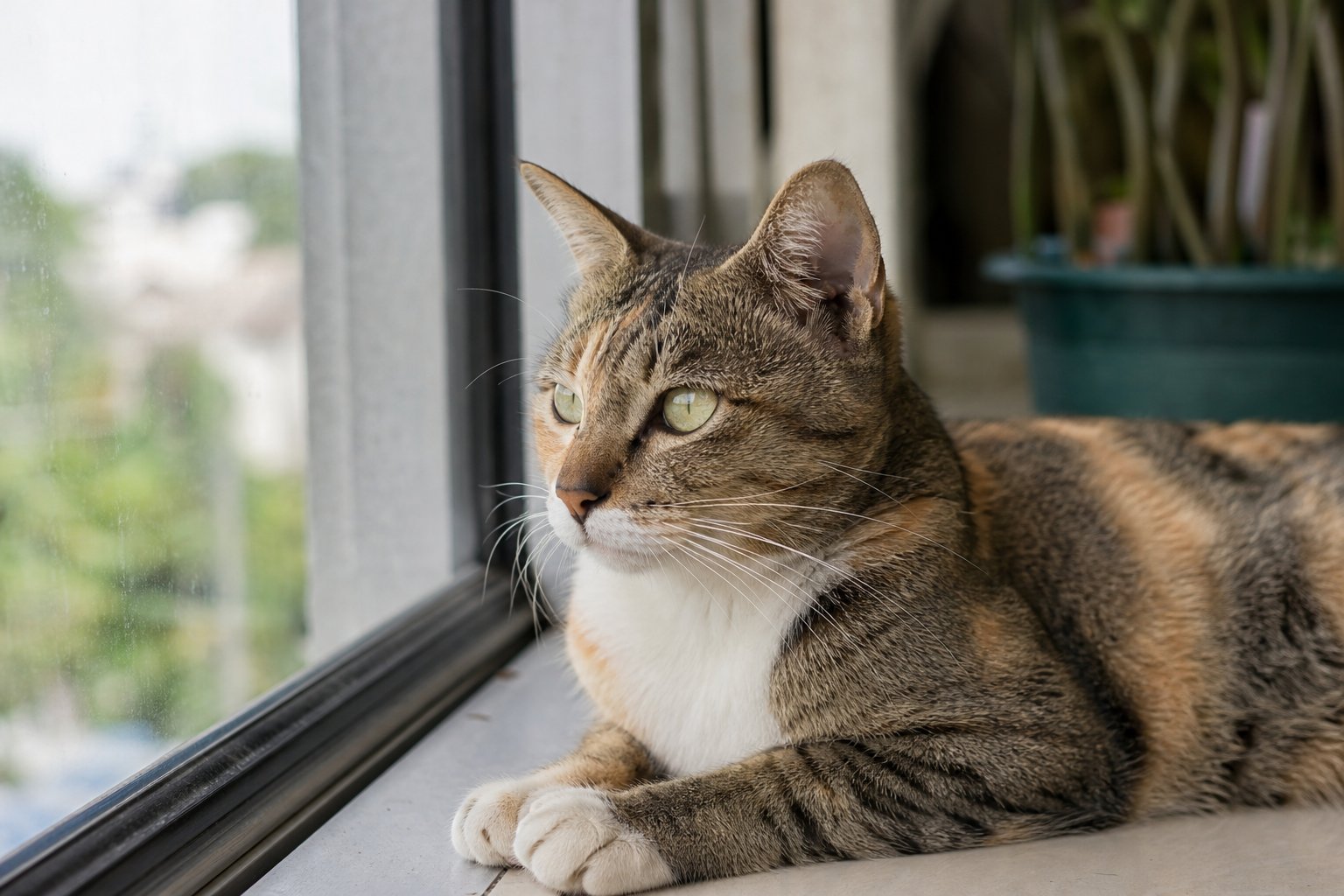
Quick answer: A trusting cat shows a package of relaxed signals — slow blinks, belly-up naps, kneading, head bunts, sleeping facing you or with its back to you, a tail held straight with a curled tip, and willingness to eat near you. Read them as a group, in context, over time. One gesture on its own proves very little; a rising pattern over two weeks is the real evidence.
The seven signals at a glance
Before the detail, here is the whole vocabulary in one place. Treat this as a checklist rather than a scorecard — no single item is mandatory, because personality varies enormously from one cat to the next.
| Signal | What it actually means | Most common misreading |
|---|---|---|
| Slow blink | 'I can drop my guard around you' | Half-sleepy eyes with flattened ears = unease, not trust |
| Belly exposure | 'This space is safe enough to be unprotected' | Being read as an invitation to rub the belly |
| Kneading | A safe memory projected onto you | A hard bite mid-knead being read as an attack |
| Head bunting | 'You are one of my own' — a pheromone-style social mark | Confused with ordinary body rubbing, which is territory marking |
| Sleeping facing you, or back against you | 'You are on watch duty' | Assuming any co-sleeping equals deep bonding |
| Straight tail, curled tip | A clear, friendly greeting | Confused with a puffed-up raised tail, which is fear |
| Eating near you | Willingness to be vulnerable beside you | Ignored because it seems too ordinary to count |
A useful rule of thumb: the more of these you see, and the more often they appear together, the higher the trust. Frequency is data. One blink in a week means little; several slow blinks a day from a cat that also naps in your line of sight is a pattern.
Signal 1: The slow blink
In the wild, a cat must stay alert constantly, and closing its eyes in front of another animal is a high-risk act. So a slow blink in your presence genuinely means: 'I don't need to stay on guard here.'
How to tell a real one from a false one: a genuine slow blink has soft eyes, eyelids closing slowly and reopening slowly, usually with the head tilted slightly down or to one side. Eyes half-closed while the ears are pinned back and the body is rigid is discomfort, not affection — do not mistake one for the other.
Blink back. This is one of the few cross-species communication behaviours that has actually been observed to work: return the slow blink, often squinting slightly, and many cats will blink back, producing a small successful 'conversation.' It is also the lowest-interference way to reassure a tense cat — say, in a waiting area before a check-up — because reaching out to touch a frightened cat is how hands get bitten.
Frequency matters more than any single moment. A cat that walks over, settles down and blinks at you several times a day is telling you something steady about how it feels about you.
Signal 2: Belly exposure — safe, but not an invitation
The belly is where a cat's most vulnerable organs sit, so flopping over with all four paws in the air in front of you is a high-level display of trust. It is also the signal most often misread.
Exposing the belly does not mean 'come rub my tummy.' To a cat, it means 'this place is so safe I can be completely undefended.' Many cats will clasp your hand with their front and back legs and bite when you reach in — not because they turned on you, but because they never authorised the contact in the first place.
The correct response: admire from a distance, speak softly, or toss a treat over. Only when a cat actively presses its belly against your hand is it a genuine invitation.
Two more points worth adding. Younger cats are far more likely to nap belly-up; senior cats, or cats that have been badly mis-touched on the stomach before, may never do it in their whole life. So do not treat belly exposure as the exam paper. Some cats express trust by sitting within a metre of you, without ever rolling over — the personality difference is real and normal.
Signals 3 to 5: kneading, head bunts and sleeping orientation
Kneading — the front paws pressing open and closed — comes from kittens massaging the mother cat's teat to encourage milk flow. An adult doing it on a blanket or on you is projecting its most contented memory onto you. Two things to note: if the kneading suddenly turns into a hard bite, that is sensory overload from overstimulation, not an attack. And cats that still knead as adults usually had a well-established sense of safety in early life.
Rubbing comes in two levels. Pressing the side of the body and the base of the tail against you is scent-gland marking of territory. But using the head, the area behind the ears and the cheeks to bump you is a step higher — the scent glands on the head leave what amounts to a pheromone-style social mark, the cat's way of saying 'this one is mine.' This head-bunting behaviour is rare even between cats, which is why it is such a strong signal.
Sleeping orientation is a signal too. A cat in defensive mode will keep its back to a wall and face outward. If your cat sleeps with its face and back exposed to you, or even presses its back against your body, it has decided you are the one watching the perimeter. Sharing a bed with a cat is, at heart, a sentry agreement.
Signals 6 and 7: the question-mark tail and eating together
A tail held straight up with the tip bent into a shape like a question mark, quivering slightly as the cat approaches you, is the clearest friendly greeting in cat society — the equivalent of 'hi, good to see you.' Learn to separate it carefully from a raised tail with the fur puffed out, which is fear-based threat display. The two look superficially similar at a glance and mean opposite things.
The opposite signals: a tail tucked between the legs, or a tail sweeping hard side to side, both point to tension and impatience. A slowly swishing tail during calm play is different again — context decides.
Willingness to eat in the same room as you is the seventh signal, and an underrated one. A cat's defences are at their lowest while eating, so whether it is willing to put its head down beside you, look up at you halfway through and then continue, is a reliable test. The reverse also holds: a cat that insists on a corner spot, or stops eating the moment you walk past, is not comfortable enough yet.
A small practical note for multi-person homes: offer the meal, sit quietly a metre or so away, and observe rather than stare. Pushing the chair closer too fast can end the experiment before it starts.
Telling real trust apart from stress
Trust signals must be read as a group and in context. A single movement is easy to misjudge. This table covers the four most common look-alikes:
| Looks like trust | May actually be | How to tell apart |
|---|---|---|
| Letting you pick it up | Freezing stress (tonic immobility) | Ears flat against the head, wide dilated pupils, rapid breathing |
| Sudden scratching or biting | Sensory overload from over-petting | Skin rippling or twitching, tail swishing first, then a sudden skin twitch |
| Sleeping on you | Simply using you as a heat source | No slow blinking at all, no purring, body held taut |
| Following you around | Hunger, or wanting a door opened | Immediately looks away the moment you turn to face it |
Genuine trust is a relaxation package: soft eyes, ears in a neutral or slightly forward position, unhurried breathing, and a tail hanging naturally or held in the question-mark shape. Before you credit any single signal, check that no stress signal is mixed in alongside it.
Context changes everything. A cat that shadows you at mealtimes is hungry; a cat that follows you on a leisurely stroll through the house is asking to accompany you on watch duty. Same behaviour, different meaning.
Why deliberate 'trust tests' backfire
Some people remove a cat's hiding places or reach out suddenly to see how the cat reacts. Those are not tests — they are stress generators. In behaviour terms, trust is an accumulated default value: every time you prove harmless while your cat is vulnerable — while it sleeps, eats, grooms or is unwell — that default slowly rises. Deliberately manufacturing a moment of vulnerability resets the clock instead of advancing it.
Be a passive recorder instead. Over two weeks, note how often each of the seven signals appears. The trend tells the truth; any single dramatic moment does not. Keep it simple: a note on your phone each evening, one line per signal, is enough.
If your cat long-term shows none of these signals, and the absence comes with hiding, refusing food or litter box accidents, consider anxiety or underlying pain as possibilities — and consult a registered veterinarian rather than assuming a personality problem.
Build your cat's personal vocabulary
Every cat has individual signals. Some show happiness with a tiny twitch of the tail tip; some turn their ears back half a notch before walking closer. Two weeks of notes will reveal a fixed combination unique to your cat. That private vocabulary usually tells you about mood changes earlier and more accurately than any general list.
Three principles for reading signals
- Read the whole body, not one part. Tail, ears, eyes and posture together — a puffed raised tail and a question-mark tail are completely different things.
- Read the context. Following you before dinner is hunger; following you during a quiet walk around the house is companionship.
- Read the trend, not the instant. Two weeks of frequency data beats any single memorable moment.
Hold to these three and the seven signals stop being trivia and become an observation framework you can use daily.
When to see a vet
Body language often reflects physical state, so do not treat every odd signal as a mood issue. See a registered veterinarian promptly if you notice:
- No trust signals at all for weeks, combined with hiding, refusing food or water, or litter box accidents
- Sudden aggression, growling or biting where there was none before — pain is a common cause
- A cat that freezes when handled, with dilated pupils and rapid breathing
- Changes in sleeping posture because it seems uncomfortable or reluctant to lie down
- Excessive grooming, over-grooming patches, or a cat that flinches when a specific area is touched
Local clinic fees and consultation charges vary across Malaysia, so ask your own vet or pet retailer for current pricing rather than relying on figures found online. For preventive care, microchipping and vaccination records, the Department of Veterinary Services Malaysia (dvs.gov.my) and animal welfare organisations such as SPCA Malaysia are useful starting points for verified guidance.
What you can do today
- Blink slowly at your cat once and see whether it blinks back
- Over one week, note which of the seven signals appear and how often
- Distinguish belly exposure from head bunting, hold back from rubbing the belly, and respond with a treat instead
- Sit about a metre from the food bowl at mealtime and observe whether eating continues
- Log the trend for two weeks, then compare week one with week two
For readers in a Kuala Lumpur apartment, keep the observation spots consistent — cats build trust around fixed routines, and moving the food bowl or bed every few days resets the experiment. During the Penang rainy season, thunderstorms and heavy downpours can temporarily suppress every trust signal at once; note the weather alongside your log so you do not misread weather-related stress as a loss of trust.
Related reading
- Cat Behaviour Guide Malaysia 2026: Decode 30 Signals, Fix the Environment First
- Why Does My Cat Purr? How to Respond the Right Way in Malaysia
- Cat Purring Meaning in Malaysia: Happy, Stressed or Hiding Pain?
- Cat Trust Signs in Malaysia: 7 Signals Your Cat Trusts You (and How to Build It)
- Signs Your Cat Trusts You: A Seven-Step Guide for Malaysian Cat Owners
- Cat Belly Up in Malaysia: 4 Meanings & Whether You Can Touch
- Cat Belly-Up in Malaysia: What It Really Means, and When You Can Touch
- Cat Biting in Malaysia: A 6-Type Triage Table and a 5-Step Fix
- Why Your Cat Scratches the Sofa (and How to Stop It) — A Guide for Malaysian Cat Owners
- How to Stop Your Cat Scratching the Sofa in Malaysia: A 5-Step Positive Training Plan
- Multi-Cat Homes in Malaysia: Getting Cats to Coexist Without the Fights