
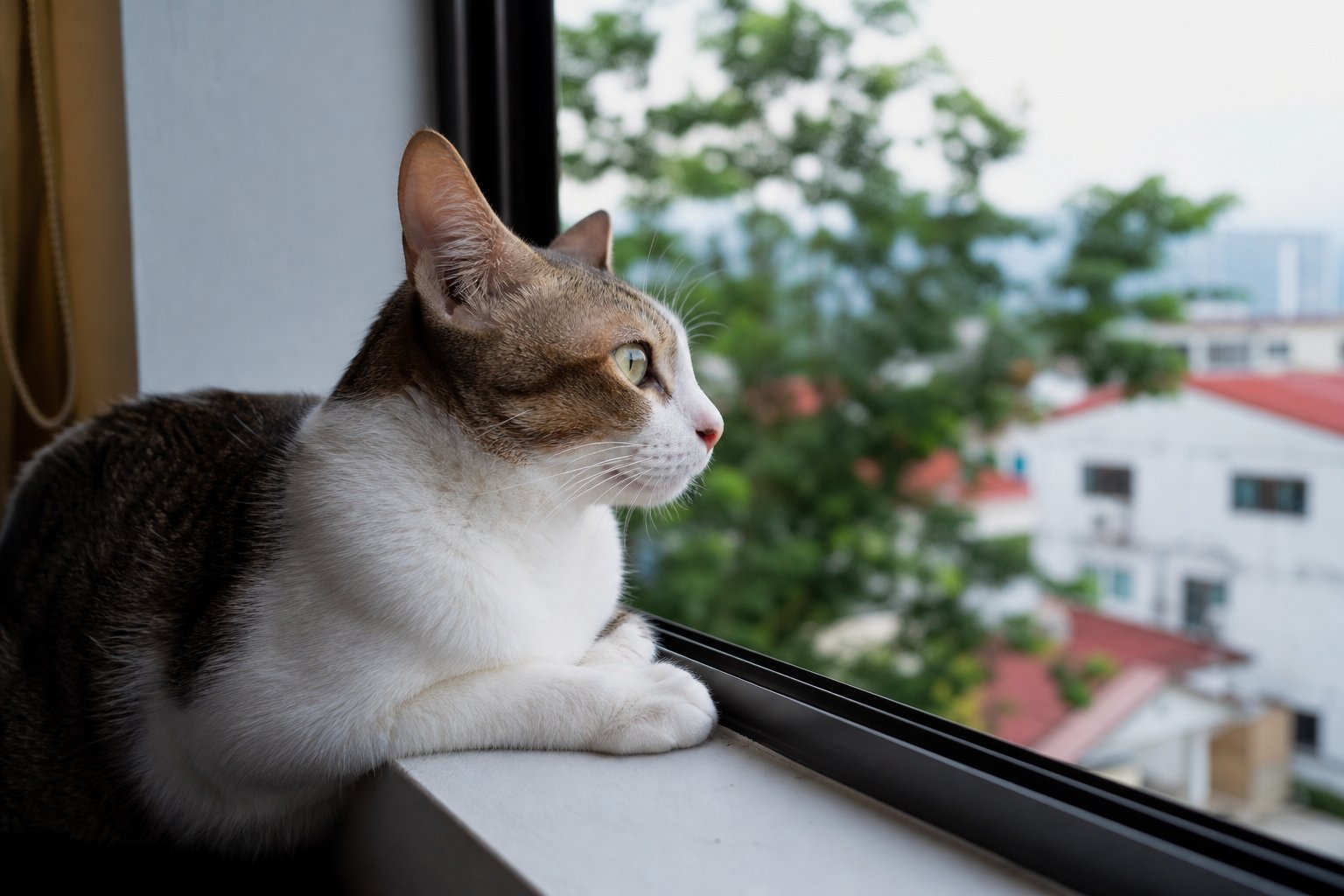
Quick answer: Chronic cat anxiety is a lasting state of tension, not a single fright. Track it for two weeks across four dimensions - appetite, grooming, hiding and toileting - then fix the environment first: resources, hiding places, predictable routine and scent. See a vet immediately if your cat stops eating, grooms itself bald, or hides for more than 48 hours.
Chronic anxiety is not the same as a one-off scare
Cats are sensitive animals, and their reaction to a change is often instant. But a reaction to one event - a vet visit, a burst pipe, fireworks, a crowd of guests - is different from a sustained problem. Acute stress usually settles within hours to a few weeks once the trigger is gone.
Chronic anxiety is the opposite: a steady, low-level tension that runs for weeks or months. It usually comes from an environment that never quite stabilises - unpredictable household rhythm, not enough resources, ongoing friction between cats, or constant noise and traffic through the home. Because it builds slowly, the signs creep in quietly: fur thinning on the belly, meals skipped, litter box avoidance, irritability with the family, or a cat that simply stops appearing.
Three points worth keeping in front of mind:
- Chronic anxiety is continuous, not a single incident. Give yourself an observation period of at least two weeks before drawing conclusions.
- Environment is the first line of treatment. Resources, hiding places, routine and scent all need attention together, not one at a time.
- Rule out physical causes first. Pain, skin disease, hormonal conditions and kidney disease can all mimic or worsen anxiety, so a health check comes before any behaviour plan.
The four-dimension anxiety scale: a two-week observation window
Rather than guessing, score your cat once a week on the same sheet for two weeks. Keep a simple notebook or phone note with dates. The table below moves from normal through mild and moderate to a level that needs action.
| Dimension | Normal | Mild | Moderate | Seek help |
|---|---|---|---|---|
| Appetite | Eats normally, on schedule | Slightly picky | Eats about half the usual amount | Refuses food for over 24 hours |
| Grooming | Even, normal coat | Licks one spot more | Thin fur on belly or inner thighs | Bald patches, red or broken skin |
| Hiding | Comes out as usual | Only hides when visitors arrive | Hides more than half the day | Hides continuously for over 48 hours |
| Toileting | Uses the tray normally | Occasional misses near the tray | Urine or stool outside the tray | Frequent straining, blood in urine, cries of pain |
| Social contact | Initiates interaction | Interacts less | Avoids being touched | Attacks family members or yowls repeatedly |
| Sleep | Settled pattern | Light sleep, startles easily | Day and night reversed | Night-time calling that does not stop |
How to use it: if any single cell falls into the moderate or urgent column, deal with the urgent item first - that means a vet visit - and handle the remaining cells with environmental changes. Do not try to fix everything at once, and do not wait for every column to worsen.
Practical tips for recording: note the time of day, what happened just before, and how long the behaviour lasted. A cat that hides after the vacuum runs is different from a cat that hides all afternoon for no visible reason. Patterns beat impressions.
Seven environment upgrades that actually help
This is where most of the progress comes from. Work through the list over two weeks rather than changing everything overnight.
-
Build safe retreats. Provide at least three spots that are either high up or partly enclosed - a hooded bed, the top of a bookshelf, the top of a wardrobe, a cardboard box on a shelf. Three sounds like a lot in a small home, but cats need a choice of exit routes, not a single dead end.
-
Apply the cats-plus-one rule. Litter trays, water bowls, food bowls and resting spots should each number at least one more than the number of cats, and they must be spread out rather than grouped in one corner. A tray next to the food bowl is a common cause of refusal.
-
Keep the routine predictable. Feed, play and brush at roughly the same times each day. Cats build a sense of safety from rhythm; when the schedule becomes chaotic, tension rises even if nothing else has changed.
-
Manage scent carefully. Skip strong fragrance sprays and essential oil diffusers - tea tree, eucalyptus, citrus and peppermint oils are recognised as risky for cats, whose livers process compounds more slowly. Instead, keep a familiar-smelling item such as an old blanket to help your cat feel anchored.
-
Buffer the noise. When the vacuum is running, renovation is under way, or the living room is full of people, give your cat a room that stays quiet with its resources inside. Close the door rather than hoping it will cope.
-
Add vertical space and clear sightlines. A platform lets your cat look down on activity instead of being looked down on. Reducing face-to-face encounters at floor level takes pressure off both cats and people.
-
Pre-announce big changes. Two weeks before a move, a new household member or renovation work, begin adjusting gradually - introduce one change at a time and keep the feeding and play timetable constant throughout.
A quick checklist before you move on: three retreats in place, one extra resource per category, routine unchanged, no strong fragrances in the cat's zone, a quiet room available, and at least one elevated perch. If you can tick all six, you have done the heaviest lifting.
Calming products: what they can and cannot do
Pheromone products come as litter, sprays and plug-in diffusers. They work by adding a calming signal to the places your cat already uses. The honest brief: use one continuously for two to four weeks while you improve resources, hiding places and noise at the same time. Expecting a product to carry the whole plan is the most common mistake.
Other commonly available aids include cat grass and catnip for sniffing and exploration, calming treats used as rewards during training or play, and a flowing water fountain. Keep two things in view. First, roughly a third of cats show no response to catnip or silvervine at all - that is normal, not a faulty product. Second, anxious cats often drink less, so a drop in water intake during a tense period deserves attention.
Priority order is worth repeating: environment first, routine second, products third. Products smooth the process; they do not replace it. Local prices and stock vary between retailers and clinics, so check with your Malaysian vet or pet shop rather than relying on any figure you see online.
Separation anxiety: a graduated routine
Some cats become distressed when the household empties. Work it in four steps.
- Keep departures boring. No elaborate goodbyes, no ten minutes of fuss at the door. A short, flat routine tells your cat that leaving is ordinary.
- Enrich the alone-time environment. A window perch for street watching, a puzzle feeder, a scratching post and a timed feeder all give the cat something to do rather than something to worry about.
- Practise short absences. Leave for five minutes, return calmly, repeat. Extend the duration gradually over days and weeks. Rushing to an hour on day three resets the progress.
- Record what actually happens. A pet camera shows whether your cat vocalises for ten minutes and then settles, or escalates for the whole period. The two need different plans.
If the camera shows non-stop calling, destructive scratching at exits, or refusal to eat while alone, that is a veterinary conversation rather than a training exercise.
Multi-cat homes, humid weather and major changes
Kuala Lumpur apartment with heavy daytime foot traffic: a flat with constant coming and going gives your cat no option to opt out. The minimum requirement is one room with a closable door, or a high hideaway, where the cat can be present without participating in household life. Add a second water station away from the main corridor so the cat does not have to cross traffic to drink.
Penang terrace house in the rainy season: humidity brings skin itch, and an itchy cat licks more. Increased licking during a damp spell should be checked for skin problems before being labelled anxiety. Dry the flooring your cat rests on, wash bedding more often, and keep the fur's condition stable.
In multi-cat households, apply the cats-plus-one rule strictly, offer several routes through the home and at least one elevated escape. If you already see yowling, spraying or mutual hiding, switch to zone management - separate the cats into different areas with full resources - and reintroduce them gradually rather than putting them face to face.
For a move, set up a safe room containing all resources before the boxes arrive. Move the cat in on moving day, bring the rest of the items in around it, and open the door only when things are calm. Keeping familiar furniture scents and the original feeding and play timetable is the single most effective de-stressing move.
When to see a vet
Book a veterinary appointment promptly if any of these appear:
- Bald patches, red skin or open wounds from over-grooming
- Refusing food for more than 24 hours, or visible weight loss
- Toileting outside the tray, straining, frequent urination or blood in the urine - urinary problems are urgent
- Sudden fear of people, or extreme reactions to ordinary sounds
- Hiding continuously for more than 48 hours, or non-stop vocalising
- Aggression towards family members, especially young children
The sequence matters: a vet rules out pain and disease first, environmental changes come next, and formal behaviour work follows only if needed, ideally guided by a vet with behaviour training. Never dose a cat with human medication, and never buy sedatives over the counter for an anxious pet.
Four-week tracking plan
Use the same scorecard weekly for four weeks so the trend is visible rather than anecdotal. Success looks like: less time hidden, appetite back to normal, tray use consistent, fewer night-time calls, and grooming back to an even coat. If a column has not moved after four weeks of consistent environmental work, return to the vet for a re-evaluation - medication may be the appropriate next step, and that is a normal outcome rather than a failure.
If the situation worsens at any point, skip the remaining weeks and book an appointment immediately.
Veterinary disclaimer: This article is educational information about cat behaviour and does not constitute diagnosis or treatment advice. If your cat stops eating, grooms itself bald, toilets outside the tray, or behaves unusually, consult a registered Malaysian veterinarian promptly. Any medication must be prescribed by a vet.
Related reading
- Cat Anxiety in Malaysia: A 2-Week Checklist and 7 Home Fixes That Actually Work
- Cat Body Language Decoded: What 30 Common Behaviours Really Mean
- Do Cats Hold Grudges? How Cat Memory Works and How to Rebuild Trust
- Cat Belly-Up in Malaysia: What It Really Means, and When You Can Touch
- Cat Tree Malaysia: Size Formula, Buying Checklist and Small-Home Placement
- Multi-Cat Home Space Planning in Malaysia: Cat Routes & Resource Placement
- Cat Belly Up in Malaysia: 4 Meanings & Whether You Can Touch
- Cat Biting in Malaysia: A 6-Type Triage Table and a 5-Step Fix
- Cat Purring Meaning in Malaysia: Happy, Stressed or Hiding Pain?
- Why Does My Cat Purr? How to Respond the Right Way in Malaysia