
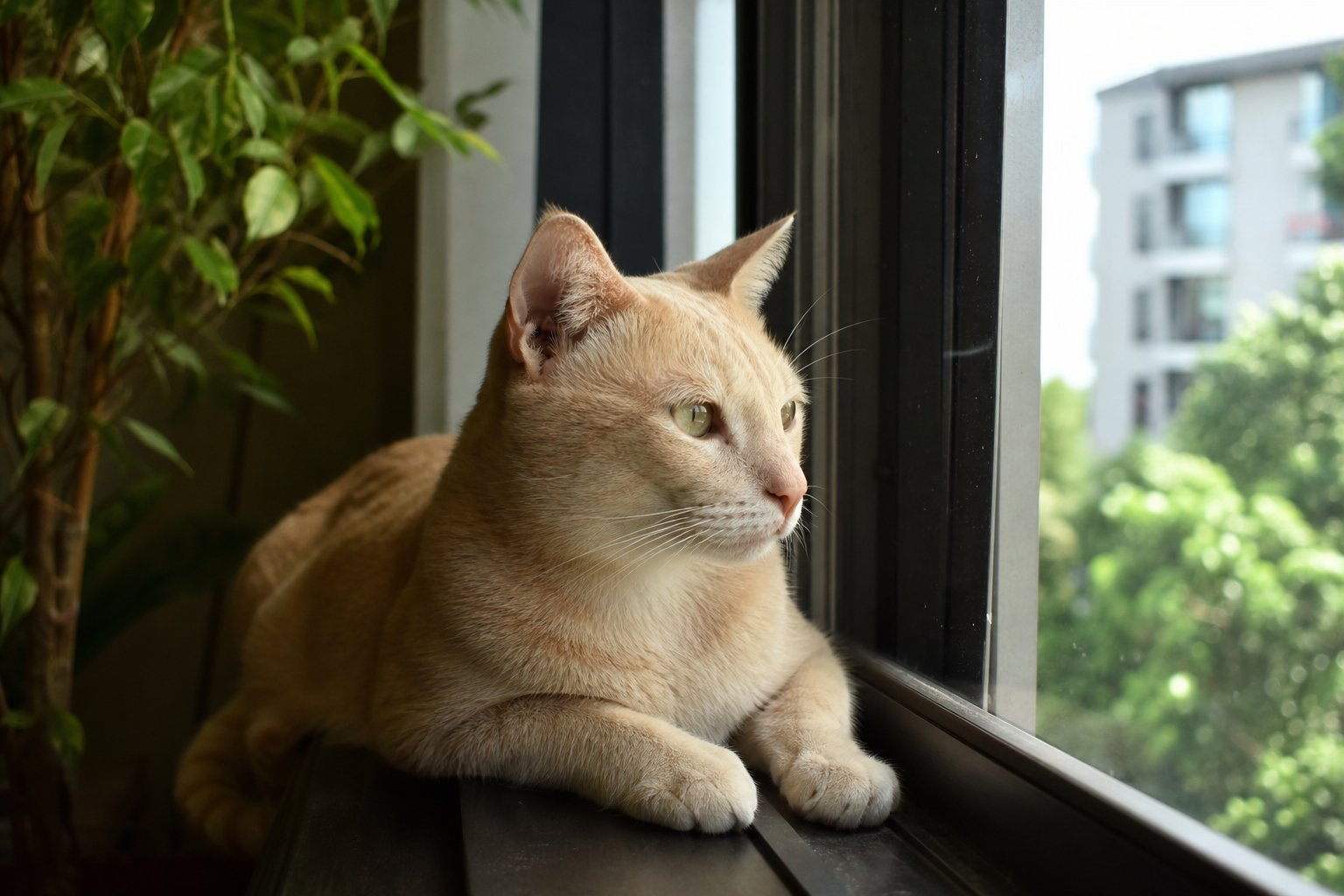
Quick answer: A cat's purr rarely means just one thing. Most of the time it signals relaxation — being stroked, dozing in a warm spot, or hovering near the food bowl. But cats also purr to soothe themselves when stressed, injured or unwell. To tell the difference, read the whole body: ears, eyes, muscle tension and behaviour around you. Never judge by sound alone.
What your cat's purr actually means
A purr is a low-frequency vibration produced by rhythmic contraction of the muscles in the larynx. It runs continuously through both inhaling and exhaling, which is why it sounds unbroken. You can feel it as much as hear it — rest a palm on your cat's chest while it sits on your lap and the buzz travels straight into your hand.
Behaviourists generally read purring in three layers:
- Relaxation. The most common layer. Gentle, steady purring while you stroke your cat, while it dozes somewhere warm, or in the minutes around feeding.
- Contentment. A signal that the environment feels safe: the food bowl is full, the house is quiet, no threats nearby. Kittens use it to tell their mother they are feeding well and are unharmed.
- Self-soothing. The layer most owners miss. Cats purr when frightened, when squeezed into a carrier, at the vet, when injured, and sometimes at the end of life. It functions much like a person taking slow breaths to steady their nerves.
So the popular idea that a purring cat is a happy cat is only half right. Purring is an emotional tool, not a happiness meter. Because the same sound can cover both satisfaction and distress, drawing a conclusion from the noise alone is one of the most common misreadings cat owners make.
The practical fix is simple: whenever you hear purring, spend ten seconds checking the rest of the animal in front of you before you decide how it feels.
Why kittens purr almost from birth
A surprising number of new owners assume purring is something cats learn. It is not. Kittens begin purring within a few days of birth. Born blind and deaf, they cannot see or hear their mother, so they rely on vibration and scent to find the teat. Purring at that age does double duty: it guides them to milk, and it reports back to the mother that the kitten is feeding and safe.
That early habit never fades. The wiring is built in from the start, which is exactly why the same instinct gets triggered by comfort and by pain later in life. When your adult cat curls on your chest and starts its motor, it is, in a real sense, repeating a behaviour learned before its eyes ever opened — a signal of safety that goes back to its first days.
This also explains a behaviour that puzzles first-time owners: a kitten purring loudly while kneading with its front paws against a blanket. The motion, the sound and the pressure all belong to the same nursing toolkit, and they often reappear in adult cats when they feel completely secure.
The self-healing side of purring
Studies of feline vocalisation have observed that a purr sits in a low-frequency band of roughly 25–150 Hz. Vibrations in that range are associated in research with bone and soft-tissue repair and with pain relief. This helps explain an otherwise confusing picture: cats frequently purr after surgery, while injured, during prolonged illness, and sometimes towards the end of life.
They are not pretending nothing is wrong. Their body has switched on a built-in comfort and repair mechanism — a self-healing instinct that runs automatically alongside whatever else is happening.
Two cautions matter here.
First, this instinct is not a treatment. It is a natural supplementary response, not a substitute for a clinical examination. If you suspect your cat is hurt or sick, the first step is always professional care, never a few days of waiting for the purring to fix it.
Second, purring can mask pain. A cat that is quietly purring while being examined may still be uncomfortable, and owners who equate purring with wellness can lose precious days. Cats are remarkably good at performing normality; the ability to purr through discomfort is stronger than most people expect.
Comfort purr or pain purr? Read the body
Two cats can produce the same sound and mean opposite things. Work through this checklist every time:
| What to check | Comfortable and relaxed | Tense, stressed or painful |
|---|---|---|
| Body | Loose, flopped on one side, paws extended | Rigid, hunched, tucked into a tight ball |
| Ears | Facing forward, naturally upright | Flattened back against the head |
| Eyes | Half closed, slow deliberate blinks | Wide, dilated pupils, fixed stare |
| Tail | Resting loosely or sweeping gently | Clamped down or lashing hard |
| Response to touch | Leans in, seeks more contact | Flinches, growls softly, retreats |
| Location | Out in the open, chosen spot | Hidden under furniture or in a box |
The rule is: same sound, different body, different meaning. Ears forward plus a soft body plus leaning into your hand equals a genuinely contented purr. Purring while curled away, rigid, or startled by a hand on the ribs should be handled as discomfort: watch food intake, water, breathing and litter box use, then decide whether a vet visit is needed.
Keep this table in mind deliberately. The instinctive thought — "it is purring, so it is fine" — is precisely the thought to override.
Context matters: where and when the purring happens
A purr is far easier to interpret when you know the situation around it. In a compact home, cat and owner are rarely more than a few metres apart, so the context is usually available if you look for it.
- Purring while sunning itself by a window or sleeping beside you — a straightforward satisfaction signal. Touching it then usually produces a louder purr, not a withdrawal.
- Purring before a vet visit or inside a locked carrier — very often nervous self-soothing. Do not read it as enjoyment of the trip.
- Purring while repeatedly hiding — raise your alert level. A cat that withdraws and purrs at the same time may be telling you it feels unwell and wants to be left alone.
- Sudden night-time purring with restlessness or an unwillingness to settle — watch for abdominal discomfort or a litter box problem that needs attention.
Multi-cat homes add another layer. If one cat suddenly purrs more often while avoiding the others, stress or competition may be involved. Check that resources are genuinely adequate: separate food bowls, more litter boxes than you have cats, and enough elevated resting spots that no individual has to pass another to reach water or an exit. Where space is tight, cardboard boxes, the backs of sofas and wall-height shelving can create separate routes so the cats do not have to squeeze past each other, which also makes each cat's purring pattern far easier to read.
Seasonal conditions can shift the picture too. During a humid, rainy stretch in Penang, a cat that normally purrs in the open may choose a cooler tiled floor or a damp corner instead, and its purring may be interrupted by longer grooming sessions. Note whether the change is comfort-seeking or avoidance — the difference tells you whether to adjust the environment or watch the health.
Build your own two-week log
Judgement improves fast when you record rather than guess. Keep it simple:
- Photograph the baseline. Take one picture of your cat when clearly relaxed and one when clearly annoyed or startled. These become your personal reference points.
- Note the trigger each time. Stroking, feeding, waking, carrier, thunder, visitors — one line is enough.
- Add the body signals. Ears, eyes, posture, tail, in a single word or two.
- Flag anything paired with symptoms. Reduced appetite, hiding, laboured breathing, repeated licking of one spot, weight loss, or litter box changes.
- Review after two weeks. Patterns show up: purring that reliably accompanies relaxation, purring that appears under stress, or purring that has quietly started covering discomfort.
Also run a hands-on check over a few evenings. Gently touch the ears, the paws and the belly, and note whether the purring suddenly intensifies while the cat pulls away or stiffens. A cat that flinches from a spot it previously tolerated is giving you useful information, and that observation is far more valuable to a vet than a description of the sound alone.
When to see a vet
Purring by itself is not a symptom. It becomes relevant when it arrives alongside other changes. Arrange a prompt examination with a registered veterinary practitioner if you notice any of the following:
- Appetite clearly reduced, or the cat is hiding for long stretches instead of joining the household
- Noisy, rapid or open-mouthed breathing, or a purr that has turned rough and laboured
- Constant licking or chewing of one area, flinching when a particular spot is touched
- Unexplained weight loss, or a sudden change in urination or bowel habits
- An older cat newly purring continuously while moving stiffly or hesitating on steps
Remember: cats hide pain well. They rarely cry out. More often they simply go quiet, disappear, and purr a little more. When your instinct says something is off, that instinct is usually worth acting on — you do not need to wait for dramatic symptoms.
If you are unsure, it is always acceptable to call a clinic and describe what you are seeing. Veterinary staff would rather hear an early, modest concern than a late, serious one.
What you can do from today
- The next time your cat purrs at you, spend ten seconds checking ears, eyes and body tension before you decide what it means.
- Photograph your cat's relaxed and tense states so you have your own comparison chart at home.
- Track where the purring happens — lap, window, carrier, hiding spot — because location changes the meaning.
- During handling of ears, claws or belly, watch for purring combined with withdrawal; that combination may point to a tender area.
- Keep a short log for two weeks, then read it back. The pattern, not the isolated moment, is what matters.
- If purring arrives with hiding, appetite loss or breathing changes, contact a vet without hesitation.
A cat's purr is one of the few pieces of feline language it willingly shares with people. Learning to read it accurately is a genuine act of trust-building — and the body, not the sound, is where the truth sits.
Vet disclaimer: This article is for general education only and does not diagnose or treat any condition. If you are concerned about your cat's breathing, appetite, weight, litter box habits or behaviour, consult a registered veterinary practitioner in person.
Related reading
- Cat Behaviour Guide Malaysia 2026: Decode 30 Signals, Fix the Environment First
- Why Does My Cat Purr? How to Respond the Right Way in Malaysia
- Cat Trust Signals in Malaysia: 7 Ways Your Cat Says It Trusts You
- Cat Trust Signs in Malaysia: 7 Signals Your Cat Trusts You (and How to Build It)
- Signs Your Cat Trusts You: A Seven-Step Guide for Malaysian Cat Owners
- Cat Body Language Decoded: What 30 Common Behaviours Really Mean
- Cat Belly Up in Malaysia: 4 Meanings & Whether You Can Touch
- Cat Belly-Up in Malaysia: What It Really Means, and When You Can Touch
- Cat Biting in Malaysia: A 6-Type Triage Table and a 5-Step Fix
- Why Your Cat Scratches the Sofa (and How to Stop It) — A Guide for Malaysian Cat Owners
- How to Stop Your Cat Scratching the Sofa in Malaysia: A 5-Step Positive Training Plan