
Quick answer: Pick a cat tree using three checks — the top platform should sit at roughly 1.5 times your cat's full stretch height, platforms spaced 30–40 cm apart, and a base at least as long as your cat. Then anchor anything taller than 100 cm, and place it beside a window or your usual chair. In a compact Malaysian home, a medium tree plus a couple of wall shelves beats one oversized tower every time.
Why height beats floor area
Floor space is the one thing you cannot order more of in a terraced house or a high-rise apartment, but height is almost always available. Cats read their environment vertically: a raised platform gives them a survey point, a retreat from a vacuum cleaner, a warm spot near a window, and somewhere to be near you without being touched. Behaviour guidance from international feline welfare bodies consistently treats elevated resting places as part of a cat's core environmental needs, alongside hiding spots, scratching surfaces and safe feeding areas.
That is why a cat tree is one of the better-value pieces of cat furniture you can buy. It packs four functions into a single footprint: climbing, perching, scratching and resting. The failure mode is not buying one — it is buying the wrong size, putting it in the wrong corner, and ending up with an expensive coat stand.
A useful mental shift: think of the tree as one stop on a route, not as a standalone attraction. A cat moving from the floor to a shelf to a window ledge to the top of the tree is far more engaged than a cat asked to jump onto a single isolated tower.
The sizing formula
Three measurements do most of the work.
1. Top platform height. Have your cat stand and stretch up against a wall or doorframe, or note the highest point of a natural stretch after a nap. Multiply that by 1.5. For a typical adult cat, a full stretch of 60–70 cm points to a top platform around 90–110 cm. Kittens and small breeds need less; large breeds and tall cats need more, so measure your own cat rather than relying on averages.
2. Platform spacing. Aim for 30–40 cm between levels. That gap lets a cat step up in two motions instead of making one demanding leap, which matters for kittens, older cats and any cat with joint trouble. It also makes the tree usable as a genuine route rather than a series of hurdles.
3. Base size. The base should be at least as long as your cat's body, typically 40–50 cm for an average adult. A narrow base on a tall tree is the classic tip-over risk, especially when a cat launches itself onto the top level at speed.
Height alone does not impress a cat. Four well-spaced platforms at 110 cm will get more traffic than a 180 cm column with one platform at the top and nothing in between. If your ceilings are generous, spend the extra height on additional levels, not on a taller gap.
What to check before you buy
Use this as a checklist in the shop or while scrolling product pages. Prices for cat trees vary widely by brand, material and size, so ask a Malaysian pet retailer for current figures rather than budgeting from a number you saw elsewhere.
| Item | What to look for | Why it matters |
|---|---|---|
| Top platform height | Stretch height × 1.5, usually 90–110 cm | Reaches the right height without becoming a tipping hazard |
| Platform spacing | About 30–40 cm | Lets the cat climb in two steps; easier on joints |
| Base footprint | At least as long as the cat, 40–50 cm typical | Prevents rocking when the cat jumps or lands hard |
| Platform size | Large enough for the cat to lie flat, roughly 35 cm across | A perch the cat cannot settle on gets ignored |
| Sisal posts | Natural sisal rope, replaceable | Cats prefer a rough vertical surface; rope wears out over time |
| Fabric | Removable, washable covers | Humidity and shedding build up quickly in tropical weather |
| Tipping safety | Wall anchor, tether or heavy base for anything over 100 cm | A fall can injure the cat and end all trust in the tree |
| Condition | No wobble, no cracks, no sharp screw ends | Loose hardware can trap claws or toes |
Two rows deserve extra attention. First, washable fabric: in Malaysia's humidity, a tree that cannot be cleaned will hold odour and encourage mould in the seams. Second, replaceable scratching surfaces — sisal rope and corrugated panels are consumables, and a tree whose posts are worn smooth loses half its purpose.
Where to put it in a Malaysian home
Placement decides usage more than any other factor. A great tree in a bad spot stays unused; a modest tree in the right spot becomes the household's favourite address.
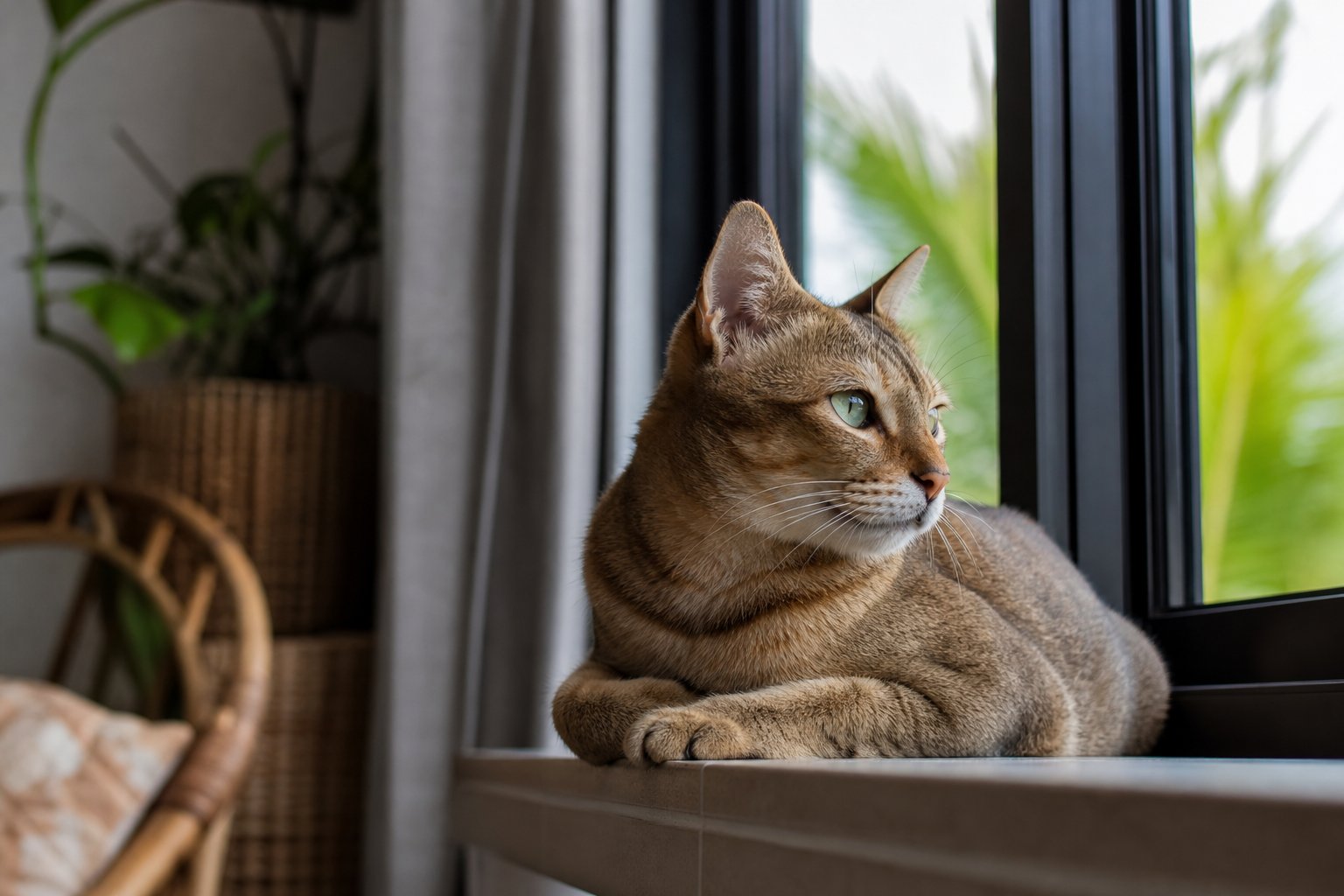
Start with the window. Cats like to monitor the outside world, and a window-facing perch delivers free entertainment. In a Kuala Lumpur apartment, a living-room window with a view of trees, traffic or a balcony is prime real estate — position the tree so the top platform sits just below the sill line, so your cat can step across rather than make a risky jump.
Then consider your own routine. Put a second level of the tree near the sofa or the desk where you spend your evenings. Cats often want proximity without contact, and a perch at shoulder height while you work satisfies that perfectly.
Avoid dead zones. Corners stacked with storage, the inside of a utility yard, or a spot directly under a ceiling fan or air-conditioning blast all suppress usage. In a Johor terrace house, the air-conditioned living room may be the only comfortable spot for half the year — but check that the tree is not sitting in the direct cold draught, which your cat will avoid.
Watch for window stress. If stray cats or birds regularly pass right outside, a cat can become over-aroused at the glass — vocalising, charging the window, pacing, or remaining permanently on high alert. Partially blocking the sightline with a film or a shifted piece of furniture, or rotating the tree to a quieter window, usually resolves it.
Keep it off the traffic path. Do not position the tree in the middle of a hallway or directly in front of a door. Every time someone walks past, a climbing cat is interrupted, and repeated interruption teaches the cat to stop using it.
Seasonal note: during the Penang rainy season, the area beside a window can become damp and drippy. Leave a gap between the tree and the glass, and wipe the platform fabric regularly so it does not stay damp under your cat.
Stopping it from tipping
Stability is non-negotiable. A tree that shifts when a cat lands will be abandoned, and a tree that actually falls can cause a genuine injury.
Secure anything taller than about 100 cm. Options include L-shaped brackets screwed into a stud, a safety strap or tether to the wall, a tension pole spanning floor to ceiling, or simply weighting the base. For rental homes where drilling is off the table, tension rods, a wider added base, or bracing the tree between a bookshelf and a wall corner all work — provided the tree itself is not already unstable.
Run a monthly check: press on the top platform and see whether anything flexes, tighten any screws that have worked loose, and inspect the scratching posts for fraying. If the tree wobbles, wobble means stop: take it out of use and repair or replace it before your cat tests it again.
One more practical tip — if the tree stands on tile or polished floor, a non-slip mat under the base adds grip and protects the floor. Cats slipping on landing is a surprisingly common reason they start avoiding a perch they previously loved.
DIY or ready-made?
A ready-made tree is the right default for most households. Materials such as plywood, sisal rope and hardware fluctuate in price, and you also have to solve load-bearing and anti-tip engineering yourself. Unless you have the tools and the experience, the saving rarely justifies the risk.
Where DIY genuinely wins is custom sizing: a shelf-and-post combination built to fit an awkward alcove, a window recess that no standard tree suits, or a wall-mounted step system that keeps the floor completely clear. Even then, apply the same safety standard as a commercial product — no wobble, no sharp edges, no fasteners that can catch a claw, and anchoring adequate for the height.
A sensible middle path for a first-time buyer: start with one medium tree in the best location, confirm your cat actually uses it, then expand with wall shelves. Buying the biggest tree first, before you know your cat's preferences, is the expensive mistake.
Multi-cat homes
Two cats do not simply need double the tree — they need separate high places. If both cats want the top platform, the dominant one takes it and the other retreats to the floor, which wastes the whole point of the furniture. Aim for cats plus one elevated resting spot: two cats, at least three distinct perches, ideally on different pieces of furniture so a single blockage cannot close off the route.
Watch how your cats use the tree together. Parallel resting at different levels is healthy. Repeated stalking up the trunk, body blocking at the base, or one cat sleeping with one eye permanently open suggests the vertical resources are too few or too clustered — spread them out before the tension becomes a litter tray or grooming problem.
When to see a vet
Most tree-related issues are environmental, but some are medical. Arrange a veterinary consultation if your cat:
- suddenly stops jumping or climbing when it previously did so daily;
- hesitates, scrambles, or falls when landing on platforms;
- avoids the tree after a slip, or avoids all elevated surfaces;
- shows limping, reluctance to be picked up, or vocalising when jumping;
- is gaining or losing weight in a way that changes how it moves;
- spends unusual amounts of time licking a paw or hind leg after climbing.
Reluctance to jump is one of the earliest visible signs of joint discomfort in cats, and cats are very good at hiding pain. A check-up that catches it early is far cheaper — and far kinder — than a fall from height. The same applies to older cats whose vision is failing: they may misjudge a platform they have used happily for years.
If your cat does fall from the tree, or gets a claw caught and pulls free, have it examined even if it seems fine afterwards. Soft tissue injuries and torn claws often look minor at first.
Frequently asked questions
How many levels does a cat tree need? Three to four platforms at 30–40 cm spacing suit most adult cats. The top level should be high enough for your cat to survey the room comfortably; below that, additional platforms matter more than extra centimetres of total height.
Can I convert an old bookshelf or cabinet into a cat tree? Yes, provided it is stable and free of strong paint or varnish odours. Add a shelf overhang for a perch and wrap a leg in sisal rope. Secure it to the wall before your cat uses it — stability beats appearance every time.
Where is the single best spot for a cat tree? Beside a window or next to the chair you use most. Avoid utility corners, cold draughts from fans or air-conditioning, and the middle of a walkway. If it is not on a natural route, it will not get traffic.
I rent and cannot drill. How do I anchor a tree? Use a floor-to-ceiling tension pole, a weighted base, or brace the tree between a bookshelf and a wall. If the tree is inherently unstable even with those measures, replace it rather than rely on a workaround.
Do I need more than one tree for two cats? Yes — target at least three elevated resting spots for two cats, spread across the room. Separate perches reduce competition and give each cat an escape route when it wants space.
How often should I replace the scratching parts? Whenever the sisal is heavily frayed or the corrugated panel has torn through, not when the structure fails. Worn-out posts stop satisfying the scratching urge and redirect it to your sofa.
This article is about product selection and household setup, not veterinary advice. If your cat stops jumping, slips, limps or shows any sudden change in mobility or behaviour, please consult a registered veterinarian.
Related reading
- Cat Behaviour Guide Malaysia 2026: Decode 30 Signals, Fix the Environment First
- Cat Anxiety in Malaysia: A 2-Week Checklist and 7 Home Fixes That Actually Work
- Cat Anxiety in Malaysia: Chronic-Anxiety Scorecard and 7 Home Fixes
- Cat Body Language Decoded: What 30 Common Behaviours Really Mean
- Cat Belly-Up in Malaysia: What It Really Means, and When You Can Touch
- Cat Biting Behaviour in Malaysia: 6 Types, 5 Fixes & When to See a Vet
- Do Cats Hold Grudges? How Cat Memory Works and How to Rebuild Trust
- Multi-Cat Home Space Planning in Malaysia: Cat Routes & Resource Placement
- Cat Belly Up in Malaysia: 4 Meanings & Whether You Can Touch
- Cat Biting in Malaysia: A 6-Type Triage Table and a 5-Step Fix
- Why Does My Cat Purr? How to Respond the Right Way in Malaysia