
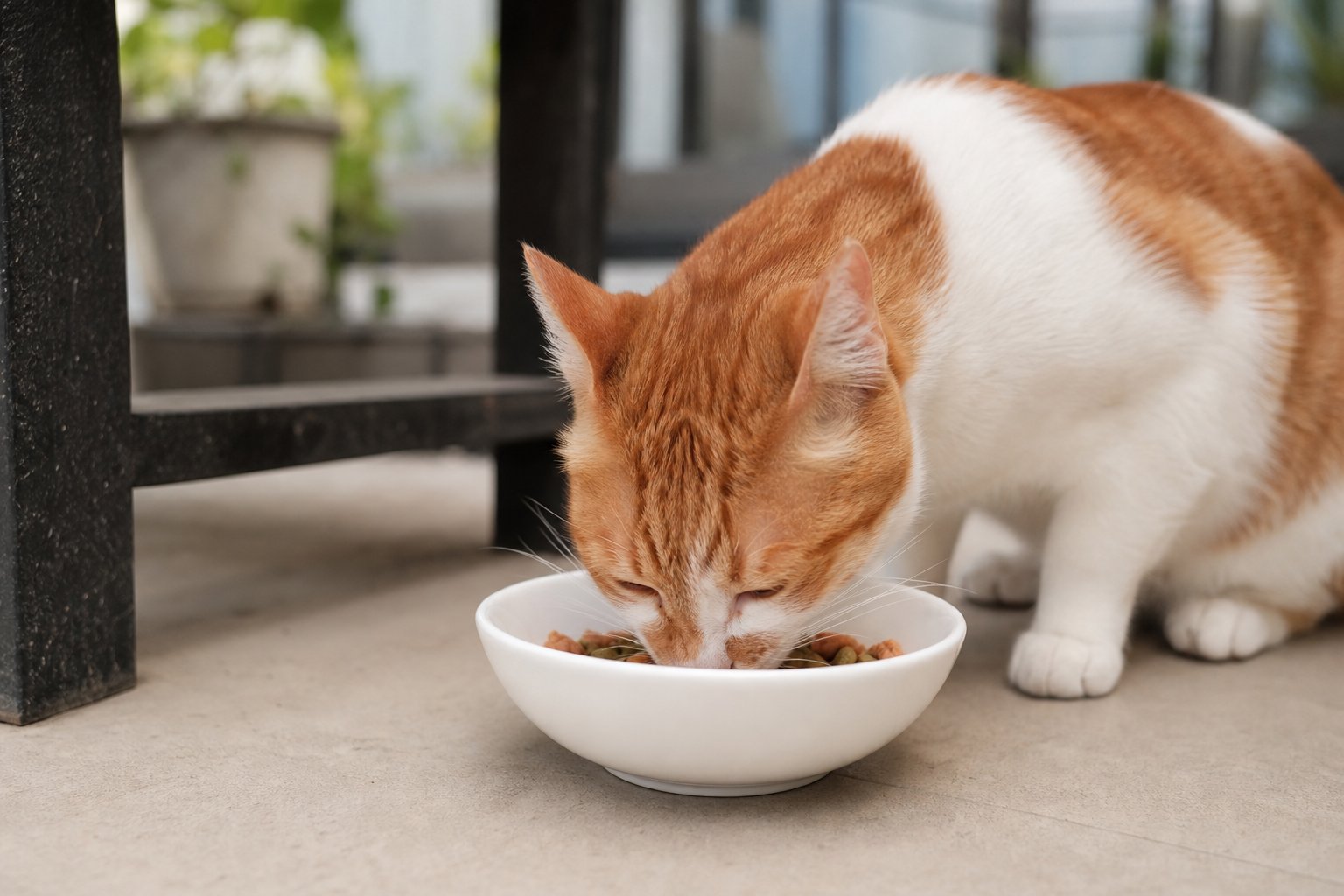
Short answer first: work out your senior cat's daily calories with RER = 70 × weight(kg)^0.75, then multiply by 1.0–1.2 for an older, low-activity cat. A 4 kg cat comes to about 198 kcal at rest, or roughly 200–240 kcal a day. Split that across two or three set meals, weigh your cat every week, and treat any sudden jump or drop in appetite as a reason to see a vet, not as normal ageing.
Why an older cat's digestion quietly changes
From around eight years of age, a cat's internal organs — kidneys, liver, gut — begin ageing gradually, and digestive efficiency slips with them. Older cats do a better job with food that is easy to digest and nutritionally dense, which is exactly what senior-specific formulas are built around: highly digestible quality protein, controlled fat, and careful mineral balances suited to ageing bodies.
Portion frequency matters just as much as the food itself. Smaller, more frequent meals place less strain on a metabolism that is already slowing, and a cat aged 10 or above generally does better on three small meals than one or two large ones.
One habit worth checking: regularity is learned young. A cat fed at fixed times from kittenhood accepts routine easily; a cat first put on a strict schedule in old age will often resist it. If your senior cat has always grazed freely, introduce scheduled meals gradually rather than overnight, and expect a few days of vocal complaining.
Practical checklist for this stage:
- Choose a food labelled for senior or mature cats, or one your vet recommends for your cat's specific health status.
- Plan for smaller portions served more often, not bigger bowls.
- Move food and water to spots your cat can reach without climbing or jumping, since stiff joints are common in older cats.
- Keep the feeding spot quiet, away from the litter tray and the household's busiest traffic.
Work out the daily calories: RER and DER
Veterinary nutrition uses two simple figures:
Step 1 — RER (resting energy requirement): RER = 70 × body weight in kg, raised to the power of 0.75.
Step 2 — DER (daily energy requirement): multiply RER by an activity factor. Senior cats that are quiet and mostly stationary do fine at 1.0; older cats that still move around normally can use up to 1.2.
Worked example for a 4 kg senior cat:
- 4^0.75 ≈ 2.83
- RER = 70 × 2.83 ≈ 198 kcal
- DER = 198 × 1.0–1.2 ≈ 200–240 kcal per day
Two cautions. First, this is a starting point, not a prescription — individual metabolism varies, and the only reliable way to confirm the number is to watch what happens to the cat's weight over the following weeks. Second, cats with ongoing medical conditions often need different targets, so if your cat has kidney disease, diabetes, hyperthyroidism or is underweight, ask your vet for a specific figure rather than using the formula alone.
Portion guide by body weight
The table below uses a typical senior dry food at 3.8 kcal per gram. If your bag lists a different energy density, convert it yourself: daily grams = daily kcal ÷ kcal per gram.
| Body weight | RER (kcal) | Daily target (kcal) | Dry food per day (g) |
|---|---|---|---|
| 3 kg | 70 × 3^0.75 ≈ 160 | 160–190 | 42–50 g |
| 4 kg | 70 × 4^0.75 ≈ 198 | 200–240 | 53–63 g |
| 5 kg | 70 × 5^0.75 ≈ 234 | 235–280 | 62–74 g |
Use the table this way:
- Weigh the food, don't eyeball it. A kitchen scale removes the guesswork — the visual difference between 40 g and 60 g of kibble is far smaller than most owners expect, and free-pouring tends to creep upward month after month.
- Count treats inside the daily total. Treats should stay under about 10% of daily calories, and every biscuit given between meals has to come out of the meal allowance.
- Convert wet food by calories. A typical 80 g senior can carries roughly 70–90 kcal. Note the figure from the label, then deduct it from the day's target before weighing out the dry portion.
- Never slash an overweight cat's food by half. Cats are not people; abrupt fasting can set off hepatic lipidosis, a dangerous liver condition. Weight reduction is a supervised project, usually beginning with a reduction of around 10% and adjusted against weekly weigh-ins.
Dry, wet or both: split by calories, not by scoops
The most common feeding mistake with senior cats is dividing food by volume instead of energy. Two bowls that look equally full can differ by 30% or more in calories.
Worked example for a daily target of 200 kcal:
- All dry, at 3.8 kcal/g: 200 ÷ 3.8 ≈ 53 g per day.
- Half and half: an 80 g can providing about 80 kcal leaves 120 kcal for dry food, which at 3.8 kcal/g is about 32 g per day.
- All wet: read the kcal on the can or pouch and work out how many units add up to the target — no gram guessing needed.
Reading the label properly: look for metabolisable energy (ME), usually given as kcal/kg for dry food and kcal per can or pouch for wet. If your label shows kcal/kg, divide the target kcal by that number and multiply by 1,000 to get grams.
Why many owners end up mixing: wet food carries a lot of moisture, which helps cats that are not enthusiastic drinkers and supports kidney function — a genuine advantage for older cats. Dry food, meanwhile, is easy to weigh precisely and convenient for the meal you leave out when you head to work. A combination usually gives you the moisture of wet food with the measuring accuracy of dry.
Storage note for humid weather: keep kibble in a sealed container and check it has not gone stale or damp before serving, since a senior cat's appetite is often the first thing to suffer when food quality slips.
Meals and feeding routine: two or three set sittings
| Age and stage | Meals per day | How to serve |
|---|---|---|
| 7–10 years | 2 | Fixed times, measured portions, bowl removed after eating |
| 10 years and above | 3 smaller meals | Same times daily, smaller volumes per sitting |
| Any age, weight loss planned | 3–4 small meals | Only under a vet-supervised plan |
A workday routine that works for owners who are out of the house:
- Feed a measured breakfast before leaving, roughly a third to 40% of the day's calories.
- Serve the largest portion at a fixed time in the evening, about 60%.
- For a cat aged 10 or above, add a small third meal at a consistent evening hour if someone is home.
- A timed feeder can hold the scheduled meal when nobody is around, but leftover food should still be picked up rather than left out indefinitely.
Why free-feeding is risky for seniors: a cat that barely moves and can eat at any hour will very slowly drift over its target, and the gain is barely visible until the vet steps on the scale. Scheduled meals with the bowl lifted afterwards make the intake measurable.
Multi-cat households need extra discipline. Put each cat in a separate room with its own measured bowl, because the greedier cat will finish its own portion and then work through everyone else's. Feed the senior cat first, in peace, so she is not pushed aside by a younger, faster eater.
And if your cat begs constantly, ask honestly how the habit formed: food handed over while you eat, biscuits given between meals, or a bored cat using you as a vending machine. Cut high-calorie treats completely, and redirect a bored beggar with a toy or a short play session instead of a snack.
Local context: in a Kuala Lumpur apartment where the owner leaves early and returns late, a timed feeder covering the morning meal keeps the schedule consistent, while the evening meal stays a hand-measured sitting so portions are actually monitored. In a Penang terrace house during the rainy season, sealed kibble storage and a quick check for stale or damp food prevents the small appetite dips that otherwise get mistaken for fussy eating.
Weigh weekly and adjust by trend, not by one reading
For an average domestic cat, a healthy adult weight generally sits between 3.5 and 5.5 kg, with larger breeds judged separately. The number matters far less than the direction of travel.
A workable monitoring routine:
- Weigh at the same time each week — step on the scale holding your cat, then subtract your own weight.
- Write the figure down. One reading means nothing; six weeks of readings tell a story.
- If weight keeps falling, raise daily calories by about 10%.
- If weight keeps climbing, cut daily calories by about 10%.
- If your cat loses more than 5–10% of body weight within a month, skip the self-adjustment and see a vet.
Pair weigh-ins with regular health checks: from around seven years old, a check-up twice a year is a sensible baseline, and cats over ten often do better with a review every three to six months. Bloodwork is what turns unexplained weight change into an answer, because hyperthyroidism, kidney disease and diabetes can all hide behind a scale reading.
Appetite changes are warning signs, not personality quirks
Eating far more than usual. With food freely available and normal activity, a cat's daily intake is fairly constant. If your cat finishes her portion and sits at the bowl, follows you meowing, or always seems unsatisfied, treat it as a clinical sign. Common explanations include hyperthyroidism, diabetes, and overactive adrenal function; heavy parasite burdens can also drive appetite up. Hyperthyroidism deserves particular attention in middle-aged and older cats, classically showing as a strong appetite combined with weight loss, restlessness and increased thirst.
Eating less than usual. A drop in appetite is equally urgent. Mouth pain is a frequent culprit — gingivitis and periodontitis are especially common in older cats, and prolonged feeding of soft food can let plaque build up faster and worsen the problem. Early clues are bad breath, drooling, and a crunching or grimacing sound while eating. Kidney trouble and digestive disease are other possibilities. Left alone, a painful mouth means the cat simply eats less, and weight follows quickly.
Both directions deserve the same rule: if the change persists, book a check rather than waiting for the next weigh-in.
When to see a vet
Arrange a visit promptly if any of these apply:
- Weight loss of more than 5–10% within a month, or any downward trend across three consecutive weekly weigh-ins.
- A ravenous appetite that is new, especially alongside weight loss, restlessness or drinking more than usual.
- A noticeable, sustained drop in appetite or refusal of meals.
- Bad breath, drooling, or chewing on one side.
- Increased thirst, increased urine output, vomiting or diarrhoea.
- Any change in appetite combined with a senior cat's routine check-up being overdue.
For choosing and confirming a practitioner, the Malaysian Veterinary Council is the professional body for veterinarians in Malaysia, and the Department of Veterinary Services Malaysia publishes general pet owner guidance at dvs.gov.my. The SPCA also carries practical cat care resources for owners at spca.org.my.
Frequently asked questions
How many calories should a senior cat eat each day?
Calculate RER = 70 × weight(kg)^0.75, then multiply by 1.0–1.2 for an older, less active cat. A 4 kg cat needs about 198 kcal at rest and roughly 200–240 kcal daily. Treat it as a starting point and fine-tune it against weekly weigh-ins.
Why is my senior cat always hungry but losing weight?
A ravenous appetite with weight loss is the classic picture of hyperthyroidism, and can also point to diabetes or gut parasites. Do not write it off as normal ageing. Ask your vet for a blood test, including T4 and glucose, plus a body condition check.
Should a senior cat eat dry food, wet food or both?
Split portions by calories, not by scoops. Wet food brings useful moisture for cats that drink little and supports kidney health; dry food is convenient and easy to weigh accurately. Many owners combine both, adding up the kcal on each label to reach the daily target.
How many meals a day for a cat aged 10 or above?
Three smaller meals at fixed times. Cats aged 7 to 10 can usually stay on two scheduled meals. Smaller, more frequent portions ease digestive and metabolic load, and food left out around the clock makes overfeeding easy in a cat that barely moves.
When does weight loss in a senior cat become urgent?
If an older cat loses more than 5–10% of body weight within a month, see a vet promptly instead of adjusting the diet yourself. Weekly weigh-ins catch gradual change early, before the loss is obvious when you look at the cat.
Should I cut my senior cat's food in half to help her lose weight?
Never cut a cat's intake abruptly. Halving portions can trigger hepatic lipidosis, a serious liver condition. Obesity should be managed as a supervised plan with your vet, using gradual reductions of around 10%, revised against weekly weigh-ins.
This article is general information only and is not a substitute for veterinary diagnosis or treatment. Calorie formulas are reference tools; your cat's actual needs depend on her health status. Please consult a registered Malaysian veterinarian for advice specific to your cat.
Related reading
- Senior Cat Care Guide Malaysia: 7+ Health Checks, Kidneys, Joints & Daily Care
- Senior Cat Food in Malaysia: What to Change After Age Seven (And What Not To)
- Cat Blood Calcium Disorders in Malaysia: High and Low Calcium, Fatigue Signs, Ca/Phosphorus/PTH Tests and Diet
- Caring for a Cat With Neurological Damage in Malaysia: Home Safety, Rehab and Long-Term Support
- Senior Cat Care in Malaysia: Age Signs, Check-ups and Daily Home Adjustments
- Senior Cat Care in Malaysia: 10 Ageing Warning Signs and a Practical Daily Care Checklist
- Senior Cat Not Eating in Malaysia: 8 Causes, Warning Signs & Practical Appetite Tips
- Senior Cat Arthritis in Malaysia: Signs, Home Fixes and What Supplements Can Really Do
- Senior Cat Care Hub Malaysia: Kidney, Joints, Cognition, Diet and Check-Up Timetable for Cats Aged 7 and Above
- Senior Cat Care in Malaysia: Daily Routine and Home Checklist from Age 7
- Senior Cat Checkups in Malaysia: Start at Age 7, Plus What Every Blood Panel Should Cover