
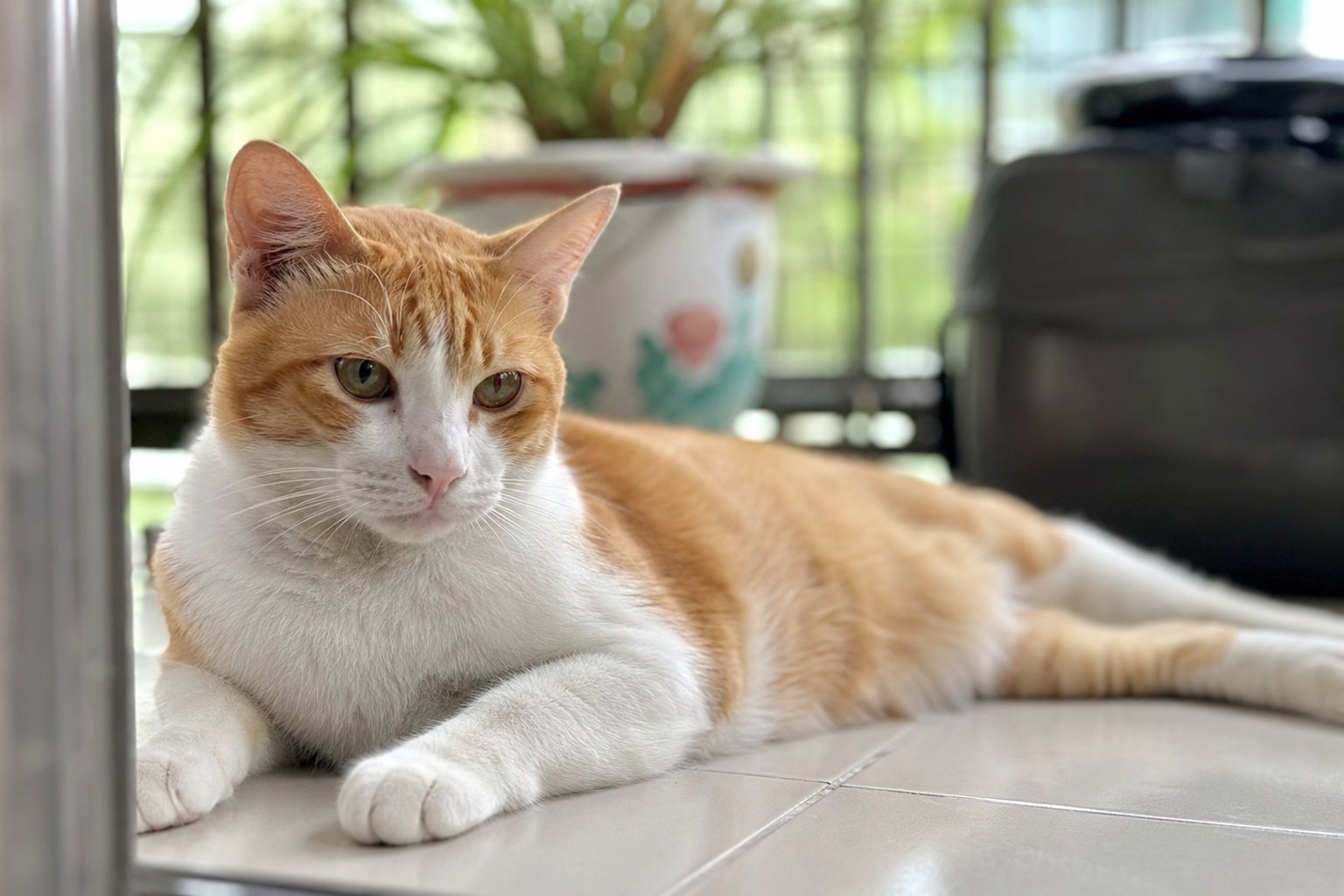
Short answer: Arthritis in senior cats cannot be cured, but it can be managed well. The three moves that matter most are keeping your cat at a healthy weight, adapting the home so everyday actions need no jumping or climbing, and letting a vet handle pain relief. Supplements such as glucosamine and chondroitin are nutritional support, not treatment. Watch for a cat that simply stops doing things.
How a senior cat's joints change
Cartilage is the shock absorber built into every joint. In a young cat it is thick, springy and well hydrated, so movement is cushioned and quiet. With age that cartilage thins and loses elasticity, the padding between bones shrinks, and ordinary motion starts to feel uncomfortable. This slow 'wear and tear' pattern is why the problem appears gradually rather than overnight — one month your cat is on the wardrobe top, the next month it isn't.
Joint trouble in cats usually falls into two broad patterns. Acute inflammation often follows an incident: a heavy landing from a height, a collision, a strain or other injury. Chronic degenerative change is the age-related kind that builds over years. During an acute flare a vet may use medication to calm inflammation and discomfort; chronic change is managed for life rather than fixed.
One important difference from dogs: cats are extremely good at hiding pain. They rarely limp in a way a visitor would notice. Their version of a limp is behavioural — they decline the jump, they stop grooming the hard-to-reach patch along the back, they take the floor route instead of the stairs. Feline arthritis is also generally less common than in dogs, but it becomes a real concern as a cat passes into its senior years and its body condition starts to drift upward.
The signs: look for what your cat has stopped doing
The most reliable clues are absences. Keep a note on your phone for a fortnight and tick off anything that matches:
| What you notice | What may be behind it |
|---|---|
| No longer jumping onto cabinets, beds or window ledges | Jumping needs a strong rear-leg push-off; if it hurts, the cat opts out |
| Slower or hesitant on stairs, or pausing before hopping off the sofa | Reduced range of motion in the affected joints |
| Grooming less, with a dull or matted patch along the back | Twisting to reach the spine or hips hurts |
| Avoiding a high-sided litter box, or toileting outside it | The cat cannot lift its legs over the rim |
| Flinching, crying or becoming irritable when you touch the hips or lower back | Tender to pressure |
| Sleeping much more and playing much less | Overall drop in activity drive |
These signals overlap with several other conditions common in older cats — heart disease, anaemia, poor vision and cognitive decline can all produce a cat that has quietly retired from jumping. That is why you should not diagnose at home. Get a check-up first, then let a vet combine your account of activity changes with hands-on examination and palpation, using X-rays where appropriate to confirm what the joints actually look like.
Weight: the strongest lever you control
Carrying extra kilograms is not a cosmetic issue for a cat; it is a mechanical one. As a working rule, a cat more than about 15% above its ideal body weight is considered obese, and obesity is one of the main drivers of joint disease in older cats — alongside other risks such as diabetes.
Think in proportions rather than absolute numbers. Taking a full kilogram off a four-kilo cat is an enormous relative loss, comparable to a much larger human shedding many kilos. The load on every joint drops immediately, which is why weight reduction is normally the single most effective part of a joint-care plan.
Speed, however, matters enormously with seniors. The safe target is roughly 0.5–1% of body weight per week — for a four-kilo cat, that is only 20 to 40 grams, slow enough to look like nothing is happening. Losing faster risks serious liver trouble, the same danger as fasting. Practical guardrails: cut total calories by no more than about a fifth, do not cut protein with them (take the reduction from fat and carbohydrates instead), and weigh once a week on the same scale at the same time of day. Your vet should set the calorie target and may suggest a senior weight-management formula that is less calorie-dense while keeping protein up.
For an owner in a Kuala Lumpur apartment, this matters even more: a small flat offers limited space for a cat to burn energy, so the food bowl does most of the work of managing weight. Measuring meals precisely beats relying on the cat to exercise.
Home modifications you can start this weekend
Most of these are cheap, reversible and take an afternoon. Walk your own home at your cat's eye level and you will spot the problems immediately.
- Litter box: swap to a low-entry model, or cut a doorway into the side of an existing box so the entrance is about one paw high. In multi-cat households, put one box on each level so nobody has to climb to toilet.
- Steps and ramps: stack two boxes or storage tubs beside the sofa or bed and cover the tops with non-slip fabric or a towel. Cardboard is fine as a first version while you decide what works.
- Food and water: keep both on the floor and raise the bowls 5–10 cm so your cat does not have to crouch deeply to eat.
- Sleeping spots: provide thick, warm bedding rather than a thin mat on a hard floor. Place it where sun falls without becoming scalding, and add a low-temperature pet heat pad in cooler weather — stiff joints hate cold, hard surfaces.
- Flooring: lay non-slip mats or carpet strips along the main walking route across tile or timber. A senior cat's biggest fear is slipping as it rises from a crouch.
During the Penang rainy season a cat may barely step outside for days at a stretch, which means the indoor circuit — bed, bowl, litter box, favourite perch — carries the entire day. Walk that route yourself, notice every gap where your cat currently has to jump, and close it. If the route is comfortable in the wettest week of the year, it is comfortable all year.
Joint supplements: honest scope and honest limits
Two ingredients dominate the shelf: glucosamine and chondroitin. Glucosamine is one of the raw materials used to build the cartilage matrix, and in theory it helps cartilage hold on to water and stay elastic. Chondroitin is a major component of cartilage itself and is thought to help maintain it as cartilage wears down.
Now the honest part. These ingredients are nutritional support, not essential drugs for treating arthritis — they do not replace a diagnosis, a pain plan or a weight plan. There is also genuine uncertainty about how much of an oral dose actually reaches the joint after digestion, and how large the real-world benefit is in cats specifically. Plenty of owners report that their cat seems more comfortable, but do not expect a 'took it, pain gone' result.
If you decide to try one, do it properly:
- Ask your vet first, especially since your cat is likely on other treatments.
- Choose a feline-specific formula. Dog products differ in dose and sometimes in additives; international brands such as VetriScience market cat-specific joint versions.
- Judge it over a fair trial period, not a few days, and keep a simple comfort diary.
- Never let it displace the two things that actually work: weight control and home modification.
- Prices vary between shops and formulations, so ask a Malaysian vet or pet retailer for current local pricing rather than assuming.
Here is how the pieces of a joint-care plan compare:
| Part of the plan | Effort | Effect on comfort | Notes |
|---|---|---|---|
| Weight reduction | High, daily discipline | Highest | Slow and vet-guided; never crash-diet a senior |
| Home modification | One-off, low cost | High and immediate | Removes the daily friction |
| Vet pain plan | Ongoing appointments | High during flare-ups | Vet-prescribed only; review regularly |
| Joint supplements | Daily, ongoing | Modest and uncertain | Support layer, not a substitute |
Pain relief: what you must never do
Whether medication is needed is entirely the vet's call. During an acute inflammatory flare, a vet may prescribe medication to control discomfort; for chronic degeneration, the long-term pillars are weight management, environment and nutritional support, with the pain plan reviewed at follow-up visits.
The one absolute rule: never give your cat human painkillers. Many common human analgesics and fever reducers are highly toxic to cats, and a dose that seems tiny to a person can be fatal to a cat. There is no safe home experiment here. Also do not start, stop, split or adjust any prescribed dose on your own — if the plan looks wrong, ring the vet.
Hands-on care and physical therapy
Beyond medication and home changes, there are supportive options such as gentle massage, acupuncture and laser therapy. These should always be performed by, or under the direction of, a registered veterinary professional — be cautious about unqualified 'pet massage' services, since working on a painful joint wrongly can make things worse.
What you can safely do at home is simpler: a few minutes of gentle stroking along the limbs and back, offered rather than imposed. If your cat leans into it, continue; if the cat walks away, gets up or growls, stop at once. Short, pleasant sessions build trust, and a cat that enjoys being touched is far easier to monitor for new tender spots.
When to see a vet
Book promptly if you notice any of the following:
- Reluctance to jump that is new, or that is getting worse week by week
- Eating noticeably less, or refusing food altogether
- Crying, hissing or flinching when touched, especially around the hips and spine
- Limping, dragging a leg, or trouble rising after resting
- Missing the litter box, straining, or not passing urine at all
- Hiding, sleeping far more than usual, or grooming less
- Any unexplained weight loss
- A fall from a height or any accident — do not wait and see
At the visit, expect the vet to ask about changes in activity, examine and palpate the joints and spine, and use X-rays where needed to confirm joint changes while ruling out other causes such as heart problems, anaemia or vision loss. Leave with a written plan covering a target weight, home changes to make, any pain relief, and when to come back. Ask how you will judge quality of life between visits — a cat that still eats, grooms and chooses company is a cat you are managing well. For general pet-care information, the Department of Veterinary Services Malaysia and SPCA Malaysia both publish public guidance for owners.
A simple routine to keep it on track
- Daily: watch for the absences — did the cat jump today, groom today, play today?
- Weekly: weigh at the same time, log it, and check that bedding and mats are clean and dry.
- Monthly: re-walk the home route and fix one new friction point, such as a bowl that has crept higher or a box that has been moved.
- Each vet visit: bring your weight log and your list of absences, and ask for the next review date.
At a glance
- The signs are absences: not jumping, not grooming, not using the high-sided box
- Weight control is the most powerful step, but it must be slow
- Home modification gives quick, noticeable relief and costs almost nothing
- Supplements are support, never a treatment and never a reason to skip the rest
- Human painkillers are dangerous to cats — pain relief comes only from a vet
This article is for general information only and does not replace veterinary diagnosis or treatment. If your senior cat shows signs of pain, sudden mobility changes or loss of appetite, please consult a registered veterinarian.
Related reading
- Senior Cat Care Guide Malaysia: 7+ Health Checks, Kidneys, Joints & Daily Care
- Senior Cat Care in Malaysia: Age Signs, Check-ups and Daily Home Adjustments
- Senior Cat Care in Malaysia: 10 Ageing Warning Signs and a Practical Daily Care Checklist
- Senior Cat Care Hub Malaysia: Kidney, Joints, Cognition, Diet and Check-Up Timetable for Cats Aged 7 and Above
- Senior Cat Care in Malaysia: Daily Routine and Home Checklist from Age 7
- Senior Cat Cognitive Dysfunction in Malaysia: Night Yowling, Wandering and Accidents Explained
- Cat Blood Calcium Disorders in Malaysia: High and Low Calcium, Fatigue Signs, Ca/Phosphorus/PTH Tests and Diet
- Caring for a Cat With Neurological Damage in Malaysia: Home Safety, Rehab and Long-Term Support
- Senior Cat Not Eating in Malaysia: 8 Causes, Warning Signs & Practical Appetite Tips
- Senior Cat Checkups in Malaysia: Start at Age 7, Plus What Every Blood Panel Should Cover
- Senior Cat Food in Malaysia: What to Change After Age Seven (And What Not To)