
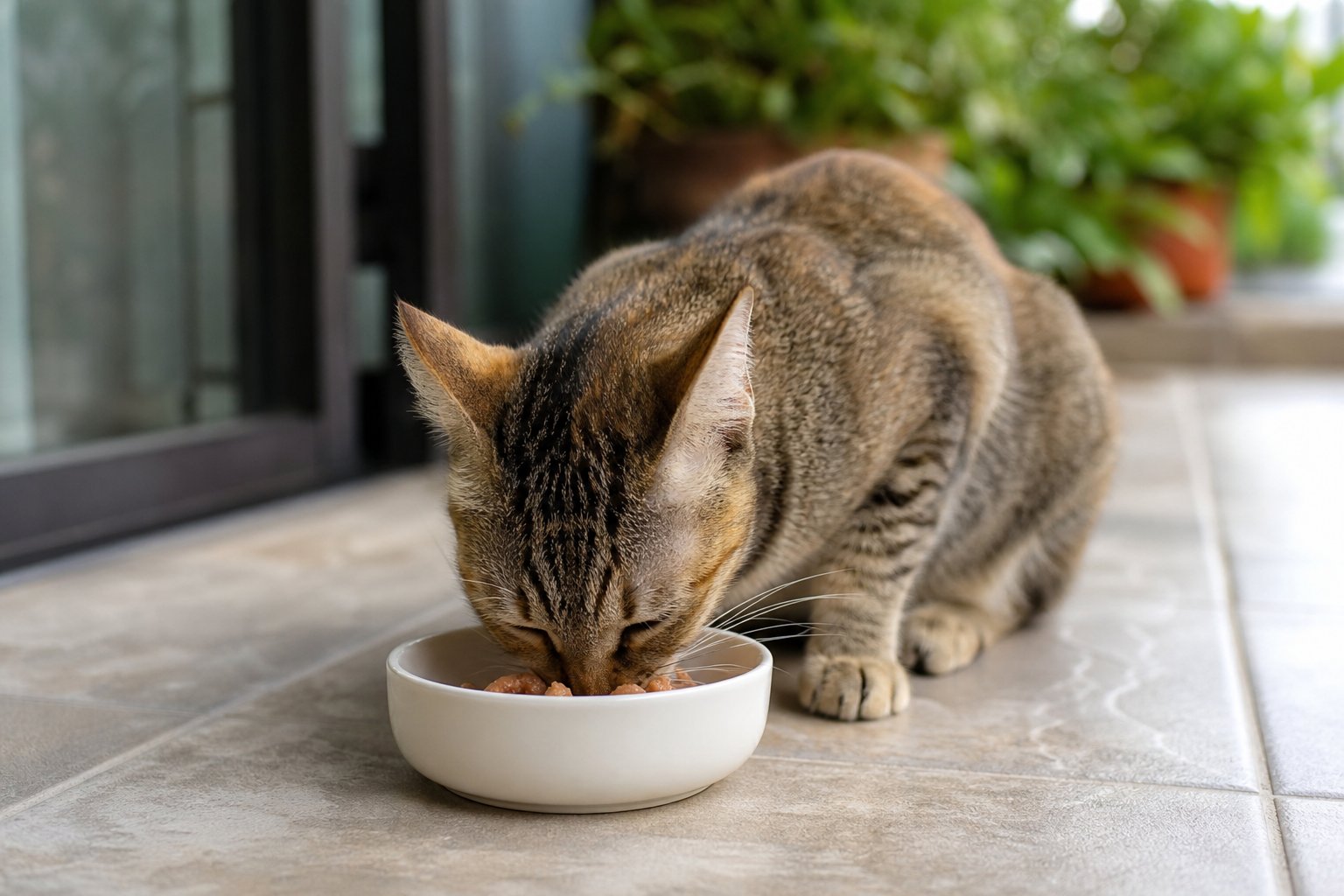
Do you need to switch your cat to senior food the moment it turns seven? Not urgently. The priorities after seven are protein quality, moisture, comfortable textures and six-monthly bloodwork — not automatically cutting protein or phosphorus. Below is how to choose senior cat food in Malaysia, how to read a label honestly, and when diet must follow a diagnosis rather than age.
Why Nutrition Shifts Around Age Seven
Cats are generally classed as mature or senior from about seven years old, though a healthy indoor cat can stay playful well into its teens. Several quiet changes tend to happen around this stage:
- Muscle is lost faster than fat. This condition, sarcopenia, is one of the most under-recognised problems in older cats. A cat that looks the same weight can still be losing lean mass.
- Thirst drive falls. Older cats drink less voluntarily, and the kidneys become less able to concentrate urine, so dehydration creeps up gradually.
- The sense of smell dulls. Food that used to be irresistible may seem bland, which reduces portion size at each meal.
- Dental disease is common. Broken teeth, inflamed gums and oral ulcers make hard kibble painful, so a cat may approach the bowl, chew once, and walk away.
One important reality check: "senior" is a marketing category, not a regulated nutritional standard. There is no separate legal profile for senior cat food, so many senior products are simply adult maintenance formulas with a softer texture or added joint ingredients. That is why reading the actual label matters more than reading the front of the bag.
Protein: Keep It Up, and Choose Quality
The instinct with older animals is to dial protein down. For healthy senior cats, that instinct is wrong.
Because lean mass declines with age, adequate high-quality protein is what protects against weakness, a dull coat, slow wound healing and that characteristic bony appearance over the hips and spine. Look for a clearly named animal protein source near the top of the ingredient list — chicken, chicken meal, salmon, turkey or egg rather than an unnamed "meat by-product" or a formula where legumes dominate the protein count.
For reference, adult maintenance standards set a minimum of around 26% crude protein on a dry-matter basis, with taurine at 0.10% and phosphorus at 0.5%. Senior products should at least meet adult maintenance levels. Anything claiming dramatically reduced protein for an otherwise healthy cat deserves scrutiny.
The only situation where protein genuinely needs lowering is diagnosed chronic kidney disease at a later stage, and even then the protein must remain highly digestible so that less waste is produced per gram eaten. Restricting protein "just in case" in a healthy eight-year-old risks accelerating muscle wasting for no benefit.
| Situation | Protein approach | Why |
|---|---|---|
| Healthy senior, normal bloodwork | Keep high, digestible animal protein | Prevents sarcopenia and weight loss |
| Senior with slight weight gain | Keep protein adequate, adjust calories | Cutting protein to cut calories costs muscle |
| Chronic kidney disease, early stage | Usually maintain protein, control phosphorus | Early restriction is rarely needed and may unbalance the diet |
| Chronic kidney disease, later stage | Vet-directed reduced, high-quality protein | Limits urea build-up while preserving body condition |
| Diabetes or pancreatitis | Often higher protein, lower carbohydrate, vet-formulated | Supports blood sugar control under treatment |
Phosphorus: Decide with Bloodwork, Not with Age
Phosphorus restriction is a kidney intervention, not a birthday intervention.
A healthy senior cat with normal renal values gains nothing from a low-phosphorus diet, and restricting phosphorus too early can make it harder to keep other nutrients in balance. Phosphorus control begins once chronic kidney disease is diagnosed and staged by your vet.
The International Renal Interest Society staging system guides dietary phosphorus density: roughly 150 mg per 100 kcal or less for stages 1–2, and around 120 mg per 100 kcal or less for stages 3–4, alongside corresponding blood phosphorus targets. Those figures are decided after blood and urine testing, not by the age printed on the food bag.
A practical difficulty: labels usually list phosphorus as a percentage on an as-fed basis, which does not translate directly into mg/100 kcal without knowing the energy density and moisture content. If your cat has a kidney diagnosis, ask your vet to confirm that the chosen diet actually meets the target rather than trusting a "low phosphorus" claim on the packaging.
Water and Texture: The Most Practical Change
If you only make one change for an older cat, make it about moisture and comfort.
Cats on dry food alone take in far less water than cats eating wet food. Wet foods typically contain around 78–88% moisture, while dry kibble sits near 10%. Cats should ideally take in about 50–60 ml of water per kilogram of body weight daily, counting water from food as well as the bowl — and an older cat with a reduced thirst drive is unlikely to drink its way to that figure on dry food alone.
More moisture supports kidney function, helps prevent constipation, and dilutes urine. Texture solves a second problem at the same time: soft pate, mousse, shreds in gravy or broth-based foods are far easier for a cat with sore gums or missing teeth to manage.
Practical ways to make food more appealing:
- Warm it slightly. Food at about 35–40°C releases more aroma, which matters when smell has declined.
- Serve small, frequent meals. Older cats often eat less per sitting but will take more across four or five small offerings.
- Offer variety in texture, not just flavour. A cat refusing pate may still take shredded meat in jelly, and vice versa.
- Keep water bowls away from food and litter. Some cats prefer a wide, shallow bowl or a circulating fountain.
- Refresh and wash bowls daily. A slimy bowl rim discourages drinking.
How to Read the Label in Plain Language
Skip the front-of-pack promises and check these lines:
- Moisture percentage. For a wet food, anything below about 80% is delivering less hydration than you think. For a "wet" product with suspiciously low moisture, ask what else is providing bulk.
- Protein source order. A named animal protein in the first two or three positions is a better sign than a long list of cereals ahead of meat.
- Phosphorus figure. Note it, but remember the unit problem above. If your cat has kidney disease, get the number confirmed in the right units.
- Energy density. kcal per kilogram or per can lets you work out how much to actually serve. Feeding by tin size alone over- or under-feeds cats.
- "Complete and balanced" statement. This confirms the food is formulated to supply all nutrients on its own — important if you plan to feed that product exclusively.
- The word "senior". Treat it as a shelf label. Compare two products side by side and you may find the ingredient panels are almost identical.
- Guaranteed analysis versus as-fed. Moisture inflates every other percentage in a wet food; dry-matter comparison is fairer between a can and a bag.
A useful habit: photograph the ingredient and analysis panels on your phone when you shop, then compare products at home without a queue behind you.
Feeding Strategies That Balance Cost and Health
Many owners assume that caring for an older cat means choosing between expensive wet food and cheaper dry food. A mixed approach usually solves it.
A typical healthy senior cat of around 4 kg needs roughly 200–250 kcal per day, though the exact figure depends on body condition, activity and whether weight needs to come off. Always work from calories, not scoop counts.
| Approach | Moisture delivered | Practical notes |
|---|---|---|
| Dry food only | Low | Convenient and economical, but relies on the cat drinking enough; monitor water intake closely |
| Wet food only | High | Best hydration and easiest on sore mouths; costs more and needs careful portioning to avoid waste |
| Dry plus one wet meal daily | Moderate to high | The common compromise — meaningful hydration, better palatability, lower cost than all-wet |
| Wet plus a small dry portion | Moderate | Useful for cats who still enjoy crunching but struggle with large kibble |
| Therapeutic diet | Depends on product | Vet-directed; do not mix with other foods without checking with your vet |
Money-saving tactics that do not compromise senior care:
- Buy the largest practical bag of dry food your cat can finish while still fresh, and store it in an airtight container away from heat and humidity.
- Use wet food strategically — at the meal where appetite is weakest, or as the daily hydration boost — rather than at every sitting.
- Compare on cost per calorie, not cost per packet. A small pouch with high energy density can go further than a larger but watery one.
- Check the expiry date and the condition of the food. Rancid fat or stale kibble is a common, overlooked cause of an older cat turning its nose up.
- Ask your vet or pet retailer about current local pricing; prices vary between brands, pack sizes and outlets, so confirm before budgeting.
In a Kuala Lumpur apartment where the air conditioning runs most of the day, dry food can dry out faster than owners expect — a sealed container and a smaller bag size often work better than one large sack left open.
Common Senior Conditions and the Dietary Response
Diet supports treatment; it rarely replaces it.
| Condition | Dietary response | Important note |
|---|---|---|
| Chronic kidney disease | Staged renal diet controlling phosphorus density | Requires blood and urine staging first |
| Hyperthyroidism | Veterinary treatment first; some cases use iodine-restricted diets | Diet cannot substitute for medication or monitoring |
| Dental disease or mouth pain | Soft pate, mousse or shredded textures; avoid hard kibble | Drooling or chewing on one side needs a dental check |
| Arthritis | Weight control plus omega-3 fatty acids | Lighter body weight directly reduces joint load |
| Poor appetite | Small frequent meals, warmed food, texture changes | Over 24–48 hours of not eating needs veterinary attention |
| Constipation | More moisture, appropriate fibre | Dehydration worsens constipation in older cats |
| Diabetes | Vet-formulated high-protein, lower-carbohydrate diet | Never adjust a diabetic cat's diet without your vet |
| Obesity | Senior-specific weight management formula | Lose weight slowly; rapid loss destroys muscle |
| Hairballs and constipation | Adequate moisture and moderate fibre | Persistent hairballs may signal underlying gut issues |
Transitioning Food Over 7–14 Days
Older cats have more sensitive guts than kittens and young adults, so a rushed switch usually ends in vomiting or loose stools.
A workable schedule:
| Days | New food proportion | What to watch |
|---|---|---|
| 1–3 | About 25% | Stool consistency, vomiting, appetite |
| 4–6 | About 50% | If stools soften, hold at this ratio for extra days |
| 7–9 | About 75% | Energy level and interest at mealtime |
| 10–14 | 100% | Settled stool, stable weight over the following fortnight |
If diarrhoea or vomiting appears, step back to the previous ratio and stay there for a few days before advancing again. Some seniors take the full 14 days, occasionally longer. Stability beats novelty: once a cat is eating well and holding weight, there is no benefit in changing foods for the sake of variety.
Also avoid abruptly changing the diet of a cat that is already unwell or off its food. Getting calories in matters more than getting the perfect product in during a difficult week.
Monitoring: Weight, Muscle and Body Condition
Weigh your cat every one to two months, ideally on the same scale, and record the number. Alongside weight, track two visual scores:
- Body condition score (BCS): a 1–9 scale where ribs should be felt with light pressure and a visible waist should appear from above.
- Muscle condition score (MCS): a check of the head, shoulders and hindquarters, where flat or hollow areas indicate muscle loss.
This combination matters because a cat can hold steady weight while losing muscle and gaining fat — a pattern that looks fine on the scale but not in the mirror. Gradual, unexplained weight loss is one of the earliest warning signs in a senior cat and should never be dismissed as normal ageing.
When to See a Vet
Arrange a veterinary visit promptly if you notice any of the following:
- Not eating for more than 24 hours (48 hours is an emergency risk in cats, especially overweight ones)
- Weight loss despite a normal or increased appetite
- Drinking and urinating noticeably more, or urinating outside the litter box
- Repeated vomiting, straining in the litter box, or no stool for several days
- Drooling, chewing on one side, bad breath, or food falling from the mouth
- Hiding, vocalising at night, stiffness when rising, or a sudden change in behaviour
- Any lump, wound that will not heal, or changes in breathing
Check-up rhythm from seven years onwards: weight, body and muscle scoring and an oral examination roughly every six months; blood count, biochemistry covering kidney and liver values, thyroid hormone, urinalysis and blood pressure every six to twelve months depending on your vet's advice. Heart imaging, X-rays or ultrasound are added when something in the basic screening suggests a problem.
Between visits, keep a simple log of meals eaten, weight, stools and any vomiting. Bringing real observations to an appointment is far more useful than a general impression of "seeming tired".
Vet disclaimer: This article is general information only and is not a diagnosis or a feeding prescription. Every cat's needs differ — discuss diet changes, portion sizes and therapeutic foods with your own registered veterinarian, especially if your cat has kidney, thyroid, diabetic or dental conditions.
Related reading
- Senior Cat Care Guide Malaysia: 7+ Health Checks, Kidneys, Joints & Daily Care
- How Much Should a Senior Cat Eat in Malaysia? Calorie Formula, Portions and Meal Timing
- Senior Cats and Pear in Malaysia: Safe Portions, Prep Steps and Cats Who Must Skip It
- Cat Blood Calcium Disorders in Malaysia: High and Low Calcium, Fatigue Signs, Ca/Phosphorus/PTH Tests and Diet
- Caring for a Cat With Neurological Damage in Malaysia: Home Safety, Rehab and Long-Term Support
- Senior Cat Care in Malaysia: Age Signs, Check-ups and Daily Home Adjustments
- Senior Cat Not Eating in Malaysia: 8 Causes, Warning Signs & Practical Appetite Tips
- Senior Cat Arthritis in Malaysia: Signs, Home Fixes and What Supplements Can Really Do
- Senior Cat Care Hub Malaysia: Kidney, Joints, Cognition, Diet and Check-Up Timetable for Cats Aged 7 and Above
- Senior Cat Care in Malaysia: Daily Routine and Home Checklist from Age 7