
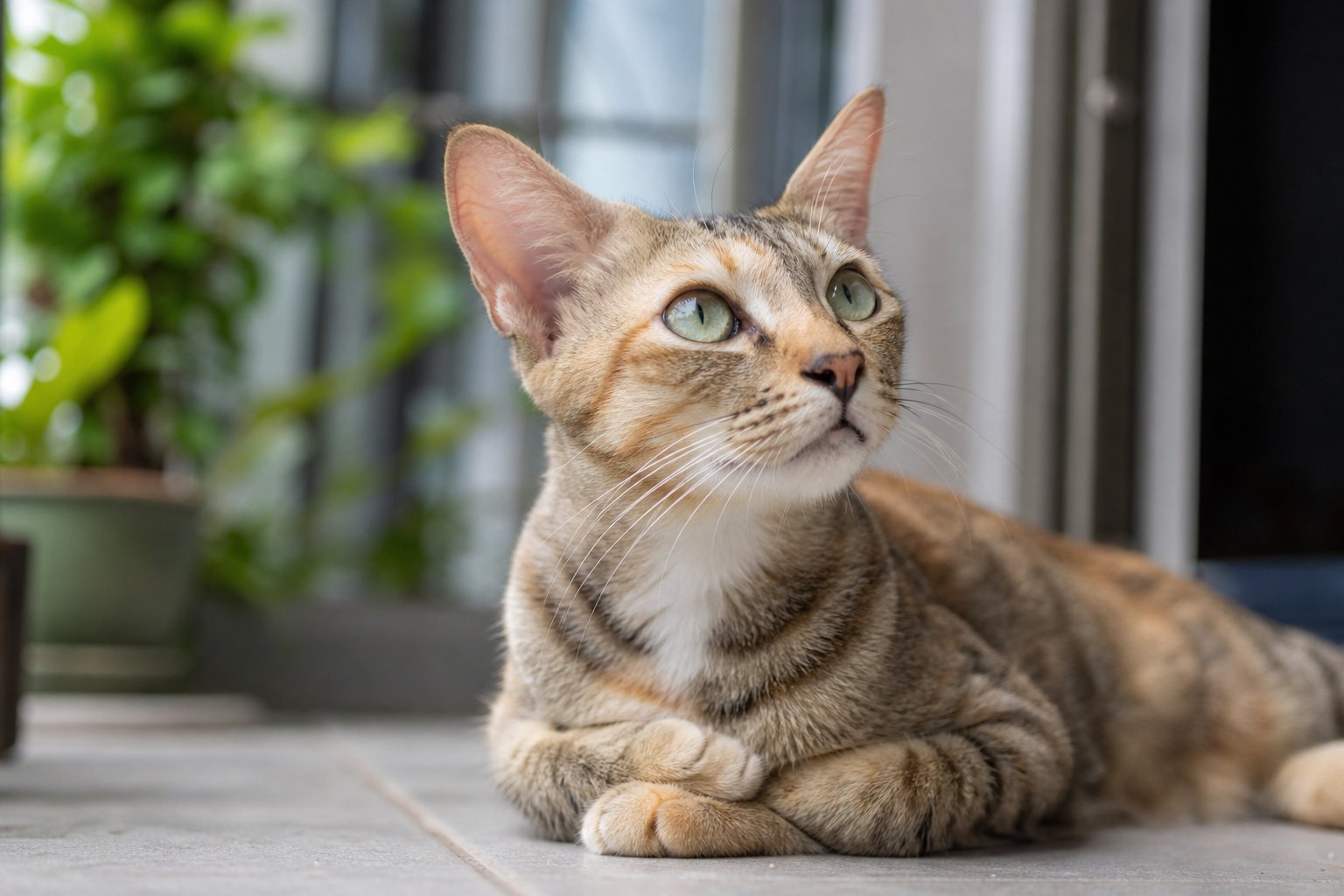
A grown male Maine Coon usually weighs 6–10 kg, a female 4–7 kg, and nose-to-tail-tip length reaches 90–120 cm. Unlike most domestic cats, they are not finished at one year: growth plates close around 18–24 months, and muscle and chest keep filling out until three to four years old. Use the chart below to track your own cat, but judge health by body condition rather than a single number on the scale.
Maine Coon size at a glance
If you only have thirty seconds, this is the whole breed in one table. The figures are typical ranges for the breed, not guarantees — pedigree line, frame size, neuter timing and nutrition all push individuals above or below the middle of the range.
| Item | Male | Female |
|---|---|---|
| Adult weight | 6–10 kg | 4–7 kg |
| Nose-to-tail-tip length | 100–120 cm | 90–100 cm |
| Shoulder height | about 25–40 cm | about 25–35 cm |
| Fully mature age | 3–4 years (occasionally 5) | around 3 years |
| Tail length | up to 40 cm or more | up to 40 cm or more |
| Typical lifespan | 12–15 years | 12–15 years |
Three points worth internalising before you buy anything:
- A one-year-old is a teenager, not an adult. At twelve months most are only 4.5–6.5 kg, with two or three more years of growth ahead.
- Bigger is not automatically better. A 7 kg cat with visible ribs and a clear waist is healthier than a 11 kg cat with no waistline at all.
- Space, not weight, is usually the constraint. A compact apartment can work if you plan vertical territory; a 10 kg cat on flat surfaces alone will get bored and frustrated.
Age-by-age weight chart: 0 to 36 months
Maine Coons are famously slow developers. The table below gives healthy reference bands for kittens and young adults, plus what is physically happening at each stage.
| Age | Male reference | Female reference | What is developing |
|---|---|---|---|
| At birth | about 100 g | about 100 g | Steady daily gain is the only useful sign |
| 2 months | 1–1.5 kg | 0.9–1.4 kg | Weaned, first vaccinations, rapid length gain |
| 4 months | 2–3.2 kg | 1.8–2.8 kg | First adult coat coming through, ears look oversized |
| 6 months | 3–4.5 kg | 2.5–4 kg | Sexual maturity window; discuss neuter timing with your vet |
| 12 months | 4.5–6.5 kg | 3.5–5.5 kg | Adolescence only; frame still open |
| 18 months | 5.5–8 kg | 4–6 kg | Bones nearing completion, muscle catching up |
| 24 months | 6–9 kg | 4–6.5 kg | Chest and neck visibly broadening |
| 36 months | 6–10 kg | 4–7 kg | Final adult size roughly reached |
How to use it: weigh your cat once a month, on the same scale and roughly the same time of day, and write the figure down. After three months you will have a short curve instead of a stray number. A curve that climbs steadily and then flattens gently near the adult range is exactly what you want; a curve that stalls for two consecutive months, or falls, is worth a conversation with your vet.
One practical reminder: always include the tail when you think about length. The tail alone can exceed 40 cm, and owners who measure only the body consistently underestimate how much horizontal room their cat needs in a carrier, on a shelf or along a corridor.
Male vs female: the size gap
Sex is one of the strongest predictors of final size, and it only becomes obvious after the second year. Littermates of opposite sex can look almost identical at six months and then end up looking like two different breeds.
| Feature | Male | Female |
|---|---|---|
| Adult weight | 6–10 kg | 4–7 kg |
| Shoulder height | 25–40 cm | 25–35 cm |
| Nose-to-tail length | 100–120 cm | 90–100 cm |
| Age fully mature | 3–4 years, occasionally 5 | around 3 years |
| Build | broad chest, thick neck, square head frame | lighter frame but still a large cat |
Males typically carry 30–50 per cent more weight than females. That gap has practical consequences: a male Maine Coon on the examination table is genuinely heavy, so lifting him into a carrier or onto a vet's table is a two-handed job, and a carrier rated for an average cat may simply be too short for him to turn around in. If you are choosing between a male and a female on space or handling grounds alone, the female is the easier animal to live with in a small home.
Why they stay kittens until three or four
Maine Coons are one of the few cat breeds whose growth plates close late. Bone length settles around 18 to 24 months, but muscle mass, chest breadth and overall substance continue developing well into the third year, and occasionally the fifth. Five factors determine where an individual lands:
- Genetics and parental size. Heredity is the single biggest driver. A breeder who can share the recorded adult weights of both parents gives you a far more useful forecast than any published chart.
- Sex. Males are consistently heavier and slower to settle; the difference becomes clearest after two years.
- Nutrition density. Growing cats need high protein, appropriate fat and a balanced calcium-to-phosphorus ratio. Food formulated for kittens or large-breed growth is appropriate through the growing phase; adult maintenance food offered too early can leave the frame under-supported.
- Neuter timing. Neutering can influence when growth plates close and how long the frame develops. There is no universal right age — this is a decision to make with your own vet based on your cat's individual development.
- Health status. Intestinal worms, chronic gut disease, absorption problems and cardiac issues all flatten a growth curve. Routine faecal screening and annual checks are part of size management, not separate from it.
Weight vs body condition: how to check at home
The scale measures mass; your hands measure quality. Run this five-step check every month alongside the weigh-in:
- Feel the ribs. Run your palms along the ribcage. They should be easy to locate under a thin layer of fat, but not visible to the eye. Maine Coons are one of the few cat breeds whose growth plates close late. Bone length settles around 18 to 24 months, but muscle mass, chest breadth and overall substance continue developing well into the third year, and occasionally the fifth. Five factors determine where an individual lands:
- Genetics and parental size. Heredity is the single biggest driver. A breeder who can share the recorded adult weights of both parents gives you a far more useful forecast than any published chart.
- Sex. Males are consistently heavier and slower to settle; the difference becomes clearest after two years.
- Nutrition density. Growing cats need high protein, appropriate fat and a balanced calcium-to-phosphorus ratio. Food formulated for kittens or large-breed growth is appropriate through the growing phase; adult maintenance food offered too early can leave the frame under-supported.
- Neuter timing. Neutering can influence when growth plates close and how long the frame develops. There is no universal right age — this is a decision to make with your own vet based on your cat's individual development.
- Health status. Intestinal worms, chronic gut disease, absorption problems and cardiac issues all flatten a growth curve. Routine faecal screening and annual checks are part of size management, not separate from it.
Weight vs body condition: how to check at home
The scale measures mass; your hands measure quality. Run this five-step check every month alongside the weigh-in:
- Feel the ribs. Run your palms along the ribcage. They should be easy to locate under a thin layer of fat, but not visible to the eye. Ribs you cannot find at all point to excess weight; ribs that protrude sharply point to too little.
- Look from above. Stand behind your cat and check for a visible waist behind the ribs. A straight-sided, barrel-shaped torso means fat has filled in the narrowing.
- Look from the side. The abdomen should tuck up slightly towards the hind legs. A sagging belly in an adult is a surplus signal; a slight puppy-like tuck is normal in kittens.
- Track the trend. Plot each monthly weight. A steady rise then a gentle plateau is normal. Two weeks with no gain in a growing kitten, or any weight loss in an adult, is not.
- Check condition, not just mass. Coat quality, energy, appetite and firm muscle over the shoulders all belong in the assessment. A 9 kg cat that feels solid and lively may be perfectly fine; a 9 kg cat that has stopped jumping is not.
Feeding a big cat: portions by weight
Big cats eat more — that part is obvious. The less obvious part is that food energy density varies widely between brands, so treat any gram figure as a starting point and adjust against the body condition check above.
| Weight band | Approximate daily dry food | Body condition target |
|---|---|---|
| 3–4 kg (older kitten) | 50–70 g | Growth curve rising; slight belly roundness is fine |
| 4–6 kg (young female) | 60–80 g | Ribs palpable, waist visible |
| 6–8 kg (average male) | 80–100 g | Firm muscle, abdomen tucked |
| 8–10 kg (large male) | 90–110 g | Weight stable, no creeping gain |
Three feeding principles keep big cats honest:
- Scheduled meals beat free feeding. Large cats on unlimited access can drift to 12 kg or more. Two or three measured meals a day are easier to control and easier to monitor.
- Read the body, not the empty bowl. Maine Coons are accomplished food beggars. A clean bowl does not prove hunger.
- Cap gains after development. Once growth is complete, any sustained monthly gain above roughly 0.3 kg is likely fat rather than muscle, and extra kilos load the joints and strain the heart.
Food and litter costs scale with size, and local prices vary between brands and stores — ask your Malaysian pet retailer for current figures rather than relying on a figure quoted online.
Gear that has to be oversized
Standard cat equipment fails a 8–10 kg animal in predictable ways: a shallow litter box forces an awkward crouch, a flimsy carrier sags under the load, and a suction shelf simply cannot hold a cat of this mass. Size these items up deliberately.
| Item | What to look for |
|---|---|
| Litter box | Extra-large footprint with room to turn around fully; a deep-sided storage tub works if it has a low entry |
| Carrier | Rigid base, wide door, enough length for the cat to lie out straight; check it fits through your vet's door process |
| Cat tree | Solid wood or heavy posts rated well above your cat's adult weight; avoid lightweight suction units |
| Food and water bowls | Wide, shallow mouth so whiskers are not constantly pressed against the rim |
| Grooming tools | A steel comb and a slicker for a double coat that mats easily |
The money-saving trick: buy the oversized version first. A litter box and carrier bought at kitten stage will be outgrown within a year, and replacing gear three times over three years costs more than one correct purchase. Treat the cat tree as furniture with a load rating, not as a toy.
Two local planning notes:
- In a Kuala Lumpur apartment, floor area is scarce but wall area is usually not. A full-height cat tree plus wall-mounted shelves gives a 10 kg cat climbing and perching space without eating into the living zone.
- In Penang's humid, rainy season, the thick double coat holds moisture and tangles faster. Budget five to ten minutes of combing most days during the wet months; mats on a large cat form quickly and become uncomfortable fast.
Maine Coon vs other large breeds
Weight ranges overlap, but silhouettes do not. Choose equipment based on body length and activity, not scale reading alone.
| Breed | Adult male weight | Fully mature | Build |
|---|---|---|---|
| Maine Coon | 6–10 kg | 3–4 years | Long rectangular frame, very long tail |
| Norwegian Forest Cat | 5.5–9 kg | about 3 years | Triangular face, dense weatherproof double coat |
| Ragdoll | 5–9 kg | about 4 years | Heavy bone, softer and more placid |
| British Shorthair | 4–8 kg | about 2 years | Cobby, dense and round |
| Average domestic cat | 3.5–5 kg | about 1 year | Fully settled early |
The same 9 kg reads differently on each: a Maine Coon at that weight is long and muscular, a Ragdoll at that weight is dense and slack. Length and muscle distribution, not the number, should drive your choice of carrier, shelf span and bed size.
When to see a vet
Bring your cat in promptly if you notice any of the following:
- A growing kitten that gains no weight for two consecutive weeks, or whose curve turns flat or downward
- An adult cat losing weight, especially with a normal or increased appetite
- Ribs that protrude visibly, or a torso that has become completely barrel-shaped with no waist
- Lethargy, vomiting, loose stools, or a coat that becomes dull and unkempt
- Reluctance to jump, a limping gait, or stiffness after rest — all worth checking in a breed prone to joint and heart conditions
- Any sudden change in drinking or urination habits
Do not wait out a flat growth curve on the assumption the cat will catch up. Parasites, malabsorption and developmental problems are all treatable when caught early, and a vet can also confirm whether your feeding portions match your cat's actual needs.
This article is general information only and does not replace a physical examination. For advice specific to your cat's weight, growth or diet, consult a licensed Malaysian veterinarian.
Related reading
- Cat Breeds in Malaysia: A Practical Guide to Choosing the Right Cat (2026)
- Abyssinian Cat Colours in Malaysia: The Four Ticked Tabby Shades, Kitten Colour Development and Buying Costs
- British Shorthair Disadvantages in Malaysia: Weight, Shedding and What to Budget
- British Shorthair Price in Malaysia: What You'll Actually Pay (2026 Guide)
- Calico Cats in Malaysia: Coat Colour, Not a Breed (2026 Guide)
- Calico Cats in Malaysia: Is Calico a Breed, and How Do You Tell a Calico, Tortie and Torbie Apart?
- Cat Breeds in Malaysia: 12 Popular Breeds Compared (2026)
- Cat Breeds in Malaysia 2026: 12 Popular Breeds, Personalities and Costs Compared