
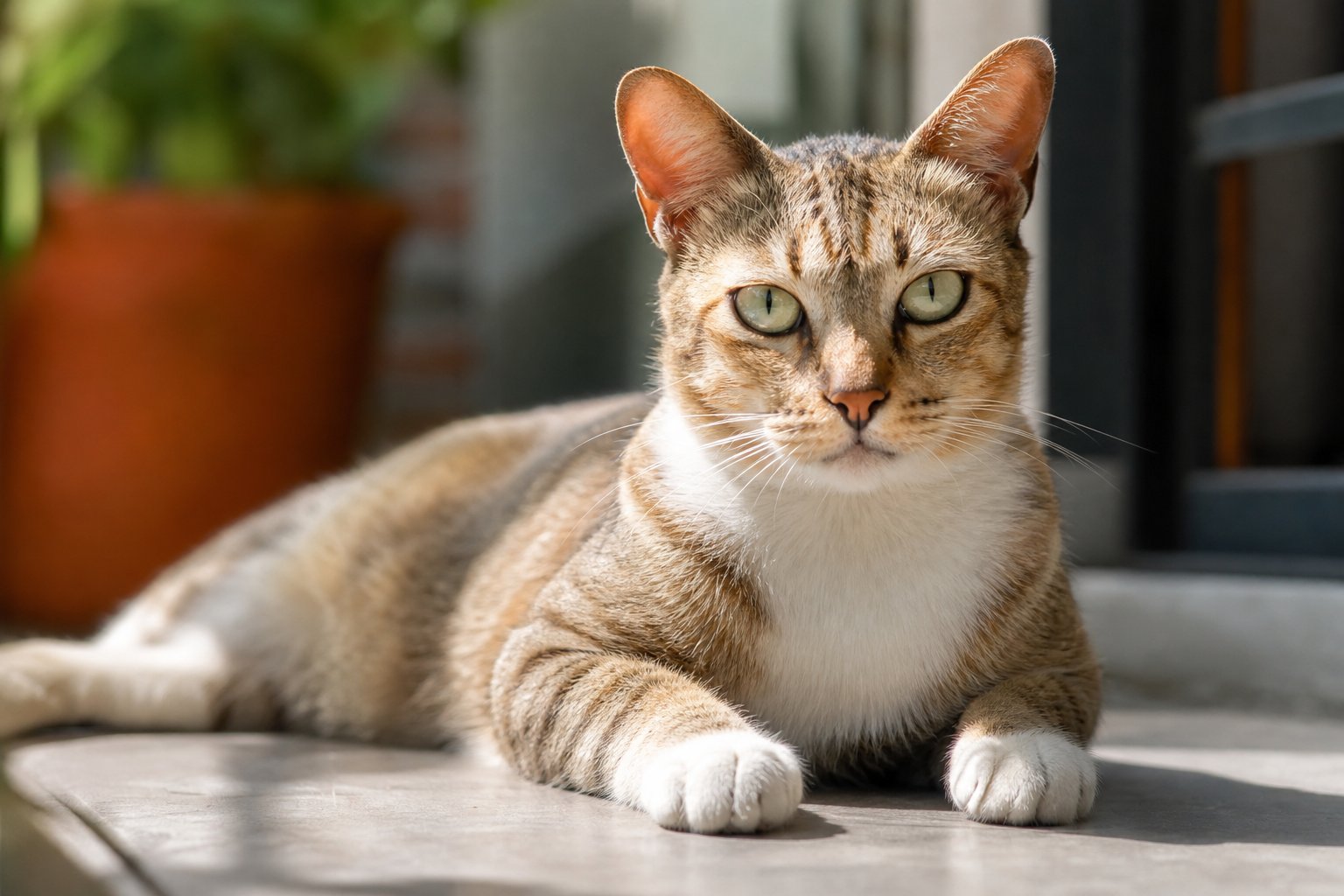
Quick answer: a Siamese's real downsides are not feeding or grooming. They are volume, constant company-seeking, boredom when the house sits empty, and a stomach and urinary tract that need active management. Short hair and quick wits are the trade-off. If someone is home most of the day, most of these problems shrink. If your flat is empty for nine hours daily, read the separation section before you decide.
What a Siamese cat actually is
The Siamese is a short-haired breed from Thailand, long known for blue almond eyes, colourpoint markings — darker fur on the face, ears, limbs and tail — and a running commentary on everything you do. It is also an ancestor line of the modern Oriental shorthairs, which tells you where its intensity comes from: this is a breed built for interaction, not for observing from a distance.
| Feature | What to expect |
|---|---|
| Origin | Thailand (formerly Siam) |
| Typical lifespan | 12–15 years |
| Weight | Males 4–5.5 kg, females 3–4 kg — medium, not small |
| Coat | Short single coat, moderate shedding |
| Voice | Frequent, loud, nasal — a breed trait |
| Tolerance for being alone | Low; separation anxiety risk is above average |
| Intelligence | High; learns tricks, can be leash-trained |
| Monthly running costs | Varies widely by food, litter and vet — get local quotes |
Three things worth absorbing before anything else:
- The talking is not a behaviour problem. If you want a silent cat, choose a different breed.
- Clinginess cuts both ways. The upside is closeness and trainability; the downside is stress when you leave.
- Short coat is not zero grooming. Single-coat breeds still blow their coat seasonally, though brushing takes about half the time of a long-haired breed.
The seven downsides at a glance
Put sentiment aside and lay the costs on one page. This is the honest overview; each row is unpacked below.
| Downside | Severity | What genuinely helps | Where the cost lands |
|---|---|---|---|
| Frequent, loud calling | High, inherent | Routine changes, never rewarding calls with food | Almost none financially |
| Extreme clinginess | High | Fixed play sessions, a trained 'go to your spot' cue | Your time |
| Separation anxiety | Moderate to high | Alone-time practice, enrichment, possibly a second cat | Toys, possibly behaviour advice |
| Boredom destruction | Moderate | Vertical space, puzzle feeders, secure cabinets | One-off furniture outlay |
| Sensitive stomach | Moderate | Slow food transitions, measured meals | Quality food, occasional vet visits |
| Urinary tract tendency | Moderate | High water intake, wet food share | Monthly vet savings fund |
| Hereditary tendencies | Low to moderate | Verified parent health records, annual checks | Screening plus savings fund |
Why a Siamese is so loud
A Siamese does not simply call; it picks its moments. Dawn hunger, evening boredom, and you being on the other side of a closed bathroom door are all stage opportunities. Breed descriptions of temperament emphasise an extremely outgoing cat that wants large amounts of human interaction, and the voice is how it requests it.
Three levers actually work:
- Never let a meow produce a meal. Feed on a fixed schedule tied to a different signal — a clap, a container sound — so the association "voice equals food" never forms.
- Front-load the evening. A hard 15-minute play session followed by a small supper shortly before bed measurably shrinks the pre-dawn concert.
- Expect spikes, then settle them. Vocalisation rises during a move-in period and in intact cats; neutering removes the second cause.
Realistic target: an occasional chat with you, not a flat-wide echo. In an apartment, thick curtains and a quiet word to neighbours early on are cheaper than a noise complaint later. Avoid responding to night calls at all — attention, even angry attention, rewards them.
Clinginess: the other side of the coin
A Siamese follows you from living room to kitchen to bedroom. You sit, it lands beside you; you open a laptop, it occupies the keyboard. Solo owners often experience this as the reason they got the cat. Anyone who needs uninterrupted focus experiences it differently.
Practical responses, in order of effectiveness:
- Give it an official position. A window bed or a small perch beside your desk, taught with treats using a "go to your spot" cue. Siamese learn fast, so this trick succeeds more often than with most breeds.
- Buy quiet windows. Before an important call, spend 15–20 minutes on wand play or a food puzzle. You are trading energy now for silence later.
- Watch the line. Clinging that turns into wailing, inappropriate urination or refusal to eat when you leave is no longer affection — it is an anxiety signal.
Separation anxiety and boredom: the most underestimated downside
This is where the breed punishes unrealistic expectations. In a household that stands empty all day, a bored Siamese invents entertainment: shredded tissues, opened cupboards, knocked-over items, dragged curtains, and sometimes urination outside the box as a stress message.
Clinical reasoning is consistent on the order of operations: stress-related over-grooming and appetite changes usually start with insufficient environmental stimulation, so rule out physical illness first, then fix the environment.
A three-layer plan:
- Burn energy: two genuine play sessions daily, morning and night, wand toys preferred over solo toys.
- Enrich the space: cat tree or shelving for vertical territory, a window perch for street theatre, a rotating food puzzle.
- Provide company: if your working hours cannot move, a second cat is the option Siamese tolerate best — this breed does poorly as a single cat in an empty home.
A Kuala Lumpur apartment that is empty from 8am to 7pm on weekdays is exactly the setting where this list becomes non-negotiable. A Johor terrace house during a rainy season, with everyone indoors and play space compressed, needs the same enrichment indoors — a garden does not substitute for interaction.
Health: stomach, urinary tract, teeth and heredity
Stomach. Sensitive digestion is common enough to plan around. Transition food over 7–10 days rather than switching overnight, measure meals instead of free-feeding, and refrigerate opened wet food properly — a turned or chilled meal can trigger soft stool.
Urinary tract. Cats are instinctively poor drinkers, and indoor air-conditioning makes it worse. Keep water bowls away from food and the litter box, refresh water at least three times daily or run a fountain, and build wet food into the diet. A male cat straining in the box with little or no urine is an emergency measured in hours — go immediately.
Teeth. Dental disease accumulates quietly from the mid-years; annual checks should include the mouth.
Heredity. Documented tendencies include strabismus (a squint that usually does not impair vision and is largely cosmetic), heart conditions in some lines, and an AMY2-related familial neuropathy that responsible breeders screen for. The fair summary: these are risks that verified parent health records substantially reduce, not sentences you serve. Ask for screening paperwork before paying for a kitten, and book an annual examination from adulthood onward.
Budgeting without guessing
Price figures quoted elsewhere on the internet are usually in another currency and cannot be meaningfully converted, so treat every number you read as a prompt to ask, not a fact. Malaysian prices vary by state, clinic and brand — request written quotes from your own vet and retailer before committing.
Use this worksheet:
| Line item | Get a quote from | What changes the number |
|---|---|---|
| Acquisition (purchase or adoption) | Registered breeder, shelter or rescue | Pedigree papers, health screening, neuter status |
| First-year vaccines and deworming | Your clinic | Number of doses, parasite schedule |
| Neutering | Your clinic | Male or female, clinic type |
| Monthly food | Pet retailer | Dry-only versus wet-heavy diet |
| Monthly litter | Pet retailer | Clumping versus tofu litter |
| Annual health check | Your clinic | Age, blood and urine add-ons |
| Emergency fund | Your own savings | Urinary blockage and digestive crises are the big ones |
| Insurance or savings | Insurer or bank | Coverage caps, excess, exclusions |
Three spending philosophies, chosen before something goes wrong:
- Lean: economy dry food, no set-aside fund. Works only if you hold genuine emergency cash.
- Standard: mixed diet, yearly checkup, a fixed monthly amount moved into a vet fund. Suits most households.
- Steady: wet-food-led diet, twice-yearly checkups for seniors, and either insurance or a substantial savings balance.
Insurance versus self-saving depends on your liquidity: a healthy cash buffer gives you flexibility, while insurance smooths a shock you cannot absorb. You rarely need both at full strength.
Who this breed suits — and who it does not
| Household | Fit | Reason |
|---|---|---|
| Works from home or semi-retired | Excellent | Company time is abundant; the voice becomes a perk |
| Two adults with staggered shifts | Good | Someone is home long enough to keep alone-time manageable |
| Single person out 9+ hours daily | Poor | Separation anxiety risk climbs sharply |
| Family with young children | Depends on ages | Tolerant but does not enjoy being squeezed — teach gentle handling |
| Rented unit with thin walls | Proceed carefully | Carrying voice; a neighbour conversation beats a complaint |
Reverse self-test — answer three questions:
- How many hours a day does someone actually spend at home?
- Can you accept being woken several nights running, for months?
- Can you set aside a fixed monthly amount for veterinary care?
If two answers are no, consider a quieter breed or adopting two cats together instead.
Compare before you decide:
| Breed | Voice level | Clinginess | Coat work | Best suited to |
|---|---|---|---|---|
| Siamese | High | Very high | Low | People home often who want interaction |
| British Shorthair | Low | Medium | Low | Long, quiet workdays |
| American Shorthair | Low | Medium | Low | First-time owners wanting independence |
| Russian Blue | Low | Medium-high | Low | Quiet homes, moderate play |
| Ragdoll | Low | High | High (long hair) | Owners prepared for brushing |
The Ragdoll's cost is your hands; the Siamese's cost is your presence. Neither is better — you are choosing which cost you will actually pay.
Commitment checklist: confirmed daily home hours; a vet identified and registered before an emergency; a written budget using local quotes; enrichment already purchased; and, if walls are thin, an early word to the neighbours.
When to see a vet
Book promptly — same day for the urgent items — if you notice any of the following:
- Straining in the litter box, crying out, or producing no urine. This is a urinary emergency, especially in males.
- Blood in urine, or litter box visits every few minutes.
- Not eating for 24 hours, repeated vomiting, or diarrhoea lasting beyond 48 hours.
- Weight loss of more than 5% in a month — weigh monthly and track it.
- A sudden jump or drop in drinking, which can signal kidney, urinary or metabolic trouble.
- Bald patches, raw skin or compulsive licking, before assuming it is a behaviour issue.
- Sudden biting or flinching when touched, which usually means pain rather than temperament.
- Squinting, eye discharge or sneezing that persists.
Routine schedule: vaccinations and deworming in kittenhood as advised by your clinic, neutering around six months subject to your vet's assessment, a full checkup yearly from age one, urine and blood work added from the senior years, and six-monthly visits from about age seven. Confirm all timing with your own veterinarian.
The bottom line
- The Siamese's downsides are time and noise, not grooming.
- Vocalising is breed character: manage it through routine, never eliminate it.
- Empty-households need enrichment, fixed play, or a second cat — plan for it before the destruction starts.
- Sensitive stomach and urinary tendencies are handled by feeding and water habits, backed by a monthly vet fund.
- Hereditary risks drop sharply when you verify parent health records up front.
- Choose the breed whose cost you are willing to pay: the long-haired breed costs your hands, the Siamese costs your presence.
This article is general information only and does not replace examination, diagnosis or treatment by a registered veterinarian. Consult your own vet about your individual cat's health and behaviour.
Related reading
- Cat Breeds in Malaysia: A Practical Guide to Choosing the Right Cat (2026)
- Calico Cats in Malaysia: Is Calico a Breed, and How Do You Tell a Calico, Tortie and Torbie Apart?
- Siamese Cat Malaysia: Temperament, Colours, Care and Costs
- Cat Breeds in Malaysia: 12 Popular Breeds Compared (2026)
- Cat Breeds in Malaysia 2026: 12 Popular Breeds, Personalities and Costs Compared
- Exotic Shorthair Price in Malaysia: Buying, Adoption and First-Year Costs
- Kucing Kampung Care in Malaysia: The Complete Guide to Feeding, Health and Living With a Local Cat
- Maine Coon in Malaysia: 8 Real Drawbacks and How to Handle Them
- Ragdoll in Malaysia: The 8 Real Costs Before You Bring One Home