
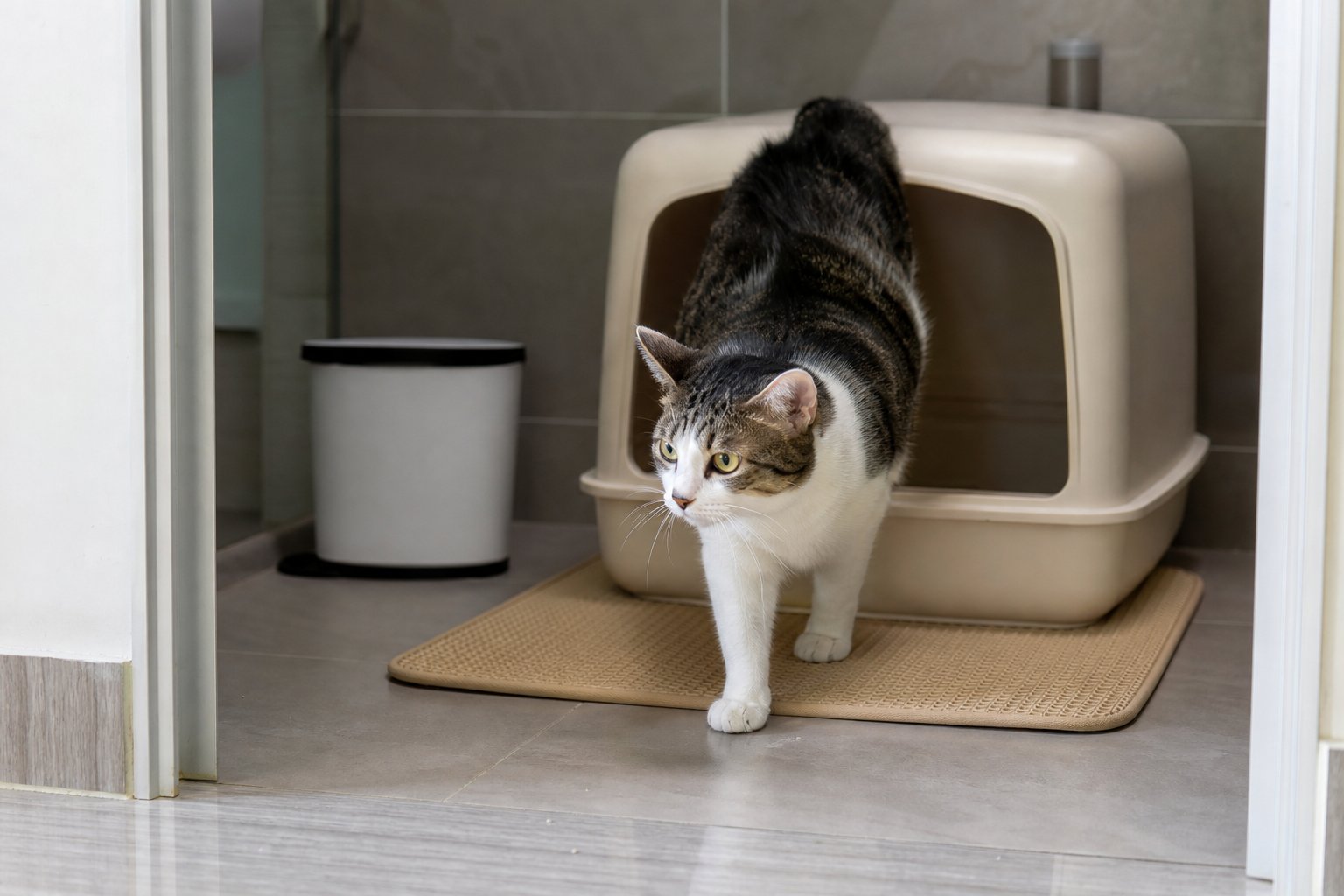
The short answer
An automatic litter box is worth shortlisting if you have one or two cats, a stable mains socket and roughly 70 × 80 cm of floor space you can leave untouched. Budget for two things: the machine itself, and the monthly consumables it needs — litter, deodoriser refills, a sifting screen and waste bags. Noise is a smaller problem than most people expect: flagship drum models are rated 40 dB at 20 cm and 35 dB at 100 cm. Prices differ widely by shop and season, so treat any figure you see online as a reference and confirm current pricing with a Malaysian pet retailer or vet.
How an automatic litter box actually works
Every self-cleaning box follows the same five-step loop. Understanding it tells you where things go wrong — usually the sensors, the screen or the waste drawer.
| Step | What the machine does | What to check before buying |
|---|---|---|
| 1. Detect | Infrared, weight and thermal sensors notice the cat entering and leaving | More sensors generally means fewer false triggers |
| 2. Delay | A countdown starts after the cat exits — either immediate or scheduled cleaning | Confirm you can choose between "clean right away" and "clean at set times" |
| 3. Sift | The drum rotates and the screen separates clumps and crumbs from clean litter | A full cycle takes around 90 seconds on mainstream drum models |
| 4. Deodorise | An antibacterial or odour unit treats the waste area; some need a refill liquid | Refills are a recurring cost, so price them before you commit |
| 5. Store | Clumps drop into a sealed waste drawer | Drawer size sets how often you change the bag |
The practical takeaway: a machine with more sensors and a genuinely sealed drawer will feel more reliable day to day than a cheaper unit that over-detects or lets odour escape. If a model does not publish its sensor count or drawer capacity, treat that as a warning sign rather than a minor omission.
What the noise figures really mean
Manufacturers of flagship drum units publish two numbers: about 40 dB measured 20 cm from the shell, and about 35 dB at 100 cm. For context, 40 dB is comparable to a quiet room or soft conversation, and 35 dB is close to a library. Placed in a living room or hallway, the machine will not compete with the television.
Two caveats matter in real homes. First, decibel figures are taken in controlled conditions; a unit sitting on tiled or timber flooring, or next to a bare wall, will sound louder than the datasheet suggests because the sound reflects. Second, the cleaning cycle is mechanical — you will hear a motor and a rotating drum in an otherwise silent house at 2 a.m. Most cats ignore it after the first week; most owners stop noticing it after the first month.
A simple test before you buy: ask the shop where the motor sits, and whether the drum is suspended or resting on the shell. Suspended drums with rubber mounts transmit less vibration into the floor, which is what you actually hear in the next room.
Space, power and Wi-Fi: the three reality checks
Floor space. A flagship drum is about 480 × 520 mm at the body, and a cat needs clear approach room to step in and out. Practically, reserve around 70 × 80 cm of permanently occupied floor. Once your cat accepts the box, do not keep moving it — cats strongly dislike relocated toilets, and a monthly shift can undo weeks of habit-building.
Power. The unit needs to remain plugged in permanently. That sounds obvious, but it rules out corners served only by an extension lead you unplug when you vacuum, and it matters during outages: a machine without power will not self-clean, so keep one traditional box available at all times as a fallback.
Network. App-enabled models connect over 2.4 GHz Wi-Fi only, not 5 GHz. Some home routers now broadcast a single combined band or default to 5 GHz, in which case you will need to enable the 2.4 GHz band during setup. If you would rather not put a cat toilet on your network, check whether the model offers a fully offline timer mode before purchasing.
Weight. A flagship unit weighs around 10 kg empty and passes 16 kg once filled with litter. That is fine on a concrete floor, but worth thinking about if you rent, move house frequently, or plan to place the box on a raised or timber platform. Lighter entry-level sensor models are easier to shift; drum flagships are effectively furniture.
In a Kuala Lumpur apartment where the laundry corner is already contested, decide the permanent spot first and buy the machine to fit it — not the other way round.
Choosing a tier: what you are actually paying for
Malaysian shops group these machines into three broad tiers. Exact prices move with stock, currency and promotions, so compare specifications rather than sticker numbers.
| Tier | Typical design | What the money buys | Best suited to |
|---|---|---|---|
| Entry | Open sensor-triggered rake or basic cycling box | Automatic removal without an app, drum or camera | One cat, tight budget, first-time buyers |
| Mid | Enclosed drum with sifting screen, deodoriser and app | Quieter cycle, sealed drawer, remote start, usage logs | The default choice for daily use with one or two cats |
| Flagship | Drum plus camera and AI recognition | Weight and toilet-frequency tracking, multi-cat identification, alerts | Anxious owners, health monitoring, three-cat homes |
The mid tier is where most owners land, because it delivers the two features people actually use daily — a sealed waste drawer and a quiet cycle — without paying for camera analytics you may never open. The flagship tier is justified mainly if you want automatic logs of when each cat toilets and how long they stayed, which can be genuinely useful for early detection of urinary problems in a multi-cat home.
International names you will encounter include PETKIT (models such as Pura Max, Pura X and the PUROBOT camera series) and Litter Robot. Availability and pricing differ by retailer, so ask a Malaysian pet store which models they stock, what the warranty covers, and whether replacement parts are held locally — a machine with no local supply of screens or gaskets becomes expensive the moment something wears out.
Monthly running costs: the part nobody budgets for
The machine is a one-off purchase; litter and consumables are forever. Before buying, price the full loop.
| Consumable | Typical replacement cycle | Why it exists |
|---|---|---|
| Deodoriser or purifying refill | Roughly one to two months per pack | Neutralises bacteria and smell inside the waste area |
| Sifting screen or filter | About every 3–6 months | Wears from grit; a damaged screen lets clumps through |
| Cat litter (tofu, mixed or clumping clay) | One to two bags a month for a single cat | The machine cannot run without it |
| Waste drawer bags | About every 4–6 days on a 7 L drawer | Sealed bags keep odour inside the drawer |
Two patterns are worth knowing. First, basic entry-level models often take standard household liners and generic litter, so their running cost is close to a normal box. Mid and flagship drum models frequently use branded bags, screens and refills, which raises the monthly total. Second, litter choice dominates the bill: tofu and mixed litters are usually the largest line item, and switching blends changes your monthly cost more than any other decision.
Ask the retailer for the price of a spare screen and a pack of branded bags before you pay for the machine. A unit that is affordable today but expensive to re-stock is a trap. Also check whether the waste drawer accepts ordinary drawstring liners — if it does, you can buy them at any supermarket instead of waiting on branded stock.
Safety systems, kittens and multi-cat homes
Automatic boxes move, and moving parts are the main safety question. Mainstream full-auto models advertise a multi-layer protection scheme — commonly a set of around 12 sensors plus a branded six-layer safety logic — covering entry detection, weight sensing and an immediate stop if a cat is detected inside during a cycle. Some models, such as the PETKIT Pura X, are built specifically around anti-pinch geometry.
What to look for in the shop:
- Does the drum stop instantly when you place your hand or a weight on the entry threshold?
- Is there a mechanical backup that halts rotation if a sensor fails?
- Can you lock the machine into manual mode with one tap?
- Are replacement sensors or the control board available locally?
Kittens. Wait until a kitten is around 1.5 kg, or roughly four to six months old, before using an automatic box. Below that weight the cat may not trigger the weight sensor reliably, and a small kitten can be startled by a drum that starts without warning. Use a shallow open tray until then.
Senior and unwell cats. Older cats with arthritis struggle with high entry lips. Look for a low step-in height or fit a ramp. If your cat has been diagnosed with a urinary or kidney condition, a model that logs toilet frequency gives you useful data to hand to your vet.
Multi-cat maths. A 7 L drawer lasts about 15 days with one cat and roughly 7–8 days with two. Three or more cats should be paired with a second, traditional box. Remember the general rule of thumb: one litter box per cat, plus one spare.
In a Johor terrace house with an indoor-outdoor cat, a covered automatic box plus a simple open box in a different room gives you both hygiene and redundancy — and stops one blocked machine from leaving your cat with nowhere to go.
Which litter you can use, and how to transition your cat
Manufacturers list three compatible types: tofu litter, mixed litter and clumping bentonite (clay) litter. All three form firm clumps the screen can separate cleanly.
Litters to avoid in a drum machine:
- Crumbling or pine wood litter — it breaks into powder that packs into the screen and can drop through into the drawer as dust.
- Very light or ultra-fine litter — it clings to the drum wall and scatters when the cycle reverses.
- Non-clumping litter — there is nothing for the screen to catch, so the machine simply stirs it.
If you prefer pine, keep it in a two-layer traditional box instead; that is what the upper grate is designed for.
Transition plan over seven days:
- Days 1–3: place the automatic box next to the existing box, powered but switched to manual mode — no rotation at all.
- Days 4–5: add a scoop of your current litter into the new box so it smells familiar.
- Day 6: run one short supervised cycle while the cat is in another room.
- Day 7 onward: enable automatic cleaning, but keep the old box available for a further week.
Remove the old box only once your cat is consistently using the new one. If the cat starts toileting on floors or bedding instead, that is not stubbornness — stop the transition and read the situation as a health signal.
Cleaning and maintenance schedule
An automatic box reduces scooping; it does not eliminate cleaning. A realistic schedule:
| Frequency | Task |
|---|---|
| Every day | Check the waste drawer indicator, top up litter to the fill line, wipe the entry step |
| Every 2 weeks | Remove and wash the inner drum and sifting screen with mild detergent; dry completely before refilling |
| Every month | Wipe sensors and the entry threshold with a dry cloth; inspect the power cable and plug |
| Every 3–6 months | Replace the sifting screen if warped or clogged; replace deodoriser refills on schedule |
| As needed | Replace the drawer bag when two-thirds full rather than waiting for the alert |
Two details cause most failures. Wet components put straight back into a closed drum will grow mould within days, so every washed part must be fully air-dried first — this is especially true in Penang during the rainy season, when indoor humidity stays high for weeks; run a fan or leave parts in an air-conditioned room before reassembly. And a dusty, overfilled drum strains the motor, so never fill above the marked line even if the box looks half empty.
When to see a vet
Automatic boxes make it easier to spot changes, but only if you look at the data. Contact a registered Malaysian veterinarian if you notice:
- Straining in the box, crying while urinating, or producing only small drops — possible urinary tract blockage, which is an emergency in male cats.
- Blood in the urine, or frequent trips to the box with little output.
- A sudden drop or spike in toilet frequency recorded by the app.
- Toileting outside every box after a period of normal use, once you have already ruled out a dirty box, a relocated box and a rejected litter type.
- New accidents in a cat that has been reliable for years, especially alongside increased thirst, vomiting or reduced appetite.
Do not wait more than a day on any straining or no-output case. Write down what the machine logged — times, duration and weight changes — and take it to the appointment; it saves the vet guesswork.