
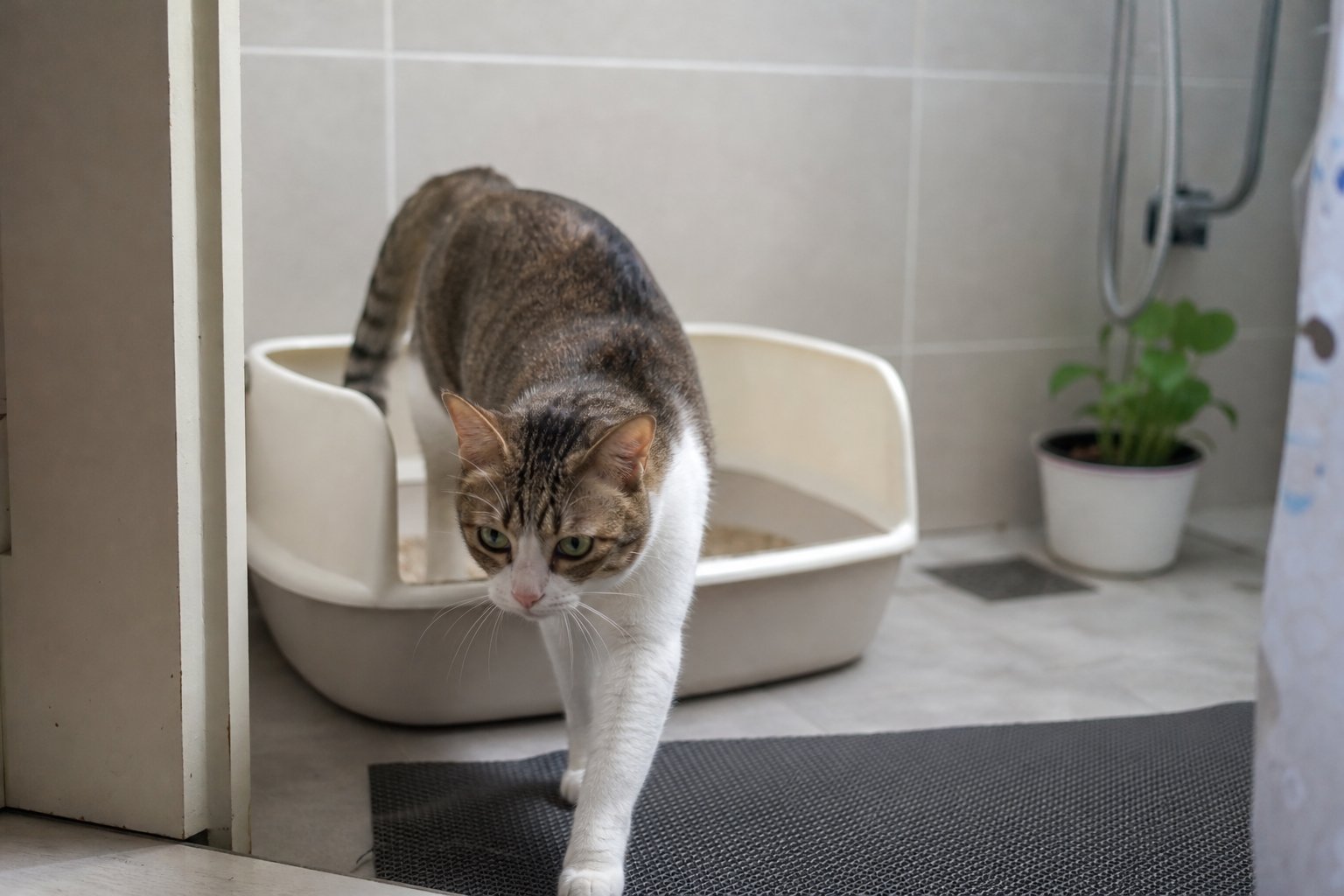
Cat spraying is a form of communication, not revenge and not a litter-box accident. A spraying cat stands tall, raises and quivers its tail, and leaves a small amount of urine on a vertical surface. Desexing stops or sharply reduces spraying in roughly nine cases out of ten. When a desexed cat keeps spraying, the cause is usually conflict with another cat, an outside cat provoking it, or a stressful change at home.
1. Spraying or litter-box trouble? Read the posture first
The single most useful thing you can do is watch how your cat urinates. Marking and inappropriate toileting look completely different once you know what to look for, and they call for opposite responses. Marking is a message aimed at other cats; toileting outside the box is usually a physical complaint or a dislike of the box itself.
| What you observe | Spraying (marking) | Toileting outside the box |
|---|---|---|
| Body posture | Standing, back straight, tail raised and vibrating | Crouched in the normal squatting position |
| Target | Vertical surfaces: walls, doors, curtains, cupboard sides | Flat surfaces: bed, sofa, carpet, tiled floor |
| Amount of urine | A small squirt, often repeated in several spots | A normal-sized puddle |
| Common triggers | Territory anxiety, social tension, hormones | Urinary discomfort, dirty or badly placed box |
| First step | Adjust the environment; consider desexing | Rule out a medical problem, then audit the box |
Two practical notes. First, spraying can happen on horizontal surfaces too, so posture and volume matter more than direction alone. Second, never assume a medical problem has been ruled out simply because the posture looks like marking. If there is blood in the urine, loud crying while passing urine, repeated trips to the box with little output, or no urine at all, treat it as an emergency and get to a vet the same day.
2. The five main triggers
Understanding why a cat marks tells you exactly what to change. In practice, spraying in Malaysian homes comes down to five recurring situations.
| Trigger | Typical scene at home | What to focus on |
|---|---|---|
| Not desexed, or in heat | A young male or an unmated female, often seasonal | Arrange desexing; about 90% of cases improve |
| Conflict between household cats | A new cat has moved in; one cat guards the box or food | Double and spread resources; box count equals cats plus one |
| Cats outside the window, gate or door | Spraying at the glass, the front door, the balcony | Block the line of sight; discourage roaming cats |
| A big change in the home | Renovation, new furniture, a move, a shift in routine | Keep familiar scents; introduce changes gradually |
| General anxiety and insecurity | Hiding, over-grooming, yowling at night | More high perches, predictable play, pheromone support |
A quick way to narrow it down is to ask when the spraying started. If it began within weeks of a new pet, a house move or a renovation, the environment is the lead suspect. If it has been going on since kittenhood and your cat is not desexed, hormones move to the top of the list.
3. Neutering: the single biggest lever
Veterinary behaviour literature consistently reports that desexing stops or greatly reduces spraying in around 90% of cats. Un-neutered males are the highest-risk group because their entire reproductive drive is tied to advertising their presence, but females can mark too, particularly around their heat cycle.
Timing matters. The behaviour is easiest to prevent before it becomes a well-rehearsed habit, so talk to your vet early rather than waiting for several months of wet curtains. That said, an older cat can still benefit; desexing is not wasted on a mature animal, and it removes a whole layer of hormonal motivation.
If your cat is already desexed and still marks, do not conclude that nothing can be done. It simply means you should look elsewhere: competition with other cats in the house, a cat patrolling outside your windows, or an underlying stressor such as unpredictable noise, visitors or a disrupted routine. Desexing is a powerful tool, not a guarantee.
4. The resource rule for multi-cat homes
Cats are often described as social, but they do not share resources the way dogs do. When every resource sits in one corner of the house, a nervous cat is forced to walk through another cat's territory just to eat or toilet, and that daily stress is exactly what fuels marking.
The fix is mechanical rather than emotional: give every cat its own set of resources, then spread them out.
| Resource | Minimum configuration | How to spread it out |
|---|---|---|
| Litter boxes | Number of cats plus one | In different rooms, never lined up side by side |
| Food | One separate spot per cat | So a single cat cannot guard every bowl |
| Water | At least two or three stations | Away from boxes and away from food bowls |
| Resting places | At least one raised spot per cat | Wall shelves, wardrobe tops, a cat tree |
| Play | About two short sessions daily | Wand toys that mimic a hunting sequence |
A few household-specific tips work well in local layouts. In a Kuala Lumpur condominium unit, vertical space is your best friend: a wall-mounted shelf above the sofa gives a wary cat a safe route that never crosses the floor where the other cat eats. In a Johor terrace house, the long ground floor often funnels all resources down a single corridor; splitting them between the living area and the back of the house immediately reduces traffic conflicts.
Also keep litter boxes away from washing machines and loud extractor fans. A cat that startles while toileting will start looking for a quieter spot, and walls are quiet.
5. Outdoor cats at the window, gate and corridor
Territorial spraying is often triggered by a cat your own pet has never actually met. A stray passing the porch, a neighbour's cat crossing the garden, or a cat appearing at the condominium window is enough to send a resident cat straight to the curtains.
The most effective response is visual, in this order:
- Block the view. Frosted or translucent window film, closed blinds, or a solid screen along the lower part of a glass door all break the sightline while still letting light in.
- Give your cat the high ground. A perch near the window lets it watch without feeling exposed, which converts a threat into background scenery.
- Reduce the appeal outside. Avoid leaving food bowls outdoors, seal off spaces under the gate where strays shelter, and consider a motion-activated deterrent if a particular cat keeps returning.
Most owners see a clear improvement within a few weeks once the sightline is broken, because the trigger is simply no longer available. Combine this with the resource layout above and you address both the message and the mood behind it.
6. Cleaning: why ordinary detergent leaves the problem behind
Cat urine contains uric acid crystals that standard household cleaners do not fully break down. Your nose may say the corner is clean, but your cat can still read the residue, returns to the same spot, and adds another layer. That is how a single mark becomes a habit.
A reliable cleaning sequence:
- Blot up fresh urine with paper towels or a cloth, pressing rather than rubbing.
- Rinse with plain water. Avoid ammonia-based products; the smell of ammonia is close enough to urine that it invites your cat to mark again.
- Apply an enzymatic cleaner and leave it to work for 10 to 15 minutes rather than wiping it off immediately.
- Wipe dry and let the area air out.
- Repeat two or three times on porous surfaces such as painted walls, skirting boards and wooden furniture. Washable fabrics like bedsheets and curtains can go through a normal wash with an enzymatic soak first.
Product availability and pricing vary across Malaysia, so check with your vet, a pet retailer or your usual online marketplace for current options rather than relying on any single listed price. Look specifically for cleaners labelled for enzymatic action on pet urine; multi-purpose floor cleaners will not do the job.
7. Pheromones, calming aids, and the three mistakes to avoid
Pheromone products mimic the soothing facial signals cats leave on each other. They are a legitimate supporting tool: diffusers, sprays and even pheromone-infused litter can take the edge off a tense household. What they cannot do is reorganise your home for you. Used alone, they usually disappoint.
Think of pheromones as the equivalent of soft background music during a difficult conversation. Helpful, rarely sufficient.
Three behaviours consistently make spraying worse:
- Punishing the cat. Shouting, spraying water or rubbing a nose in the mess increases anxiety. Anxious cats mark more, not less. Behaviour guidance from veterinary sources is unanimous on this point.
- Cleaning with ammonia-based products. You are essentially leaving an invitation to re-mark the same wall.
- Making big changes during an outbreak. Swapping litter type, relocating every box or rearranging the whole room while the problem is active adds fresh stress. Stabilise first, then change one thing at a time.
A useful working checklist before you buy anything:
- Every cat has its own box, bowl and resting spot
- Boxes are in different rooms, not clustered
- Outdoor cats can no longer be seen through the main windows
- Spots have been cleaned with an enzymatic product, not just wiped
- No one in the household is scolding the cat
- A vet visit has ruled out urinary tract trouble
8. When to see a vet
Make a veterinary appointment promptly if any of the following appear alongside the spraying:
- Blood in the urine, or urine that looks cloudy or strong-smelling
- Crying or straining while passing urine
- Repeated visits to the box producing only drops
- Going more often than usual, or urinating outside the box for the first time
- Sudden lethargy, loss of appetite, or hiding combined with vocalising
A cat that cannot pass urine is a same-day emergency, not a wait-and-see situation. Even when the posture looks like ordinary marking, a urinary tract problem can sit underneath it, and treatment delays are risky.
If your vet rules out medical causes, ask about referral to a veterinarian with behaviour interest, or consult a certified cat behaviourist. Persistent spraying in a multi-cat home often needs a structured reintroduction plan rather than more products.
Frequently asked questions
Is spraying always caused by an un-neutered cat? No. Un-neutered males are the highest-risk group, but desexed cats spray too, usually because of multi-cat tension, an outside cat provoking them, or a stressful change at home.
Do female cats spray as well? Yes, though less often than males. In females, spraying is frequently linked to being in heat or to pressure from other cats sharing the same space.
How do I tell spraying apart from a urinary problem? Check posture and volume: standing, quivering tail, small amounts on a wall or curtain means marking. Straining, crying, frequent trips to the box, blood in urine or no urine at all means see a vet the same day.
How many litter boxes should a multi-cat home have? One box per cat plus one, spread across different rooms rather than lined up together. Add separate feeding stations, several water points and at least one raised resting spot per cat.
Do pheromone products actually work? They can help as an add-on, including pheromone-infused litter, but they rarely solve spraying on their own. Environmental changes and, where relevant, desexing carry most of the improvement.
My cat sprays whenever a stray passes the window. What now? Block the view first: frosted film, curtains or a solid screen. Then give your cat a high perch nearby so it can watch without feeling cornered. Cases like this often improve noticeably within a few weeks.
This article is general information only and is not a diagnosis or treatment plan. If your cat keeps spraying, or if spraying comes with any change in urination, please consult a registered veterinarian.
Related reading
- Cat Litter Guide Malaysia 2026: Types, Costs and How to Choose
- Cat Peeing Outside the Litter Box in Malaysia: 5 Emergency Red Flags, 6 Causes and a Home Action Plan
- Cat Litter Box Malaysia: Size, Placement and Cleaning Guide (2026)
- Auto Litter Box in Malaysia: What to Check Before You Buy (2026 Guide)
- Automatic Litter Box Malaysia 2026: Noise Data, Small-Home Fit, Safety and Monthly Running Costs
- Cat Litter Guide Malaysia 2026: Tofu, Mineral, Pine, Tapioca and Blends Compared
- Cat Litter in Malaysia: How to Choose the Right Type for Your Cat and Home
- Cat Litter in Malaysia: 5 Types Compared and How to Pick the Right One
- Cat Scratchers in Malaysia: How to Choose, Place and Save Your Furniture
- Cat Toys in Malaysia: Choosing, Rotating and Playing the Right Way