
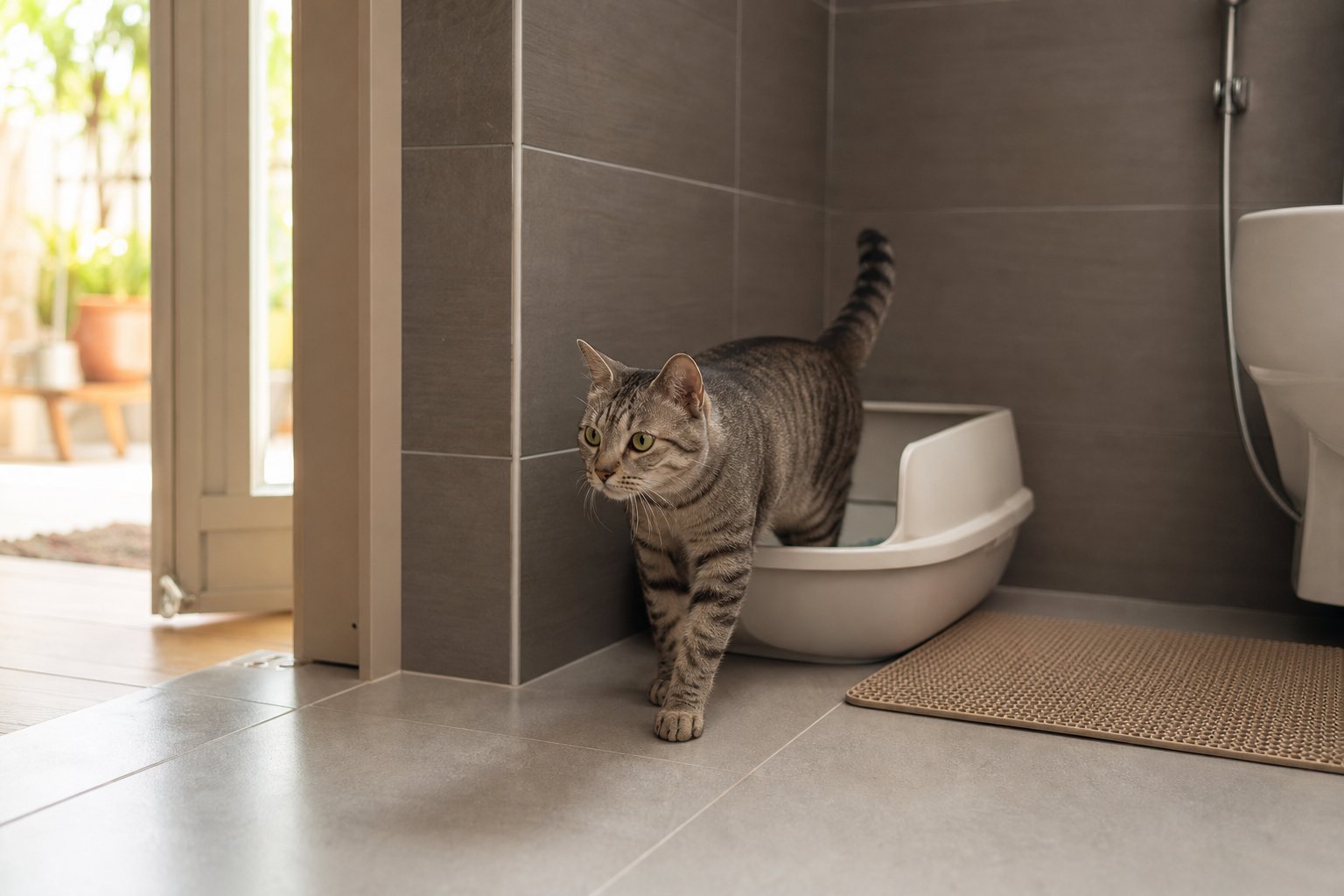
Cats do not urinate outside the litter box to punish you. It is almost always a medical or environmental problem, and the first job is to rule out a urinary emergency. If your cat cannot pass urine, cries while straining, passes blood, or suddenly stops eating, see a vet the same day — a blocked urethra can become fatal within 24 to 48 hours. Once emergencies are excluded, most cases respond to litter box and home adjustments.
First: rule out five red flags
Run this checklist before you change anything else. A single red line means a same-day vet visit, not a wait-and-see approach.
| What you see | Urgency | What to do |
|---|---|---|
| Cannot pass urine, repeatedly strains in the box | 🔴 Emergency, same day | Go to a veterinary clinic immediately — obstruction can be fatal within 24–48 hours |
| Crying, arched back or extreme restlessness while urinating | 🔴 Emergency, same day | Do not wait until tomorrow |
| Blood in the urine (pink, red or clots) | 🔴 Same-day visit | A urine test is needed; websites cannot diagnose this |
| Frequent box visits producing only a few drops | 🔴 Same-day visit | Blockage risk, especially in male cats |
| Low energy, refusing food, vomiting alongside urination changes | 🔴 Same-day visit | May indicate a whole-body problem |
🟡 Arrange a vet visit within 24–48 hours if the urine smells unusually strong, the posture has changed, your cat licks the genital area excessively, or urine output has clearly increased — the last may point to an internal medical condition.
🟢 Home adjustments are reasonable first when urine volume looks normal, there is no blood and no crying, and your cat is simply choosing the sofa, bed, carpet or bathtub instead of the box.
Why the urgency matters: male cats have a narrower urethra than females, so crystals or a mucus plug can shut the flow down completely. A cat that goes into the box repeatedly and produces only drops is not "a bit constipated" — it is obstructed and deteriorating. Cats also hide discomfort well, so a normally sociable cat that goes quiet, stops eating and keeps returning to the box should always be taken seriously.
This table is a triage aid, not a diagnosis. If any red flag appears, contact a registered vet directly rather than trying home remedies first.
Inappropriate urination or spraying? They are different problems
Once you know what to watch for, the two are easy to tell apart — and they need different fixes.
| Feature | Inappropriate urination | Spraying (urine marking) |
|---|---|---|
| Posture | Squatting, normal toileting stance | Standing, tail raised and quivering |
| Surface | Horizontal: bedding, carpet, sofa, bathtub | Vertical: walls, curtains, door frames |
| Volume | A normal single bladder emptying | Small amounts, often in several spots |
| Typical drivers | Box aversion, urinary pain, litter or placement problems | Territorial anxiety, multi-cat tension, hormones |
| Where to focus | Litter box environment plus a medical check | Resources, neutering, reducing conflict |
Out-of-place urination is a toileting failure. The cat assumes the usual squat and produces a usual volume, but something has made the box unacceptable: pain, a dirty tray, an awkward location, or a litter texture it now dislikes.
Spraying is communication instead. It is common in unneutered cats and in households where a cat feels its territory is under pressure. If your cat is not neutered or spayed, that procedure is usually the single most useful step, alongside offering more resources and easing tension between cats. Mistaking spraying for a box problem wastes weeks, so note the posture, the surface and the volume before you start work.
Six common causes and what to do about each
Most real cases stack two or three of these together rather than sitting neatly in one category, so expect to fix more than one thing.
| Cause | Typical clues | Practical fix |
|---|---|---|
| Too few or too small boxes | Multi-cat home, fewer boxes than cats plus one | Aim for cats plus one, each large enough to turn and dig |
| Poor box placement | Tray beside noisy appliances, food bowls or busy doorways | Move to a quiet spot with a clear escape route |
| Unsuitable litter | Problems starting right after a litter change; avoiding the tray edge | Transition over 7–10 days; offer an unscented, low-dust option |
| Dirty tray or shallow litter | Scooping less than once a day; layer under 5 cm | Scoop 1–2 times daily, keep 7–8 cm depth, full wash monthly |
| Stress and life changes | Renovation, new pet, new baby, schedule disruption | Restore routine, add vertical space and hiding places |
| Urinary or internal illness | Any red flag, changed urine volume, excessive licking | Veterinary examination and urine testing — never self-diagnose |
A cat that takes a dislike to new litter and then balks at a tray next to a rumbling washing machine has both an aversion and a placement problem. Fixing only one usually changes nothing, which is why owners often report that "nothing works" after a single adjustment.
Your practical home action plan
Work through these in order over the first 48 hours. Consistency matters more than buying anything expensive.
- Clean with an enzymatic cleaner. Ordinary detergent cannot break down uric acid crystals, and a cat's sense of smell is far keener than yours, so the spot still reads as a toilet. Choose a biological or enzymatic product made for pet urine (Four Paws is one widely recognised international brand). Prices vary by retailer — ask a Malaysian pet shop or your vet for what is available locally, and always patch-test on a hidden area of fabric first.
- Block the spot temporarily. After cleaning, lay foil, a plastic mat or a placemat over the area, or move a food and water bowl there. Cats rarely choose to eliminate next to their feeding station, and most will move elsewhere once the surface is unpleasant.
- Add a box rather than only relocating the old one. Start with a large, open-topped tray in a different part of the home from the original. Covered or automatic boxes are poor first choices: they trap odour, limit the cat's view of exits and can feel like a trap.
- Get the litter right. Return for now to the type your cat already accepts — most settle for fine clumping mineral or a tofu-based litter — and set up a second tray with a different type beside it so the cat can choose. Switch back to a single tray once preferences are clear.
- Lower the pressure. Keep feeding times fixed, add two short interactive play sessions of about ten minutes each, and provide a high perch plus a quiet hiding box so the cat can observe the room without being touched.
- Keep a written log. Record the time, place, approximate volume and posture of every episode, plus anything unusual that happened that day. Vets find this log invaluable, because patterns you cannot remember at the appointment often reveal the trigger.
- Review at day 14. If nothing has improved after two weeks of consistent changes, book a vet consult or a cat behaviour professional rather than continuing to improvise.
Never punish accidents. Scrubbing a cat's face at the scene or startling it mid-urination only teaches the cat to hide its toileting from you and raises overall anxiety, which makes the problem more persistent.
Litter box rules that actually work
- Count: at least cats plus one. Two cats need three trays; three cats need four.
- Depth: 7–8 cm of litter, enough to cover a deposit and let the cat dig a proper hole.
- Scooping: once to twice daily. Cats are fastidious and will refuse a tray that smells used.
- Full wash: monthly, using a mild detergent and a thorough rinse, with the tray dried completely before refilling.
- Placement: quiet, with more than one way in and out, never in a dead-end corner where the cat can be cornered, and away from food, water and high-traffic corridors.
- Format: open and roomy first. The cat should be able to turn around, squat and cover without touching the sides.
- Changing brands: use the blend method — three-quarters old litter with one quarter new, increasing the new proportion every two days across roughly seven to ten days. If the cat balks, stretch the transition out rather than pushing through.
Multi-cat homes: sharing without conflict
Conflicts over resources are one of the most common reasons a perfectly litter-trained cat starts avoiding the tray.
- Spread the boxes around the home rather than lining them up in one room, so no single cat can block the route to all of them.
- Watch which cat follows which into the toilet area. A cat that is being chased away from the tray will quietly start using the sofa instead.
- Separate feeding stations and provide multiple water points, so one animal cannot control everything.
- Add vertical territory — cat trees, shelves, window perches — so cats can share a room by occupying different levels.
- Introduce a new cat gradually, with scent swapping and separate resources, before allowing free access to the whole home.
- Scoop every box daily; in a busy household, twice daily is better.
Cleaning the spot so it does not happen again
Residual odour is the biggest reason a cat returns to the same corner. Uric acid binds to surfaces and survives ordinary washing, so the area can look and smell clean to you while still being obvious to your cat.
Use an enzymatic cleaner as directed — enough product to reach the contaminated layer, and enough dwell time for the enzymes to work. Avoid scented household sprays and ammonia-based products used neat over the spot; the residue can be read as a rival's marking signal and invite a repeat. For carpets and upholstery, work from the outside of the stain inwards so it does not spread, and rinse or blot as the label instructs.
Local prices for enzymatic cleaners vary widely by brand and bottle size, so check with a Malaysian pet retailer or your vet rather than relying on any figure you see online. Budget for a proper bottle: this is the one product that genuinely prevents a cycle of repeat soiling.
Stress, routine and seasonal changes
Cats are creatures of habit, and toileting is one of the first things to slip when the household rhythm changes.
In a Kuala Lumpur apartment, the triggers are often close to home: renovation works next door, a lift lobby's constant traffic, a new flatmate, a new baby, or a balcony that lets outdoor cats walk past the window. In a small floor plan there is also less room to spread resources. Work with the space you have by putting trays in separate rooms or on opposite ends of the same room, adding wall shelves and tall cat trees to create vertical escape routes, and using a covered resting box in a corner where the cat cannot be approached from behind.
During the Penang rainy season, heavy downpours and thunderstorms can unsettle cats, and persistent humidity can leave litter damp and more strongly scented than usual. Scoop more often, top up litter to maintain the 7–8 cm depth, and check that trays are not sitting near a window or doorway where rain blows in. If a stray cat is appearing on the balcony or at the gate, keep it out of sight of your cat where possible, and consider closing blinds on that side; visible rivals are a classic trigger for both spraying and box avoidance.
Beyond weather, restore what you can control: fixed meal times, predictable play, and a quiet retreat. Add new elements gradually — a new pet, a new person, a moved piece of furniture — and give the cat somewhere to observe the change from a distance.
When to see a vet
Book a same-day appointment if any of these appear: complete inability to pass urine, crying or straining while urinating, blood in the urine, repeated box visits with only drops produced, or low energy with loss of appetite. A blocked cat can become critical within a day, and male cats are at higher risk.
Arrange a visit within 24–48 hours for unusually strong-smelling urine, a changed urinating posture, constant licking of the genital area, or a clear increase in urine output.
At the appointment, expect a physical examination, urine testing and possibly further checks to distinguish a urinary tract problem from a behavioural one — this cannot be done from a photograph or an online forum. Bring your written log of episodes; it shortens the consult and improves the chances of finding the trigger. If home adjustments have produced no improvement after two weeks, or if episodes recur after apparent recovery, ask for a recheck rather than assuming the problem is solved.
This article is general information only and is not a diagnosis or treatment plan. If your cat shows any urinary abnormality, please consult a registered veterinarian in Malaysia; in an emergency, contact a 24-hour animal hospital immediately.
Related reading
- Cat Litter Guide Malaysia 2026: Types, Costs and How to Choose
- Cat Spraying in Malaysia: Why Your Cat Marks Walls and How to Stop It
- Automatic Litter Box Malaysia 2026: Noise Data, Small-Home Fit, Safety and Monthly Running Costs
- Cat Litter Guide Malaysia 2026: Tofu, Mineral, Pine, Tapioca and Blends Compared
- Cat Litter in Malaysia: How to Choose the Right Type for Your Cat and Home
- Cat Litter in Malaysia: 5 Types Compared and How to Pick the Right One
- Cat Scratchers in Malaysia: How to Choose, Place and Save Your Furniture
- Cat Toys in Malaysia: Choosing, Rotating and Playing the Right Way