
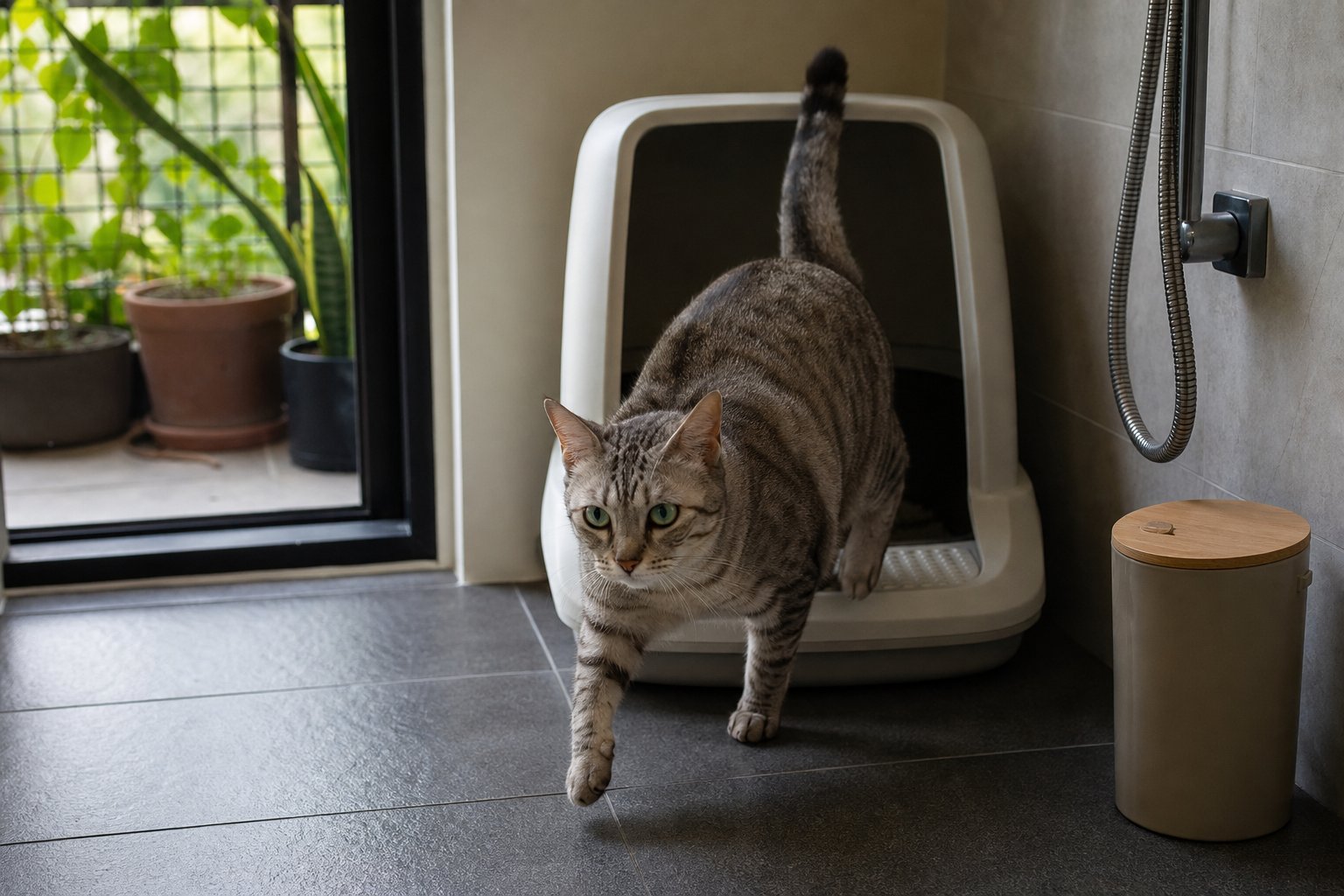
Quick answer: Size the box at least 1.5 times your cat's body length, keep one more box than you have cats, place it somewhere quiet and airy, and scoop at least once a day. Start with an open tray, watch how your cat reacts, then decide whether a hooded or automatic model is worth upgrading to.
A litter box is one of those quiet purchases that decides how well a cat settles into a home. When the size, the number and the location are right, most odour and litter-tracking complaints solve themselves. When they are wrong, you get avoidance, accidents and a cat that stresses every time it needs to go. Local prices vary widely by brand and size, so treat the figures below as categories rather than budgets, and ask a Malaysian vet or pet retailer for current pricing.
Litter box types compared
There is no single best box, only the best match for your cat's age, temperament and your home layout.
| Type | Strengths | Weaknesses | Best suited to |
|---|---|---|---|
| Open tray | Excellent airflow, high cat acceptance, easy to scoop and monitor | Litter can scatter, odour is more noticeable | First-time owners, nervous cats, small flats |
| Hooded or enclosed | Traps odour and flying litter, gives privacy | Poorer ventilation, some cats dislike the dim interior | Households that prioritise neatness and smell control |
| Double-layer tray | Upper litter, lower absorbent pad; fine dust falls through | Only works with crumbly wood or pine-style litter | Owners already using plant-based or wood litter |
| Automatic self-cleaning | Scoops on a timer, strong odour control, less daily work | Needs power, mechanical noise can startle cats, consumables cost extra | Busy owners and multi-cat households |
| Top-entry | Best litter containment, reduces tracking | Hard for kittens, seniors and stiff-jointed cats to climb into | Young, agile, energetic cats |
Two details deserve emphasis. Enclosed boxes trade fresh air for smell control, and some cats simply refuse to toilet in a dark, enclosed space. Automatic boxes need electricity, and the sweeping mechanism can frighten a cat that has not been introduced to it gradually. The safe pattern is always the same: introduce the new box alongside the old one, let the cat approach it in its own time, and only retire the old tray once the new one is being used confidently.
International brands such as Catit, PETKIT, Petmate and Unicharm each cover a different category above, but the category matters more than the logo. A well-sized open tray from a basic brand will outperform an expensive automatic unit your cat is afraid of.
Getting the size right
The measurement rule is simple: box length should be at least 1.5 times your cat's body length, measured from the nose to the base of the tail. The cat needs enough room to step in, turn a full circle and dig without its body pressing against the walls.
| Cat type | Suggested interior size | Notes |
|---|---|---|
| Kitten under six months | About 30 x 40 cm | Low lip so it can climb in easily |
| Average adult cat | About 40 x 50 cm | Covers most domestic shorthairs |
| Large breeds such as Maine Coon | 50 x 60 cm and up | Needs room to manoeuvre |
| Senior or arthritic cat | About 40 x 50 cm with a low entry | High walls make stepping painful |
Litter depth matters as much as the tray itself. Aim for a starting depth of roughly 5 to 7 cm, then adjust to your cat's digging style. Too shallow and claws hit the bare plastic, which most cats find unpleasant, and clumps stick to the bottom. Too deep and you waste litter while the cat struggles to find a stable footing.
A common compromise in compact homes: choose a medium half-enclosed tray rather than shrinking the dimensions, then control scatter with a litter-trapping mat and a splash guard. Shrinking the tray to fit a corner is the faster way to end up with a cat that stops using it altogether.
How many boxes: the n+1 rule
The working formula is number of boxes = number of cats + 1. One cat gets two boxes, two cats get three, three cats get four. It sounds excessive, but it directly reduces territorial tension and inappropriate urination, because no cat ever has to queue, wait, or share a spot with a rival it dislikes.
Placement of those boxes matters as much as the count. Do not line every tray up in one corner; a single cat can guard that spot and block the others. Spread them across different rooms, and in a multi-storey terrace or split-level home, keep at least one box on each level so no cat has to negotiate stairs mid-need.
For single-cat homes, the second box is your insurance. If one tray is being cleaned, blocked by a closed door, or temporarily out of service, the cat still has a clean option instead of finding a sofa.
Where to place it
Good locations: a quiet corner with decent airflow, easy for the cat to reach at any hour. A bathroom, a utility area, or a sheltered corner of a balcony all work, provided the cat can always get in.
Poor locations: next to food and water bowls (cats dislike eating and toileting in the same zone), beside a washing machine or dryer (sudden noise deters them), in a busy hallway (no privacy), inside a sealed cupboard (heat and odour build up fast and the cat abandons it), and anywhere the cat has to pass a feared object such as a vacuum cleaner to get there.
Two Malaysian housing contexts come up often:
- A Kuala Lumpur high-rise apartment: space is tight, so the bathroom corner is usually the best default. Check that the exhaust fan actually runs, that the door cannot swing shut and lock the cat out, and that the tray sits clear of the shower splash zone. If the bathroom has no window, schedule a daily airing so humidity does not turn the litter damp and heavy.
- A Penang terrace house during the rainy season: outdoor or balcony placement needs a roof and shade, because rain-soaked litter clumps, goes heavy, and can smell far worse than usual. Keep the tray off the floor slightly if the area floods, and move it indoors during prolonged wet weather rather than letting the cat walk through puddles to reach it.
Humidity across the peninsula accelerates odour in any tray, so ventilation and scooping frequency matter more here than buying a stronger-smelling litter.
The cleaning rhythm
Consistent cleaning is the single biggest factor in odour control. Buying an expensive litter rarely compensates for a tray that is scooped too rarely.
Daily (one or twice a day):
- Scoop solids and clumps, then top the litter back to 5-7 cm.
- Glance at each urine clump for size and consistency while you scoop.
- Wash your hands thoroughly afterwards.
Weekly:
- Empty the tray, rinse with warm water, and wash with a pet-safe cleaner rather than a heavily fragranced household product, which leaves a scent cats find repulsive.
- Dry the tray completely before adding fresh litter; residual moisture makes litter stick.
Monthly:
- Deep clean with diluted white vinegar or a pet-safe disinfectant.
- Inspect the tray for cracks and deep scratches, which harbour bacteria and hold stale odour long after cleaning.
- Decide whether the tray needs replacing.
Scooping doubles as a health check. Normal urine clumps are roughly palm-sized, and stools should be formed with no blood or mucus. A cat that strains in the tray, cries while passing urine, or produces very small or very large clumps is telling you something important.
Pregnant household members should avoid handling cat faeces because of the risk of toxoplasmosis; assign litter duty to someone else for the duration.
Enclosed, top-entry or automatic: when to upgrade
Not every household needs an upgrade, but four situations justify it:
- Odour is the complaint. If the tray is the first thing anyone smells on entering, a hooded box with a carbon filter helps, provided it vents from the top. Avoid fully sealed boxes that trap heat and fumes inside.
- Nobody is home to scoop. If a twice-daily routine is impossible on workdays, an automatic box keeps the baseline clean. Note that automatic units still need a manual backup: if the machine jams while you are away for a weekend, you come home to a mess.
- Your cat already accepts an open tray. Transition in stages: remove the lid for a week, then place it on without latching, then close it fully. If the cat balks, step back a stage instead of forcing it.
- Kittens or seniors in the household. Both are better served by open, low-entry trays. Moving parts and high entrances are unfriendly to small, elderly or stiff-legged cats.
One iron rule before any purchase: a new box is never the first fix for inappropriate urination. Rule out urinary disease first, then fix cleanliness and placement, and only then shop.
The five most common mistakes
| Rank | Mistake | What happens | The fix |
|---|---|---|---|
| 1 | Scooping too rarely | Cat finds the tray filthy and toilets elsewhere | Scoop at least once, ideally twice, daily |
| 2 | Tray too small | Cat half-overshoots the walls | Size to 1.5 times body length minimum |
| 3 | All trays clustered in one corner | One cat guards the spot; others hold on or relocate | Spread trays across rooms and levels |
| 4 | Strongly perfumed cleaner | Residual scent puts the cat off | Warm water plus a pet-safe cleaner |
| 5 | Keeping an old, scratched tray | Grooves trap waste and smell permanently | Replace as soon as cracks appear |
A sixth habit worth breaking: do not hide the tray inside a sealed cabinet to conceal smell. The enclosed heat makes abandonment more likely, not less. Also, when a new cat arrives, ask the previous carer what litter and tray type were in use, and keep those for at least the first week before switching gradually.
When your cat stops using the box
Work through four checks in order:
- Cleanliness. Cats are extremely sensitive to odour. A tray that a human considers merely used may already be unacceptable.
- Litter type. A sudden switch of texture, scent or brand is a frequent trigger. Change over several days by mixing old and new litter.
- Location and number. Is the tray too noisy, too exposed, or too far from where the cat sleeps? Is there one tray where the n+1 rule calls for two?
- Health. Urinary tract infections, bladder inflammation and kidney disease all present as inappropriate urination or vocalising in the tray. This is a symptom, not a behaviour problem.
If environmental adjustments produce no improvement within two or three days, the health check stops being optional.
When to see a vet
Arrange a veterinary visit promptly if you notice any of the following:
- Straining to pass urine, crying in the tray, or repeatedly entering without producing anything.
- Blood in urine or stools, or mucus in the litter.
- A cat that stops urinating entirely, especially a male cat; this can be a life-threatening blockage.
- Sudden increase in urine clump size or frequency, which can signal kidney disease or diabetes.
- Litter avoidance combined with vomiting, loss of appetite, weight loss or lethargy.
- Any change in toileting habits that persists beyond a few days of clean trays and good placement.
Do not wait to see whether the cat 'settles back in' when urination is visibly difficult. Blocked cats deteriorate quickly.
Quick checklist for today
- Measure your cat from nose to tail base and multiply by 1.5; that is your minimum tray length.
- Count your cats, then confirm you have one more tray than cats.
- Walk the house and move any tray away from food bowls, busy corridors and loud appliances.
- Set a twice-daily scooping routine and a weekly wash day.
- Considering an automatic model? Borrow or trial one for a week or two before committing.
This article is general information only. Sudden changes in toileting behaviour, difficulty passing urine, blood in the urine or stools, or any signs of pain warrant a consultation with a registered Malaysian veterinarian.
Related reading
- Cat Litter Guide Malaysia 2026: Types, Costs and How to Choose
- Automatic Litter Box Malaysia 2026: Noise Data, Small-Home Fit, Safety and Monthly Running Costs
- Cat Peeing Outside the Litter Box in Malaysia: 5 Emergency Red Flags, 6 Causes and a Home Action Plan
- Cat Refuses the Litter Box: Causes, Fixes and When to See a Vet in Malaysia
- Cat Spraying in Malaysia: Why Your Cat Marks Walls and How to Stop It
- Plant-Based Cat Litter in Malaysia: What It Is Made Of, Pros and Cons, and How to Choose
- Cat Litter Guide Malaysia 2026: Tofu, Mineral, Pine, Tapioca and Blends Compared
- Cat Litter in Malaysia: How to Choose the Right Type for Your Cat and Home
- Cat Litter in Malaysia: 5 Types Compared and How to Pick the Right One
- Cat Scratchers in Malaysia: How to Choose, Place and Save Your Furniture